 Yorimichi Games
How to play I Doubt It
I Doubt It is a card game about telling lies and catching them. Players take turns putting cards face down in the middle of the table while announcing what they are: aces first, then 2s, then 3s, and so on around the deck. Because nobody can see the cards, you are free to claim something that isn’t true. Anyone who thinks a claim is false can shout “I doubt it!” The cards are turned over, and whoever was wrong – the liar or the doubter – has to pick up the whole pile. The first player to get rid of every card wins.
You may know the same game as Cheat, which is what it is usually called in Britain. The rules fit on a sticky note, so it works for families and mixed ages, yet it rewards a good memory and a straight face. On this page you play against two, three or four computer players, so there are always 3 to 5 people at the table.
Reading the table

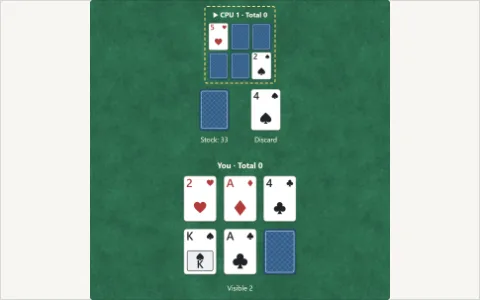
Your hand is sorted into columns, one for each rank, so you can see at a glance whether you hold the rank you will need next. Empty columns are simply the ranks you don’t have. The strip across the table shows the rank being played right now in a large colored chip, and small seat markers under the following ranks tell you who will have to play them.
1. Deal out the whole deck
Shuffle a standard 52-card deck without jokers and deal it one card at a time until every card is gone. If the deck doesn’t split evenly, some players simply start with one card more than others. Before play starts, it is worth a quick look at your hand to see which ranks you are strong in and which ones you are missing.
2. Play in order: A, 2, 3 … K
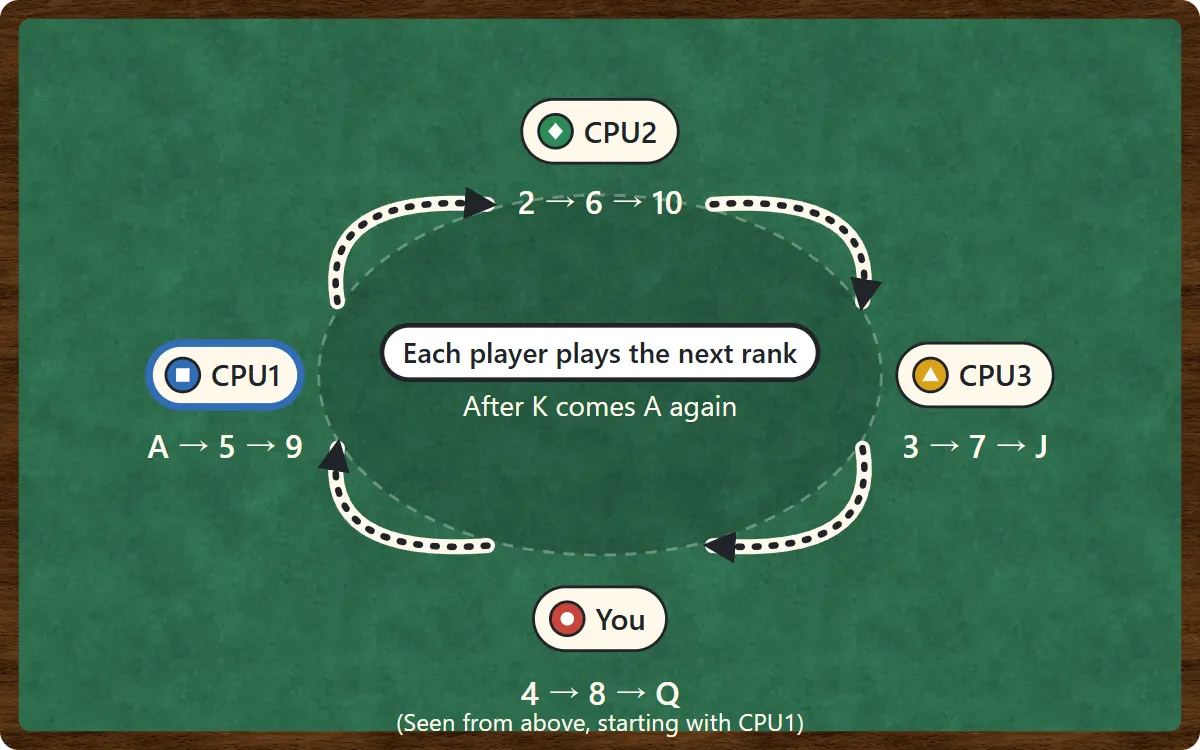
The player to the dealer’s left starts by playing aces. The next player must play 2s, the next 3s, and so on. After kings the count wraps back around to aces. Suits don’t matter. You put your cards face down and say what you are playing, for example “two 7s”.
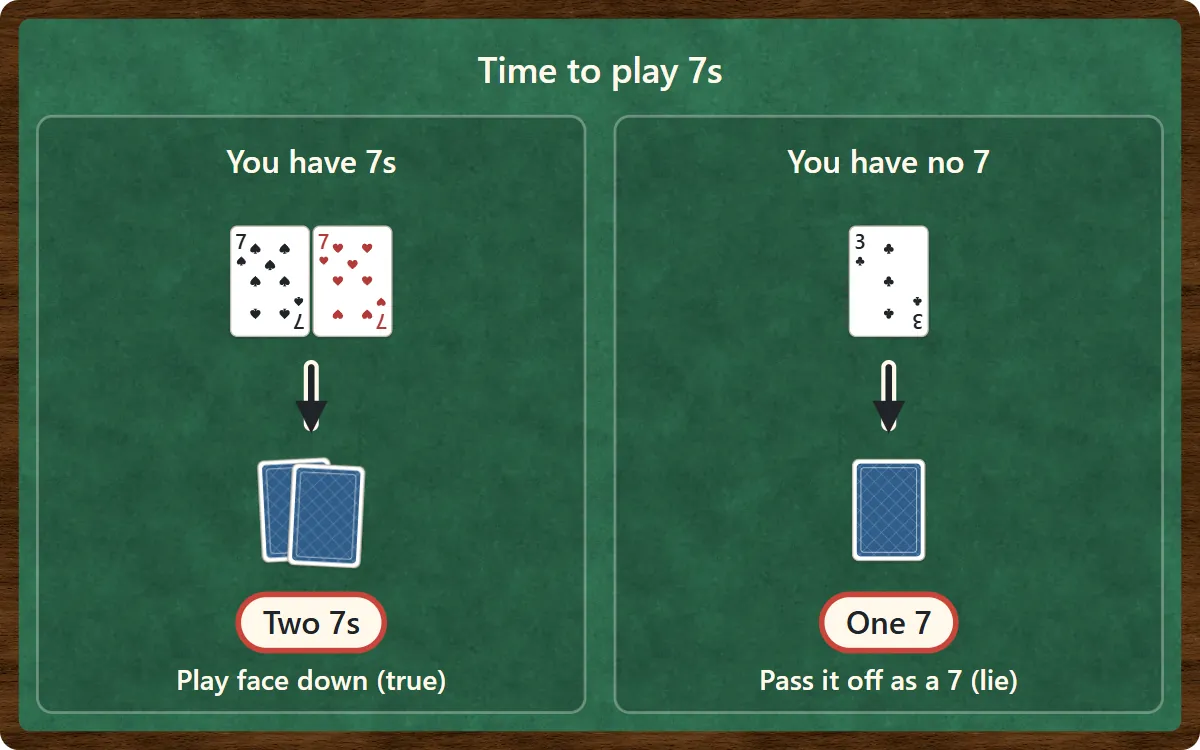
If you hold cards of the rank you have to play, you can simply play them. If you don’t, you play other cards and pretend they are the right rank – that is the bluff. You can even lie when you do have the right cards, if you would rather keep them for later. In the standard rules there is no passing, so a turn without the right rank always means lying.
In this version you tap a column in your hand to lift one card of that rank; tap again to add another. When you are happy with your choice, press Play. The cards fly face down to the middle and your claim appears underneath them.
3. Call “I doubt it!” when you smell a lie
As soon as someone plays, anyone except that player may challenge – it doesn’t have to be the next person in line. The challenged cards are turned face up for everyone to see.
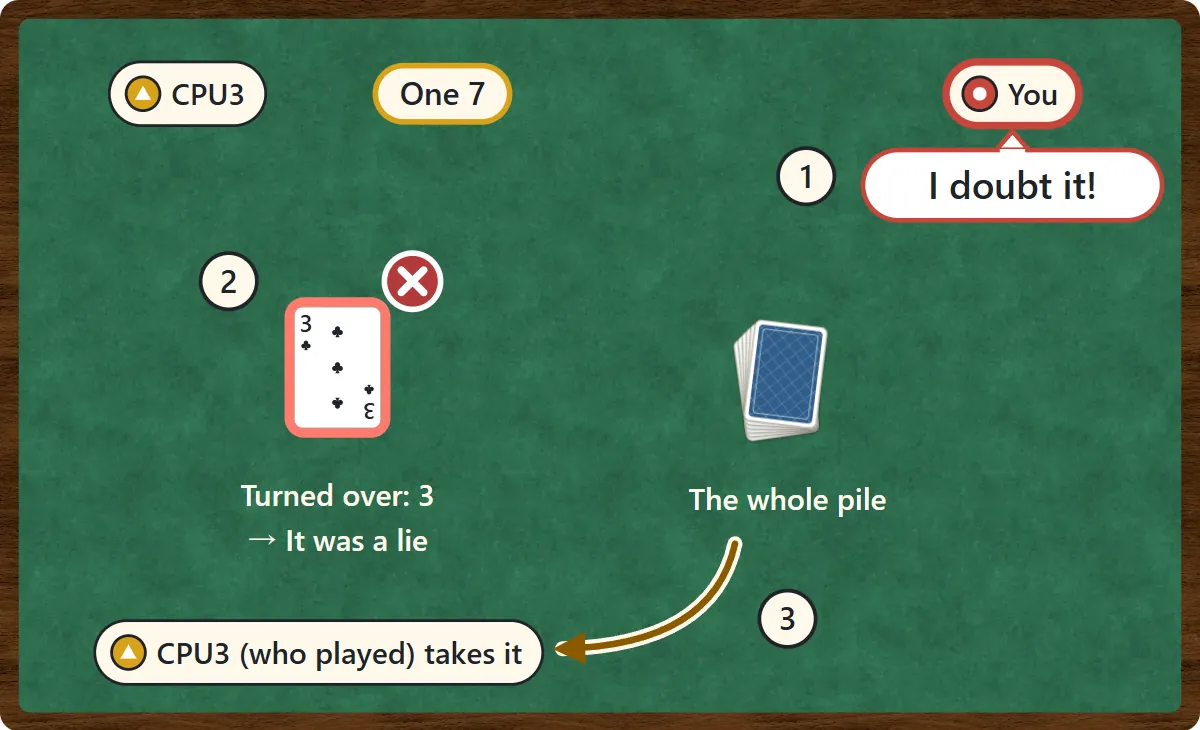
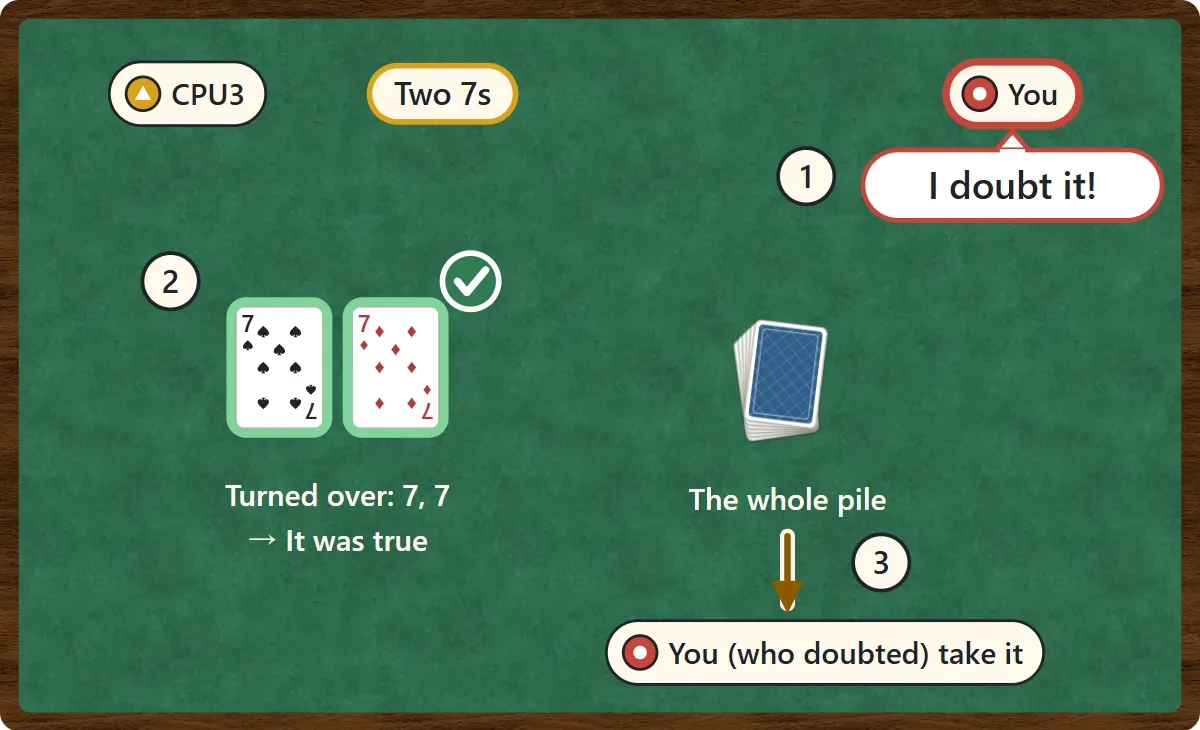
The penalty is the entire pile – not just the cards that were checked, but everything that has built up since the last challenge. After a challenge, play carries on with the player after the one who was challenged, and the count moves on to the next rank whatever the result: if the challenge happened on 7s, the next player plays 8s. If nobody challenges, the cards join the pile face down and play simply moves on.
Here, whenever a computer player puts cards down, two buttons appear – “I doubt it!” and “Let it go” – with a bar that slowly shrinks. Press “I doubt it!” before the bar runs out to make the challenge yourself. Computer players are watching too and may challenge first; whoever calls first gets the challenge.
4. Playing several cards at once
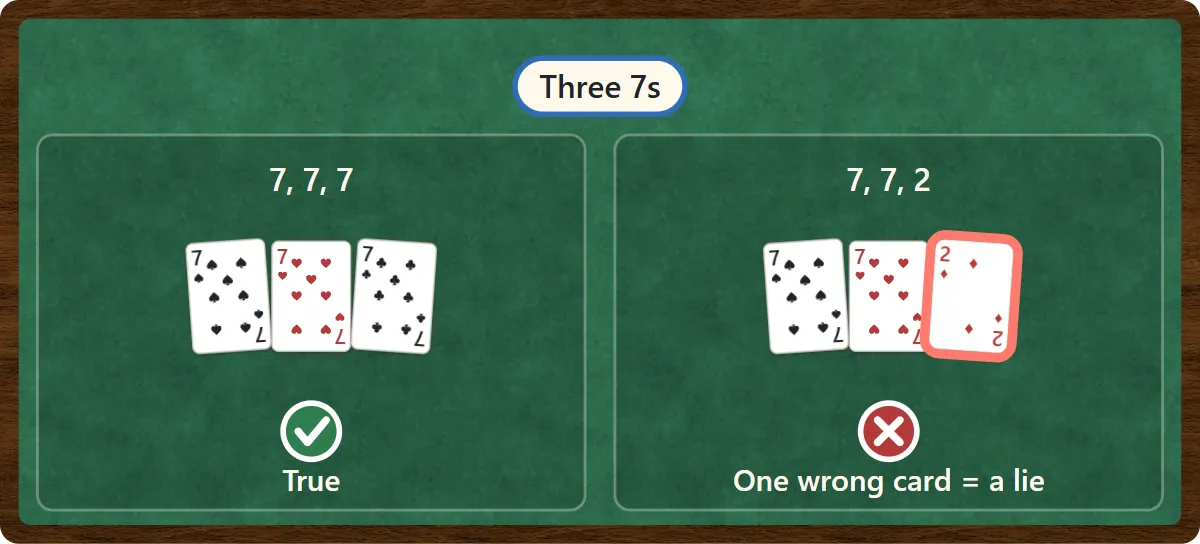
If you have more than one card of the rank, you can put down up to four at a time. When several cards are played together, a single wrong card is enough to make the whole claim a lie.
5. Going out
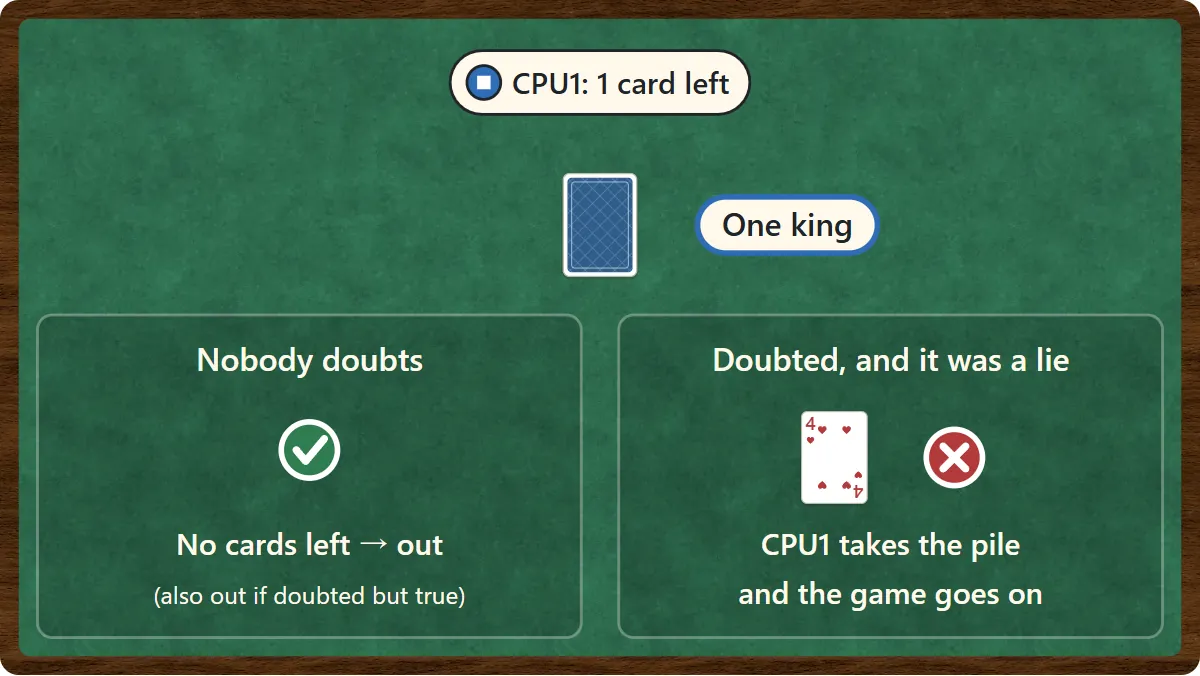
You go out when your last cards are played and survive: either nobody challenges, or someone does and your claim turns out to be true. If your final play is a lie and you get caught, you pick up the pile and the game goes on. In the standard rules the game ends as soon as one player goes out; everyone else is ranked by the number of cards left in their hand.
I Doubt It rules and variations
Every family seems to play this game a little differently. You can pick one of two ready-made rule sets here, or combine the options yourself under Custom.
| Rule set | Cards per turn | How it ends |
|---|---|---|
| Standard | 1 to 4 | First player out wins; the rest are ranked by cards left |
| Last one standing | 1 to 4 | Players drop out as they finish; the last one with cards loses |
Under “Set the rules yourself” you can change five things:
- Cards per turn – 1 to 4, or only 1. With a single card per turn, hands shrink slowly, you are forced to bluff far more often, and the game can drag on for a very long time.
- Passing – none, pass with the same rank, or pass with the next rank. Most rule books don’t allow passing at all. A well-known house rule lets you pass, with the next player facing the same rank, until everyone has passed in a row and the count moves on. The “next rank” option keeps the count moving even on a pass, for a quicker game. Either way, passing lets you skip a turn where you would rather not lie.
- After a caught lie – the next player plays either the next rank or the same rank again.
- Jokers – none, one or two. A joker can stand for any rank, so it always counts as telling the truth.
- End of the game – stop when the first player goes out, or keep going until only one player is left holding cards.
I Doubt It strategy and tips
1. Use your own hand to spot sure lies
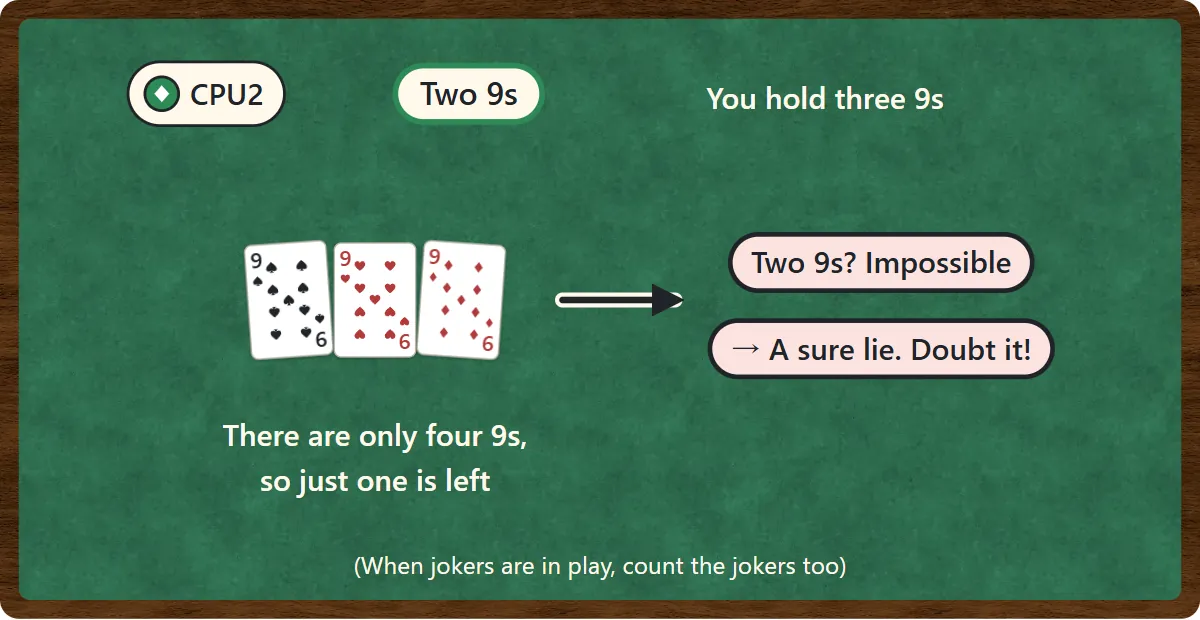
There are only four cards of each rank. If you are holding three 9s and someone claims two 9s, they are lying – no guesswork needed. Get into the habit of comparing every claim with your own hand, and remember the cards you have played yourself. Those sure things are the safest challenges in the game.
2. Look ahead to your next ranks
The order never changes, so you always know which ranks will come to you next. The “Your next” note by your name and the markers on the rank strip show them. Keep the cards you will need for your coming turns, and use cards whose turn is far away when you have to bluff.
3. Bluff while the pile is small
Getting caught costs you the whole pile. Right after a challenge, when the pile is almost empty, a lie is cheap even if it fails. When the pile has grown large, try hard to play the truth.
4. Don’t challenge everything
A wrong challenge also costs you the pile. Unless you are fairly sure, it is often better to let a play go. When two other players fight over a challenge, the pile gets cleared without costing you a card.
5. Be suspicious of a player’s last cards
Players with only a few cards left often don’t have the rank they need, so they are forced to lie. Their final card is especially important, because letting it through ends the game. If it looks doubtful, take the risk and call it.
6. Keep multi-card bluffs small
Dumping several cards at once empties your hand fast, but the more fake cards you mix in, the more likely it is that someone holding that rank knows the claim is impossible. When you lie, one card is usually the safe amount.
I Doubt It FAQ
How many players can play?
Here you play with two to four computer opponents, so 3 to 5 players in total. The more players there are, the fewer cards each person holds and the more often everyone has to bluff.
Who is allowed to call “I doubt it”?
Anyone except the person who just played. If several people call at the same moment, the fastest one counts. Once the next player has put down cards, the earlier play can no longer be challenged. In this version, you can challenge until the bar under the button runs out; you can set it to 3, 5 or 8 seconds, or have the game wait until you press “Let it go”.
Is Cheat the same game as I Doubt It?
Yes. It is one game with several names. I Doubt It is the traditional name in America, Cheat is the usual name in Britain, and you will also see it under other local names. The core is always the same: play in rank order, lie when you need to, and challenge the lies you spot. Small details such as passing or how many cards you may play differ from table to table, which is why this version lets you choose.
How do the computer levels differ?
Easy opponents bluff clumsily – for example by dumping several fake cards at once – and they often challenge at the wrong moment. Normal opponents compare each claim with their own hand and challenge when something doesn’t add up. Hard opponents also remember which cards have been revealed and who picked up which pile, so their lies are better and your lies are caught more often. None of them ever looks at another player’s hand.
What rank comes after a challenge?
The player after the one who was challenged plays the next rank, whatever the result. If the challenge happened on 7s, 8s are next. Some people make the next player repeat the same rank after a caught lie; you can switch to that under “Set the rules yourself”.
What happens if my last card is challenged?
If it was true, the challenger takes the pile and you go out. If it was a lie, you take the pile yourself and the game continues.
Can I play with a keyboard?
Yes. On your turn, use the left and right arrow keys to move between columns, the up arrow to pick a card of that rank (down puts one back), and Enter to play. When someone else plays, press D to doubt or S to let it go.
Where the game comes from
The bluffing game has been played under the name I Doubt It in the English-speaking world for well over a century, and card game writers have long listed Cheat as the same game. Similar games exist across Europe, including German and Russian versions, often with their own twists such as allowing players to claim any number of cards. The game also travelled to Japan, where it is still widely known today by the name ダウト (“Dauto”), taken straight from the English word “doubt”.