 Yorimichi Games
How to play dominoes
Dominoes is a tile game in which players take turns adding matching tiles to the ends of a single line. Each tile is split into two halves, and each half shows a number of spots, called pips. You may only join a tile to the line where the numbers match: a 5 next to a 5, a 2 next to a 2. The first player to get rid of every tile in their hand wins the hand and scores the pips still held by the other players. Several hands make a match, and the first player to reach the target score wins.
The game above plays the two classic versions that most other domino games grow out of: the Draw game, where you take tiles from a spare pile when you are stuck, and the Block game, where you simply pass. You play against one, two or three computer opponents, each with three levels to choose from.
The dominoes set: 28 tiles
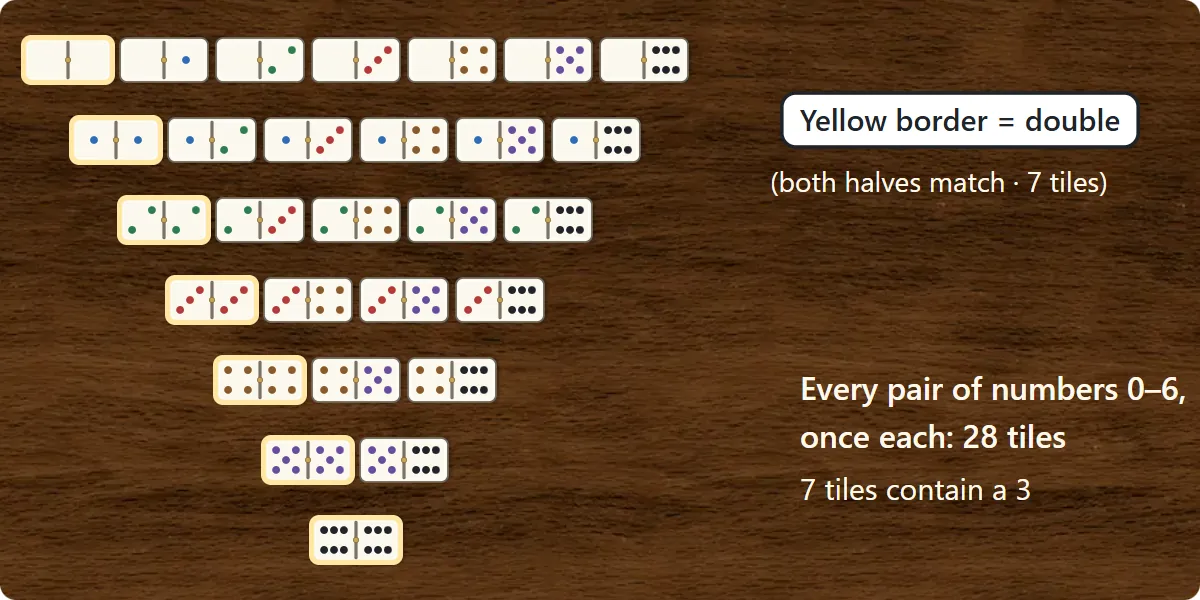
The standard set is called double-six. Each end shows 0 (a blank) to 6 pips, arranged like the faces of a die, and every combination appears once. That makes seven tiles for each number: the tiles containing a 3, for example, are 3-0, 3-1, 3-2, 3-3, 3-4, 3-5 and 3-6. Knowing this helps later, when you start counting which numbers are still out. To make matching easier on a small screen, this version colors each number differently; you can switch to plain black pips in the settings.
Shuffling, dealing and the first tile
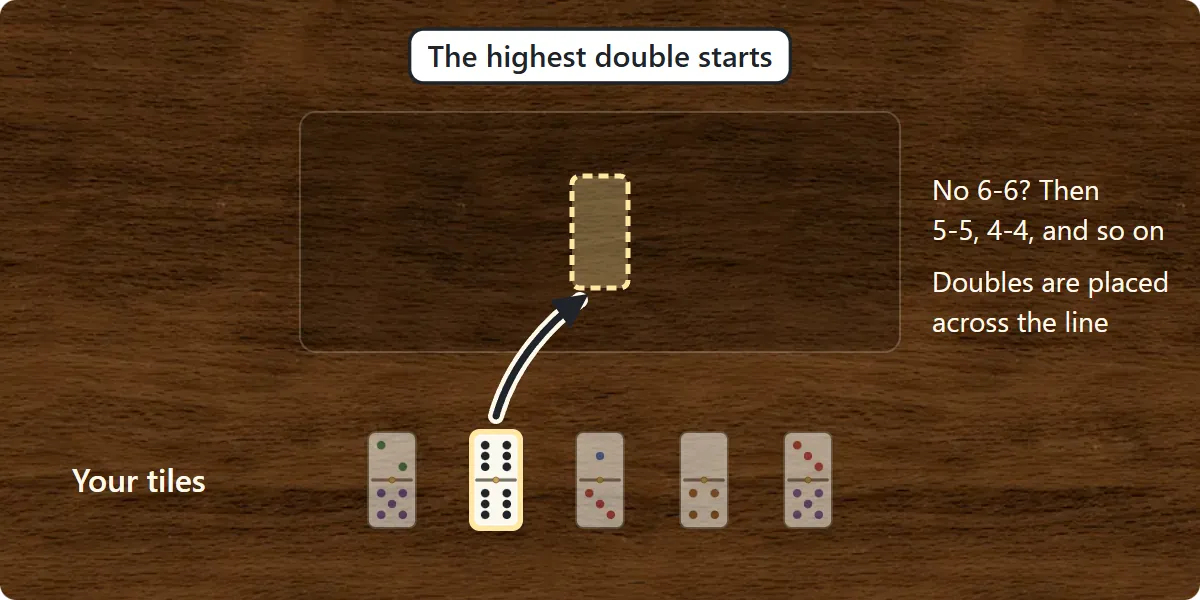
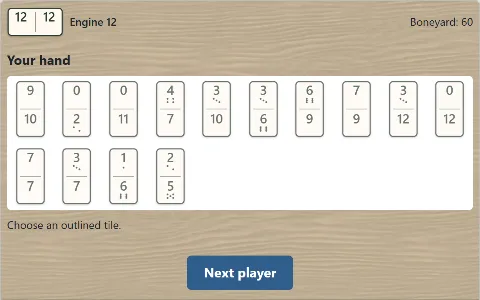
All tiles are shuffled face down. With two players each person draws seven tiles; with three or four players each draws five. The tiles that are left over form the boneyard (also called the stock). The player with the highest double, normally 6-6, places it in the middle of the table. If nobody has 6-6, the holder of 5-5 starts, and so on down. In the rare deal with no doubles at all, the player with the heaviest tile begins. Play then passes clockwise; on this screen that means you, then CPU1, CPU2 and CPU3.
Matching tiles to the open ends
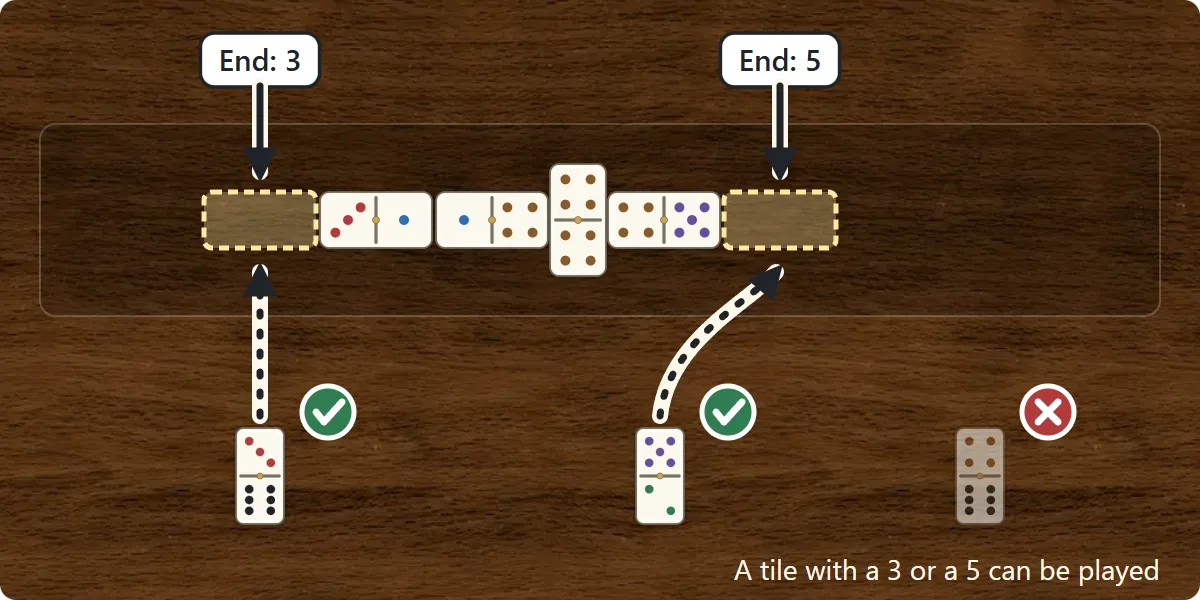
On your turn you add one tile to either end of the line. The half you place must match the number at that end. If the ends are 3 and 5, any tile with a 3 or a 5 can be played. Put a 5-2 on the 5 and that end now shows a 2. When a tile fits at both ends, you choose which one; in this game two numbered boxes appear so you can tap the one you want. Doubles are placed crosswise, but they do not branch the line in these rules. When the line reaches the edge of the table it simply turns a corner.
If you have a tile that can be played, you must play one. You are never allowed to pass while holding a match.
Draw dominoes: when you can’t play
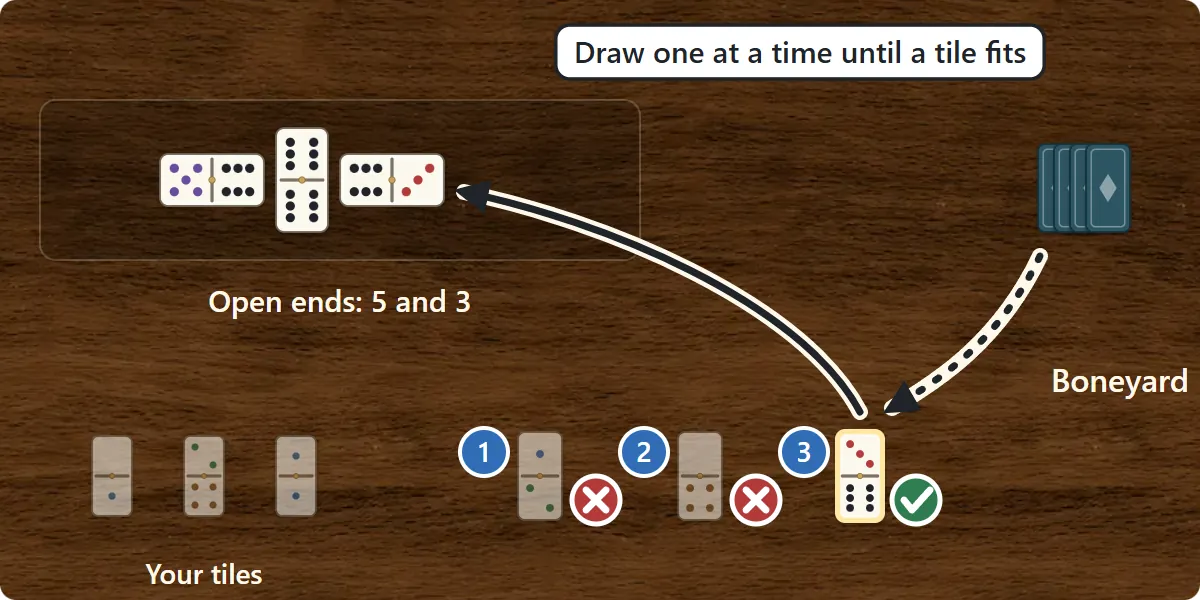
In the Draw game, a player who cannot match either end draws from the boneyard, one tile at a time, and adds each tile to their hand. As soon as a playable tile turns up, it is played and the turn ends. If the boneyard runs out before you find a match, you pass. Drawing is visible to everyone, so the other players learn that you had nothing for those two numbers.
Block dominoes: pass instead
The Block game uses the same deal, but the boneyard is never touched. If you cannot play, you simply pass. With fewer tiles in circulation, hands are shorter and far more likely to end in a blocked game, which makes counting pips even more important.
Dominoes scoring: going out
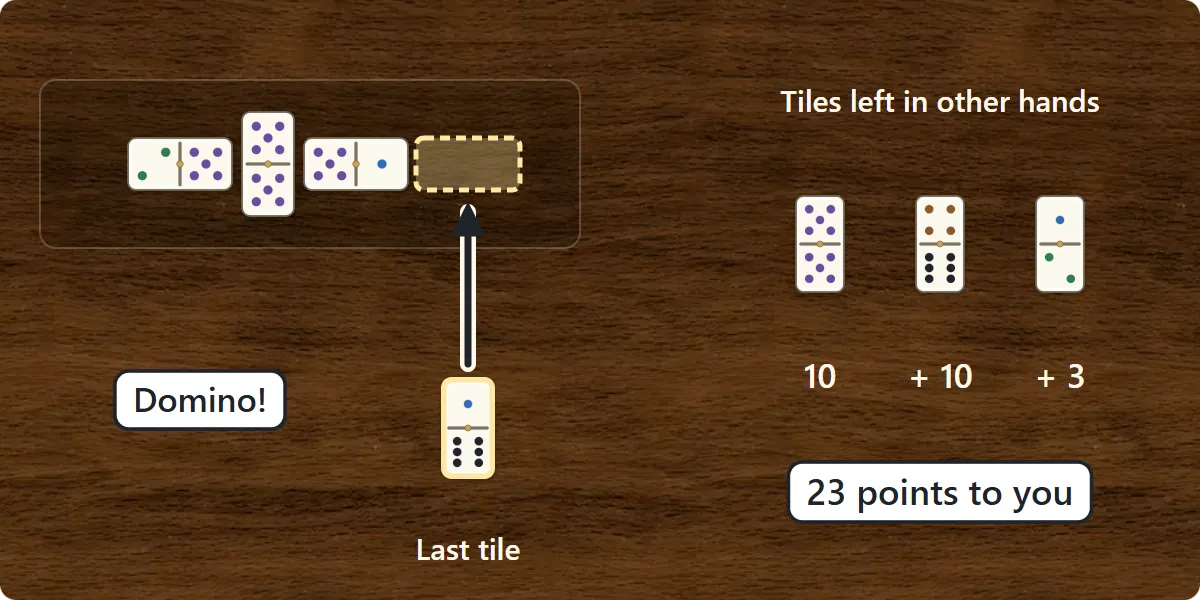
The hand ends the moment a player lays their last tile; players often call out “Domino!” when they do. That player scores the total number of pips remaining in all the other hands. In the example, the tiles left over are worth 10, 10 and 3, so the winner scores 23. A match is played to 100 points with two players and to 61 points with three or four, which is the common target in published rules. You can also play a single hand or a quick match to 50.
Blocked games
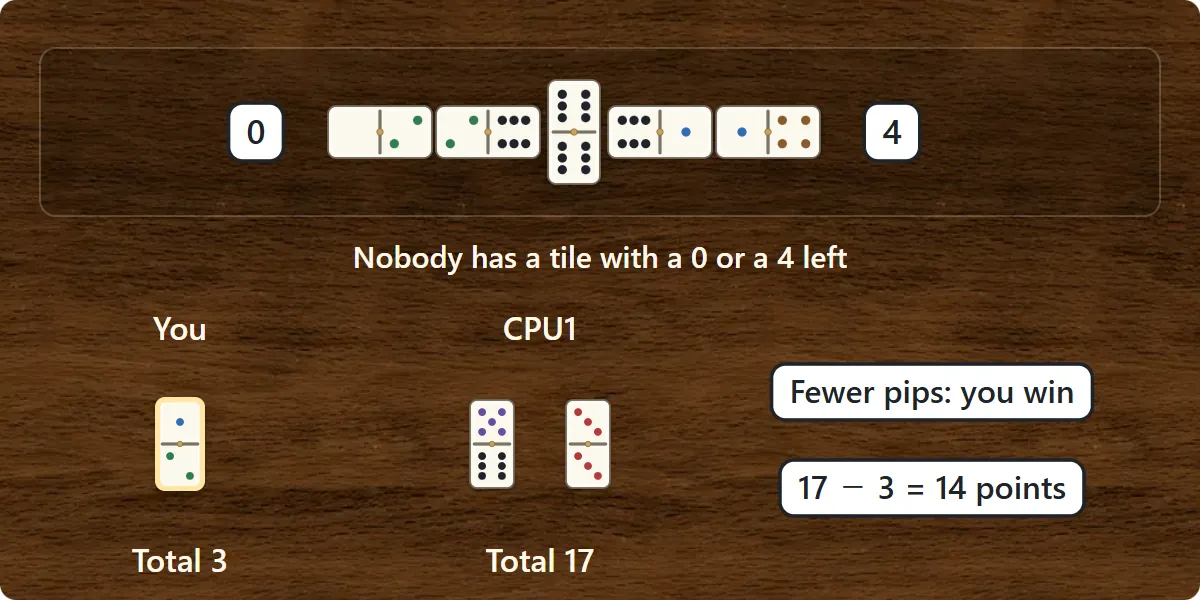
Sometimes the line gets stuck: nobody holds a tile for either end and, in the Draw game, the boneyard is empty. When every player passes in a row, the hand is blocked. Everyone reveals their tiles, and the player with the lowest pip total wins. They score the other players’ pips minus their own. If two or more players tie for the lowest total, nobody scores that hand, although you can switch to a rule where the player holding the lightest single tile wins the tie.
Dominoes rules: Draw vs Block
| Rule | Draw | Block |
|---|---|---|
| Tiles per hand | 7 (2 players), 5 (3–4) | 7 (2 players), 5 (3–4) |
| Can’t play | Draw until you can | Pass |
| First tile | Highest double | Highest double |
| Going out | Score all other pips | Score all other pips |
| Blocked hand | Everyone passes after the boneyard is empty | Everyone passes |
Dominoes is played slightly differently from one family, club or country to the next, and the Custom rule set lets you try the most common variations. You can leave the last two tiles of the boneyard undrawn, allow drawing even when you hold a playable tile, deal larger hands, or let the winner of the previous hand start the next one with any tile they like. Scoring games that count multiples of five during play, such as All Fives, and games with branching spinners are not included here.
Dominoes strategy: tips for beginners
1. Get rid of heavy tiles early
Whatever is left in your hand when someone else goes out becomes their score. Holding 6-6 or 5-6 until the end can hand an opponent a dozen points on its own. When you have a choice of equally good plays, lay the tile with more pips.
2. Play doubles while you can
A double only fits when that number is at an open end, so it is the hardest kind of tile to unload. If the chance appears, take it; otherwise doubles tend to get stuck in your hand.
3. Keep your own numbers open
Try to leave ends showing numbers you hold several of. That way you will still have a play on your next turn. If both ends show numbers you have none of, you will be drawing from the boneyard or passing while your opponents move ahead.
4. Watch what your opponents can’t play
When an opponent draws or passes, look at the two open ends: they have no tiles with those numbers. Putting one of those numbers back on an end can force them to draw or pass again. The Hard computer player uses exactly this information, and nothing more; it never sees your hand.
5. Count the tiles
Each number appears on exactly seven tiles. Add up how many of a number are on the table and in your hand. If the answer is seven, nobody else can play on that number, and making both ends show it will block the game. That can be a winning move when your hand is light.
6. Lighten your hand near the end
When a blocked hand looks likely, the lowest pip total wins. In the late stages, favour playing your heaviest tiles so that if the game locks up, you are the one holding the fewest pips.
Dominoes FAQ
How many tiles do you start with in dominoes?
With a double-six set, two players take seven tiles each and three or four players take five each. Some rule books deal more to three or four players; the Custom settings include that option.
Who goes first in dominoes?
In the first hand, the player holding the highest double starts by playing it. From the second hand on, the default is again the highest double, but you can choose to let the winner of the previous hand begin with any tile.
Can I pass if I have a tile that fits?
No. If you can play, you must. Only with the optional rule “You may draw even when you could play” can you take a tile from the boneyard instead.
Does it matter which end I play on?
Yes, when the two ends are different numbers, because it changes what everyone can play next. When a tile fits both ends, numbered boxes appear on the table so you can choose. If both ends show the same number, it makes no difference and the tile is placed right away.
Which computer level should I choose?
Easy is a good place to start: it often plays light tiles first and hangs on to its doubles, so it tends to get caught with a heavy hand. Normal tries to shed heavy tiles and doubles but frequently plays without much thought. Hard keeps the ends open for itself, blocks numbers you have shown you are missing and lightens its hand when a block is coming, though it still slips up now and then. With dominoes, a good or bad deal can always swing a hand.
Can I stop and finish later?
Yes. The game saves as you play. Open the page again on the same device and browser and press Continue.
Is there sound?
Sound is off at first. Press “Sound: off” under the table to hear tiles being dealt and placed.
History of dominoes
Dominoes are believed to have grown out of dice: each tile represents the throw of two dice, with blank halves added in the European set. Tile games of this kind were played in China for centuries, but the familiar 28-tile game of matching ends is first recorded in Italy and France in the middle of the eighteenth century, and from there it spread to Britain and the rest of Europe and on to the Americas. Today dominoes is a social game in many places, from pubs in England to street tables across the Caribbean and Latin America, where games are played fast and loud. The Draw and Block games you can play here are the simplest members of the family and the base on which most other domino games are built.