 Yorimichi Games
How to play Chinese checkers
Chinese checkers is a race. Each player starts with a set of pieces in one point of a six-pointed star, and the goal is to move every one of them into the point directly across the board. Nothing is ever captured. What makes the game fun is the hop: a single piece can leap over others again and again and cross half the board in one turn. The first player to fill the far triangle wins.
This page lets you play two versions on the same board: classic Chinese Checkers as it is played in the US and Europe, and the Diamond Game, the version sold in Japan, which adds a king piece and uses only three colors. The rules for moving and hopping are the same in both. The differences are explained further down.
The board and the setup
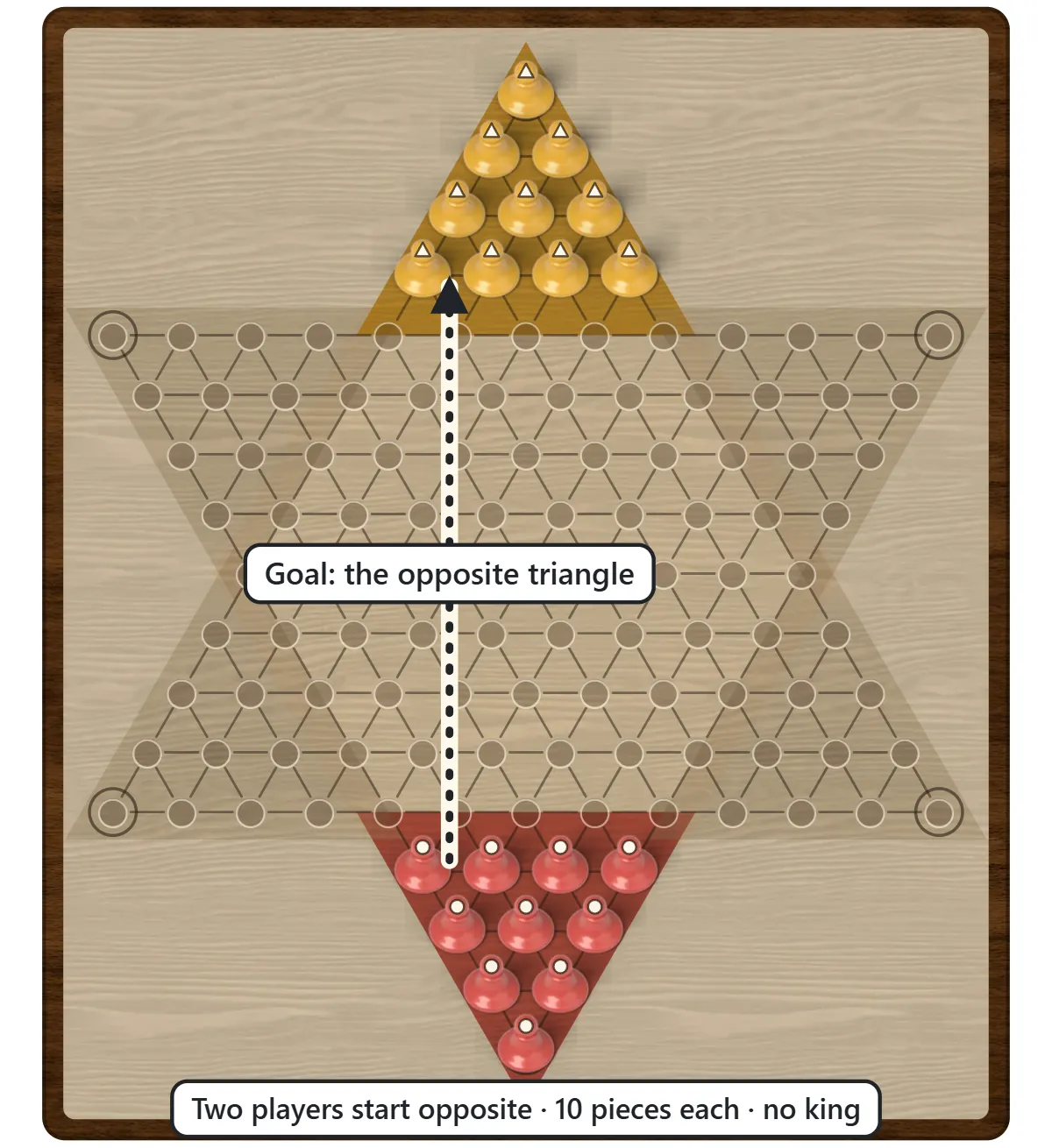
The large board has 121 holes: a hexagon of 61 holes in the middle and a triangle of 10 holes on each of its six sides. In the classic game every player fills one triangle with 10 pieces. Your goal is the triangle straight across from yours. Two players sit opposite each other; with three players, every other point of the star is used, so each player races toward an empty triangle.
Players take turns clockwise, and on your turn you move exactly one piece, either by a single step or by one or more hops.
Moving one step
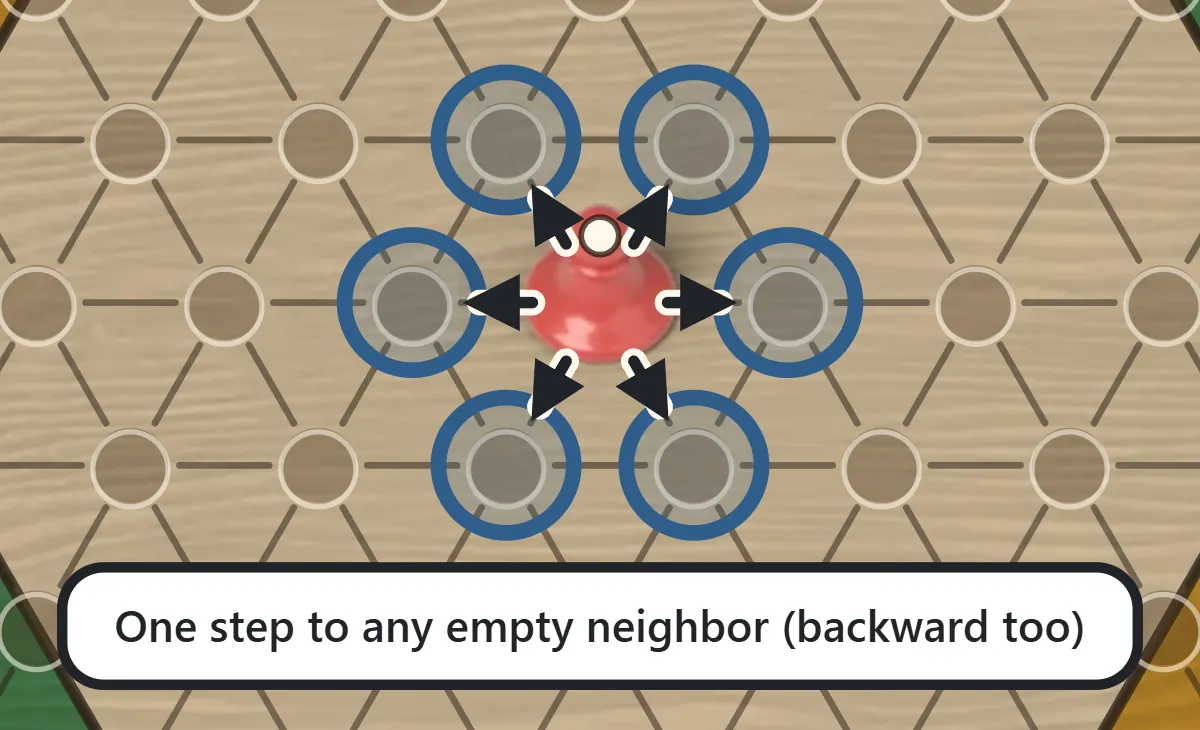
Pieces move along the lines of the board from hole to hole. Every hole has six neighbors, and you can step into any empty one: forward, sideways or even backward. Moving away from your goal is never illegal, and now and then it is the best move on the board.
Hopping over a piece
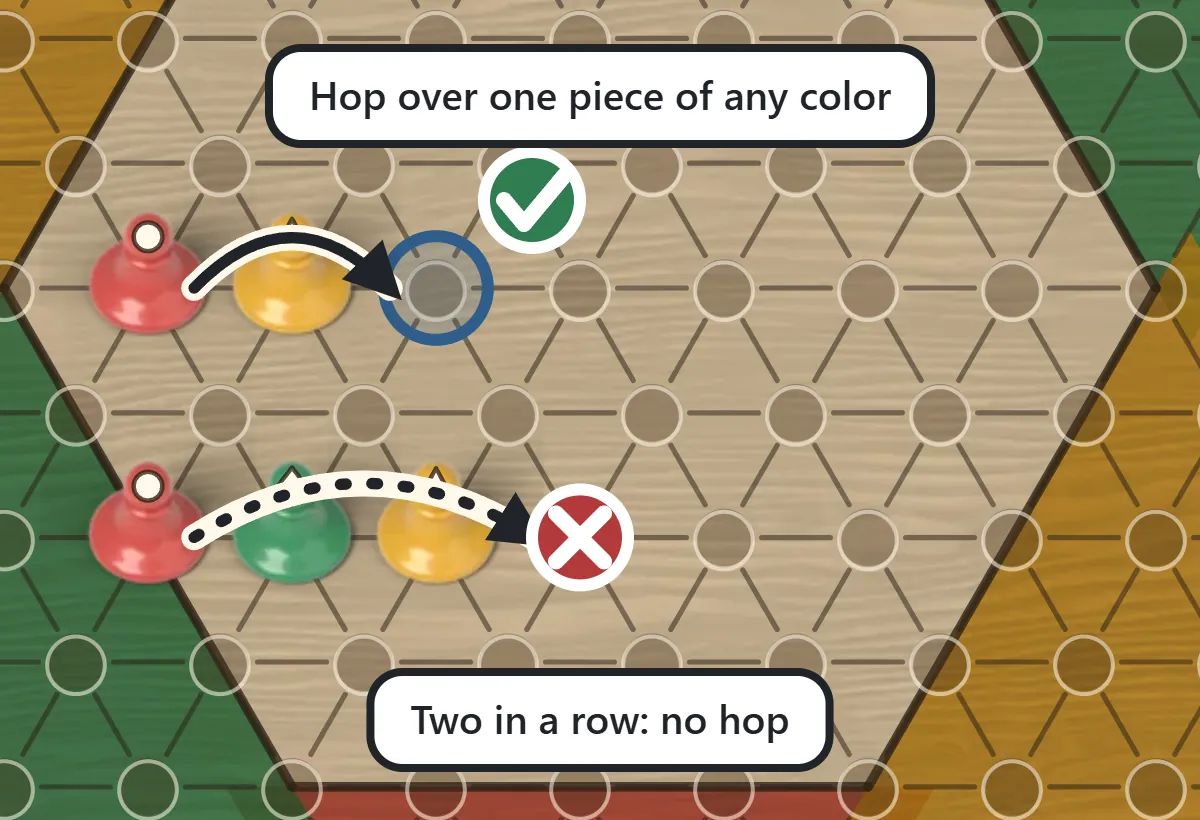
If a neighboring hole holds a piece and the hole directly beyond it is empty, you may hop over that piece and land in the empty hole. It does not matter whose piece it is. Your own pieces and your opponents’ pieces work the same way, and the piece you hop over stays where it is. You cannot hop over two or more pieces lined up next to each other.
Chain hops

After a hop, if another hop is possible from where you landed, you may carry on in the same turn, and you may change direction between hops. There is no limit to the number of hops, and you do not have to take them all. You can stop at any landing hole along the way. What you cannot do is combine a step with hops, or land on the same hole twice in one turn.
In this game, when you choose a destination, the path is shown first as numbered dots, and then the piece bounces along it one hop at a time. The computer’s moves are shown the same way, so you can always see exactly which pieces it jumped.
Winning
The first player to get all of their pieces into the target triangle wins. With three players you can keep going to decide second place. When you play against the computer, the game ends as soon as you finish, and the others are ranked by how close they are to home. If a player has no legal move at all, their turn is skipped.
Chinese checkers rules vs. the Diamond Game
The Diamond Game is how most people in Japan know this game. It is played on the same star, but with three colors and 15 pieces each, and one of those pieces is a king. Here are the main differences at a glance.
| Rule | Chinese Checkers | Diamond Game |
|---|---|---|
| Players | 2–6 (this game: 2–3) | 2–3 |
| Pieces | 10 each, all alike | 15 each, one is a king |
| Starting camp | The triangle only | The triangle plus the border row |
| Two players | Opposite points | Two of the three colors (angled) |
| Other triangles | May hop through, may not stop | No entry at all |
Rule sheets for the classic game differ on some details. Some let you stop in an unused triangle, some say you may pass through it but not stay, and many sets play with 15 pieces when only two people play. The version here follows one common reading: 10 pieces each, and you may hop through an unused triangle but not stop in it. You can change each of these under “Fine-tune the rules”.
The king piece
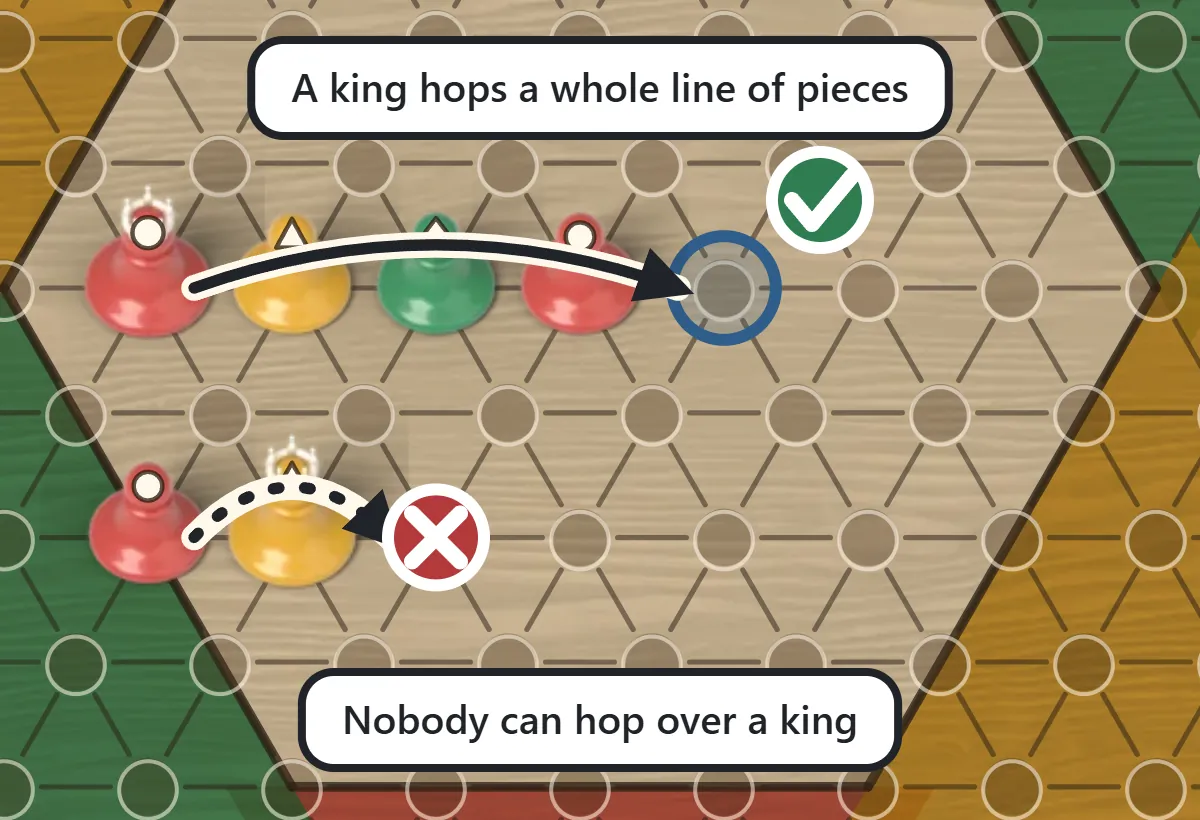
In the Diamond Game each color has one king, the piece with the crown, which starts on the tip of the triangle (the hole marked ◎). A king can hop over any number of pieces in a straight line, landing on the first empty hole just beyond the line, and it can chain these long hops just like a normal piece. On the other hand, no piece can hop over a king, not even another king, so a king standing in the middle of the board works like a wall. To finish, your king has to end up on the ◎ at the tip of your target triangle.
Other colors’ triangles
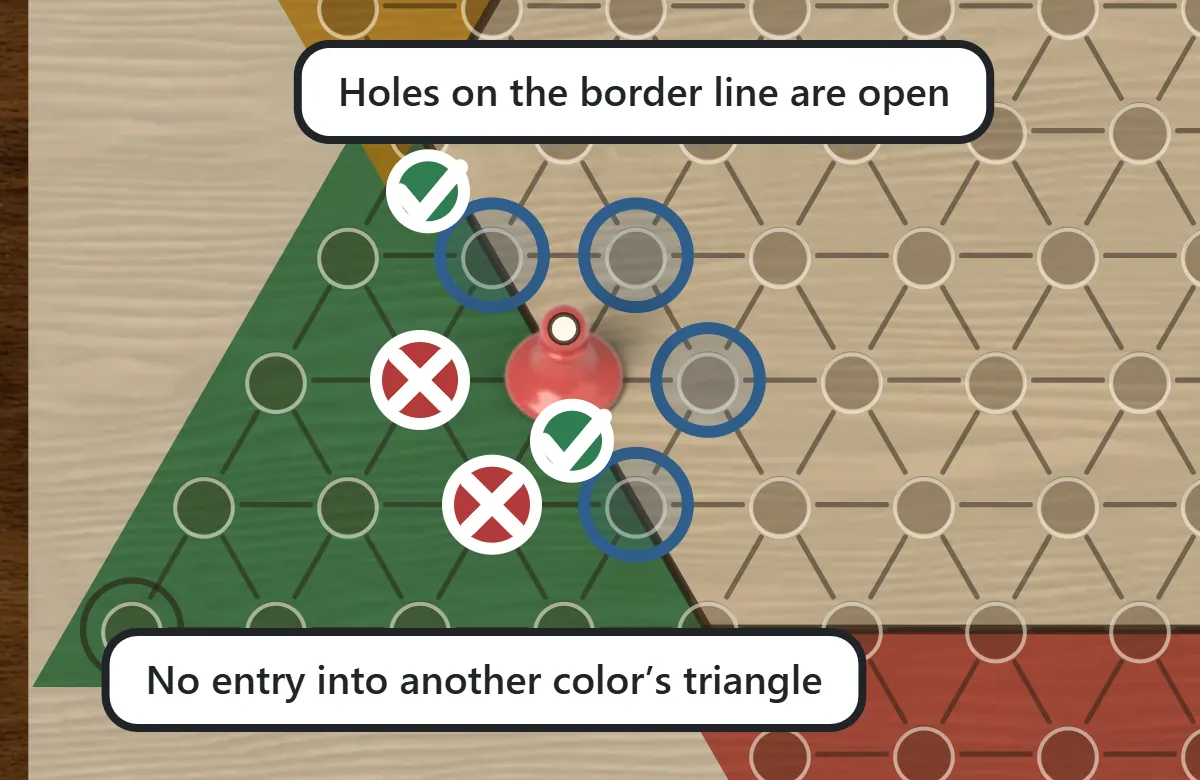
In the Diamond Game the four triangles that are not yours are closed. You cannot step into them, stop in them, or pass through them during a chain of hops. The holes on the line where a triangle meets the central hexagon are open, and you may move along that line and stop on it.
Setup and finishing in the Diamond Game
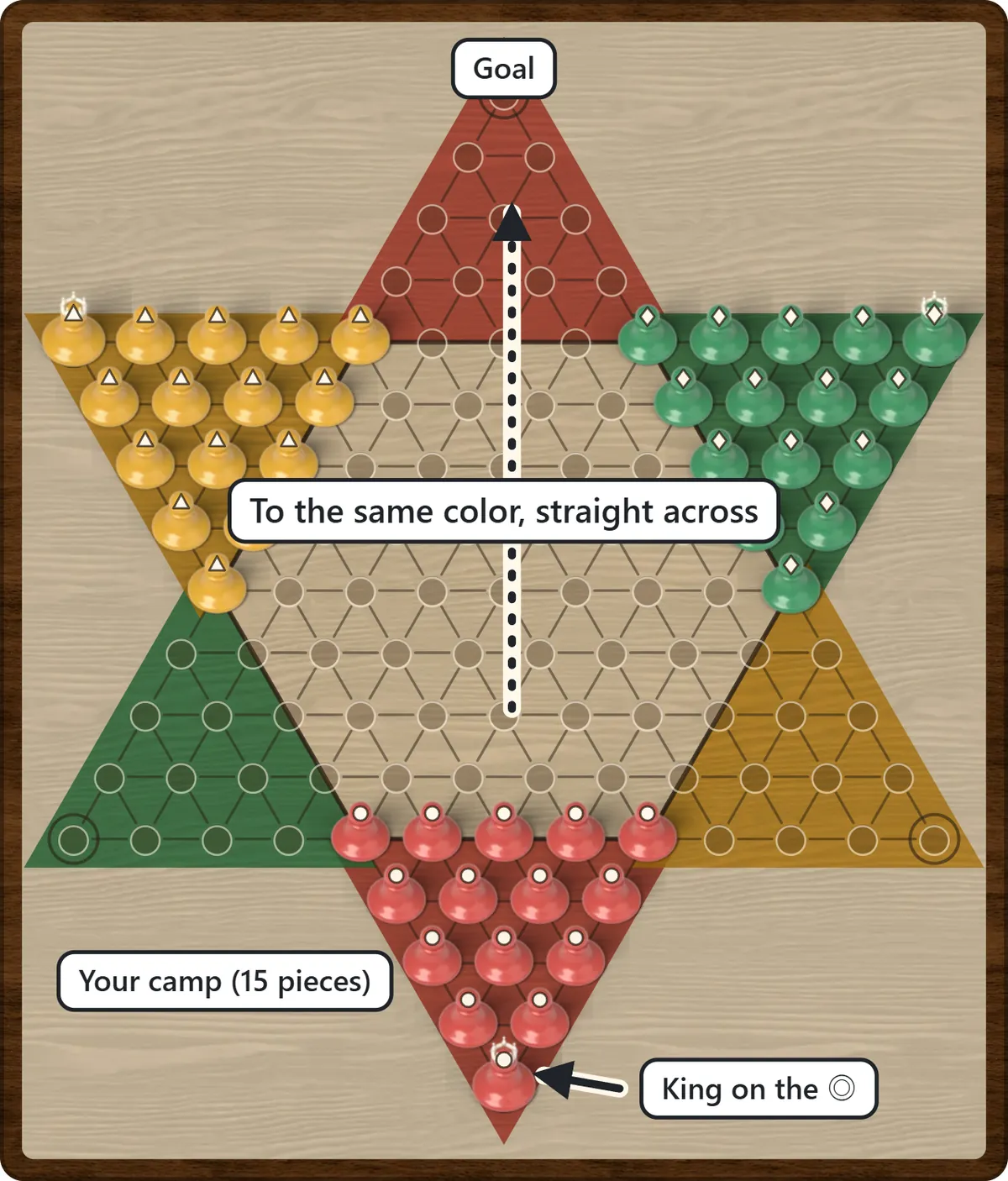
The six points of the Diamond Game board are painted in three colors, with opposite points sharing a color. Your 15 pieces fill one red, yellow or green point together with the row on its border line, and the matching point across the board is your goal. With two players, two of the three colors are used, so the players sit at an angle rather than face to face.
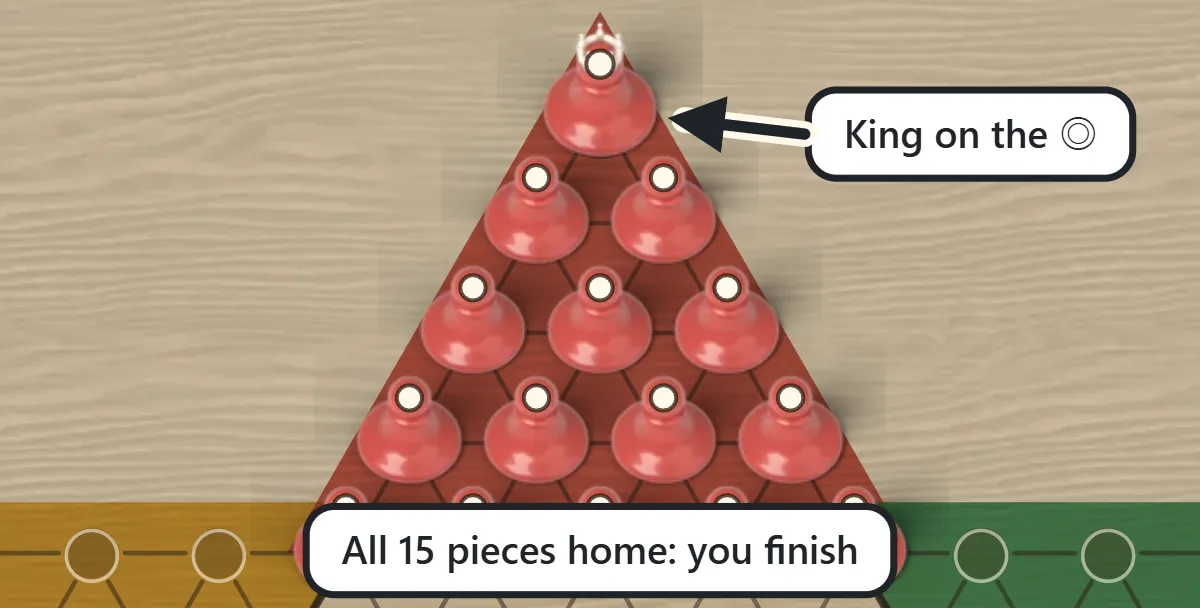
Two more variants are included. Small board uses the 73-hole side of the board that many Japanese sets have on the back, with 10 pieces each including a king. No king is the Diamond Game with 15 ordinary pieces. And if an opponent parks a piece in your goal so that every hole is full, you may swap it with one of your own pieces outside the goal (you can turn this off).
Chinese checkers strategy and tips
1. Build ladders
If your pieces stand one hole apart in a line, a piece behind them can hop over all of them in a single turn. This “ladder” is the engine of the whole game. Good players spend their early moves setting up ladders and then send the back pieces flying along them.
2. Borrow your opponent’s pieces
Any piece can be hopped over, so the other player’s pieces are part of your road too. The flip side is that your ladder can carry them just as easily. Before you complete a ladder, check whether it helps the other side more than it helps you.
3. Don’t leave a straggler behind
The most common way to lose a race you were leading is to rush the front pieces home and leave one piece stranded at the back. With nothing left to hop over, it has to crawl across the board one step at a time. Move the group together and keep stepping stones for the last pieces.
4. Fill the goal from the tip
When your pieces arrive, send them to the deepest holes first. A piece parked at the entrance of the triangle blocks the way for everyone behind it and costs you several turns at the end.
5. In the Diamond Game, get the king home early
The king’s long hops are strongest while the board is crowded, and once your goal fills up, getting the king onto the ◎ becomes awkward. Bring it home early and never let an ordinary piece sit on the ◎. A king in the center can also block an opponent’s best route, since no one can hop over it.
6. Count before you hop
The longest hop is not always the best move. A slightly shorter hop that leaves a ladder behind for your next turn is often worth more. Look at where your pieces will be after the move, not only at how far this one piece travels.
Chinese checkers FAQ
Do I have to keep hopping as long as I can?
No. You can stop on any landing hole in the middle of a chain. Stopping early to leave a stepping stone for your next turn is a common trick.
Do you capture pieces you hop over?
No. Unlike checkers, nothing is removed from the board. Chinese checkers is purely a race to get all of your pieces across.
How many pieces does each player have?
In classic Chinese checkers each player has 10 pieces. Some two-player games use 15. The Japanese Diamond Game uses 15 (14 plus a king), or 10 on the small board.
Can more than three people play?
The classic game allows up to six players, but this version supports two or three, the numbers the Diamond Game is designed for. With the “Friends” option, two or three people can take turns on one phone, tablet or computer.
Which computer level should I choose?
Easy is good for your first few games. It grabs the biggest jump it can see and tends to leave pieces behind. Normal moves the whole group forward but sometimes plays a careless move. Hard looks ahead to its next turn and builds ladders on purpose, so you will need to use your own ladders well to keep up.
Can I stop and continue later?
Yes. The game is saved as you play. Open the page again on the same device and browser and choose “Continue”.
Is there sound?
Sound is off at first. Press “Sound: off” under the board to turn on the sound of the pieces.
Where does Chinese checkers come from?
Despite its name, Chinese checkers did not come from China and has little to do with checkers. It grew out of Halma, an American game from the 1880s played on a square board, and was first published in Germany in 1892 on a star-shaped board as Stern-Halma (“star Halma”). In the late 1920s it was brought to the United States and sold under an exotic-sounding name, which eventually became “Chinese checkers”. The game had reached Japan by around 1940, where it became known as the “Diamond Game”, a name coined in Japan. Japanese sets usually come with a king piece and three colors, and that version has been a family favorite there for generations.