 Yorimichi Games
How to play cribbage
Cribbage is a two-player card game from England, played with a standard 52-card deck and scored on a wooden board with pegs. You score points by making fifteens, pairs and runs, first while the cards are being played (“pegging”) and then when the hands are counted (“the show”). The first player to move a peg into the game hole at 121 wins.
Every hand follows the same pattern: deal six cards each, throw two into the crib, turn the starter card, peg, then count. The scoring takes a little practice, so this version counts every hand for you and lists each combination (“fifteen two, fifteen four and a pair is six”). While you peg, the cards you can legally play are outlined and the ones that would score are tagged, so you can learn the game simply by playing it.
The table
Cribbage rules: the deal and the crib
To decide who deals first, each player cuts a card and the lower card deals (ace is low; equal ranks cut again). After that the deal alternates every hand, and in the next game the loser of the previous game deals first. The player who is not dealing is called the non-dealer, or “pone”.
For counting, an ace is worth 1, number cards their face value, and jacks, queens and kings 10 each. For pairs and runs, though, every rank is different: a 10 and a queen are both worth ten, but they do not make a pair.
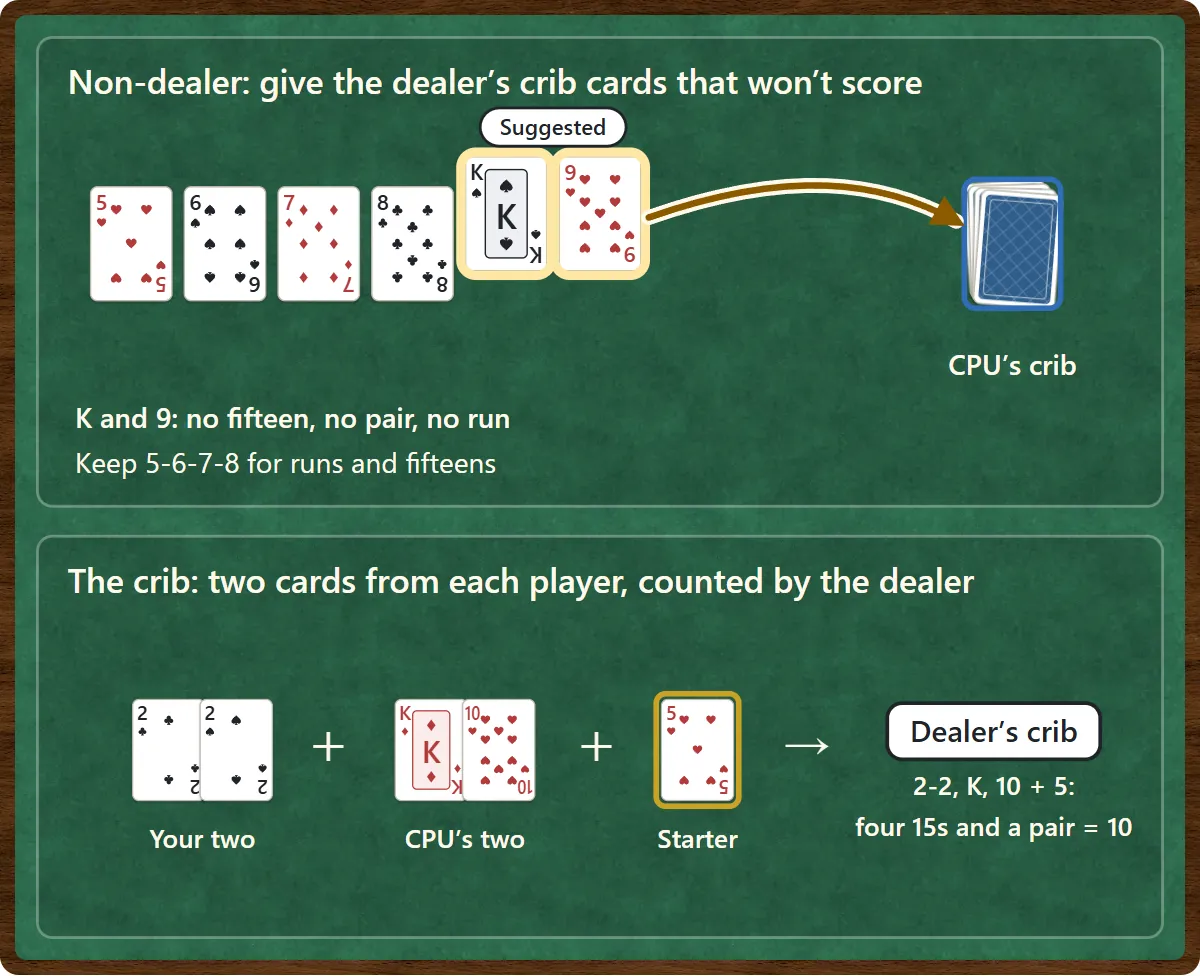
The dealer gives six cards to each player. Both players then choose two cards to place face down in the crib, a spare four-card hand that belongs to the dealer and is counted at the end of the hand. That leaves each player with four cards. When it is your crib, throwing in good cards (fives, pairs, touching cards) costs you little; when it is your opponent’s crib, you want to give away cards that are unlikely to score.
The starter and his heels
The non-dealer cuts the deck and the dealer turns up the top card of the lower half. This is the starter (or cut card). It is not used in the pegging, but it counts as a fifth card in both hands and in the crib. If the starter is a jack, the dealer pegs 2 straight away for “his heels”.
Pegging: playing toward 31
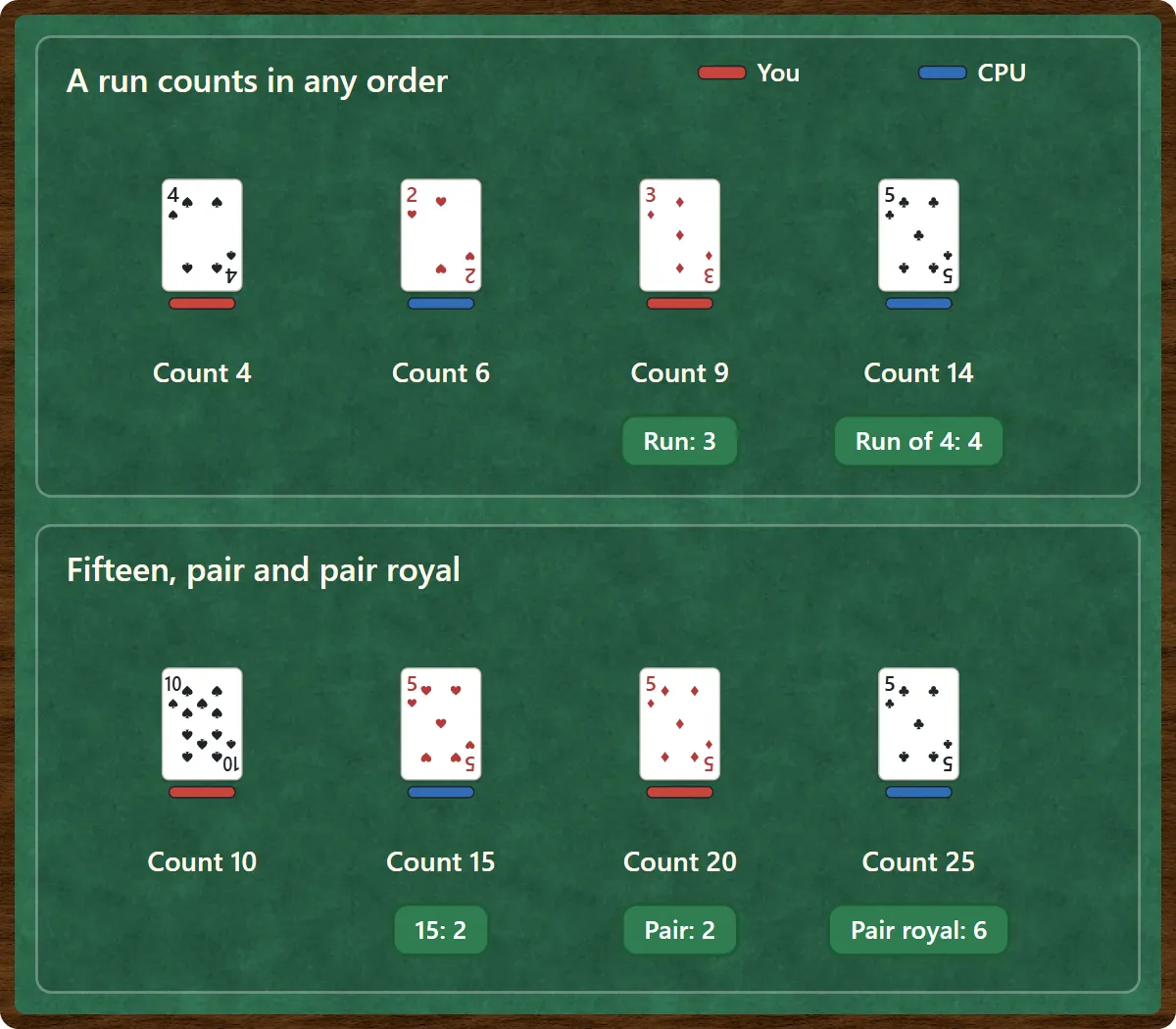
The non-dealer leads. Players take turns laying one card face up and announcing the running count. The count may never go above 31. You score right away for any of these:
| Play | Points |
|---|---|
| Count reaches exactly 15 | 2 |
| Count reaches exactly 31 | 2 |
| Same rank as the previous card (pair) | 2 |
| Third card of the rank (pair royal) | 6 |
| Fourth card of the rank (double pair royal) | 12 |
| Run of 3 or more with the cards just played | 1 per card |
Runs do not have to be played in order: 4, 2, 3 is a run of three for whoever played the 3, and a 5 after that makes a run of four. Any unrelated card in between breaks the run.
The go and the last card
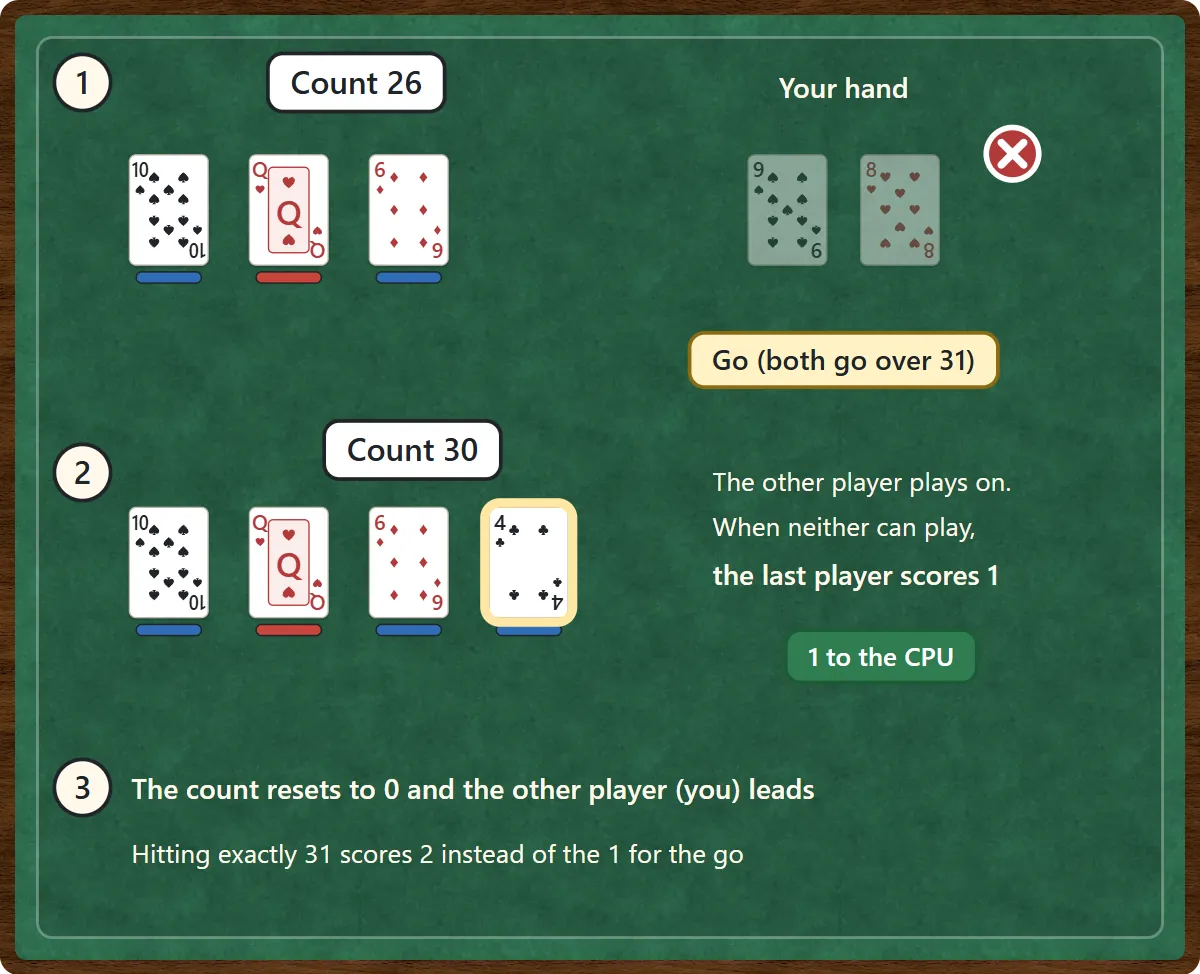
If you cannot play without going over 31, you say Go. Your opponent then keeps playing as many cards as they can. When neither player can play, the player who laid the last card pegs 1 for the go, or 2 if they hit exactly 31 (never both). The count resets to zero and the other player leads. You can never say Go while you still have a playable card. When all eight cards are played, whoever played the very last card pegs 1 for last card.
Cribbage scoring: how to count a hand
After the pegging, the hands are counted in a fixed order: non-dealer’s hand, then dealer’s hand, then the dealer’s crib. Each is counted as five cards together with the starter, and the same card can be used in as many combinations as possible.
| Combination | Points |
|---|---|
| Any cards that add up to 15 | 2 each |
| Pair (two of a kind) | 2 each (three of a kind 6, four 12) |
| Run of 3 or more | 1 per card, every distinct run |
| Flush: all four hand cards one suit | 4 (5 with the starter) |
| His nob: jack of the starter’s suit | 1 |
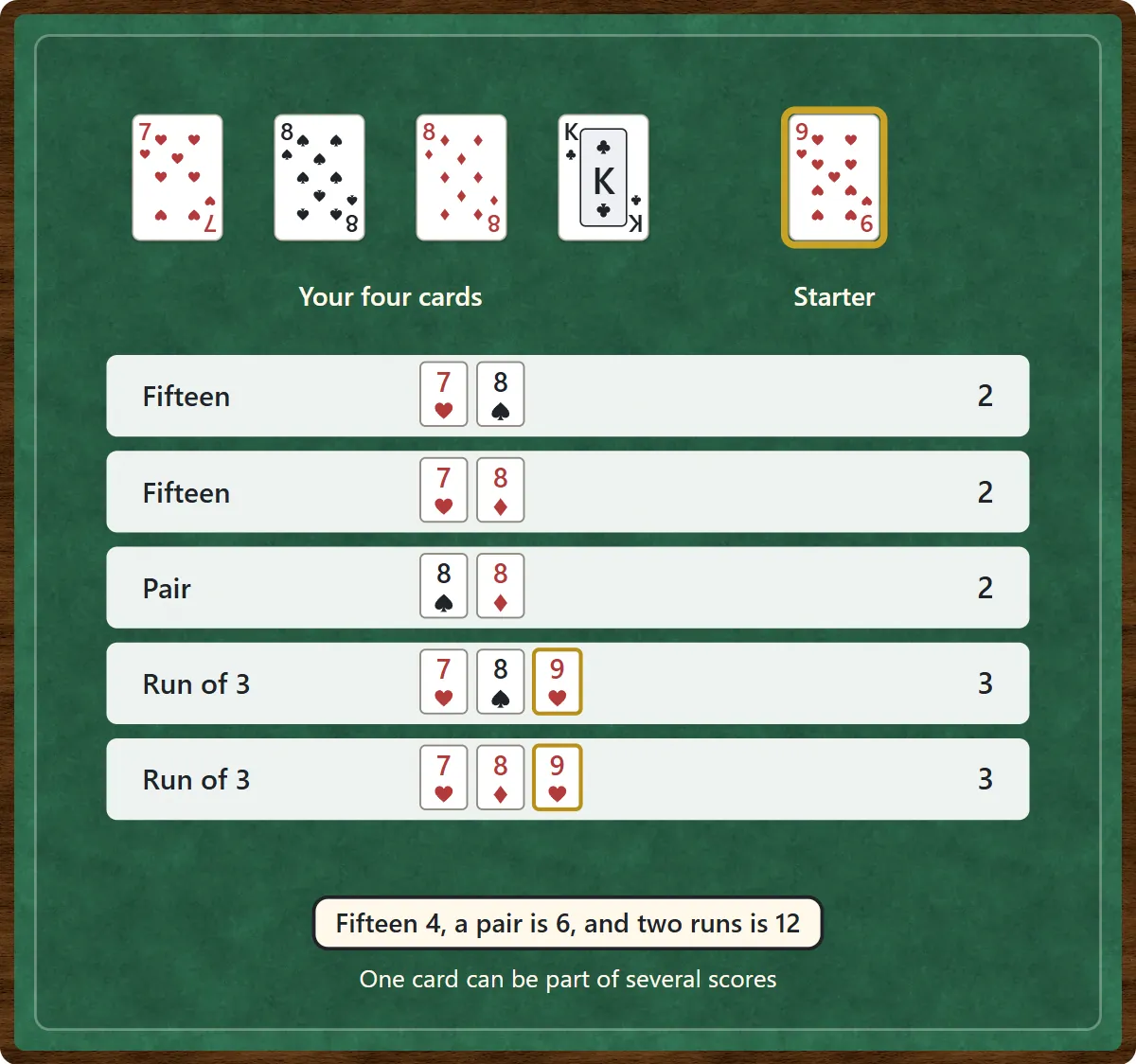
Take 7-8-8-K with a 9 as the starter. There are two fifteens (7 + 8 with each eight) for 4, a pair of eights for 2, and two runs of 7-8-9 for 6: twelve in all. The crib follows the same rules except for flushes: a crib flush only counts when all four crib cards and the starter share a suit, for 5 points.
The cribbage board and pegs
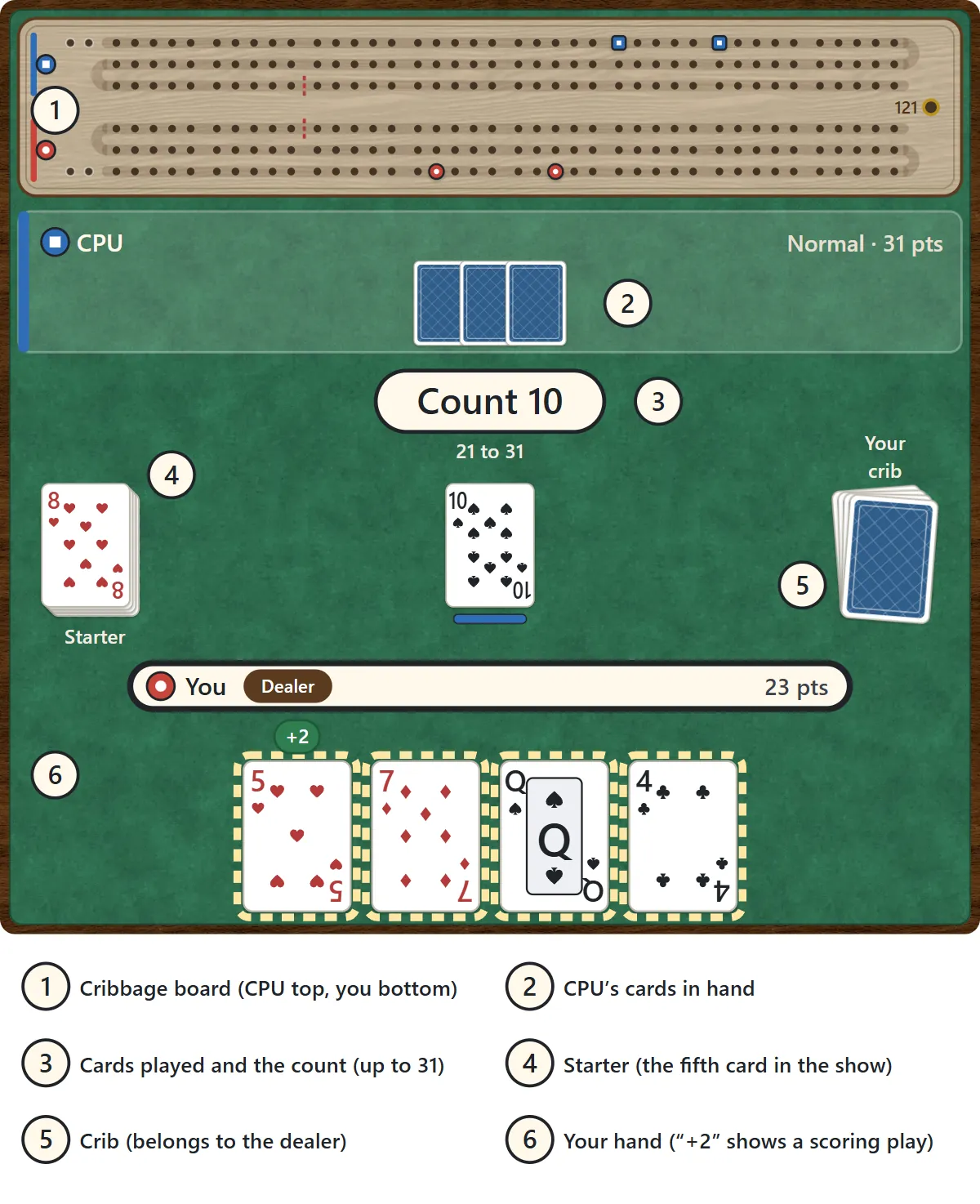
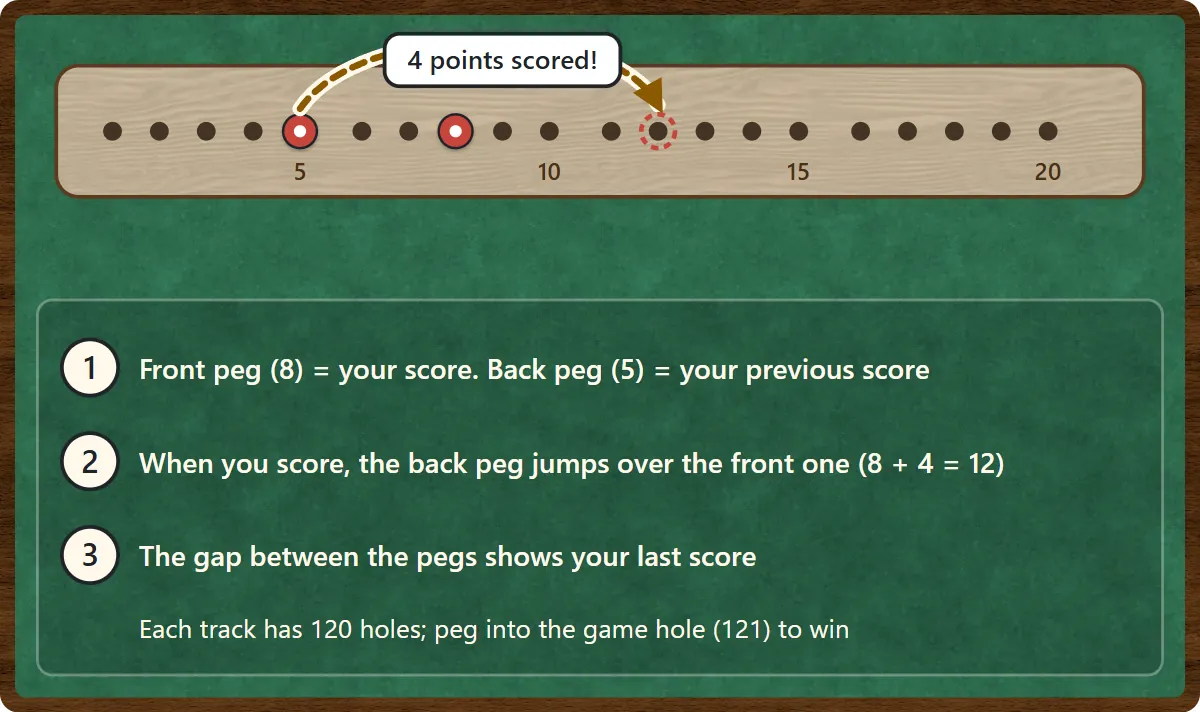
Each player has two pegs that leapfrog: when you score, the back peg jumps over the front peg to your new total. The gap between the two pegs is always your last score, which makes mistakes easy to spot. The board in this game is our own design: each player’s track has three rows of 40 holes that snake back and forth, and both tracks finish in a single game hole on the right.
Winning, skunks and muggins
The game ends the moment a player reaches 121, even in the middle of the pegging or the show. Because the non-dealer counts first, the non-dealer can go out before the dealer gets to count. If the loser has not reached 91, it is a skunk; below 61 it is a double skunk.
Muggins is an optional rule: if a player undercounts their hand, the opponent can call “Muggins!” and take the missed points. Turn it on in the settings to count your own hands, and watch the computer’s claims for points it forgot.
Cribbage variations in the settings
| Setting | Choices |
|---|---|
| Game to | 121 (standard) or 61 (short game; skunk below 31) |
| Skunks | On or off |
| Muggins | Off (automatic counting) or on |
| Helpers | Playable-card outlines, point tags and the crib suggestion can each be turned off |
Cribbage strategy and tips
1. Fives are gold in your own crib
With sixteen ten-value cards in the deck, a five makes fifteen more often than any other card. Throw fives (and pairs, and touching cards like 7-8) into your own crib, and keep them out of your opponent’s.
2. Give your opponent’s crib cards that don’t connect
As non-dealer, the safest discards are far apart and do not add to 15, such as K-9 or Q-8. The suggestion in this game weighs your hand over every possible starter against what your discard is worth in the crib.
3. Keep hands that grow with the starter
A hand that scores little right now may be strong overall. Runs like 6-7-8 and combinations of a five with face cards pick up points from many starters.
4. Lead a four or lower
If you lead a card of four or less, your opponent cannot make fifteen with their reply. Leading a five invites a ten-card for fifteen two. Avoid leaving the count on 21, where any ten-card makes 31.
5. Save low cards for the end of a count
Aces and twos let you squeeze in under 31 after your opponent says Go, collecting the point for the go or the two for thirty-one.
6. Play to the board
About 25 points change hands each deal. When you are close to 121, take every pegging point you can; when your opponent is close, play defensively and deny them easy pairs and fifteens.
Cribbage FAQ
Can three or four people play cribbage?
Yes. With three players everyone gets five cards, throws one to the crib, and one card from the deck completes it. With four, partners sit opposite each other, each gets five cards and throws one. This page is a two-player game against the computer.
What is the highest possible cribbage hand?
29 points: three fives and the jack in hand with the fourth five as the starter, the jack matching the starter’s suit. That is eight fifteens (16), four of a kind (12) and his nob (1).
What is a “nineteen hand”?
No hand can score exactly 19 (or 25, 26 or 27), so players jokingly call a worthless hand “nineteen”.
Does a jack starter also count as his nob?
No. A jack turned as the starter gives the dealer 2 for his heels. His nob is the jack of the starter’s suit held in a hand or crib.
Can I play with the keyboard?
Yes. Use the left and right arrow keys to choose a card. In the discard, Space picks or unpicks a card and Enter sends two to the crib; while pegging, Space or Enter plays the chosen card. After a count, Enter moves on.
History of cribbage
Cribbage is said to have been invented in the early 1600s by the English poet Sir John Suckling, who adapted an older game called noddy. It became a fixture of English pubs and travelled with English speakers around the world, becoming especially popular in North America. The game appears in Charles Dickens’s The Old Curiosity Shop, and a small mining town in Montana calls itself the cribbage capital of the world. The pegboard, with its leapfrogging pegs, has stayed the symbol of the game for nearly four hundred years.