 Yorimichi Games
How to play the claw machine game
A claw machine is a glass cabinet with a small crane in the ceiling. You steer the crane over something you like, drop the claw, and hope its two arms hold on long enough to carry the toy back to the chute. This free online version runs in any browser on a computer, phone or tablet, with no download and no sign-up. Each game gives you ten tries. Count how many toys you can win, and keep the ones you get in your collection. Nothing costs money, and nothing you win leaves the screen – the fun is in the grab itself and in filling up your collection.
What you see on the screen
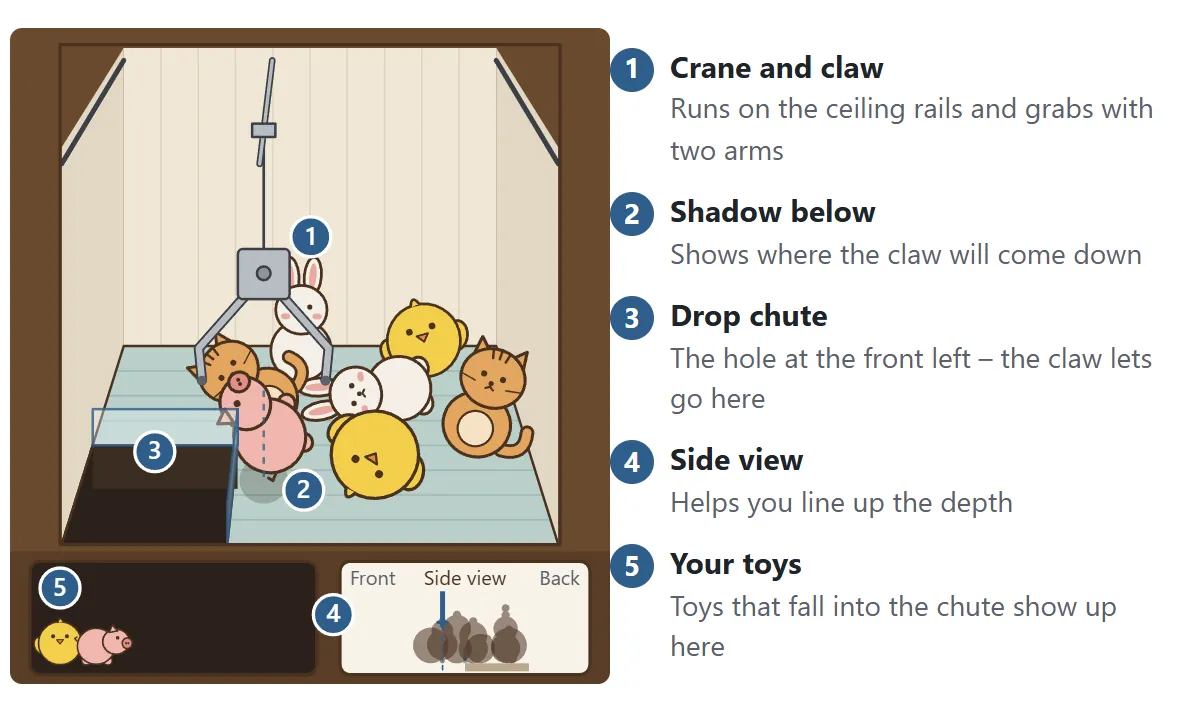
The cabinet is shown from the front, slightly from above, so the top of the picture is the back of the machine and the bottom is the front glass. The crane always starts above the drop chute in the front-left corner. A round shadow on the floor marks the spot right below the claw. Under the cabinet there is a small side view: the blue line is the crane, and the brown shapes are the toys seen from the side. Depth is the hardest thing to judge from the front, and the side view is there to help. Everything you win drops into the tray at the bottom left.
Two-button controls
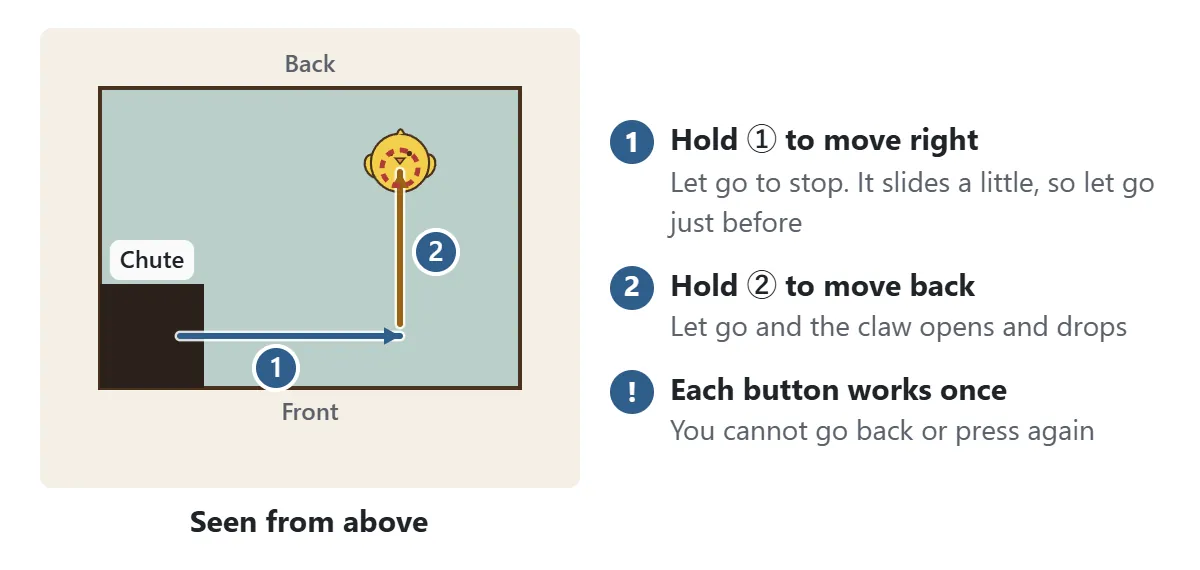
“Two buttons” works like a real cabinet. Hold button ① and the crane slides to the right for as long as you hold it. Let go and it stops – and ① is finished for this try. Then hold button ② to move the crane toward the back. When you release ②, the claw opens, drops, closes, rises and travels back to the chute, where it opens again. The crane does not stop dead: it slides a little after you let go, so release just before you reach the target. On a keyboard, the right arrow (or 1) is button ①, and the up arrow (or 2) is button ②.
If you choose “Free move”, you can steer in all four directions as often as you like with the arrow buttons or arrow keys, then press “Drop” (or Space). It is a good way to learn how the claw grabs before you try the real two-button style.
Claw machine types and difficulty
| Machine | What it is like |
|---|---|
| Plush toys | Bear, rabbit, cat, chick, dog and pig. Lift one and carry it to the chute. Each shape has its weight in a different place |
| Bridge | A box rests across two bars. Push it or lift one end until it drops off the bars. You slide it a bit at a time rather than carry it |
| Small toys | Blocks, spinning tops, wooden cars, ducks, wooden balls and trains. Light but hard and small, so they are mostly held by squeezing |
| Level | How it feels |
|---|---|
| Easy | Strong arms and very little swing. The claw is a little more forgiving if your depth is off. The bars in the bridge machine are close together, so the box wobbles easily |
| Normal | Average grip that loosens a little at the top. Good aim usually pays off |
| Hard | Weak arms and a big swing after the crane stops. Unless the tips hook under the toy, it slips out on the way. The bars are far apart, so the box sits steady |
The daily machine changes every day. The machine type and the layout come from the date, so everyone who plays on the same day gets the same cabinet (always on Normal). Your personal best is kept for each machine and level.
Claw machine tips and tricks
1. Get the tips under the widest part
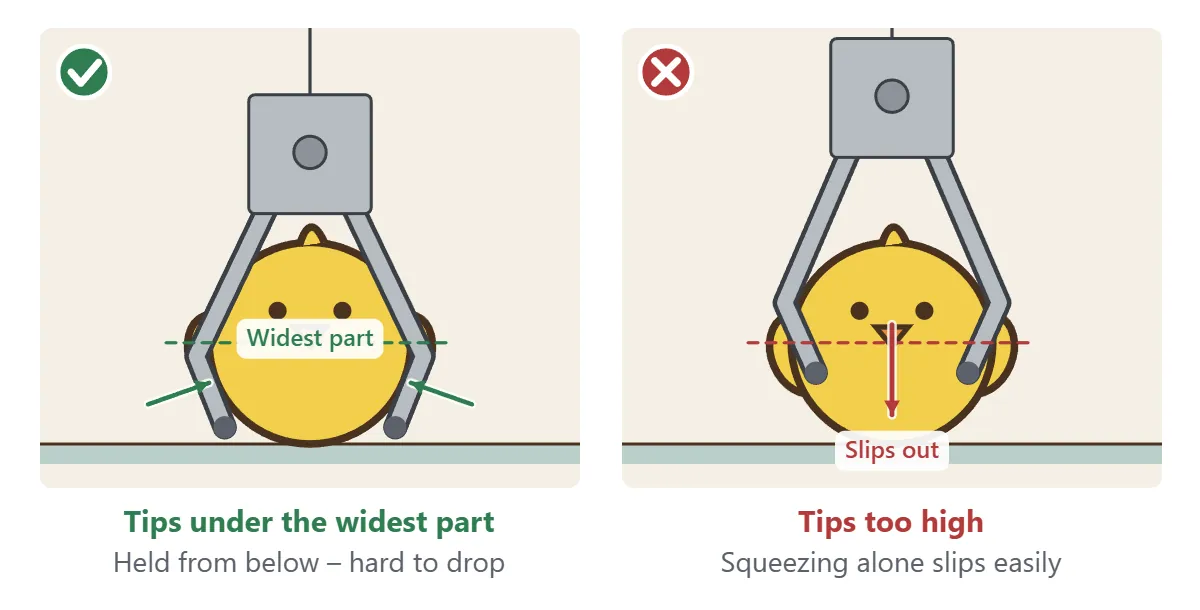
When the tips of the arms slide in below the widest part of a plush toy, they support it from underneath, and even a weak claw can carry it. If the tips only squeeze the upper half, the toy is held by grip and friction alone and tends to slip out while rising or on the way to the chute. A plush toy lying on the floor is a good target, because the tips reach almost to the floor and end up underneath it.
2. Aim at the center of gravity
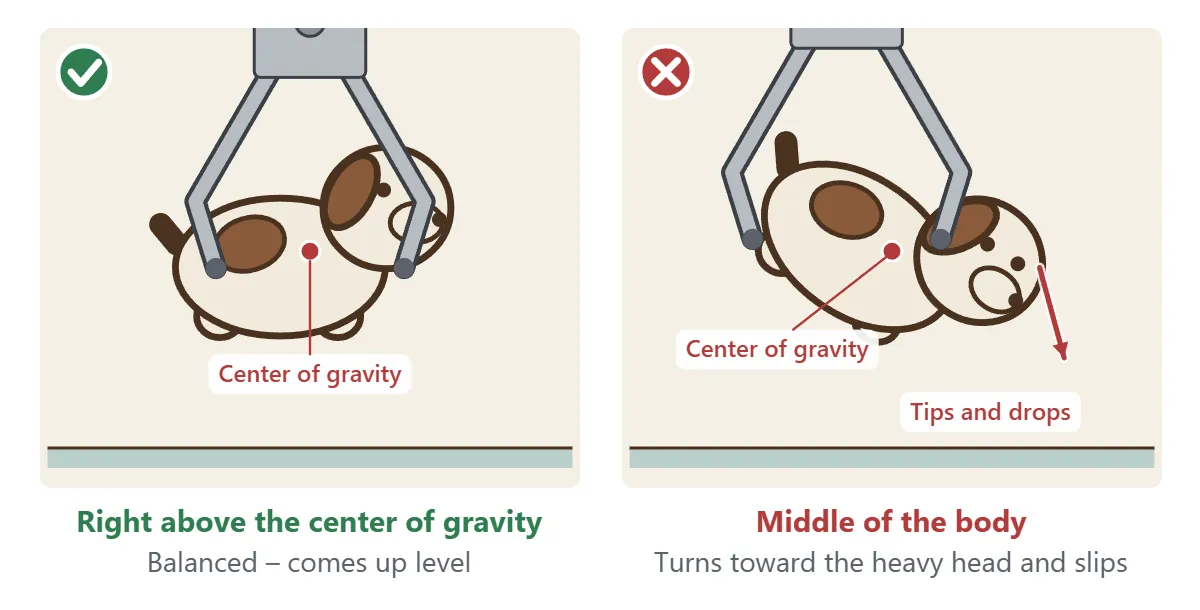
You can think of all the weight of an object as acting at one point, the center of gravity. If the claw grabs to one side of it, the heavy side swings down as soon as the toy leaves the floor, the toy twists, and the tips lose their hold. The lying dog has a big head, so its center of gravity sits toward the head, not in the middle of the body. Aim a little toward the heavy end. The cat with its tail and the pig with its snout work the same way.
3. Line up the depth with the side view
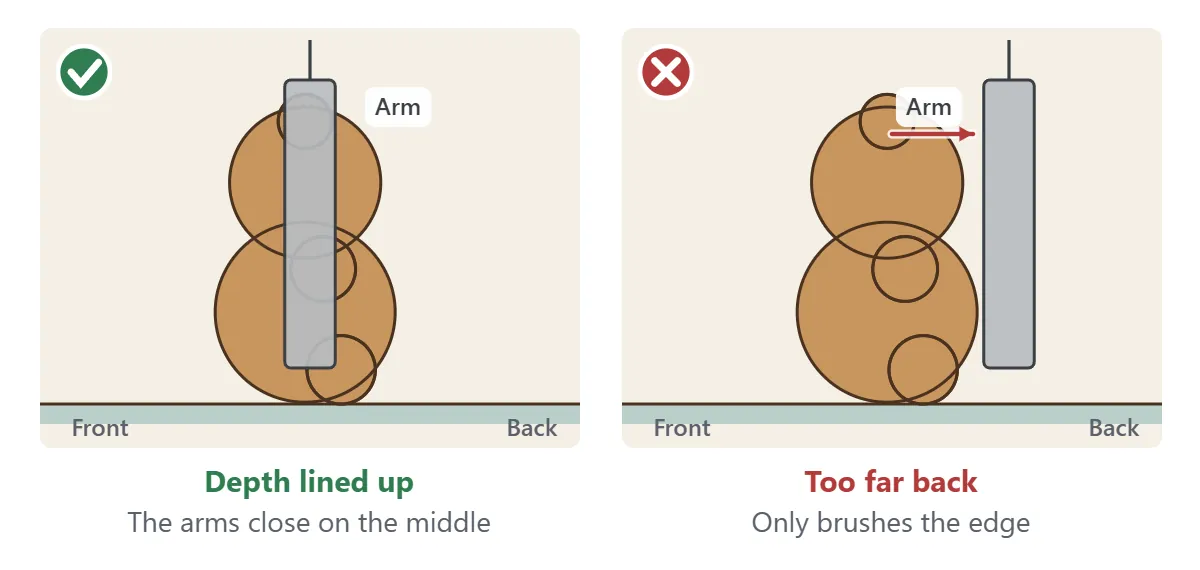
From the front you can judge left and right easily, but not front and back. While holding ②, watch the side view and let go when the blue line reaches the middle of the toy’s shape. The shadow on the floor helps too. With a real machine, many players walk to the side of the cabinet to check the depth for exactly this reason.
4. Expect some swing
The claw hangs from a cable, so it swings for a moment whenever the crane starts or stops. With two buttons, the claw drops as soon as you release ②, so a short, gentle press on ② keeps the swing small. On Hard, the swing alone can move the claw off target.
5. Start with toys near the chute
The shorter the trip, the less chance of a drop on the way. Toys that rolled close to the chute, or that sit on the edge of the clear panel around it, sometimes fall in with a small nudge. Even if you cannot lift something, dragging or pushing it closer to the chute is a real strategy, because the layout stays as it is for your next try.
6. In the small toys machine, pick one with space around it
If an open arm lands on a neighboring toy, the claw stops right there, too high to grab anything. Choose a toy with room around it that fits between the open arms. Round, slippery things like the wooden ball need to be squeezed right in the middle.
Bridge claw machine strategy
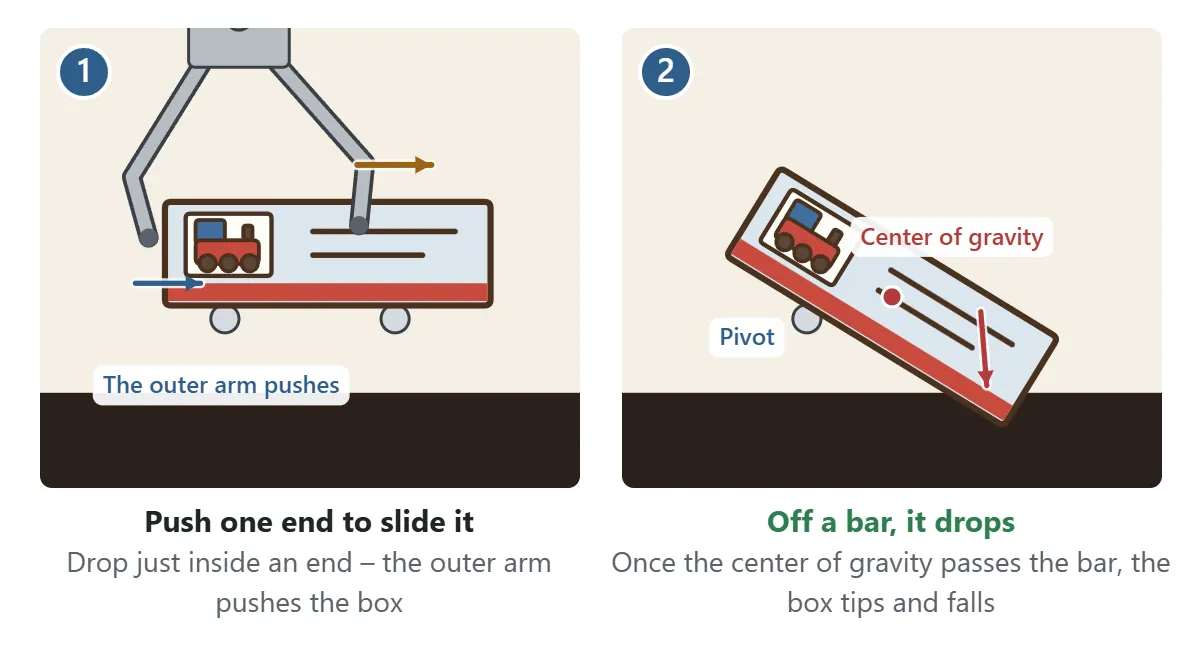
The box in the bridge machine is longer than the claw can open, so you cannot simply pick it up. Instead, you slide it along the two bars a little at a time. As soon as one end comes off its bar, the box turns around the other bar and drops into the chute below. Drop the claw just inside one end of the box: as the arms close, the outer arm pushes on that end and shoves the box the other way. Then keep pushing in the direction it is already moving. Lifting one end and letting it fall can also make the box jump a long way.
The science: levers and the center of gravity
A lot of what happens in a claw machine is simple physics. Anything hanging from a support turns until its center of gravity is right below that support. If the claw holds a toy right above its center of gravity, the turning forces balance and the toy comes up level. Hold it somewhere else and the weight times the distance from the hold point – the moment, or turning effect – tries to rotate it, which pulls the tips loose.
The bridge machine is a lever. Each bar is a fulcrum, the weight of the box acts at its center of gravity, and the claw supplies the effort where it pushes or lifts. While the box rests on both bars, its center of gravity lies between them and the box is stable. Once it leaves one bar, only a single support is left, and if the center of gravity is outside that support, the box rotates around it and falls. The closer the bars are, the smaller the shift needed to get the center of gravity past a bar, which is why a narrow bridge feels so wobbly. Think about where a push gives you the most turning effect for the least force.
Claw machine FAQ
Does it cost anything? Do I get the toys?
It is completely free and needs no account. The toys you win only go into the collection on your screen; they are not exchanged for anything and nothing is sent to you. The goal is to see how many you can win in ten tries and to complete the collection.
Can I play on a phone or tablet?
Yes. Hold the large ① and ② buttons with your finger to move the crane. The game is kept light so it also runs well on Chromebooks and iPads.
Why does the crane keep moving after I let go?
The crane cannot stop instantly, so it slides a short way before it stops. Real cabinets often do the same thing. Let go a little before your target.
Will I lose my collection?
Your collection and personal bests are saved in your browser on this device, so they are still there next time as long as you use the same device and browser. If you leave in the middle of a game, “Continue” takes you back to the start of the try you were on.
A plush toy is stuck on the edge of the chute. What now?
The layout stays the same from one try to the next, so you can nudge a toy that is hanging over the clear panel and tip it into the chute. Toys on the edge are often the easiest win in the machine.
A short history of the claw machine
Machines that let you grab something with a little crane are said to have appeared in the United States in the early 1900s, inspired by the steam shovels used on big construction projects. Hand-cranked versions were popular at fairs and carnivals in the 1920s and 1930s, and electric cabinets followed. In Japan they have been made since the 1960s, and tall cabinets filled with plush toys spread from the late 1980s. This version recreates the cabinet with original drawings of wooden toys and plush animals, so you can enjoy the grab, the carry and the drop – and see the center of gravity and levers at work.