 Yorimichi Games
How to play chess
Chess is a game for two players on a board of 8 by 8 squares. One player has the white pieces and the other the black pieces, and they take turns moving one piece at a time. There are six kinds of pieces, and each moves in its own way. You capture an opposing piece by moving onto its square. The goal is to attack your opponent’s king so that it cannot escape. That is called checkmate, and it wins the game.
Chess has a reputation for being hard, but you only need a handful of rules to play a real game. This page explains them in order, with a picture for each: the setup, how every piece moves, check and checkmate, the three special moves, and the ways a game can be drawn. If you are brand new, turn on the move and threat markers in the settings above; the board will then show where a piece can go and which of your pieces are under attack.
The chessboard and how to set up the pieces
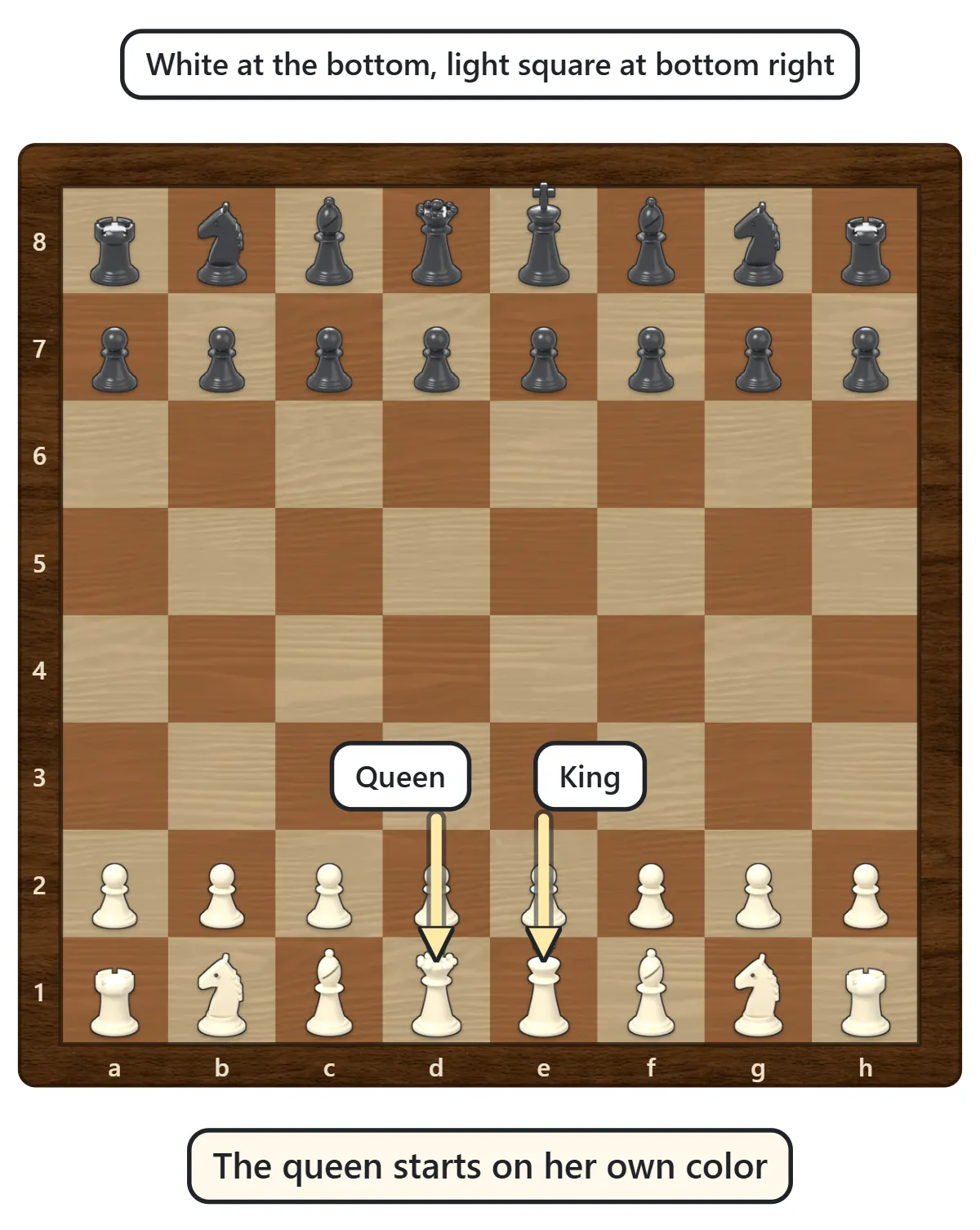
Place the board so that each player has a light square in the bottom-right corner (“light on the right”). On your back row, set up the pieces from left to right: rook, knight, bishop, queen, king, bishop, knight, rook. Put your eight pawns on the row in front of them. A handy way to remember where the queen goes is “the queen goes on her own color”: the white queen starts on a light square, the black queen on a dark one, and the kings face each other.
White always moves first, and then the players alternate. In this game you can choose to play White, Black or a random color, and the board is turned so that your pieces are always at the bottom.
How the chess pieces move
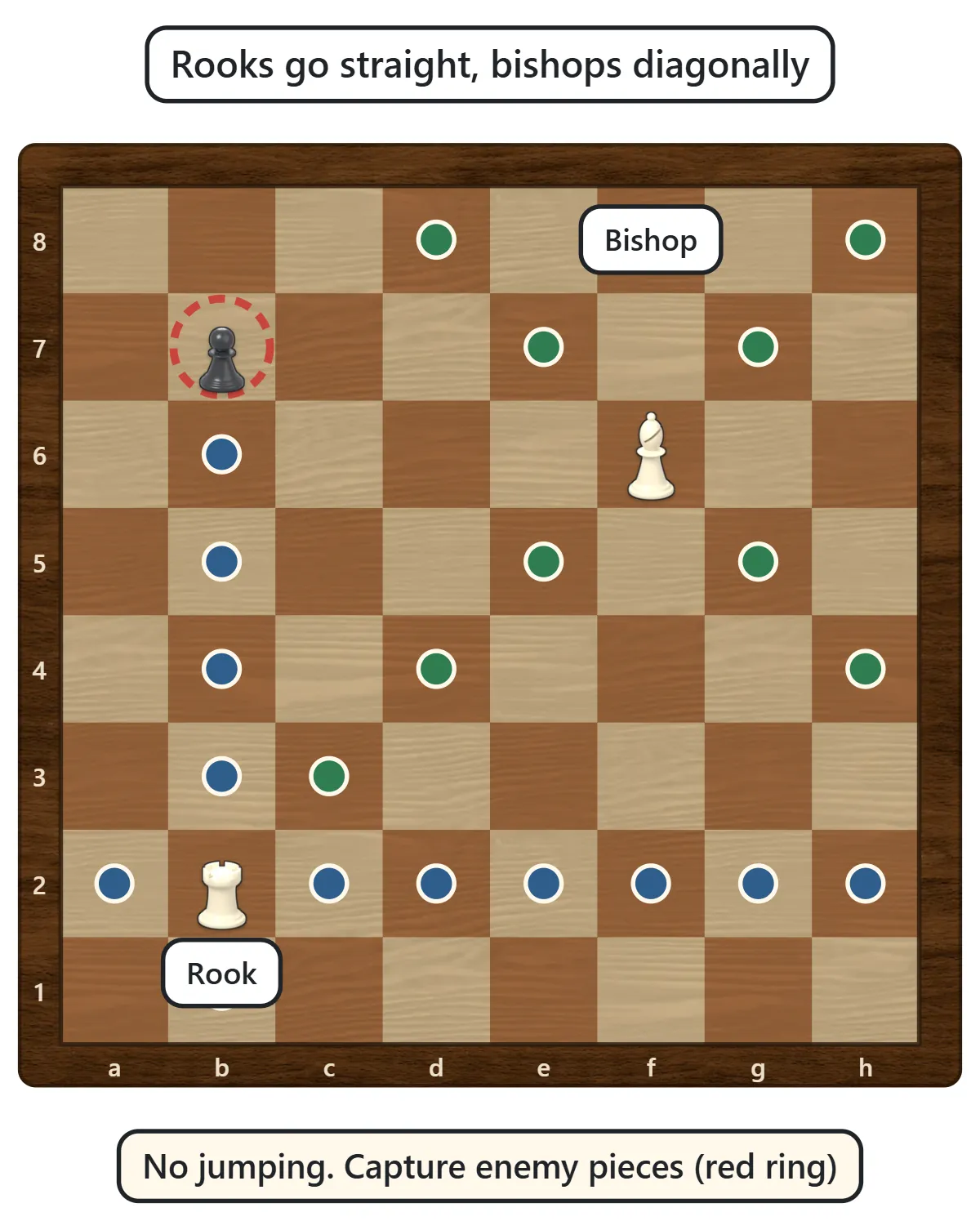
The rook moves any number of squares straight up, down, left or right. The bishop moves any number of squares diagonally, so it always stays on the same color. The queen combines the two: she can move any distance in a straight line or along a diagonal, which makes her the most powerful piece. None of these pieces can jump over another piece. If an opposing piece stands in the way, you can capture it by moving onto its square; you can never move onto a square occupied by one of your own pieces.
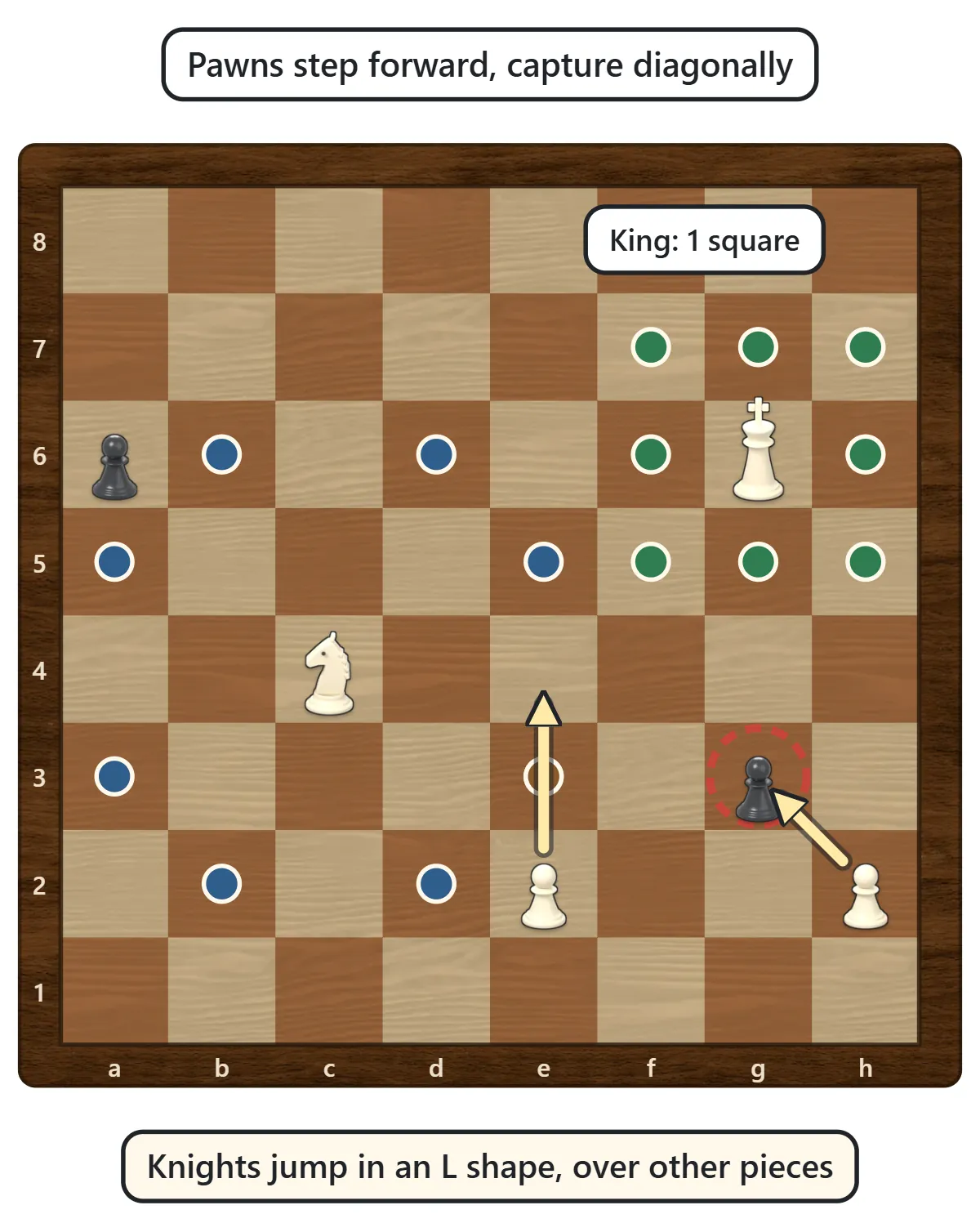
The knight moves in an L shape: two squares in one direction and then one square to the side. It is the only piece that can jump over other pieces. The king moves one square in any direction. The pawn is the odd one out: it moves straight forward one square, or two squares on its very first move if both squares are empty, but it captures one square diagonally forward. A pawn blocked by a piece directly in front of it cannot move, and pawns never move backward.
Check and checkmate
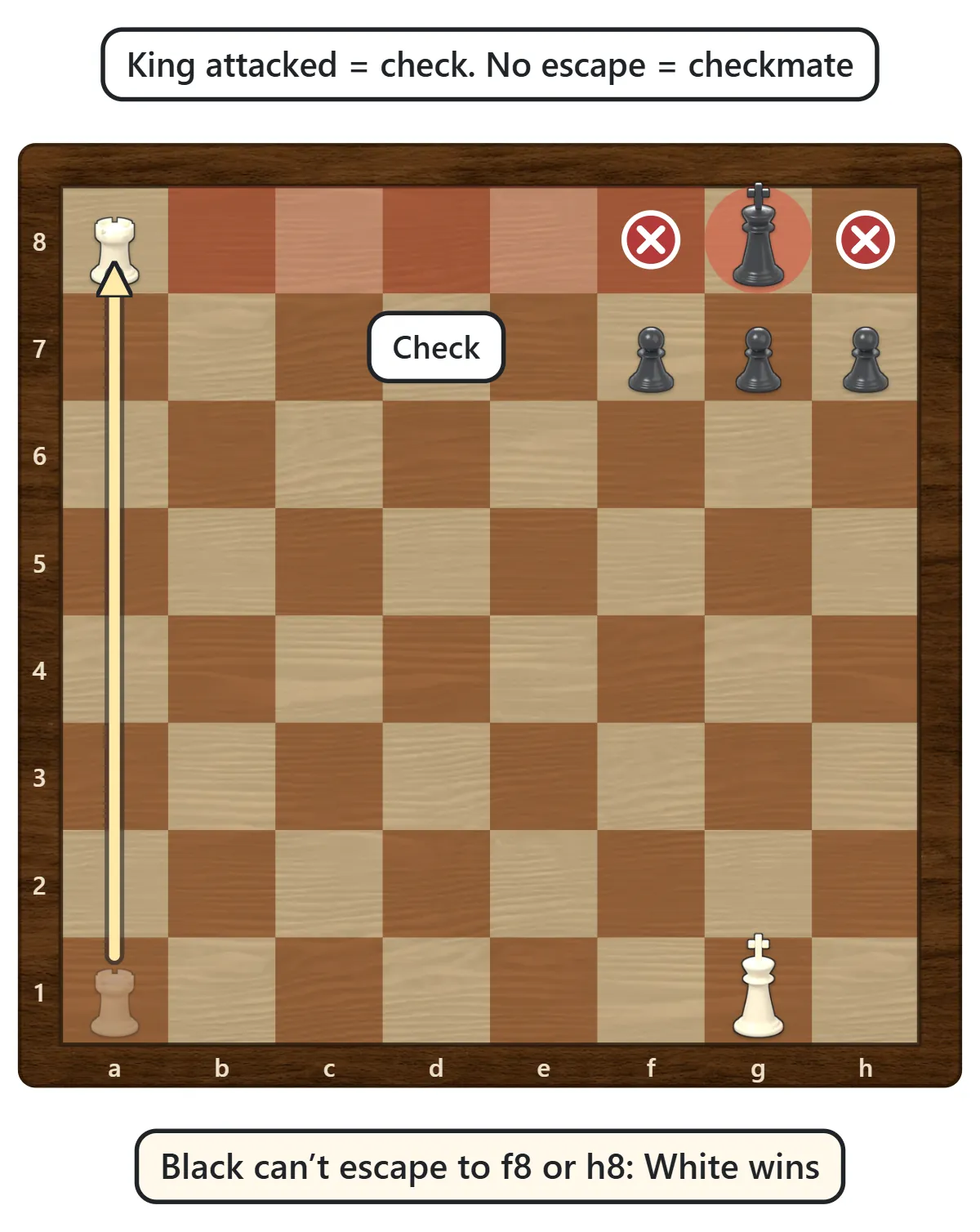
When a piece attacks the enemy king, the king is in check. A player in check must get out of it on the very next move, in one of three ways: move the king to a safe square, capture the attacking piece, or put a piece in between to block the attack. If none of these is possible, it is checkmate and the game is over. The king is never actually captured.
You are also never allowed to make a move that puts or leaves your own king in check. That means you cannot move your king next to the enemy king or onto an attacked square, and a piece that is shielding your king from an attack (a pinned piece) cannot step out of the way. In this game, if you click a piece that cannot move for this reason, a message tells you why.
Special moves: castling, en passant and promotion
Castling
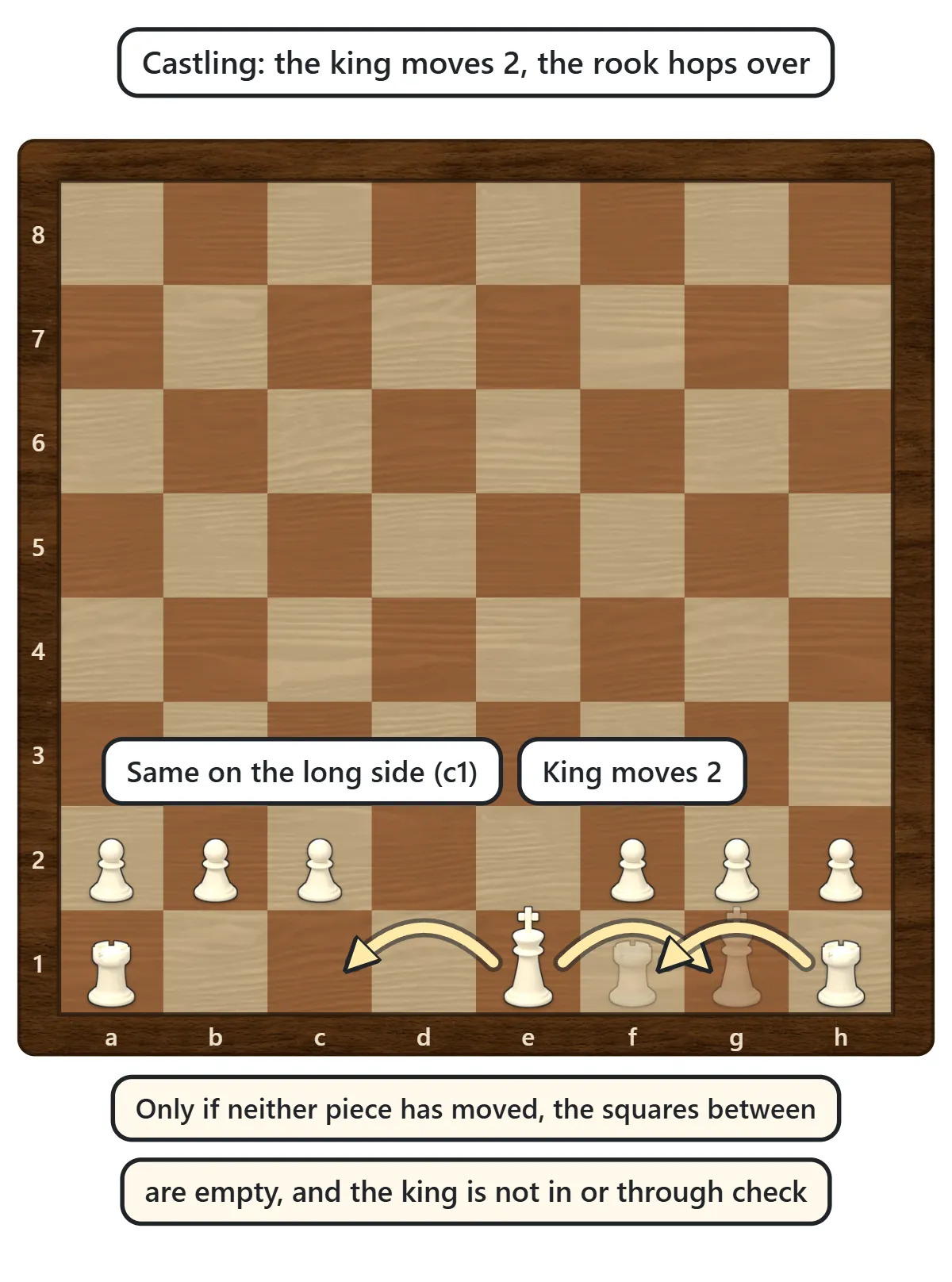
Castling is the only move in which two pieces move at once. The king moves two squares toward one of its rooks, and that rook jumps over the king to the square right next to it. Castling on the king’s side is called kingside or short castling; on the queen’s side it is queenside or long castling. You may castle only if all of these are true: neither the king nor that rook has moved yet in the game; the squares between them are empty; your king is not in check right now; and the king does not pass through or land on a square attacked by the opponent. It is fine if only the rook passes an attacked square (b1 when castling queenside).
En passant
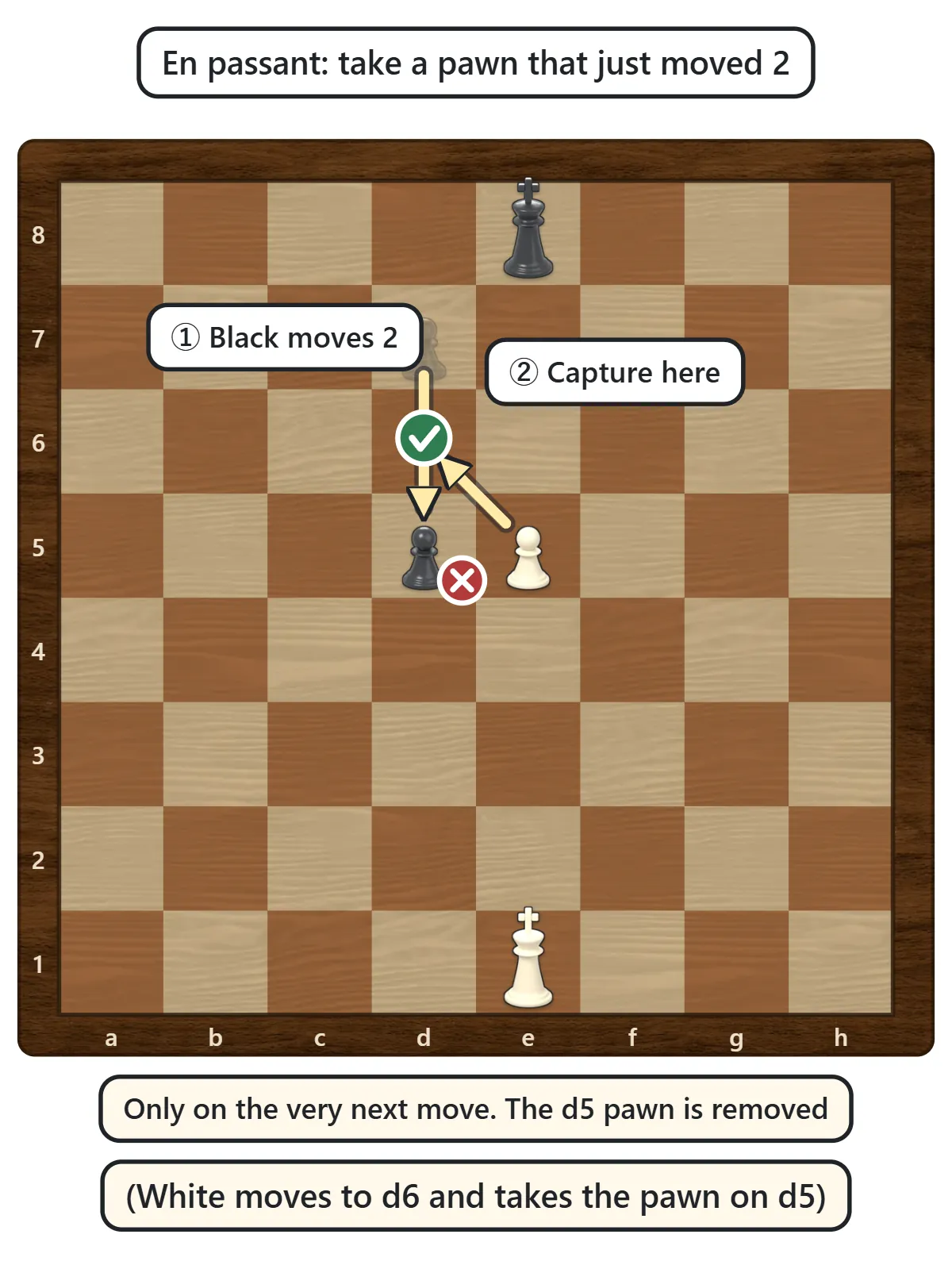
En passant (French for “in passing”) is a special pawn capture. If an enemy pawn moves two squares forward from its starting square and lands right beside your pawn, your pawn may capture it as if it had moved only one square: you move diagonally onto the square it passed over, and the enemy pawn is removed. You can do this only on the very next move; if you play something else, the chance is gone.
Pawn promotion
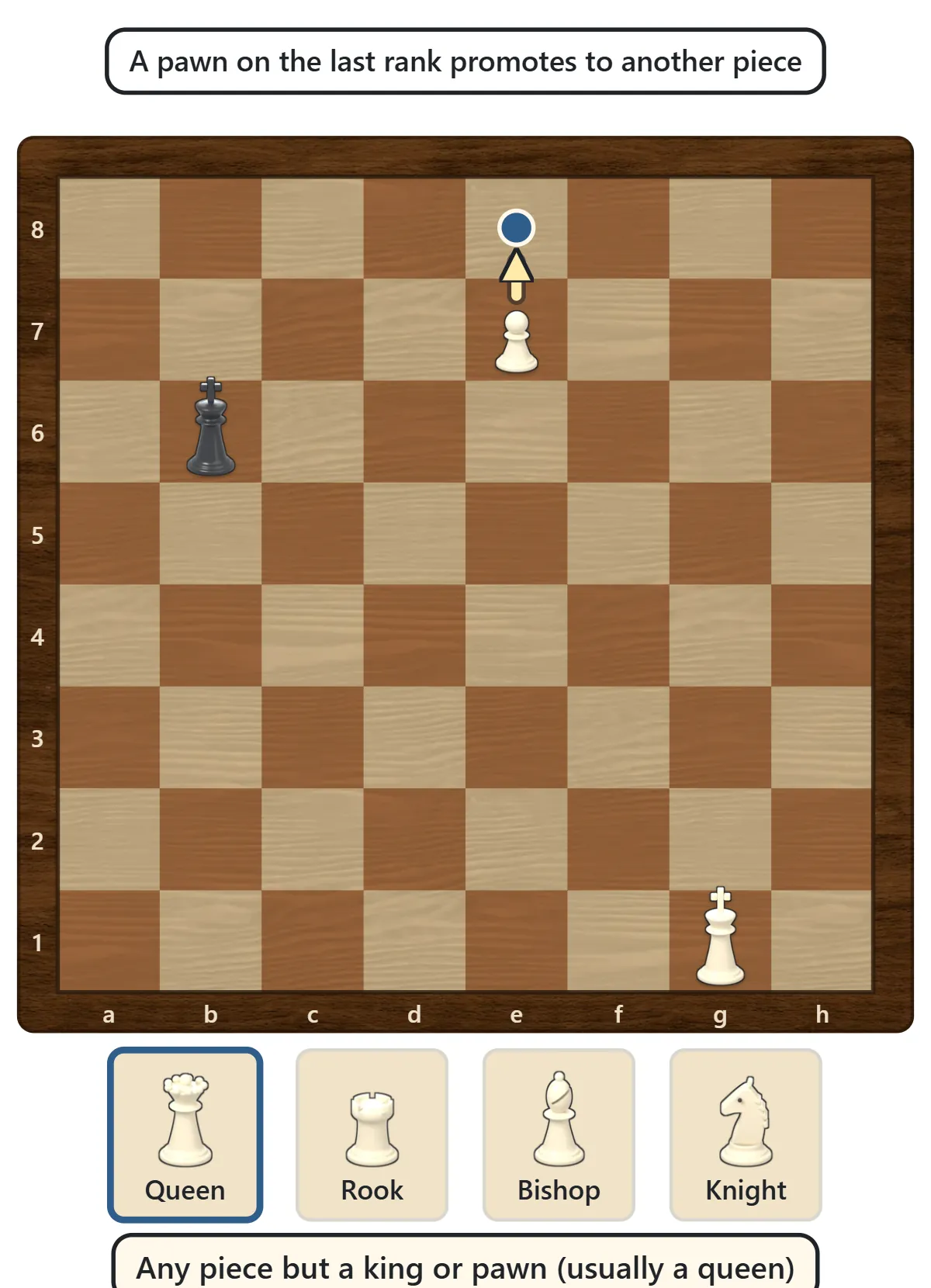
When a pawn reaches the far end of the board, it must immediately be exchanged for a queen, rook, bishop or knight of the same color. You can choose any of them, even if you still have that piece, so it is possible to have two or more queens. Almost everyone chooses a queen, but promoting to a knight is sometimes stronger when it gives an immediate check. In this game a small window pops up so that you can pick the piece.
How a chess game can end in a draw

If it is your turn, you are not in check, and you have no legal move at all, the game is a stalemate and ends in a draw. This catches many beginners: you can be far ahead and still only draw if you take away every square from the enemy king without giving check. This game also declares a draw in these cases:
| Draw | What it means |
|---|---|
| Stalemate | The player to move has no legal move and is not in check |
| Not enough material | Neither side can possibly checkmate, for example king against king, or king and one bishop or knight against a king |
| Threefold repetition | The same position, with the same player to move and the same castling and en passant rights, occurs for the third time (not necessarily in a row) |
| 50-move rule | 50 moves by each player without any pawn move or capture |
In official tournaments, a player has to claim a draw by repetition or by the 50-move rule. Here the game ends in a draw automatically as soon as it happens.
Chess piece values
To decide whether a trade is good, players give each piece a rough point value. The name tags above the board show the pieces you have captured and your lead in points (such as +3).
| Piece | Moves | Value |
|---|---|---|
| Pawn | Forward 1 (2 at first); captures diagonally | 1 |
| Knight | L-shape; can jump | 3 |
| Bishop | Diagonally, any distance | 3 |
| Rook | Straight, any distance | 5 |
| Queen | Straight or diagonal, any distance | 9 |
| King | 1 square; must never be captured | – |
Chess strategy for beginners
1. Before every move, ask “can it be taken?”
At the beginning, most games are lost by simply leaving pieces where they can be captured for free. Before you move, check whether any enemy piece can reach the destination square. With “Mark my pieces that are under attack” turned on, your pieces that can be captured get a red dashed ring.
2. Control the center
Pieces in the middle of the board (d4, e4, d5, e5) reach more squares and are more useful. A classic way to start is to move a pawn to e4 or d4 to claim space in the center.
3. Develop your knights and bishops early
Rather than moving the same piece again and again, bring a new piece into play with each move in the opening. Getting the knights and bishops out also clears the way for castling. Bringing the queen out too early usually lets your opponent chase her around and gain time.
4. Castle to keep your king safe
A king left in the center is easy to attack along open lines. Castle early to tuck it into a corner, and avoid moving the pawns in front of it without a good reason.
5. When you capture, check the recapture
Taking a defended piece with a more valuable one loses material: grabbing a pawn with your queen is a disaster if the queen is then taken. Before you capture, look at what can capture back.
6. When you are ahead, push the king to the edge
With extra pieces, drive the enemy king toward the edge of the board and bring your own king closer to help. Be careful not to take away all its squares without giving check, or you will stalemate. Always leave it one square until you can deliver mate.
Chess FAQ
Who moves first in chess?
White always moves first. Here you can choose White (first), Black (second) or Random under “Your pieces”. If you choose Black, the board is turned so that your black pieces are at the bottom.
Why can’t I castle?
One of these is the reason: the king or that rook has already moved, there is a piece between them, you are in check, or the king would pass through or land on an attacked square. When castling is possible, a dot appears two squares to the side of the king after you select it.
What happens if I ignore a check?
You can’t. A move that leaves your king in check, or puts it in check, is illegal. This game simply doesn’t allow such moves, and tells you why when you pick a piece that cannot help.
Which CPU level should I choose?
If you are just starting, choose Easy. It often leaves pieces where you can take them and misses checkmate threats. Once you are comfortable, try Normal: it usually takes free pieces and rescues attacked ones, but still slips up now and then. Hard looks several moves ahead and punishes loose pieces quickly. Even so it occasionally overlooks something, so if you watch the threat markers and never give away pieces for free, you can beat it.
Can I undo a move or get a hint?
Yes. With Undo on, the Undo button takes back your move (together with the CPU’s reply). The Hint button shows a well-considered move with a blue arrow. The number of hints and undos you used is shown at the end of the game.
Can two people play, and can I see the moves?
Choose “A friend” to take turns on one screen, with White at the bottom. Turn on “Show the move list” to see every move written in algebraic notation, such as e4 or Nf3: K is the king, Q the queen, R a rook, B a bishop, N a knight, and pawn moves have no letter. An x means a capture, + means check, # means checkmate, and O-O is castling. If you close the page mid-game, press Continue later in the same browser to pick up where you left off.
History of chess
Chess is usually traced back to chaturanga, a game played in India around the sixth century. It traveled through Persia and the Arab world to Europe, and around the fifteenth century the queen and bishop gained their long-range moves, giving the game its modern form. Japanese shogi and Chinese xiangqi are relatives descended from the same ancestor. Today the international chess federation, FIDE, maintains one set of rules used all over the world, and chess is played by millions of people online every day.