 Yorimichi Games
How to play checkers
Checkers is a two-player board game played with flat, round pieces on the dark squares of a checkered board. Pieces move diagonally, and you capture an opposing piece by jumping over it. You win when you have captured all of your opponent’s pieces, or when your opponent cannot make a move on their turn. In Britain and much of the world the game is called draughts; the version described here is the one played in the United States and the United Kingdom, often called American checkers or English draughts.
The rules fit on one page, which is why checkers is often the first strategy game people learn. But there is real depth: one careless move can let your opponent jump two or three pieces in a row. The sections below explain the rules step by step with pictures, then give practical tips for beginners.
The checkers board and setup
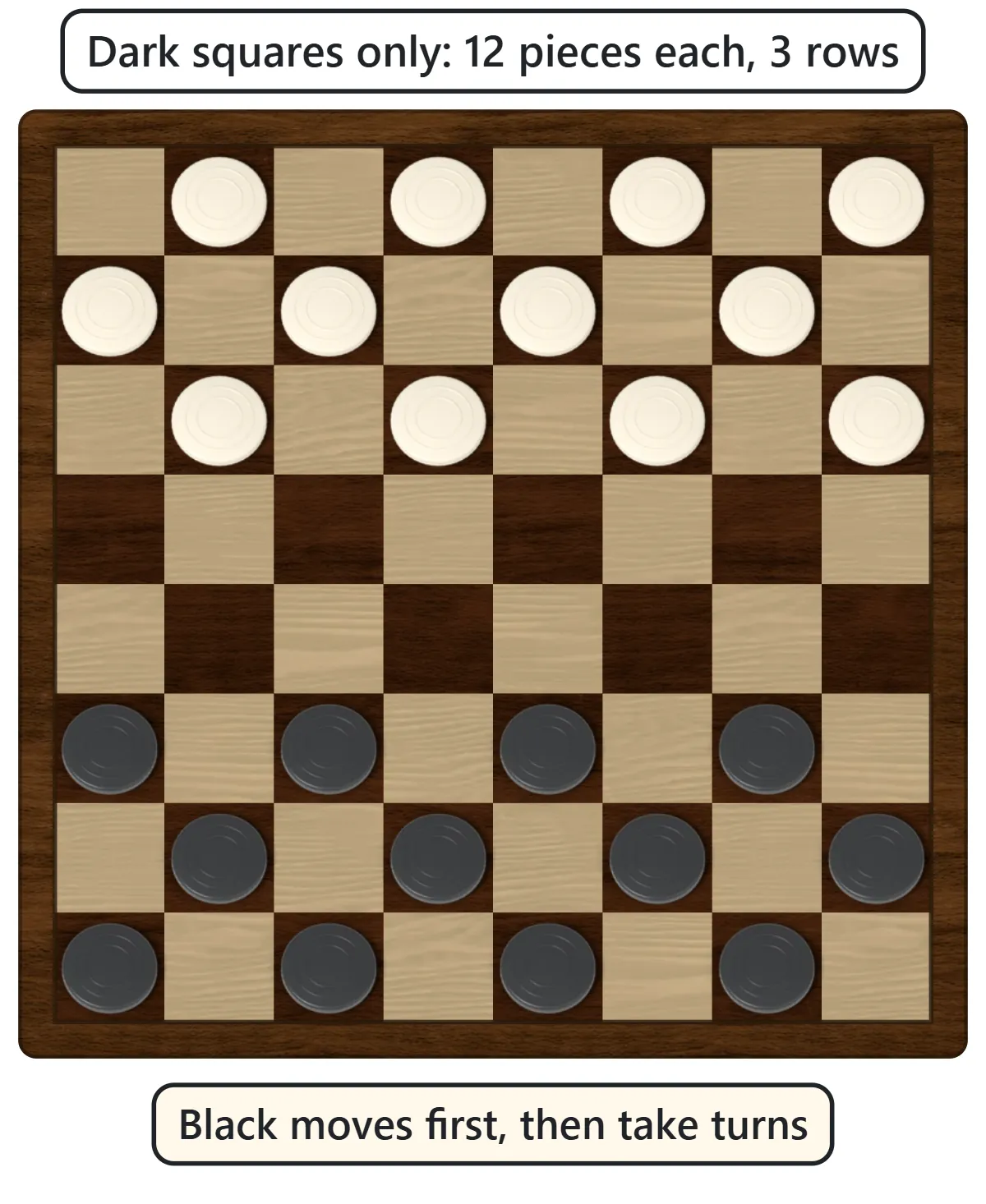
The board has 8 rows and 8 columns of alternating light and dark squares. Only the 32 dark squares are used, so every piece always stays on a dark square. Place the board so that each player has a dark square in the bottom-left corner.
Each player has 12 pieces. Put them on the dark squares of the three rows closest to you, leaving the two middle rows empty. Sets in the US are often red and black, while this game uses black and white pieces. Either way, the player with the darker pieces moves first, and then the players take turns, one move each. In this game you can choose to move first or second, and the board is turned so that your pieces are always at the bottom of the screen.
How checkers pieces move
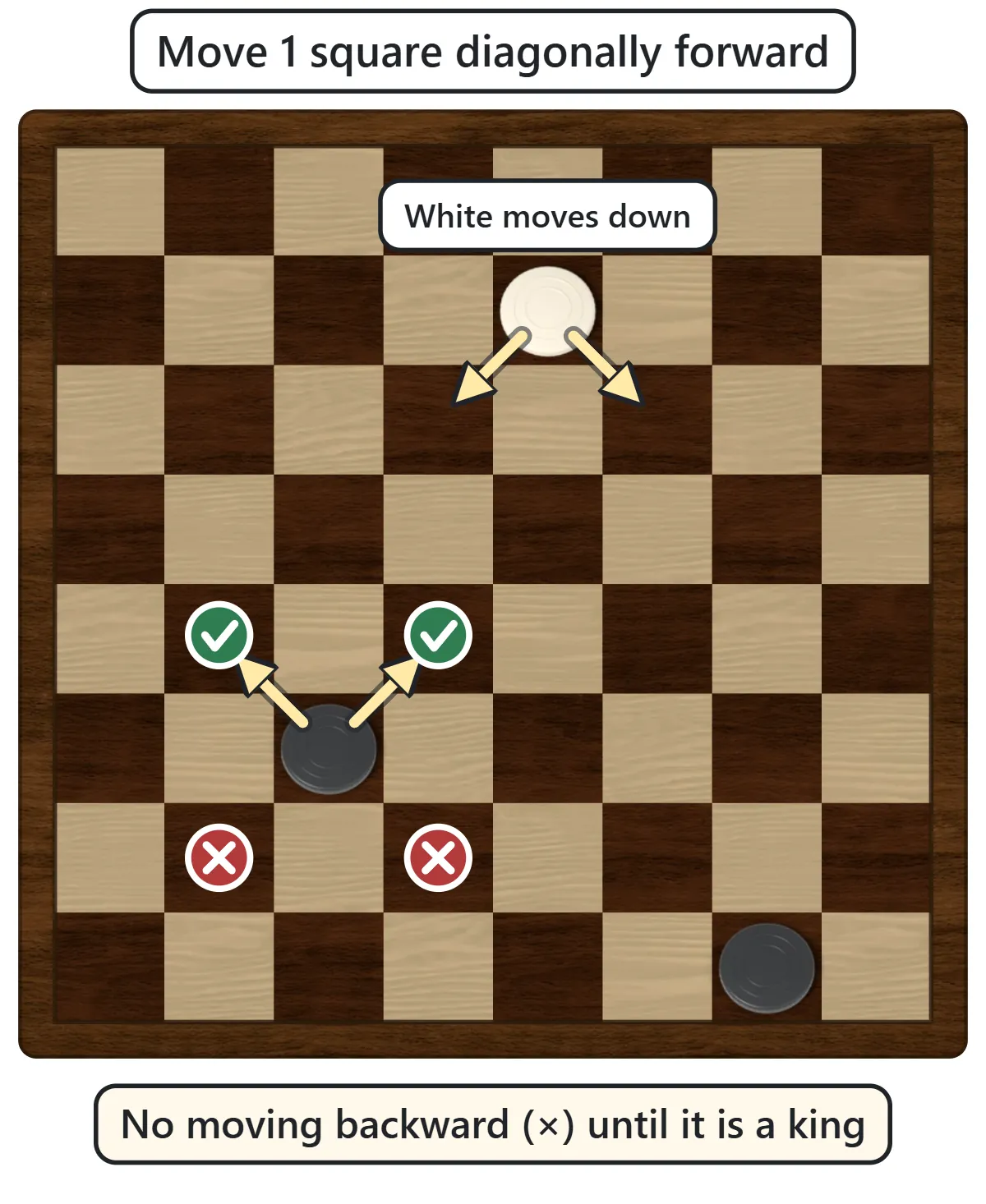
On your turn, pick one of your pieces and move it one square diagonally forward to an empty dark square. Pieces never move straight ahead or sideways, and an ordinary piece (called a man) can never move backward. If the square in front is already occupied, you cannot move that way. There is no passing: if you have a legal move, you must make one.
Jumping: how to capture in checkers
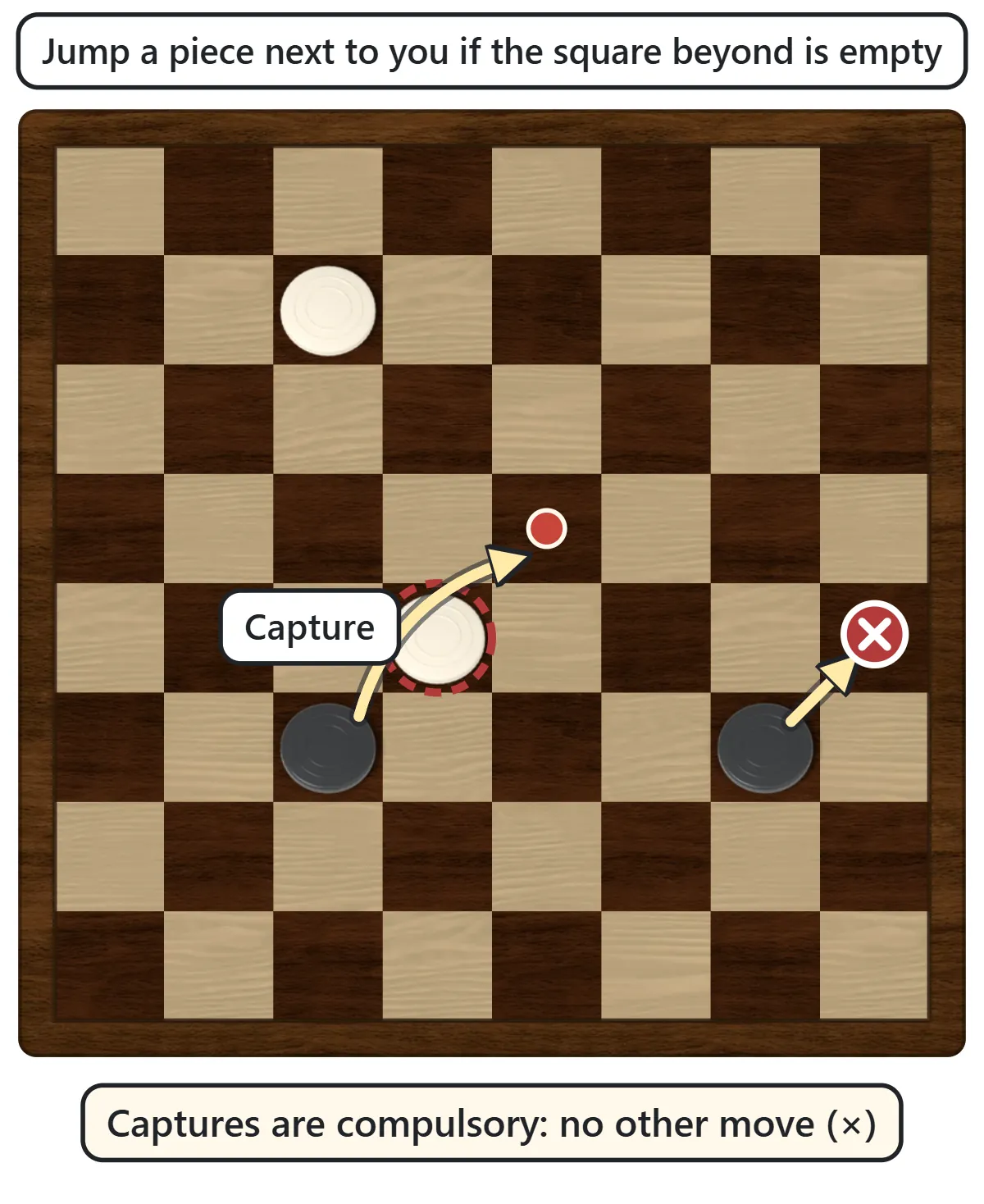
If an opposing piece is diagonally next to one of yours and the square right behind it is empty, you can jump over it and land on that empty square. The piece you jumped is captured and removed from the board. You cannot jump two pieces standing in a row, and you cannot jump if the landing square is off the board or occupied. You can never jump your own pieces.
In standard checkers, jumping is mandatory. If you can capture, you must, even when the capture is bad for you. If more than one capture is possible, you may choose which one to make; you do not have to pick the one that takes the most pieces. This rule is what makes checkers tactical: a strong player will often offer a piece on purpose, knowing that you are forced to take it and that they can then jump two of yours in return. In this game, pieces you are forced to capture get a red dashed ring, and only the pieces that can jump are selectable.
Multiple jumps
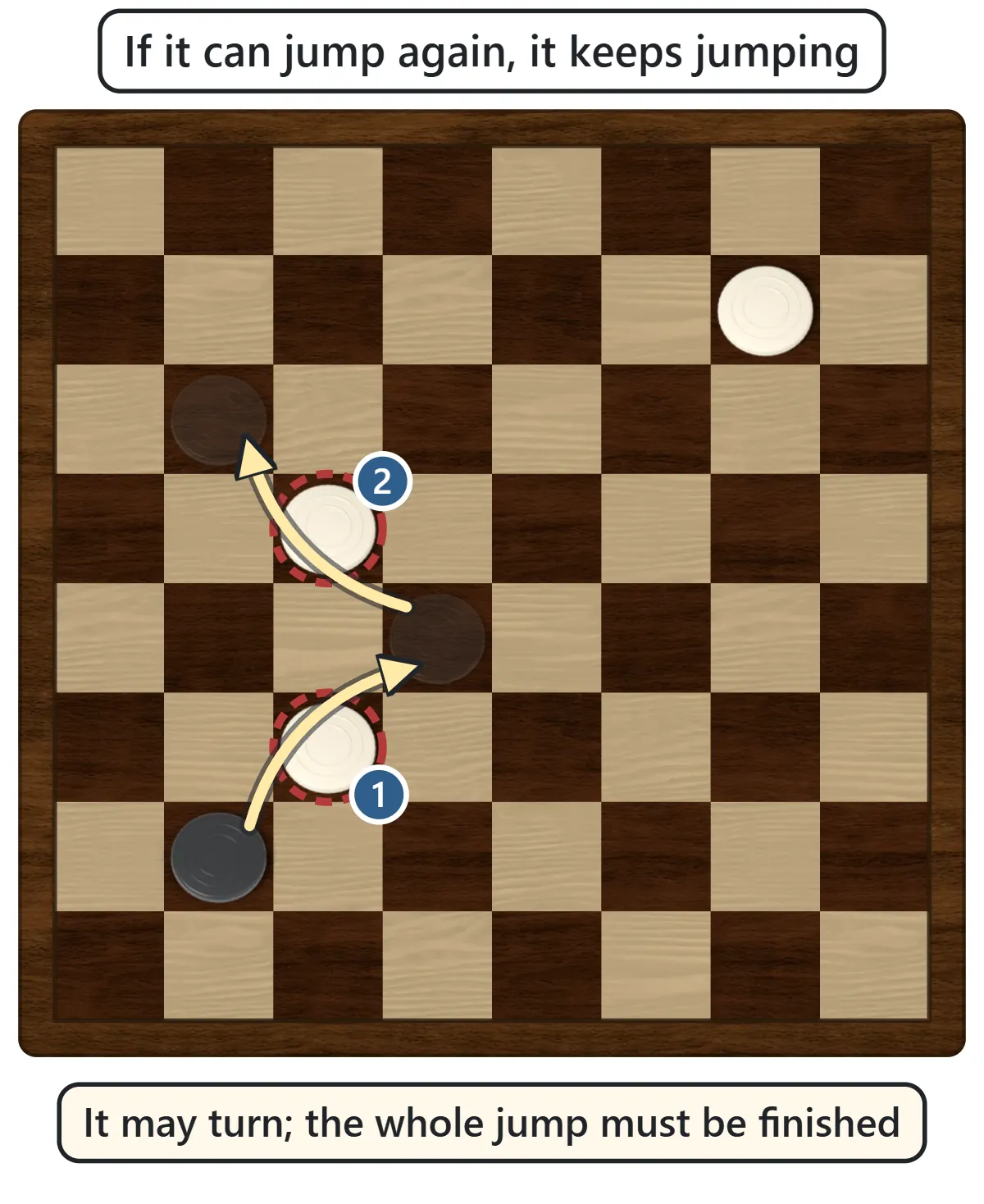
After a jump, if the same piece can jump another opposing piece from its new square, it must continue jumping in the same turn. It may change direction between jumps (a zigzag is fine). Once a multiple jump has started, it has to be completed; you cannot stop halfway. The captured pieces are removed after the whole jump is finished. In this game the piece moves one hop at a time and the jumped pieces fade until the move ends. When the jump could go two ways, you choose the next landing square yourself; when there is only one way, the piece continues automatically.
Kinging: what happens on the last row
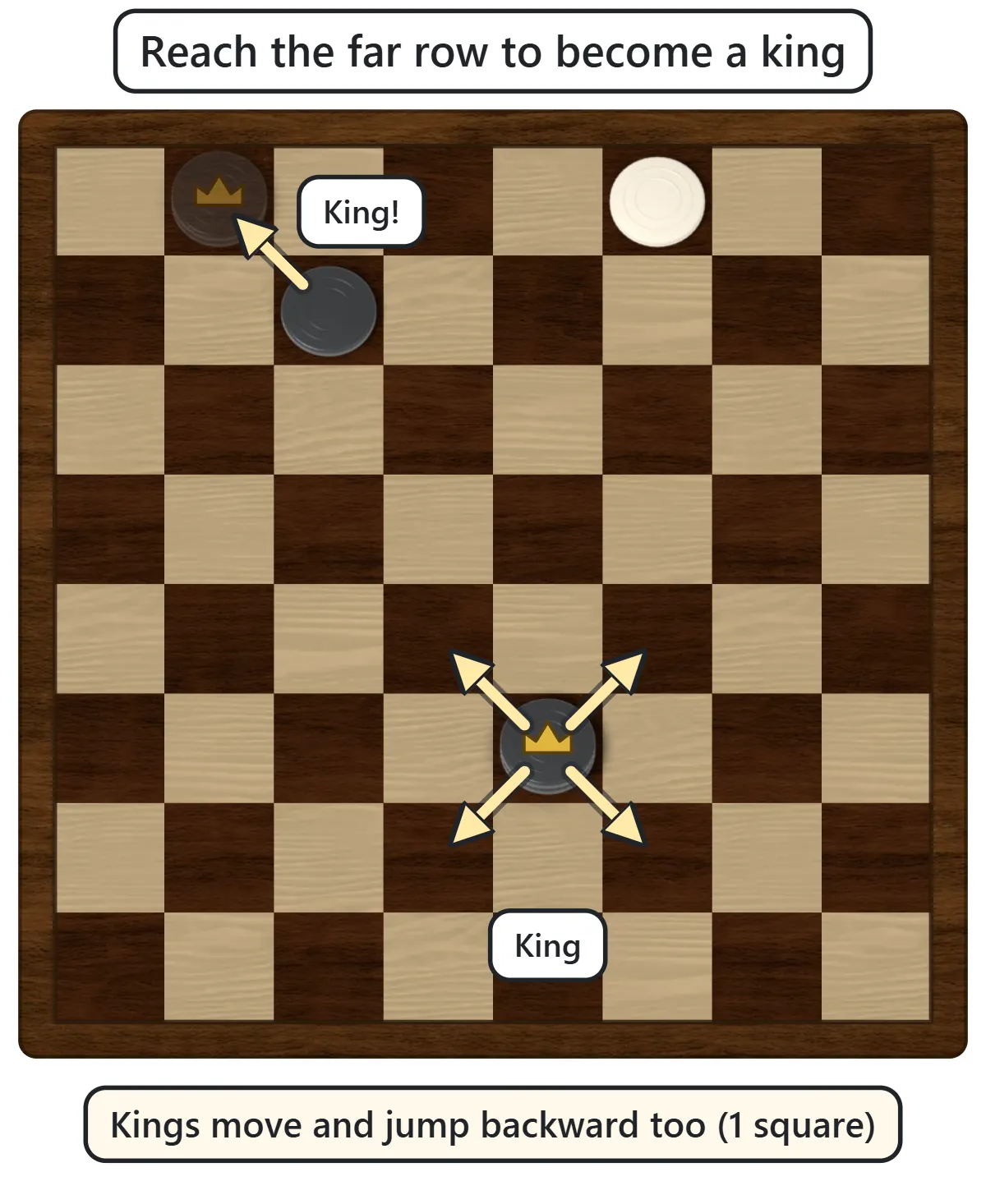
When one of your pieces reaches the row farthest from you (the king row), it is crowned and becomes a king. On a real board, a captured piece is stacked on top to mark it; here the piece becomes a double stack with a crown. A king can move and jump backward as well as forward, one square at a time along any diagonal, which makes it far more powerful than an ordinary piece.
If a piece reaches the king row by jumping, the move ends there, even if the new king could jump again. It can use its new powers from the next turn.
How to win, and when it is a draw
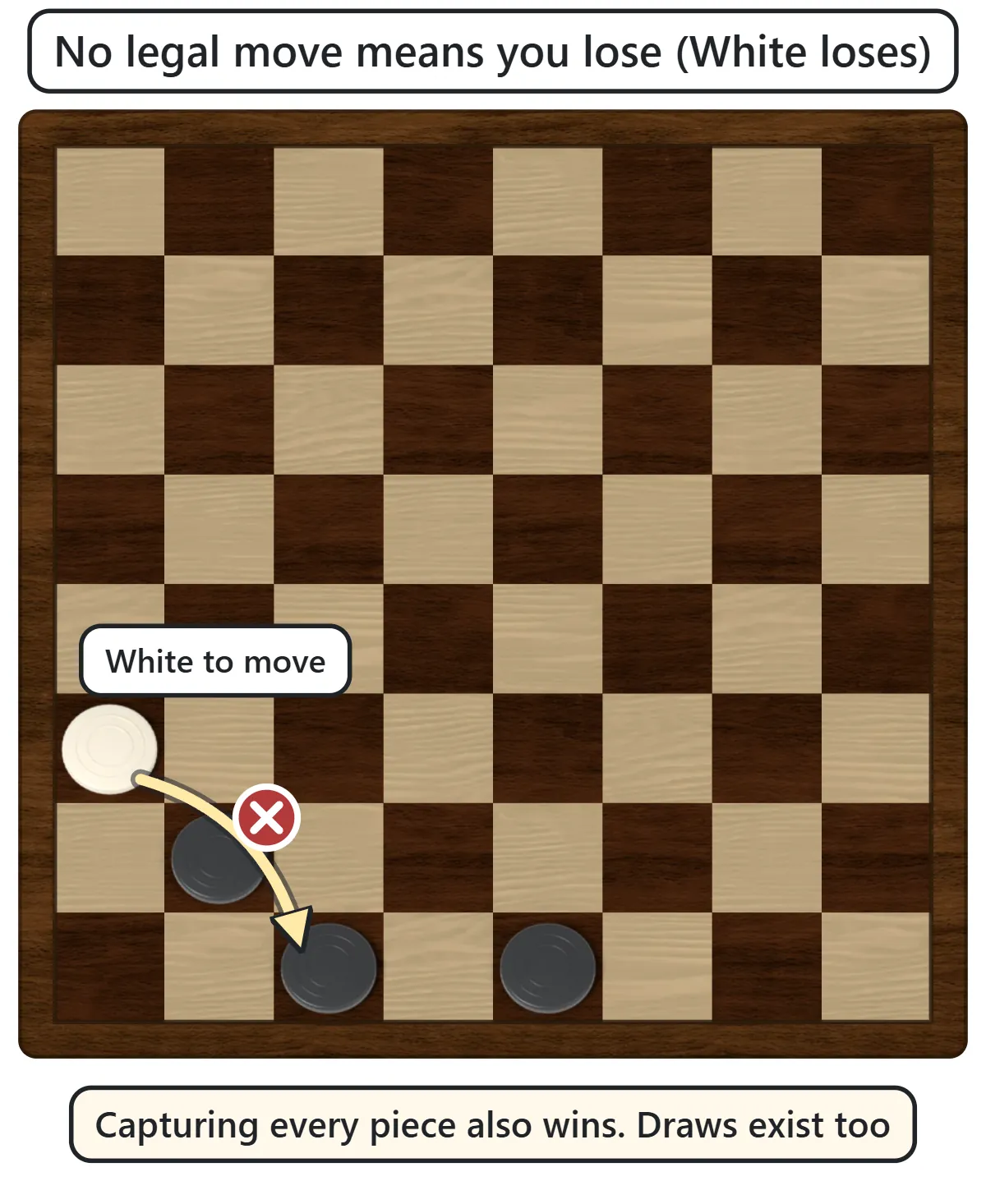
You win by capturing all of your opponent’s pieces. You also win if your opponent still has pieces but none of them can move on their turn, because they are all blocked. If neither side can make progress, the game is a draw. This game declares a draw when:
- the same position (with the same player to move) occurs for the third time;
- under the standard rules, 40 moves each go by without a capture and without an ordinary piece moving forward;
- under the international rules, 25 moves each are played with only kings moving and no captures, or a short endgame limit runs out (16 or 5 moves each when one side has a single king left).
Checkers rules variations
Checkers is played all over the world, and the rules vary a little from place to place. You can choose between three rule sets here. Standard (8×8) follows the official rules of American checkers and English draughts. No forced capture uses the same board and pieces but lets you decide whether to capture, a relaxed house rule many families grew up with (once you start a jump, you still finish it). International (10×10) is international draughts, the game played in the Netherlands, France, parts of Africa and at the world championship. With Custom you can mix the rules one by one.
| Rule | Standard | International |
|---|---|---|
| Board and pieces | 8×8, 12 each | 10×10, 20 each |
| First move | Black (dark) | White (light) |
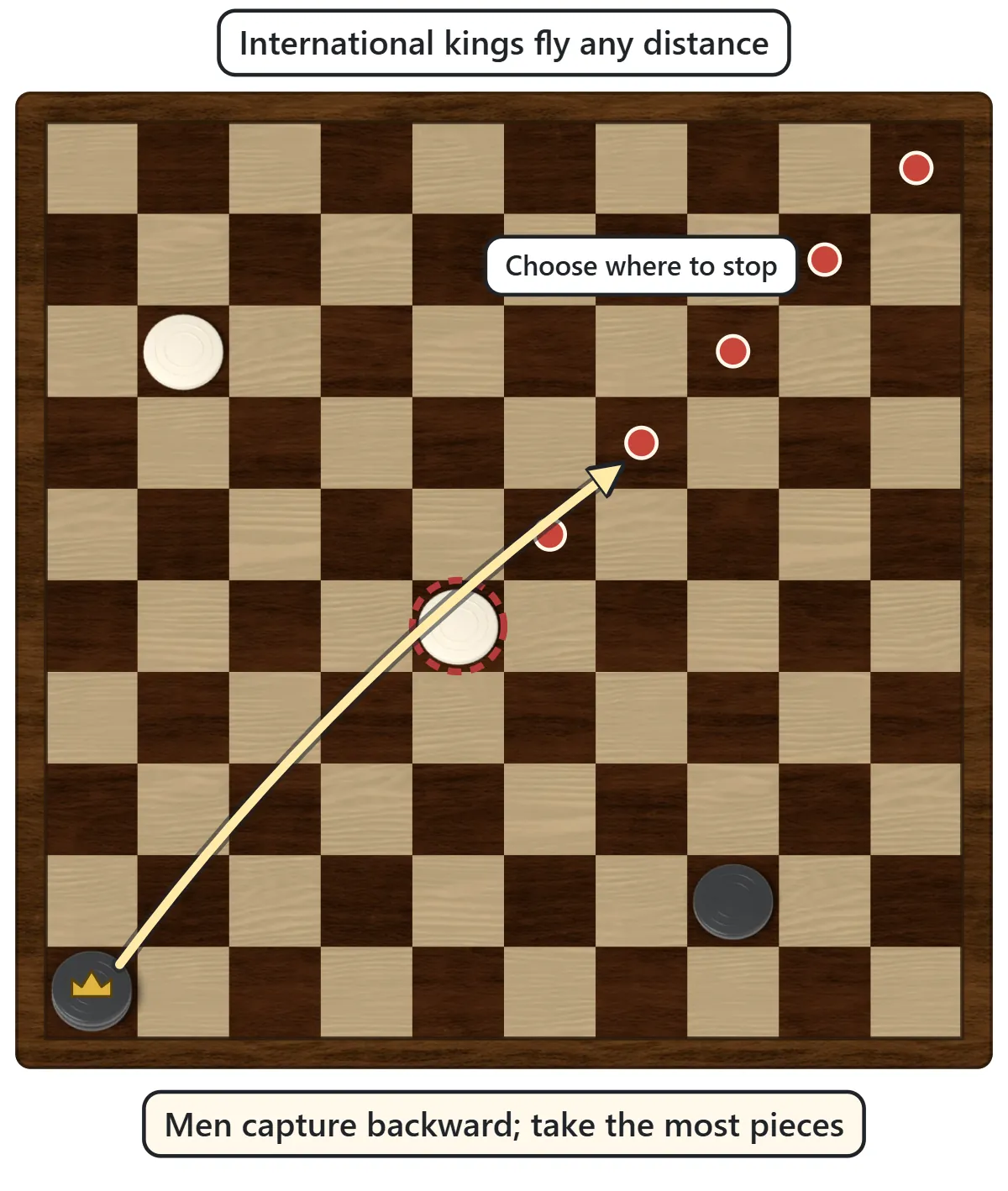
| Captures | Compulsory; any capture | Compulsory; the most pieces |
| Men capture | Forward only | Forward and backward |
| Kings | One square | Any distance |
| Reaching the far row mid-jump | Stop and become a king | Keep jumping if possible (no king) |
In international draughts, jumped pieces stay on the board until the move is over, so the same piece cannot be jumped twice and those pieces can block the rest of the jump. When counting “the most pieces”, a king and a man count the same.
Checkers strategy: tips for beginners
1. Check every move for a free jump
Because captures are forced, any piece you put next to an opposing piece with an empty square behind it will be taken. Before you move, ask two questions: “Does this move let my opponent jump?” and “If they do, can I jump back more?” Giving one piece to win two is a great trade; giving one for nothing is the most common beginner mistake.
2. Move your pieces in groups
A lone piece is easy to pick off. A piece with a friend right behind it cannot be jumped from the front, because the landing square is blocked. Advance in a compact group, keeping pieces backed up, rather than sending single pieces ahead.
3. Keep your back row as long as you can
Pieces on your back row stop your opponent from getting kings. If you move them all early, their pieces can walk in and be crowned. Many strong players keep two back-row pieces at home well into the middle of the game.
4. Control the center
A piece in the middle of the board can go either way and supports its neighbors. A piece on the edge has only one direction to move and is easier to trap, though it cannot be jumped from the side.
5. Get the first king
A king can move backward, chase single pieces and escape from traps, so it is worth much more than an ordinary piece. Race to crown one before your opponent does, and if their piece is close to your back row, block the square in front of it.
6. When you are ahead, trade pieces
If you have more pieces, exchanging one for one makes your advantage bigger: 4 against 3 is much easier to win than 12 against 11. When you are behind, avoid trades and look for a position where your pieces cannot be forced out, which may save a draw.
Checkers FAQ
Do you have to jump in checkers?
Yes, under the official rules. If a capture is available you must take it, and you cannot make an ordinary move instead. If several captures are possible, you pick which one. If you prefer to decide for yourself, choose the “No forced capture” rules.
Can a regular piece move or jump backward?
Not in standard checkers. An ordinary piece moves and jumps only forward. Only a king can go backward. In international draughts, ordinary pieces may also capture backward, but they still move forward only.
Can a king keep jumping after it is crowned?
In standard checkers, no. If a piece reaches the king row during a jump, it is crowned and the turn ends; it jumps as a king from the next turn. In international draughts, a piece that can still jump as an ordinary piece carries on jumping instead, and is not crowned.
Who goes first in checkers?
The player with the darker pieces (black or red) moves first in American checkers and English draughts. In international draughts, White moves first.
Which CPU level should I choose?
If you are new to checkers, start with Easy. It often moves a piece where you can jump it and falls for simple two-for-one shots. Normal keeps its pieces together and guards its back row, but still overlooks things now and then. Hard reads several moves of captures ahead and trades down when it gets a lead, though it does slip occasionally. Watch out for forced jumps and try to get the first king, and you can beat it.
Can I undo a move or get a hint?
Yes. With Undo turned on, the Undo button takes back your last move (and the CPU’s reply). The Hint button shows, with a blue dashed line, the move the Hard CPU would play. The number of hints and undos you used is shown when the game ends.
Can two people play? Can I continue later?
Choose “A friend” as your opponent to take turns on one screen; the player who moves first sits at the bottom. If you close the page in the middle of a game, you can pick it up again with Continue in the same browser on the same device. Sound is off at first; press “Sound: off” to hear the moves and captures.
History of checkers
Games where pieces capture by jumping over each other have been played for a very long time in many parts of the world. The form played on a checkered board is thought to have spread in medieval Europe. Later, the 8×8 game developed in Britain and America, while the 10×10 game grew in the Netherlands and France, and today both have their own tournaments and world championships. Checkers is also famous in computer science: in 2007 researchers showed that the 8×8 game ends in a draw if both players always make the best move.