 Yorimichi Games

How to play Bozu Mekuri
Bozu Mekuri (“flipping monks”) is a Japanese card game played with the picture cards of the Hyakunin Isshu, the famous collection of one hundred classical poems by one hundred poets. Each of the hundred reading cards shows a portrait of its poet, and that is all the game cares about. You do not need to read the poems or know anything about Japanese literature: if you can tell a courtier from a monk and a lady of the court, you can play. That is exactly why Japanese families bring it out at New Year, when children join the adults around the karuta box.
On this page you play against one to four computer players. Every card you turn over is shown large in the middle of the table together with the poet’s name, the number of the poem and the card type, so you can enjoy the old artwork as you play.
Reading the table

1. Shuffle the cards into one deck
All one hundred picture cards are shuffled and stacked face down. This pile is the deck. The text-only grabbing cards used in competitive karuta are not needed. Everyone starts with no cards at all. The game draws lots to decide who goes first, and turns then pass around the table in order.
2. Learn the three kinds of cards
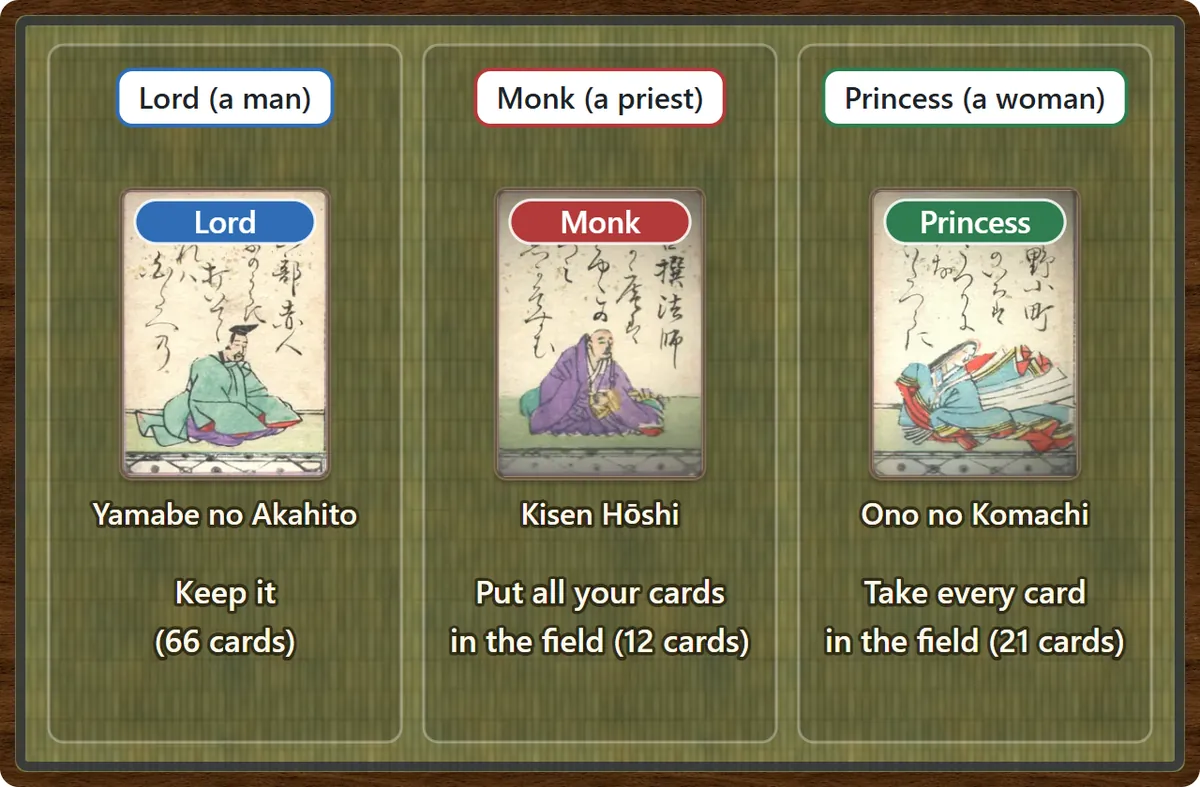
- Lord (tono): a male poet, usually a courtier in a tall black hat. Keep the card in front of you.
- Monk (bōzu): a Buddhist priest with a shaved head. These are the twelve poets whose names end in Hōshi or include a title such as Sōjō.
- Princess (hime): a woman of the court in layered robes with long flowing hair.
Some monks wear a hood, so you cannot always see the shaved head. That is why this game shows the card type under every card it turns over, and by default puts a small colored label on each card: blue for Lord, red for Monk and green for Princess. If you prefer the cards exactly as they were printed, switch the labels off in the settings.
3. Draw a monk and you lose everything
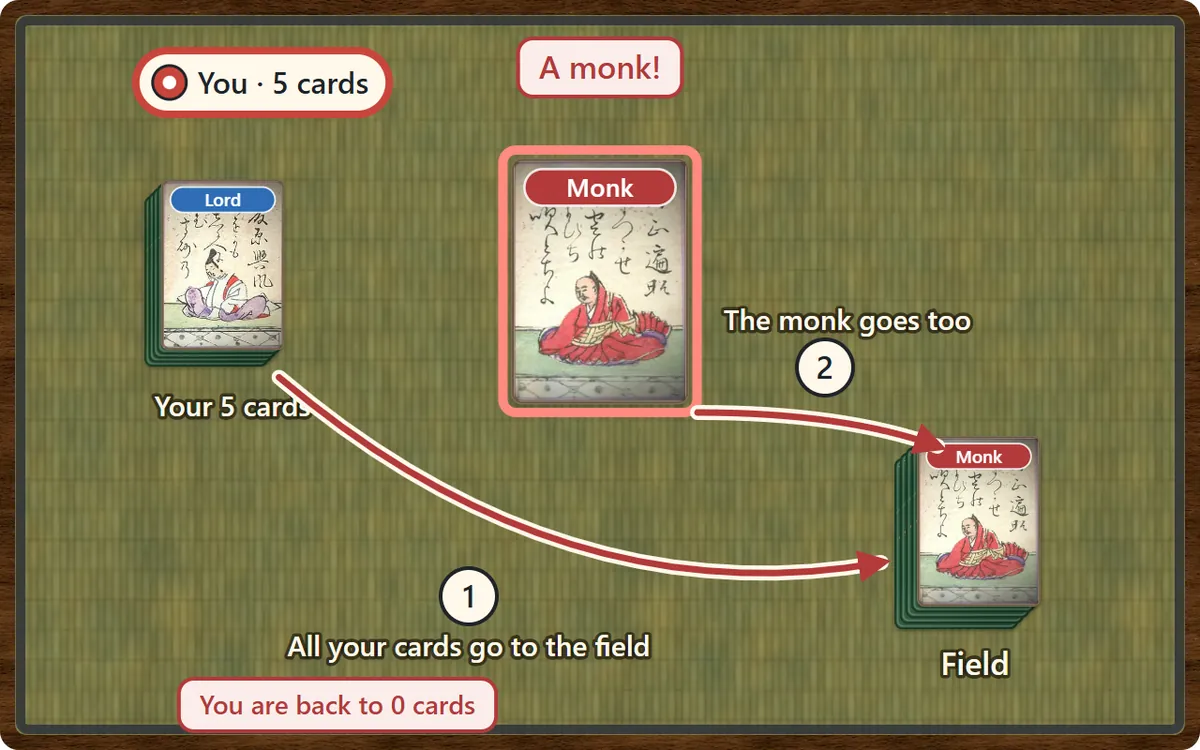
This is the heart of the game. If you turn over a monk on your turn, every card you have collected goes into the field next to the deck, and the monk goes with them. It does not matter whether you had three cards or forty; one monk sends you back to zero. The suspense of reaching for the deck with a big pile in front of you is what makes Bozu Mekuri so much fun.
4. Draw a princess and take the whole field
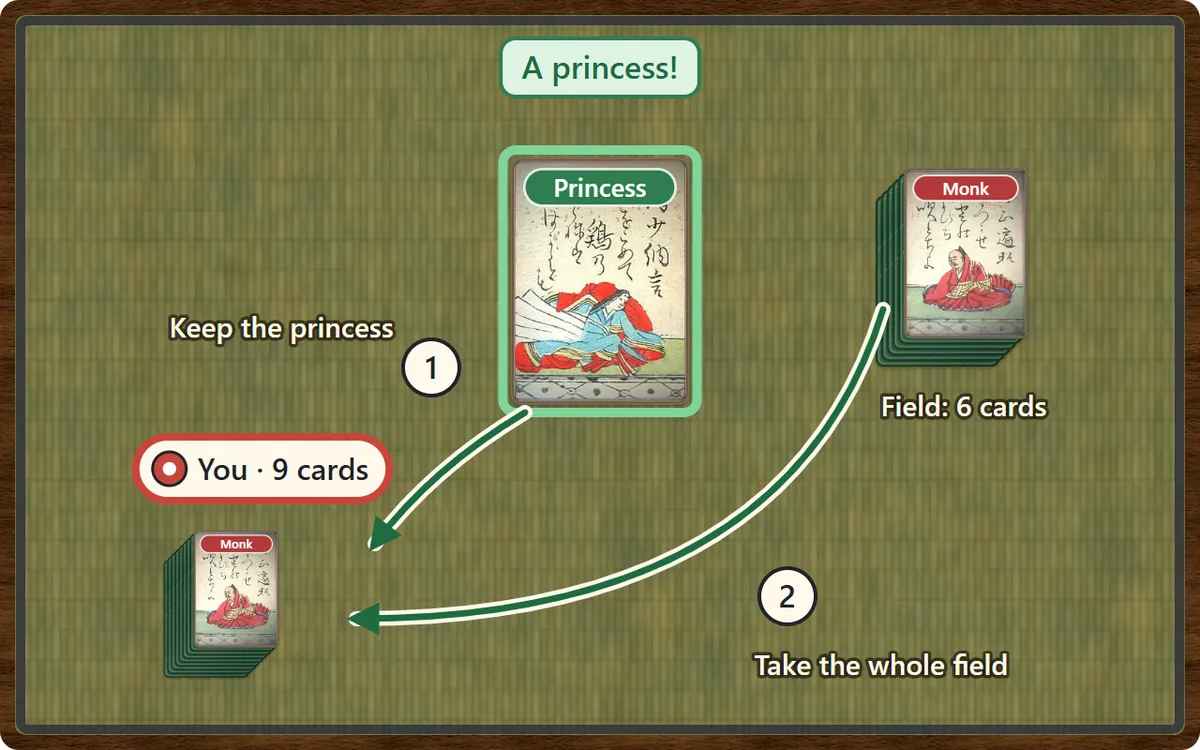
A princess goes in front of you, and you also take every card waiting in the field. After a few monks have appeared, the field can be huge, so a princess is the big comeback card of the game.
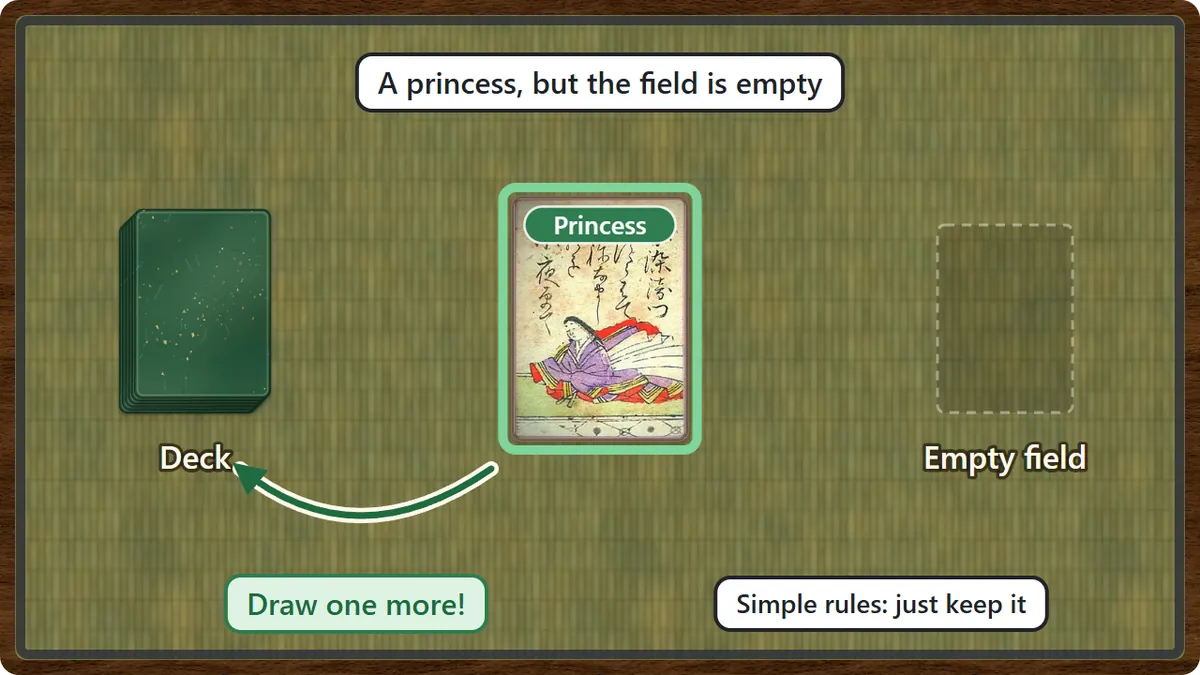
Under the Standard rules, a princess drawn when the field is empty lets you draw one more card. That extra draw might be a lord, but it might also be a monk, so it is a gamble of its own.
5. When the deck is empty, count your cards
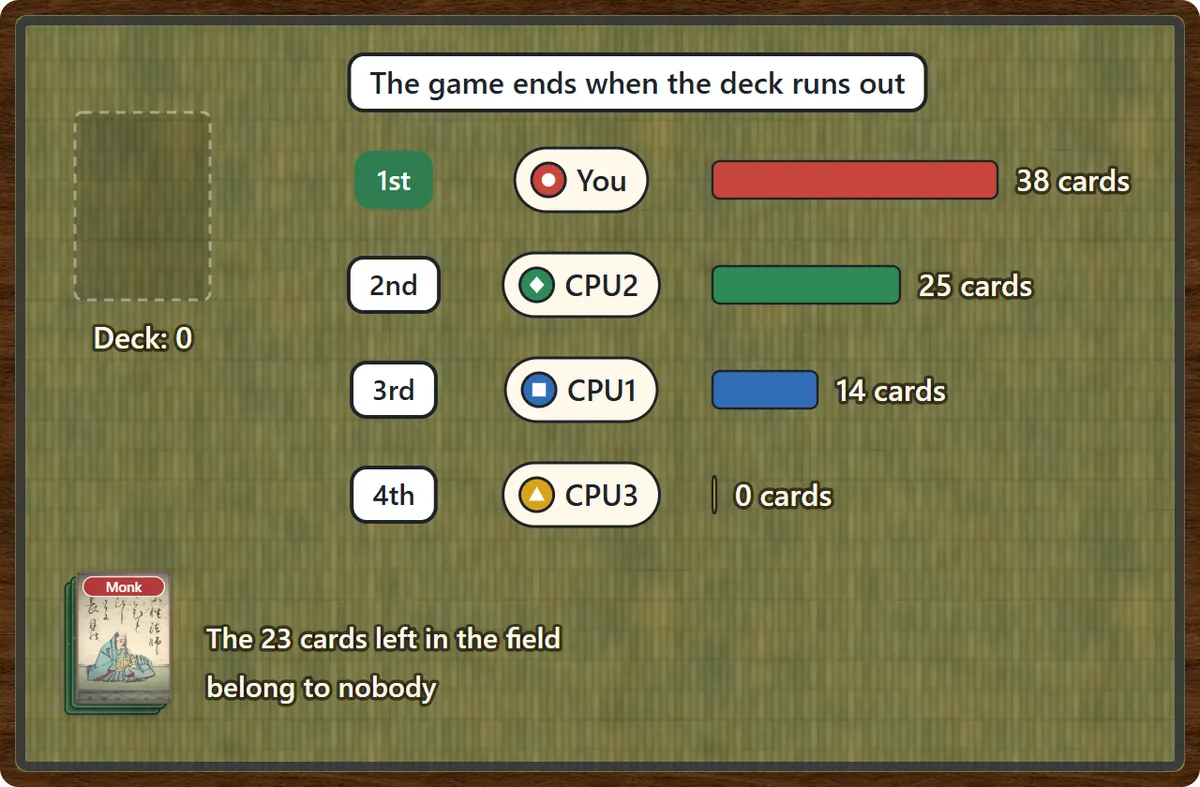
The game ends when the last card of the deck has been turned over. Everyone counts the cards in front of them, and the largest pile wins. Players with the same number share a place. Any cards still lying in the field at the end belong to nobody.
Bozu Mekuri rules and house rules
There is no official rulebook for Bozu Mekuri, and every family seems to play it a little differently. The two cards that cause the most debate are Semimaru and the “dais cards” that show emperors seated on a striped royal mat. You can pick one of three common rule sets here, or mix the options under Custom.
| Rules | Empty-field princess | Semimaru / dais cards |
|---|---|---|
| Standard | Draw one more | Monk / normal card |
| Simple | Just keep it | Monk / normal card |
| Lively | Draw one more | Everyone else’s cards to the field / draw one more |
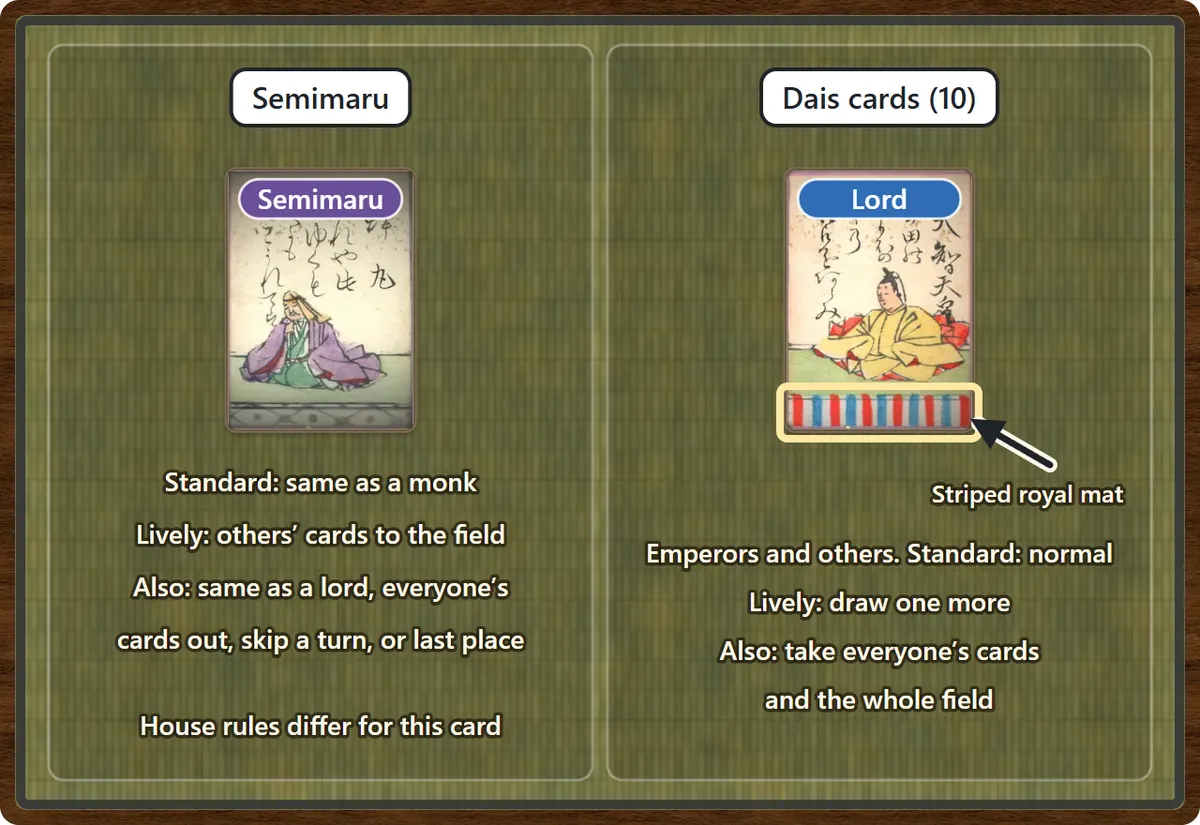
The Semimaru card
Poem number 10 belongs to Semimaru, a legendary blind musician famous for playing the biwa lute. Nobody is quite sure whether he was a monk, and card sets draw him in different ways, sometimes hooded and sometimes like a priest. So is he a monk or not? Families argue about it every year. Under Custom you can choose from six versions: same as a monk, same as a lord, everyone else’s cards to the field, everyone’s cards to the field, skip your next turn, or the player who draws him finishes last. The “everyone else” option is the wildest, because it can leave every other player with nothing in one stroke.
Dais cards (emperors and others)
Cards such as Emperor Tenji and Empress Jitō show the poet seated on a raised mat with a bright striped border, a seat reserved for the highest ranks. In the deck used here there are ten of them. Setting them to “draw one more” or to “take everyone’s cards and the field” makes every emperor an exciting draw. Which cards have the striped mat varies a little between karuta sets.
Bozu Mekuri tips
1. Keep count of the monks
There are twelve monks, or thirteen if Semimaru counts as one. If you track how many have already appeared, you know how many are still waiting in the deck. Late in the game, when most monks are gone, your pile is much safer.
2. A big field means a princess is coming
With 21 princesses in the deck, roughly one card in five is a princess. The more cards pile up in the field, the bigger the swing when someone finally draws one. There is no way to choose your card, but it makes every draw more exciting to watch.
3. Never give up
One card can take your pile to zero, and one card can add dozens. If the very last card is a monk, the player who draws it loses everything right at the end. No lead is safe until the deck is empty.
4. Try different numbers of players
With two players your turn comes round quickly and cards change hands constantly. With four or five players the field has time to grow between your turns, so princess jackpots are bigger.
5. Get to know the poets
Each card you draw shows the poet’s name and the number of the poem. After a few games you will start to recognise faces: Murasaki Shikibu is a princess, Saigyō Hōshi is a monk. It is a gentle way into the Hyakunin Isshu before trying the competitive game of karuta.
Bozu Mekuri FAQ
How many people can play?
Here you can play with one to four computer players, so two to five players in total. With a real card set, any number from two upwards works.
Does the monk card itself go to the field?
Yes. The player who draws a monk puts all the cards they hold into the field, and the monk goes on top. Even with no cards in hand, the monk still goes to the field.
Is Semimaru a monk?
It depends on who you ask. The Standard rules here treat him as a monk, and Custom lets you make him a lord or give him a special effect. It is a good idea to agree on this before you start.
What does the CPU level change?
In Bozu Mekuri everyone simply draws the top card of the deck, so there are no decisions for the computer to make. Easy is the friendlier opponent for beginners and young players. Normal draws from the shuffled deck exactly as real cards would fall.
Can my turn be played automatically?
Yes. Set “Your turn” to “Draw automatically” and the game plays through to the end without any presses. It starts on “Draw myself”, because flipping the card yourself is half the fun.
Can I play with a keyboard?
Yes. On your turn, press Enter or Space to draw a card from the deck.
Where does Bozu Mekuri come from?
Bozu Mekuri is said to have been invented as a way for small children who had not yet memorised the poems to join in with the Hyakunin Isshu cards. Nobody knows exactly who started it or when. It does not appear in books from the Edo period, so it is thought to have spread in the Meiji era, and a novel from that time describes grown women playing it under the name bōzu okoshi. The artwork on the cards in this game comes from a Hyakunin Isshu karuta set made in the Edo period, so you can also enjoy the look of old cards that are rarely seen today.