 Yorimichi Games
How to Play Block Puzzle
Block Puzzle is a calm, one-player grid game. You are dealt blocks made of little squares joined together, and your job is to fit them onto the board so that whole rows and columns fill up and disappear. Nothing falls from the top and there is no clock ticking down: you pick up a block, look for a good spot, and set it down whenever you are ready. The rules take about a minute to learn, but the game rewards planning, so a thoughtful player can keep a single game going for hundreds of moves.
1. Pick one of your three blocks and drop it on the board

Three blocks sit under the board. Choose any of them and drag it onto the grid with your finger or mouse; let go and it snaps into place. If you prefer, tap a block to select it and then tap the square where you want it. On phones and tablets the first tap only shows a faint preview of where the block will go, and a second tap on the same spot places it, which makes misplaced blocks much rarer on a small screen.
A block can’t overlap another block and can’t stick out past the edge of the board. You may place the three blocks in any order, and as soon as all three are on the board you are dealt a fresh set of three.
2. Fill a row or column to clear it
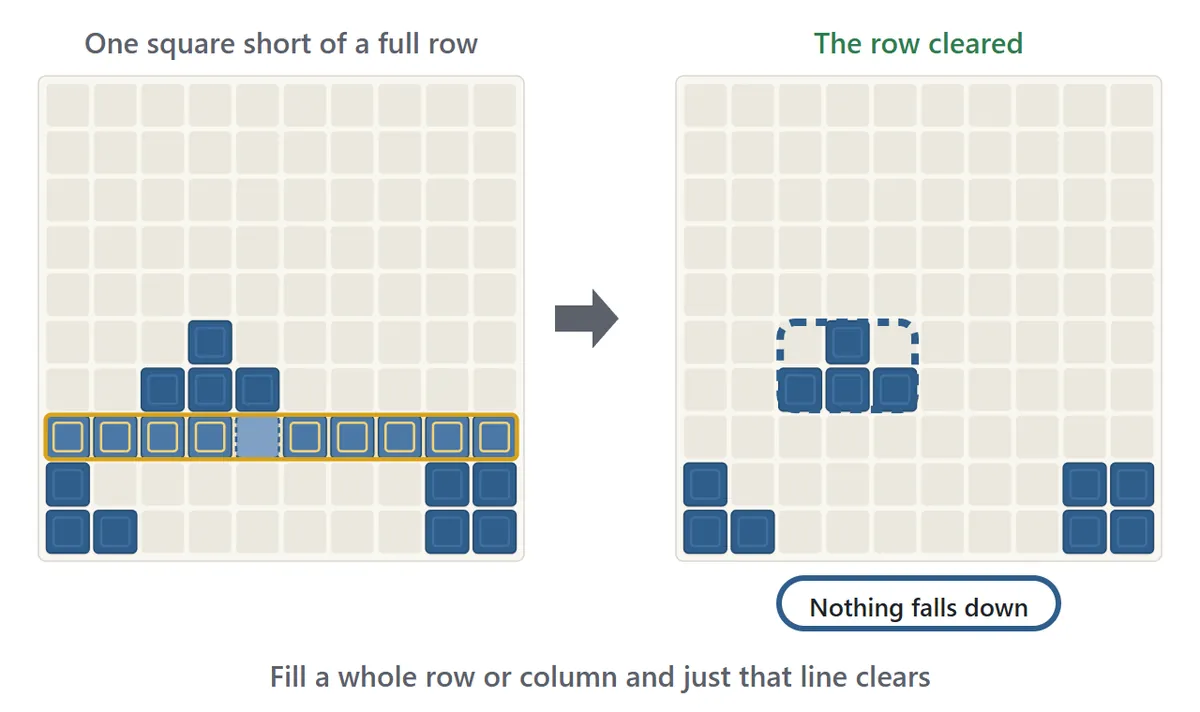
When every square in a horizontal row or a vertical column is filled, that whole line clears and its squares become empty again, ready for more blocks. Unlike falling-block games, there is no gravity here: nothing slides down to fill the space, and the blocks above or beside the cleared line stay put.
If one placement completes a row and a column at the same time, both clear together. The square where they cross counts for both lines, so a single well-placed block can wipe out a big cross-shaped area.
3. See which lines will clear before you let go
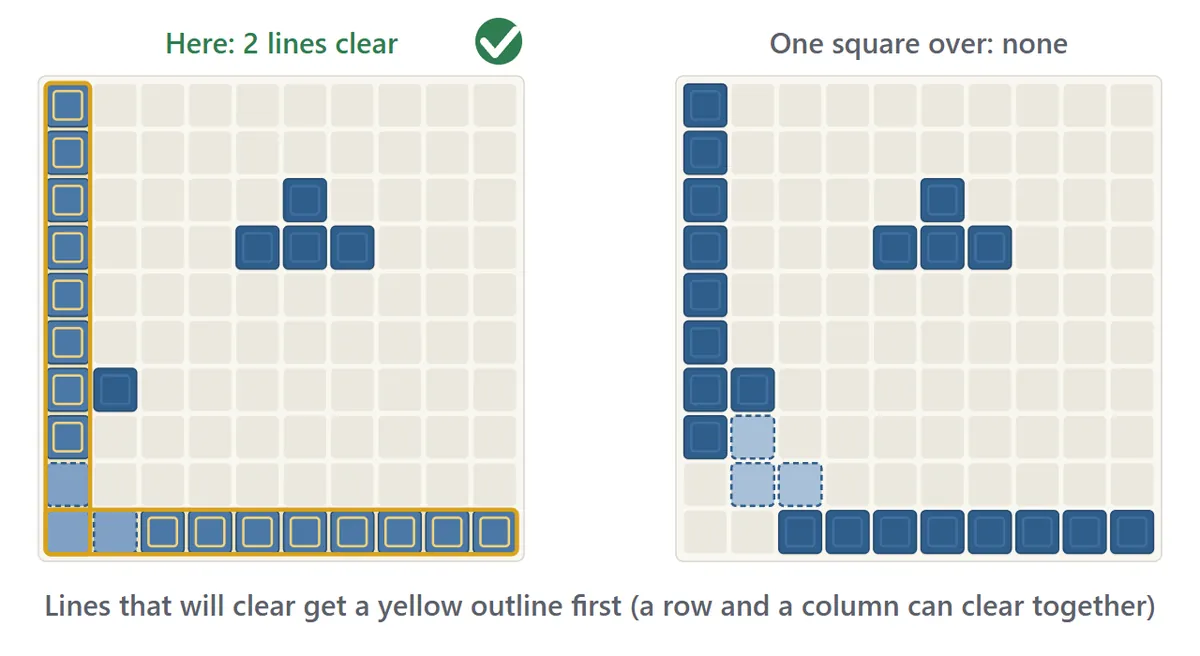
While you hold a block over the board, its landing spot is shown in pale blue. If dropping it there would complete any lines, those lines are outlined in thick yellow. Slide the block around and watch the outlines change: moving it by a single square can turn a one-line clear into a double, or into nothing at all.
4. The game ends when nothing fits

If none of the blocks in your hand can be placed anywhere on the board, the game ends. Blocks that can’t fit are shown faded, so you can see exactly what went wrong. A “No moves left” notice appears, followed by your score, your personal best and a few stats about the game.
Block Puzzle Scoring: Combos and Streaks
| What you do | Points |
|---|---|
| Place a block | 1 point per square |
| Clear 1 line | 10 |
| Clear 2 lines at once | 40 (20 per line) |
| Clear 3 lines at once | 90 (30 per line) |
| Clear 4 lines at once | 160 (40 per line) |
| Keep clearing (streak) | ×2 on the 2nd clear in a row, ×3 on the 3rd… up to ×5 |
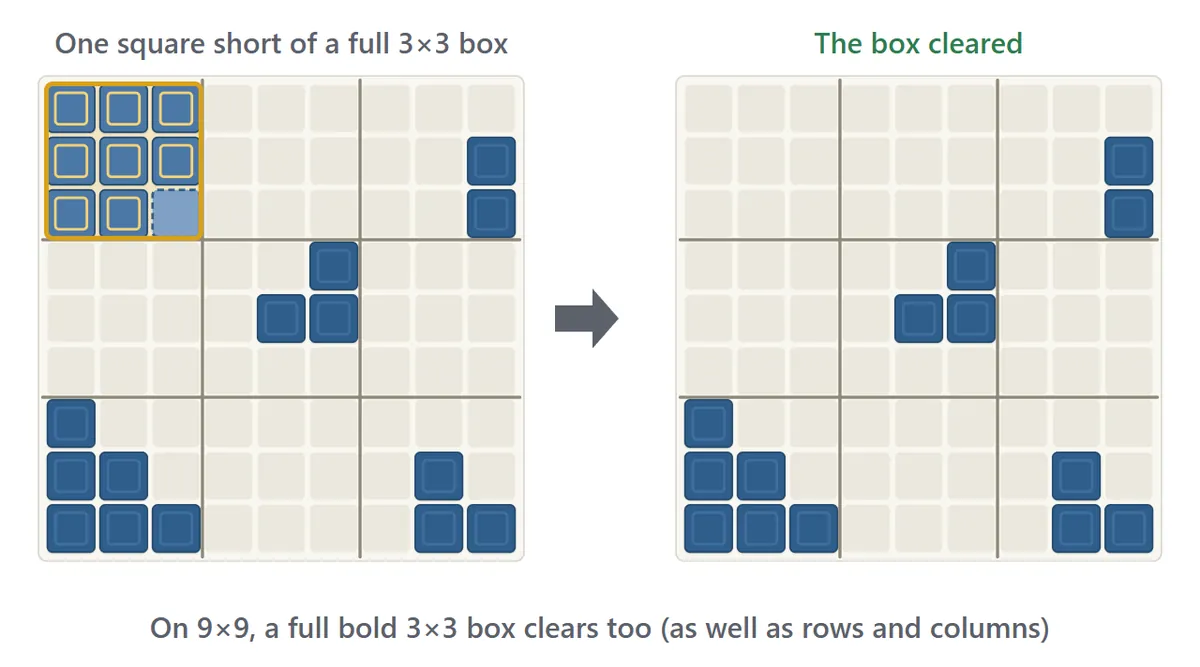
Clearing several lines with one block is worth far more than clearing them one at a time. Four single clears earn 40 points, while the same four lines cleared together earn 160. On the 9×9 board, a completed 3×3 box counts as one line too.
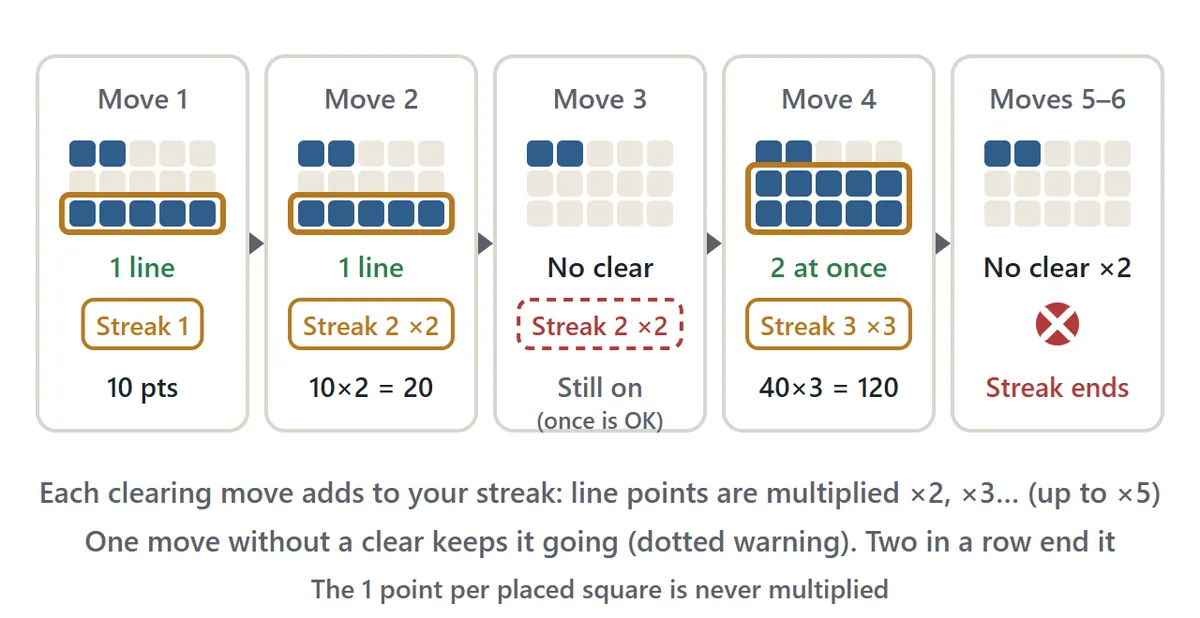
Each move that clears at least one line adds 1 to your streak. From the second clear onward, the points for the lines you clear are multiplied by the streak count: ×2, then ×3, and so on up to ×5. You get one breather: if a single move clears nothing, the streak carries on, but the streak counter turns into a red dotted box to warn you. Two non-clearing moves in a row reset it to zero. The 1 point per placed square is never multiplied.
The biggest scores come from combining the two ideas. For example, clearing three lines at once while your streak is at 5 is worth 90 × 5 = 450 points in a single move.
Difficulty Levels and Board Sizes
There are three difficulty levels. They differ in three ways: whether you can rotate blocks, whether every block you’re dealt is guaranteed to fit somewhere, and how many large shapes appear.
| Level | Rules | What it feels like |
|---|---|---|
| Easy | Rotation on · fitting shapes · mostly small shapes | Ideal for learning. Play calmly and a game can last a long time |
| Normal | No rotation · fitting shapes · some big shapes | Five-square bars and 3×3 squares turn up often, so you need to save space for them |
| Hard | No rotation · random shapes · mostly big shapes | Crosses, U-shapes and long L-shapes arrive whether they fit or not. Plan all three placements ahead |
Choose Custom to set rotation, dealing and shapes separately. You could keep rotation on but ask for mostly big shapes, for instance, or play small shapes without rotation.

“Fitting shapes” means each block, when it is dealt, fits somewhere on the board as it stands (the game doesn’t promise that all three will fit one after another). “Random shapes” ignores the board entirely, so once the grid gets crowded you may be handed blocks with no home.
| Board | What’s different |
|---|---|
| 10×10 | Rows and columns clear. The roomiest board |
| 9×9 (3×3 boxes clear) | A little tighter, but any bold 3×3 box also clears when full. More ways to clear means more chances for multi-line combos |
| 8×8 (small) | Lines are only eight squares long and easy to finish, but the board fills fast. Two big shapes in a row can leave almost no room |
Setting Undo to “On (once)” lets you take back one placement per game, even after the game has ended. If you are new to the game, start with Easy on the 10×10 board. Once the rules feel natural, move up to Normal, and when you can plan several blocks ahead, try Hard or the 8×8 board. Personal bests are kept separately for each combination of level, board and undo setting.
The Daily puzzle deals the same blocks in the same order to everyone on the same day, so you can compare scores with friends and family. It is always played on 10×10 with no rotation, random dealing, some big shapes and no undo.
Block Puzzle Strategy: Tips for a High Score
1. Build from the edges and corners
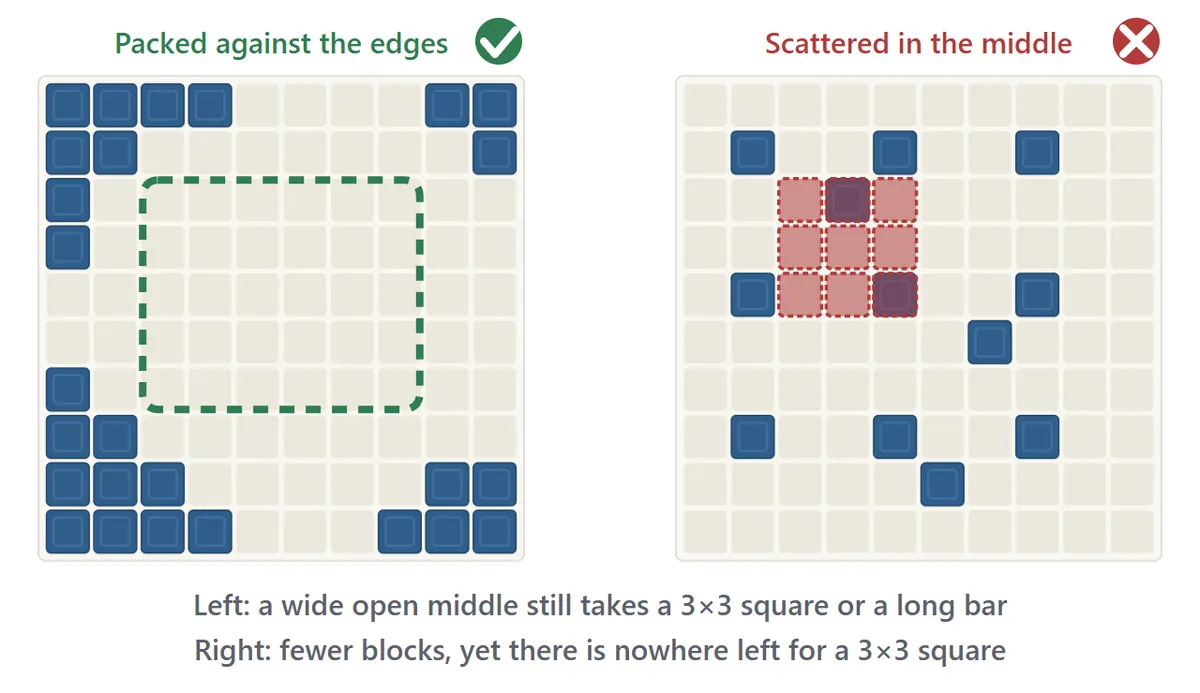
A block dropped in the middle of an empty board leaves awkward strips all around it, and those strips soon become too narrow for anything large. Push your blocks tight against the edges and into the corners instead, and keep the center of the board open. A wide open area can take any shape the game throws at you.
2. Always keep room for the big shapes
The hardest blocks to place are the 3×3 square and the five-square bars. Try to keep at least one open 3×3 area somewhere on the board at all times, plus a clear row or column long enough for a long bar. If a big block arrives and there is space waiting for it, it becomes an easy placement instead of a game-ender.
3. Don’t leave single-square holes
A one-square hole surrounded by blocks can only be filled by the single-square block, and you can’t count on getting one. Before you drop a block, check whether it will leave a lonely hole or a narrow two-square pocket next to it. Often shifting it by one square avoids the problem.
4. Plan all three blocks before placing the first
You can place your three blocks in any order, so look at all of them before you move. Decide where each one will go, then start with the largest. Many games end because the first two blocks were placed carelessly and the third, usually the big one, no longer fits.
5. Set up multi-line clears
Because points grow with the number of lines cleared together, it pays to prepare two or three lines that are each missing one or two squares in the same place, then finish them all with a single block. Don’t get greedy, though: holding lines back fills the board, and a crowded board ends games quickly. When space runs low, take the clear you have.
Keep an eye on your streak as well. While the multiplier is high, a combo scores enormous points, and when the streak counter turns into a red dotted box it is time to clear any line you can so that your multiplier survives.
6. Use the yellow preview
Hover or drag a block over the board and watch the yellow outlines. The same block can clear one line in one spot and two lines a square away. Trying a few positions before letting go is the easiest way to find hidden combos.
Block Puzzle FAQ
The game feels too easy (or too hard). What should I change?
Change the difficulty. Easy lets you rotate blocks and only deals shapes that fit. Hard takes rotation away and deals big shapes at random, so the same careful play runs out of room much sooner. Switching to the 8×8 board makes any level tougher.
Do the blocks fall?
No. Blocks stay exactly where you put them, and clearing a line never makes other blocks slide. There is no time limit either, so you can think as long as you like before every move.
How do I rotate a block?
On Easy (or on Custom with rotation turned on), select a block and press the Rotate button or the R key to turn it 90° clockwise. Tapping the selected block again also rotates it. On Normal and Hard, blocks can’t be rotated and must be placed the way they were dealt.
I placed a block in the wrong spot. Can I take it back?
If Undo is set to “On (once)”, you can take back your most recent placement once per game, even after the game has ended, as long as you haven’t used it yet.
Can I stop and continue later?
Yes. A game in progress is saved automatically in this browser on this device. Next time you open the page, press Continue to pick up with the same board, the same blocks in hand and the same rules. A daily puzzle can’t be continued after the date changes.
Where are my scores saved?
Your personal bests and the number of games played are stored in this browser for each combination of level, board and undo setting. No account or sign-up is needed, but clearing your browser data also clears your records.
Can I play on a phone, tablet or Chromebook?
Yes. The game runs in any modern browser and works with touch, mouse or keyboard. On a computer you can also play entirely from the keyboard: press 1, 2 or 3 to pick a block, move the target with the arrow keys and press Space or Enter to place it.
Where Block Puzzles Come From
Shapes made by joining squares edge to edge are called polyominoes. Puzzles built from them, such as filling a box with the twelve five-square pentominoes, are said to have spread as mathematical recreations in the 1950s, and fitting fixed wooden or cardboard pieces into a frame had been a popular pastime long before that.
The modern form, where you place shapes on a grid and clear full lines, is generally said to have taken off as a quick game on smartphones in the 2010s, and countless makers have since built their own versions. What sets it apart from falling-block games is its pace: with no gravity and no clock, it is a puzzle you can play slowly, one thoughtful move at a time.