 Yorimichi Games
How to Play Block Breaker
Block Breaker is a simple arcade game with a paddle, a ball and a wall of colored blocks. You move a flat paddle along the bottom of the screen and keep bouncing the ball back up. Every time the ball hits a block, the block breaks and the ball rebounds. Break every block on the screen and you clear the stage. Let the ball fall past your paddle and you lose a ball; lose them all and the game is over. That is really all there is to it, which is why anyone can start playing in a few seconds. The fun comes later, when you start reading where the ball will go and aiming it at the blocks you want to hit.
Move the paddle and bounce the ball back
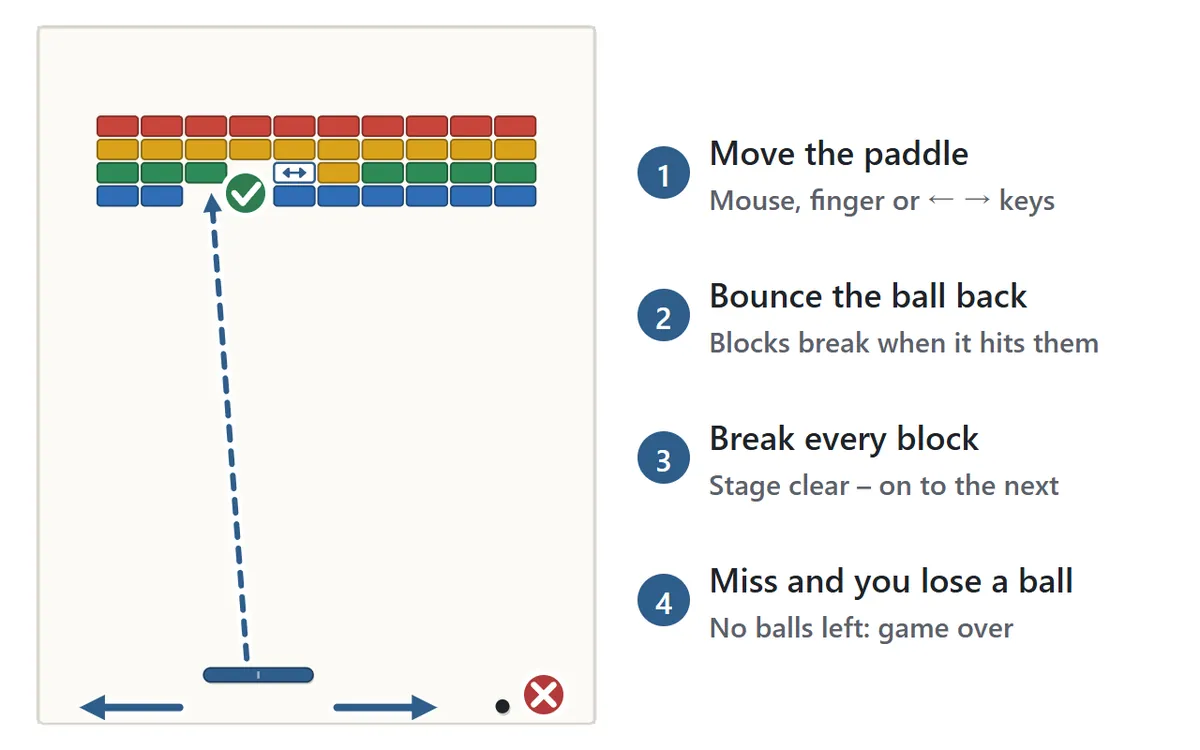
Each stage starts with the ball resting on top of your paddle, so nothing happens until you are ready. Move the paddle to where you want to start, then launch the ball: click or press the Space bar on a computer, or tap the game screen or the “Launch” button on a phone or tablet. The ball flies off at a slight angle in the direction you last moved the paddle.
There are three ways to move the paddle. With a mouse, move the pointer left and right over the game and the paddle follows it. On a touch screen, slide your finger left or right anywhere on the game screen; the paddle moves by the same distance your finger slides, so you never have to cover the ball with your finger. With a keyboard, use the left and right arrow keys, or A and D. Whichever you use, the paddle has a top speed, so you still have to move early for a ball that is heading for the far side.
Where you hit the ball decides where it goes
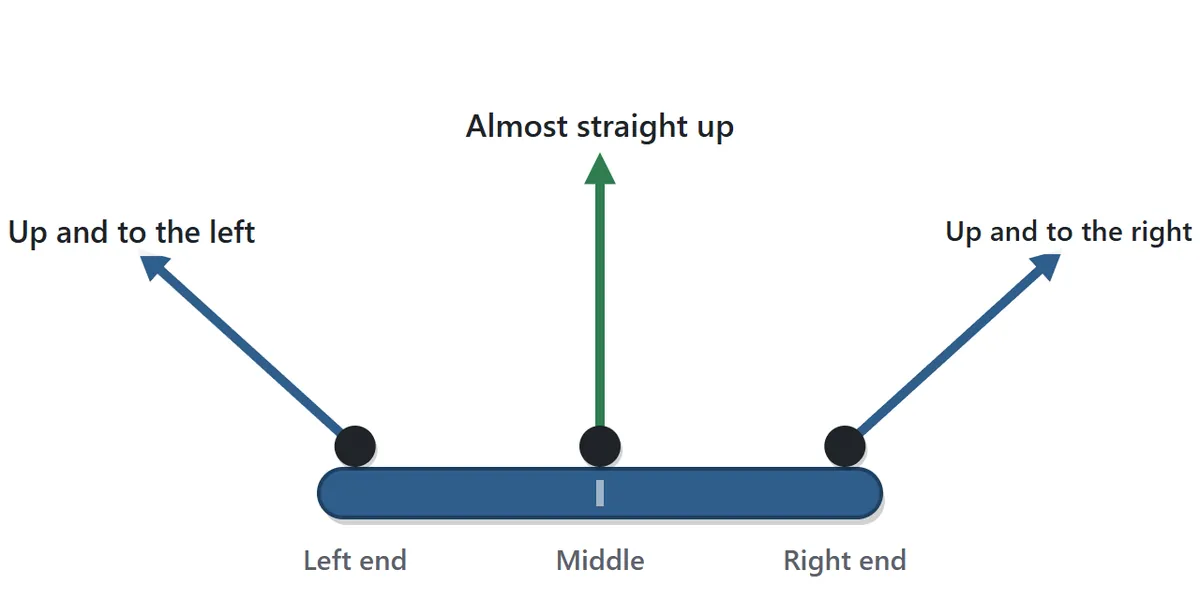
The direction of the bounce depends only on which part of the paddle the ball touches, not on the direction it came from. A hit in the middle sends the ball almost straight up. A hit near the right end sends it up and to the right, and a hit near the left end sends it up and to the left. The closer to the end, the sharper the angle. This is the most important thing to learn in the game, because it lets you steer the ball instead of just keeping it alive.
Tough blocks and power-ups
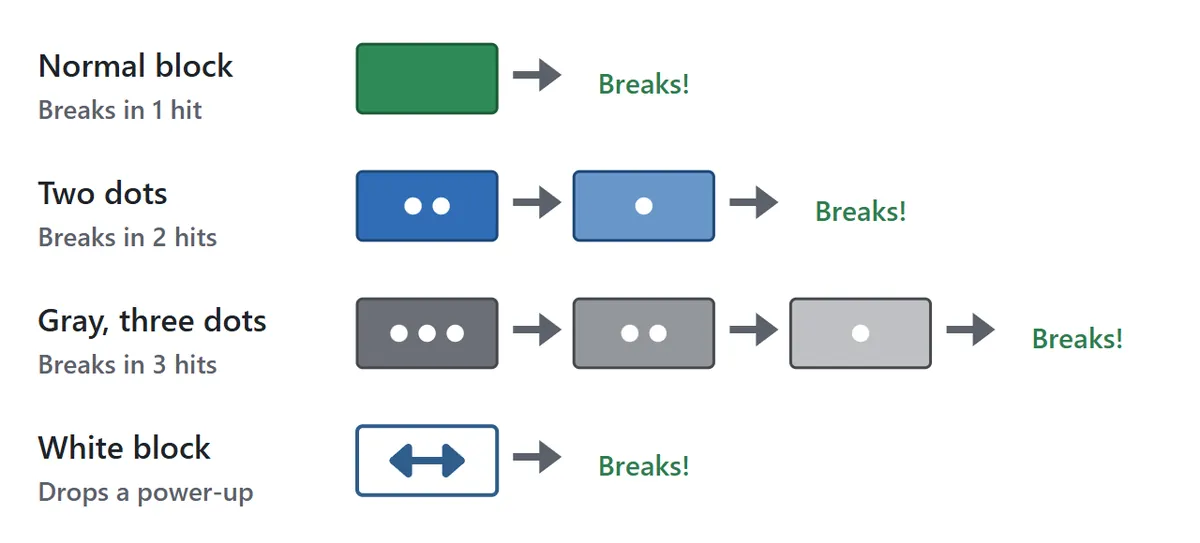
Most blocks break with a single hit, but blocks marked with white dots are tougher. The number of dots tells you how many more hits the block can take, and one dot disappears each time you hit it, while the block itself gets a little paler. Colored blocks with two dots need two hits and gray blocks need three. Tough blocks are worth more points when they finally break, so they are worth the extra effort.
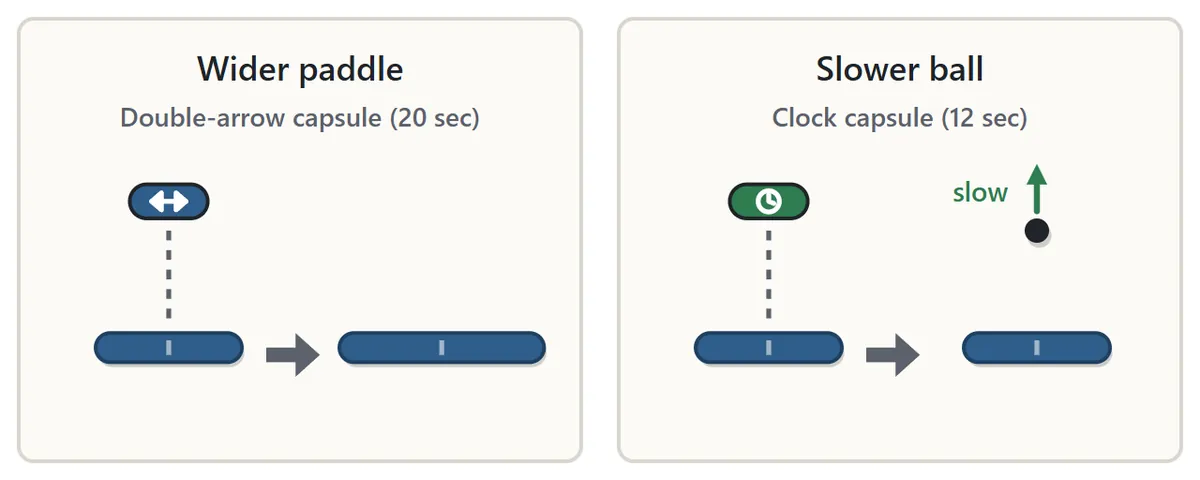
Some stages include white blocks with a small symbol. Break one and a capsule drops toward the bottom of the screen; catch it with the paddle to get the power-up. The double-arrow capsule makes your paddle one and a half times wider for 20 seconds, and the clock capsule slows the ball down for 12 seconds. The time left on each power-up is shown in the top-left corner of the game. If you lose a ball, any power-ups you had end right away.
The ball gets faster as you play
After you have returned the ball with your paddle 4 times, 12 times and 24 times, the ball speeds up a little each time. Losing a ball resets it to its starting speed. Later stages also start with a slightly faster ball, so the game keeps getting more challenging as you go.
Difficulty Levels and Stages
| Level | Ball and paddle | Balls |
|---|---|---|
| Easy | Slow ball, wide paddle | 5 |
| Normal | Medium ball, medium paddle | 4 |
| Hard | Fast ball, slightly narrow paddle | 4 |
If you have never played this kind of game before, start on Easy: the ball is slow enough to follow comfortably and the wide paddle forgives small misjudgments. Move up to Normal once you can clear the first few stages without much trouble, and try Hard when you can read the ball’s path before it reaches the paddle.
There are 15 stages in all, each with its own picture made of blocks – a mountain, a fish, a cat, a rainbow, a castle and more. You play them in order, starting from stage 1. Once you have reached a stage, you can pick it under “Starting stage” next time, which is handy for practicing a stage you find hard. Your high score is only recorded for games started from stage 1, so a record always means a full run.
Points are simple: a normal block is worth 10, a two-hit block 30 and a three-hit block 50, and every stage you clear adds a bonus that grows with the stage number. If you clear all 15 stages, each ball you still have left adds another 500 points.
Block Breaker Tips and Strategy
1. Watch where the ball will land, not the ball itself
Beginners tend to follow the ball with their eyes and chase it with the paddle. As soon as the ball starts coming down, think about where it will reach the bottom and move the paddle there first. You will be waiting for the ball instead of racing it, and far fewer balls will slip past.
2. Predict the bounce before it hits the wall
A ball flying at an angle will often bounce off a side wall before it comes down. Get into the habit of guessing “after the wall, it will land about here” before the bounce happens. Shallow angles that bounce off both walls are the trickiest, so start moving extra early for those.
3. Catch the ball in the middle of the paddle
Hitting with the ends of the paddle sends the ball off at a steep angle, which makes its next landing spot harder to predict. When your main goal is simply not to drop the ball, meeting it with the middle of the paddle is the safest choice. Save the ends for when you really want to aim.
4. Get the ball above the blocks
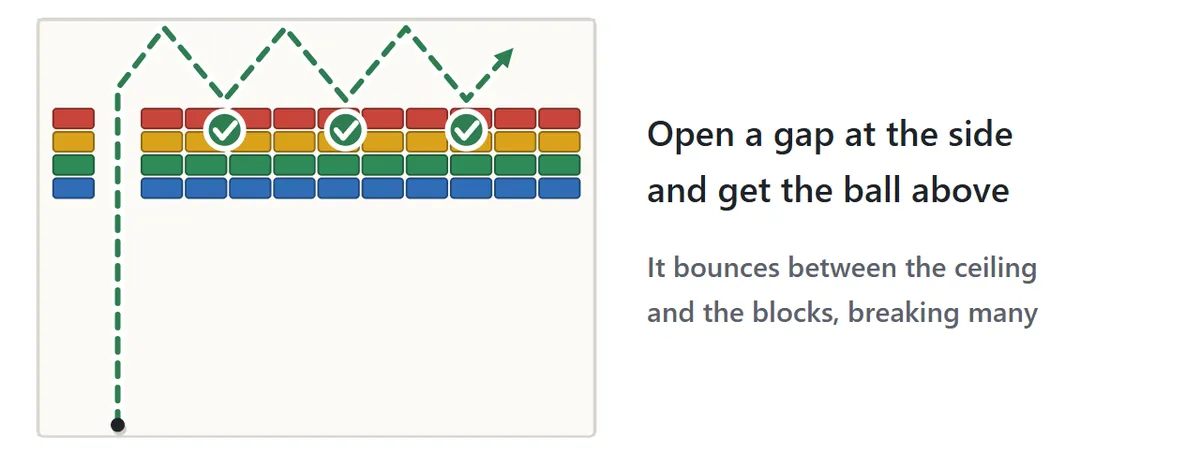
This is the classic trick of the genre. Break a path through the wall of blocks and send the ball through the gap. Once it is above the blocks, it bounces back and forth between the ceiling and the top rows, knocking out block after block while you simply wait for it to come back down. Opening the gap at one side of the wall is usually easiest, because the side wall helps guide the ball into it.
5. Use the ends of the paddle to hit the last few blocks
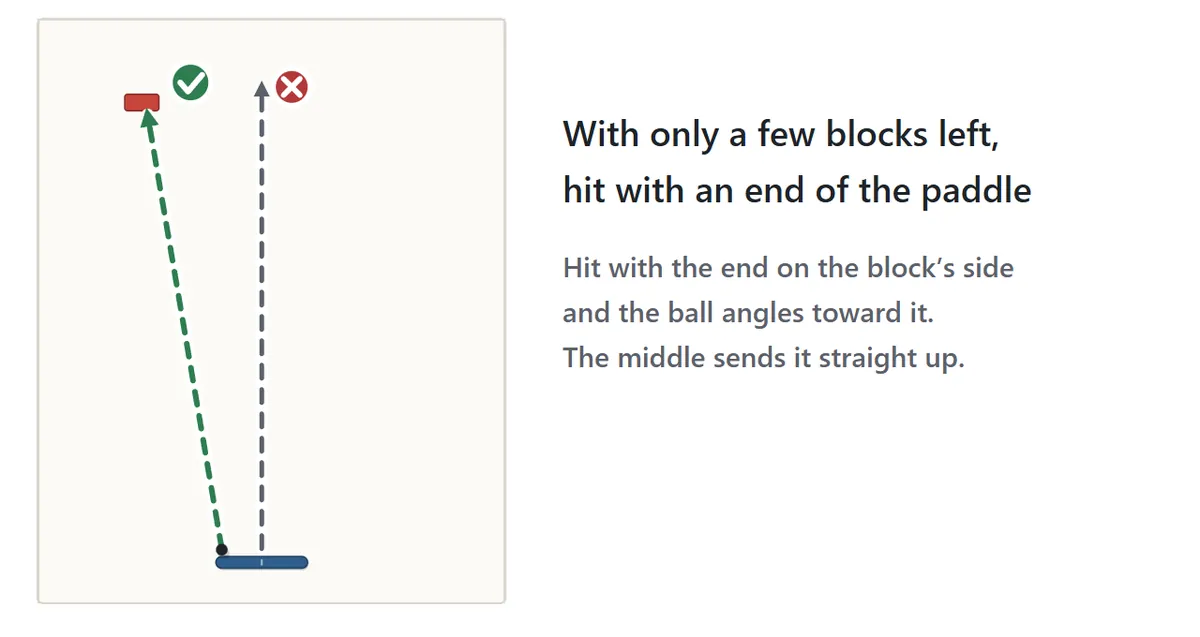
The last one or two blocks on a stage can take a surprisingly long time to hit. If the block is directly above you, put the paddle underneath it and hit with the middle to send the ball straight up. If it is off to one side, hit with the end of the paddle on that side so the ball flies off at an angle toward it. If the ball keeps traveling the same path without touching a block, the game nudges its angle slightly after a while, so you won’t be stuck forever.
6. Don’t risk the ball for a power-up
When a capsule drops while the ball is also coming down, deal with the ball first. Losing a ball costs you much more than missing a wider paddle for 20 seconds. The best time to go for a capsule is while the ball is still flying upward, when you have time to spare.
Block Breaker FAQ
Can the ball pass through a block?
No. The game checks the ball’s whole path between frames, so even when the ball is moving fast it always hits the first block or wall in its way.
Can I stop and continue later?
Yes. On the same device and browser, press “Continue” to pick up where you left off, with the same blocks broken, the same score and the same number of balls. The ball starts again resting on the paddle, so you are never thrown straight back into a fast rally.
How do I pause the game?
Press the “Pause” button, or the P key or Esc on a keyboard. The game also pauses automatically when you switch to another tab or app, and on a computer when you click outside the game. Press “Resume”, the Space bar or the game screen to carry on.
Where are my scores saved?
Your high score and the furthest stage you have cleared are kept on your device for each difficulty level. There is no account or sign-up. Sound is off at first; press “Sound: off” to turn on sound effects for breaking blocks, catching power-ups and clearing stages.
Why doesn’t the page scroll on my phone?
While your finger is sliding on the game screen, the page is kept from scrolling so you can move the paddle freely. Slide outside the game screen to scroll the page as usual.
Where Do Ball-and-Paddle Games Come From?
Games in which you bounce a ball off a paddle to knock out a wall of blocks first appeared as arcade video games in the mid-1970s. They grew out of the earliest ball-and-paddle games, which were played like a simple game of table tennis on a television screen, and replaced the opponent with a wall to break down. Over the years new ideas were added, such as blocks that need several hits, capsules that change the paddle or the ball, and stages laid out as pictures. The genre spread from arcades to home computers, game consoles and mobile phones, and it is still one of the most familiar games around. The layouts, colors and sounds in this version are all our own.