 Yorimichi Games
How to play blackjack
Blackjack is a card game with one simple goal: finish with a hand that adds up closer to 21 than the dealer’s hand, without going over. Go past 21 and you “bust,” which loses the hand straight away. Every turn comes down to one question, “another card, or stop here?”, and that small decision is surprisingly hard to get right every time.
Here you play one-on-one against a computer dealer. You start with 100 points. Before each round you choose how many points to put into play: win and you gain the same number, lose and they are gone. The points are only a score for this game. There is nothing to buy, nothing to trade in and no prizes, just your best total and your longest winning streak to beat next time.
The blackjack table
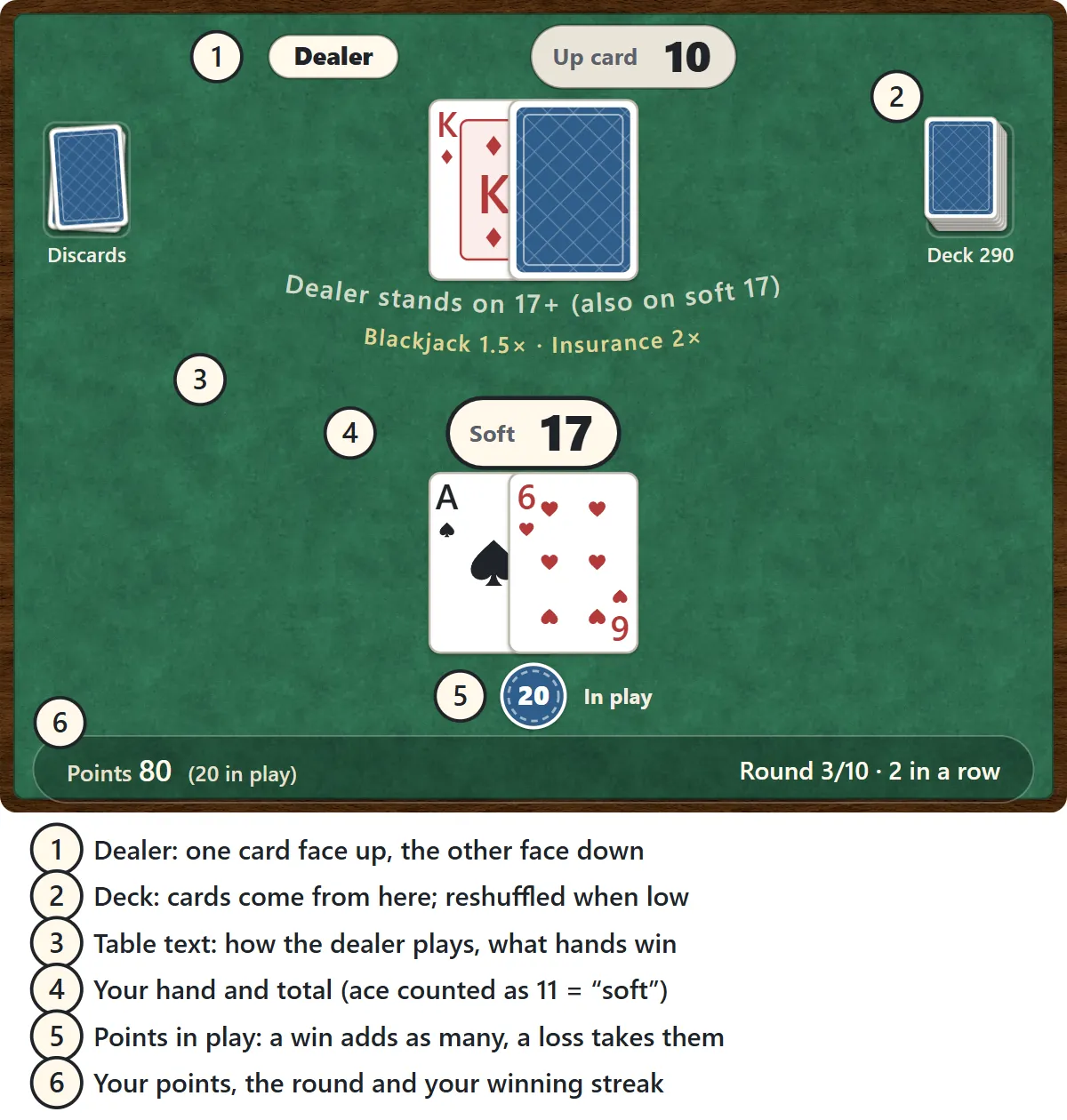
Pick 10, 20, 50 or 100 points and press Deal. You get two cards and so does the dealer. Both of yours are face up, but the dealer’s second card stays face down. That hidden card is called the hole card. All you can see is the dealer’s up card, so every choice you make is a guess about what the dealer is likely to end up with.
Card values in blackjack
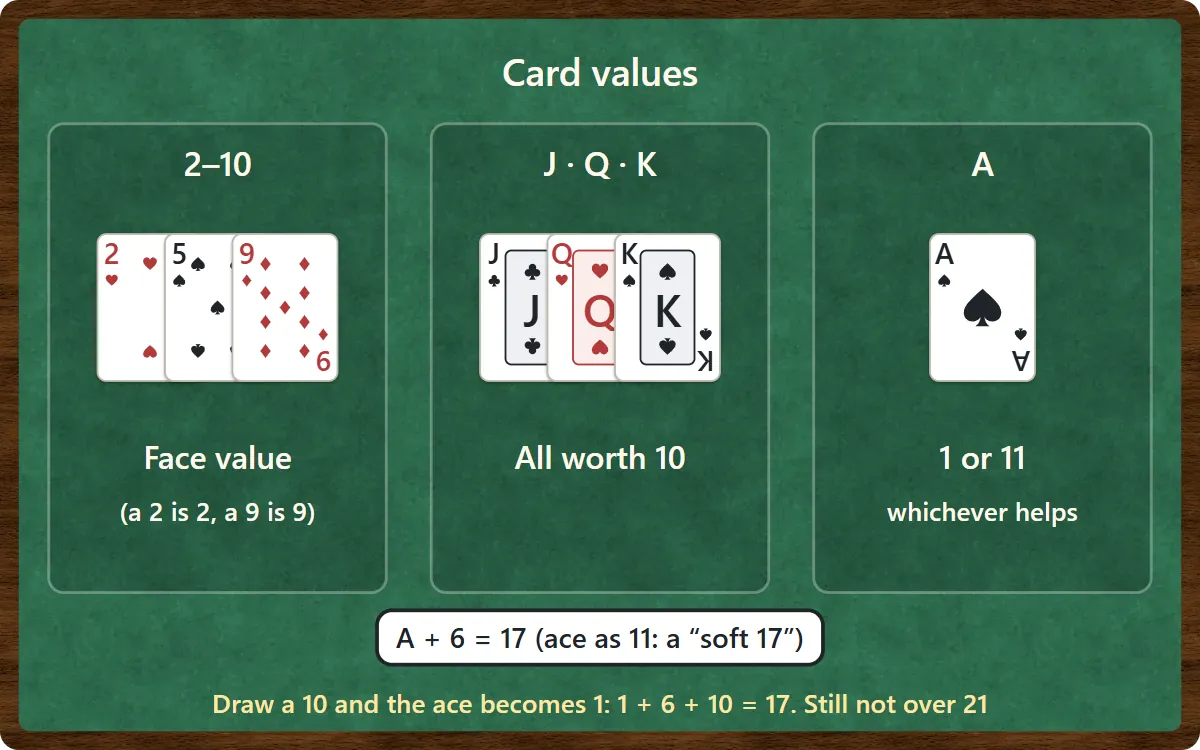
Number cards count at face value. Jacks, queens and kings are all worth 10. An ace is worth 1 or 11, whichever works best. When an ace is being counted as 11, the hand is called soft, and the game labels it that way (for example “soft 17”). A soft hand is safe to hit, because if the next card would take you over 21, the ace simply switches to 1. A hand with no ace, or with the ace forced down to 1, is called a hard hand.
Hit or stand
On your turn you choose to hit (take another card) or stand (keep what you have). You can hit as many times as you like until you bust. If you reach exactly 21, the game stands for you automatically.
How you win, lose or push
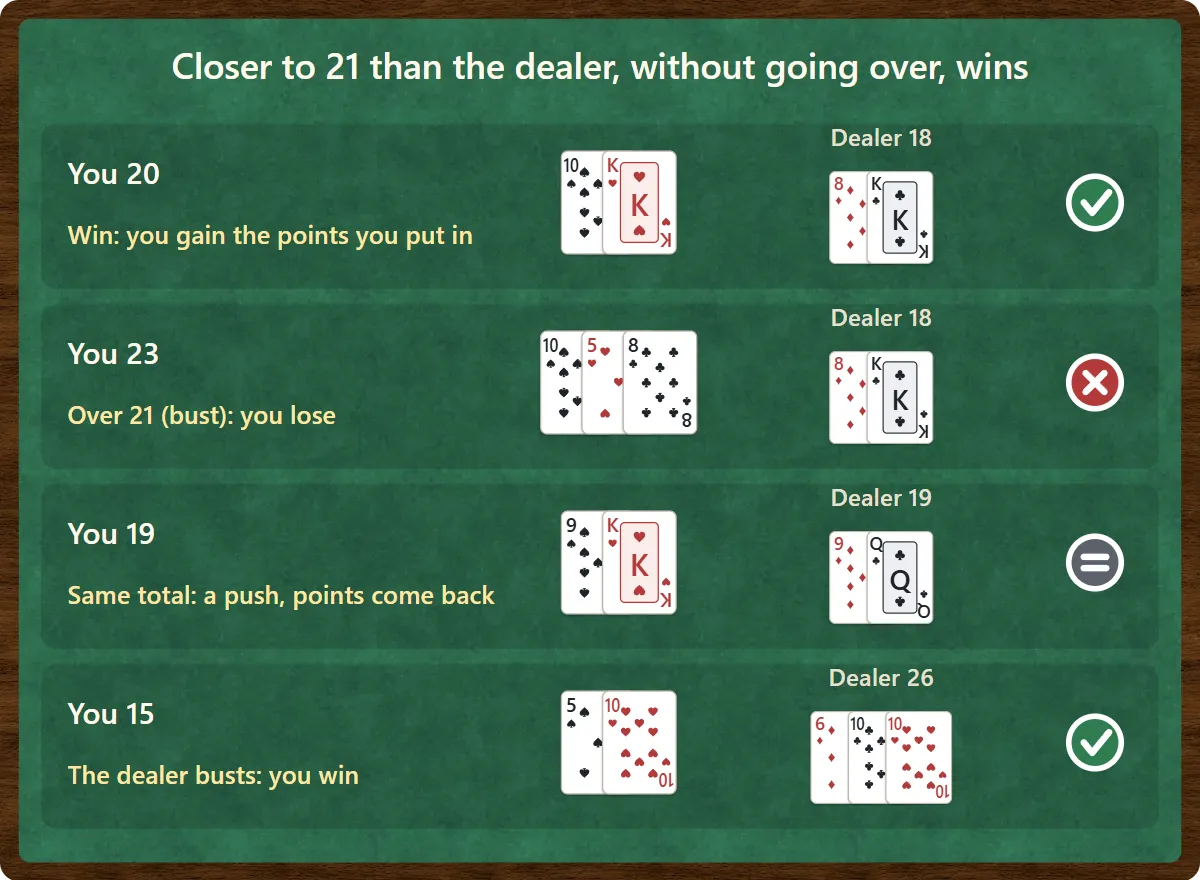
Once you stand, the dealer turns over the hole card and draws. Then the totals are compared. Closer to 21 wins, and a win gives you back as many points as you put in. If the totals are equal it is a push, a tie, and your points are returned. If you busted earlier, you have already lost, even if the dealer goes on to bust as well. That one rule is why the dealer has a small edge in the long run.
What counts as a blackjack?
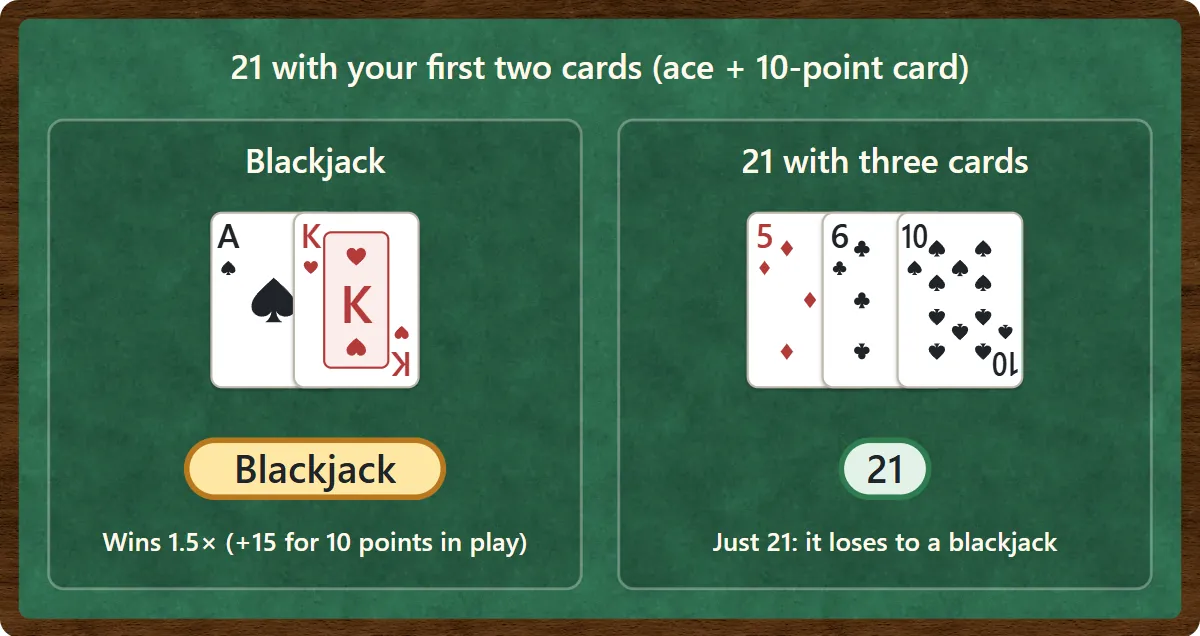
If your first two cards are an ace and any 10-point card (10, J, Q or K), you have a blackjack, sometimes called a natural. It beats any 21 made with three or more cards, and with the Standard rules it wins 1.5 times your points in play: 10 points gains 15. If the dealer also has a blackjack, the hand is a push.
How the dealer plays
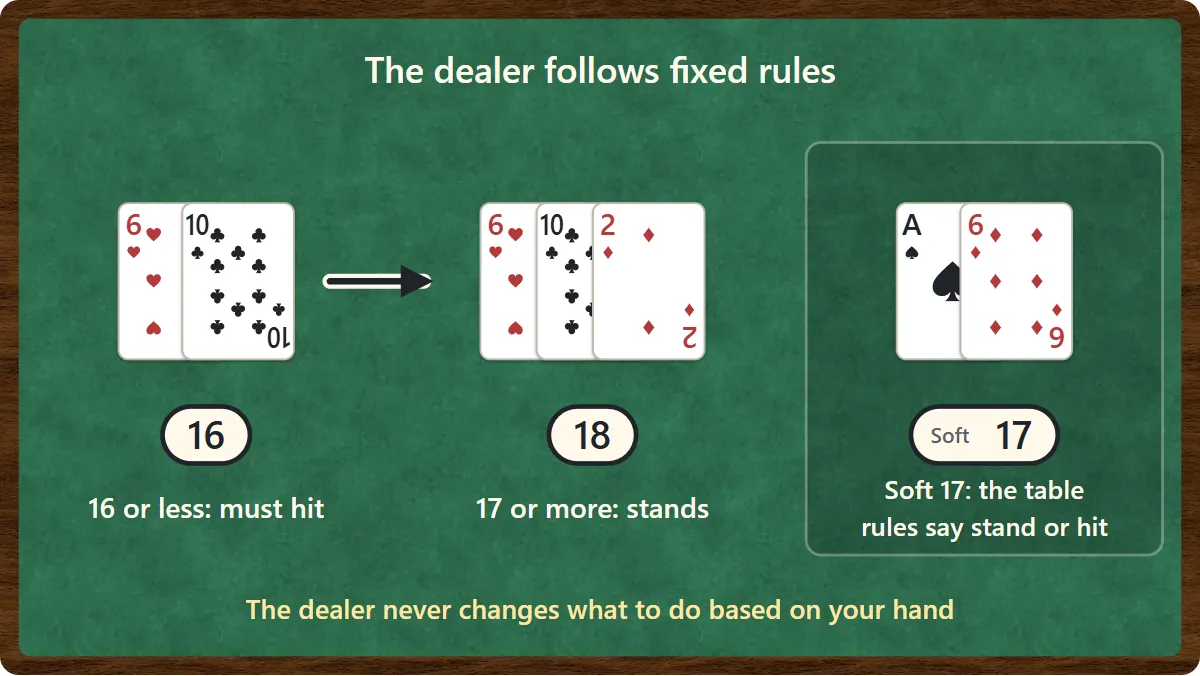
The dealer does not make decisions. The rule is fixed: hit on 16 or less, stand on 17 or more. Whether the dealer also stands on soft 17 or takes another card is written on the table felt. Because the dealer can’t react to your hand, the real skill in blackjack is reading the up card. A dealer showing a 6, for example, will often end up on a total like 16 and be forced to draw again, which is exactly when dealers bust.
When the up card is an ace or a 10-point card, the dealer checks the hole card before you act. If it makes a blackjack, the round ends immediately, so you never double or split only to lose to a hidden blackjack.
Double down, split, surrender and insurance
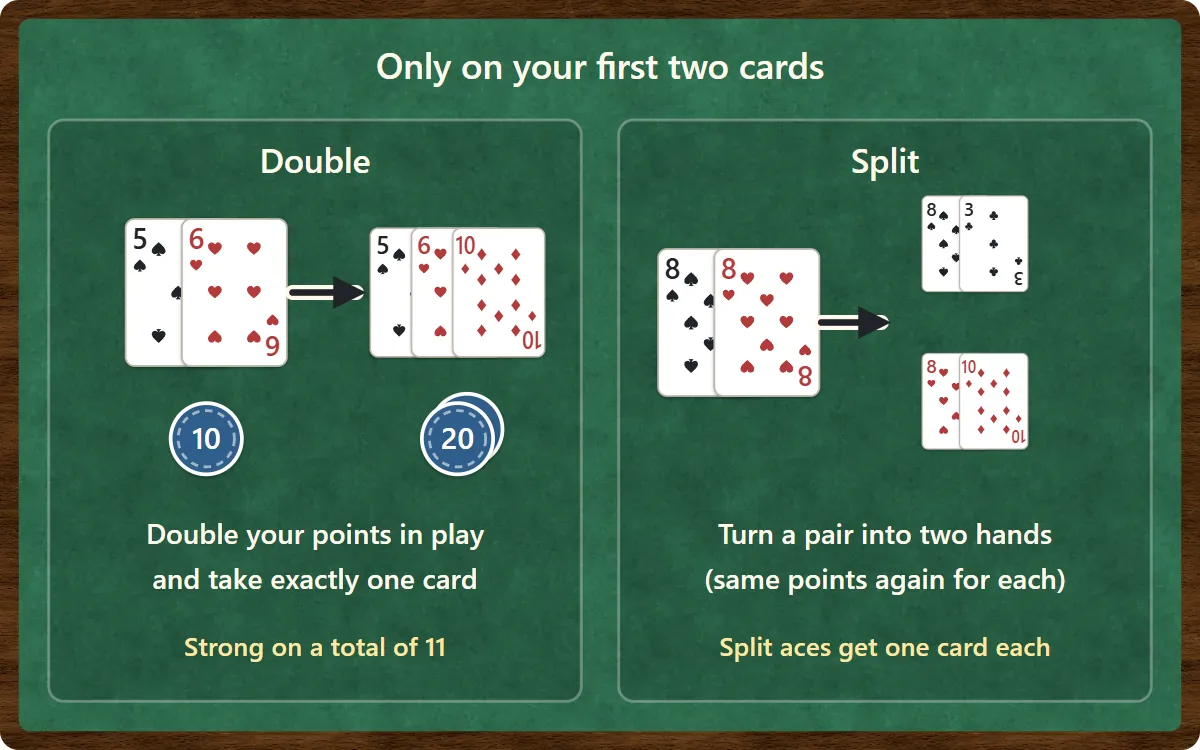
- Double down: double your points in play and take exactly one more card. It is the move to make on a strong starting total like 10 or 11, where a 10-point card turns your hand into 20 or 21.
- Split: turn a pair, such as two 8s, into two separate hands, putting the same points into play for the second one. With the Standard rules you can keep splitting up to four hands. Split aces get just one card each, and an ace plus a 10-point card after a split counts as 21, not as a blackjack.
- Surrender: if your first two cards look hopeless, give up the hand and get half your points back. It is part of the Standard rules and switched off in the other two rule sets.
- Insurance: when the dealer shows an ace, you can put in half your points in play as insurance. If the dealer has a blackjack, the insurance gains twice as much; if not, it is lost. When you hold a blackjack yourself, you are offered a sure win instead: settle for a 1× win straight away rather than risk a push against a dealer blackjack.
Blackjack rule variations
Blackjack rules differ a little from table to table, so the game has three ready-made rule sets. Pick Custom to change any rule on its own.
| Rule | Standard | Home game · Tough dealer |
|---|---|---|
| Decks | 6 | 1 (shuffled every round) · 8 |
| Dealer on soft 17 | Stands | Stands · Hits |
| Blackjack wins | 1.5× | 1.5× · 1.2× |
| Double down | Any two cards | Any two cards · 10 or 11 only |
| Split | Up to 4 hands | Once · Once, same rank only |
| Surrender, insurance | Both | Neither · Insurance only |
| 5-Card Charlie | No | Yes · No |
The Home game is the version people often play around a kitchen table with a single deck. It adds the 5-Card Charlie: draw five cards without going over 21 and you win on the spot, which gives a player on a small total a real reason to keep hitting. The Tough dealer set stacks things slightly against you: the dealer hits soft 17, blackjack only wins 1.2×, and doubling is limited to 10 and 11.
Blackjack strategy: tips for keeping your points
1. Always look at the dealer’s up card
Your own total is only half of the story. As a rule of thumb, a dealer showing 2 to 6 is weak and likely to bust (5 and 6 are the worst for the dealer), while a dealer showing 7 to ace is likely to finish with a strong hand.
2. On 12 to 16, let the up card decide
Totals from 12 to 16 are the uncomfortable ones: hit and you may bust, stand and you are probably behind. The standard answer is to stand when the dealer shows 2 to 6 and let the dealer take the risk, and to hit when the dealer shows 7 or higher. The one exception is 12, where hitting is better against a 2 or a 3 as well.
3. Double down on 10 and 11
With 10 or 11, the next card has a good chance of being worth 10. That makes it the best time to double your points in play, especially against a weak up card.
4. Always split aces and eights
A pair of aces gives you two hands that each start one card away from 21. A pair of 8s is a total of 16, the worst hand in the game, so starting over with two 8s is almost always better. On the other hand, never split two 10s: 20 is already an excellent hand.
5. Don’t be afraid to hit a soft hand
A soft hand can’t bust on the next card, so standing on something like soft 17 (ace and 6) throws away a chance to improve. Hit it, or double down when the dealer’s up card is weak.
6. Use the basic strategy chart when unsure
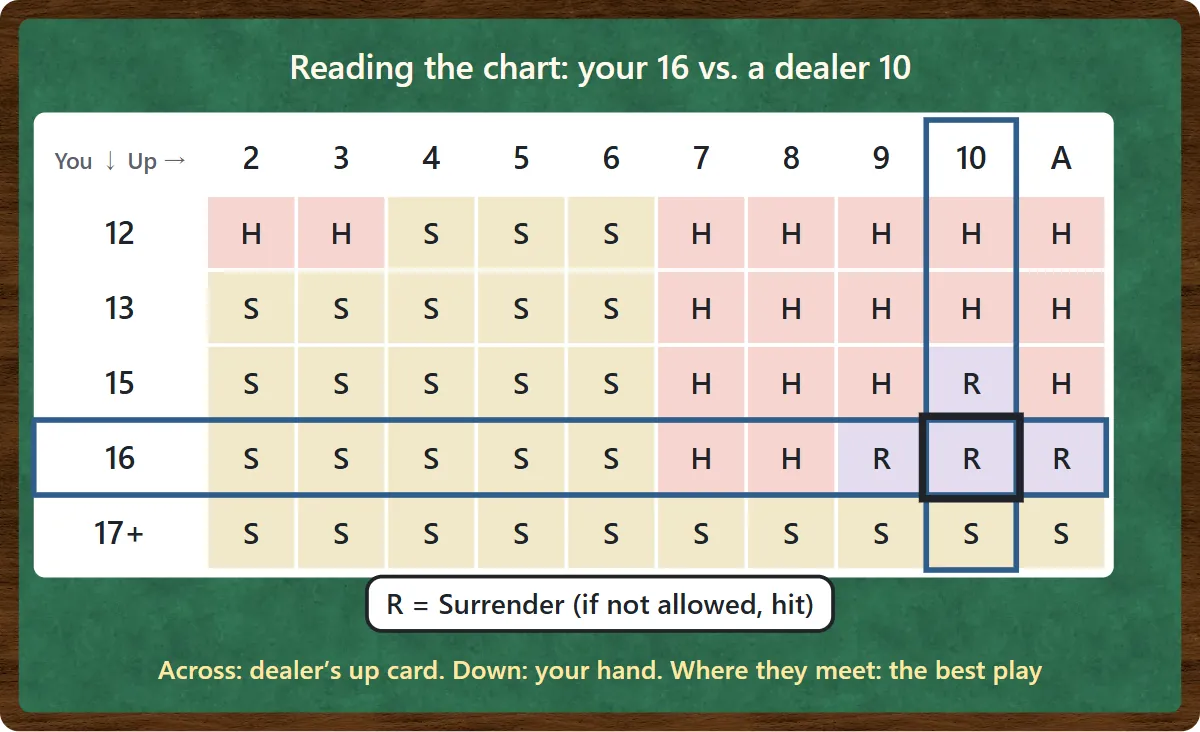
Press Hint during a game to open a basic strategy chart worked out for the rules you are playing, with your current hand highlighted. It has separate tabs for hard totals, soft hands and pairs. Basic strategy is the set of choices that loses the fewest points over many hands. It can’t change the cards, so you will still lose rounds while following it, but over a full game it makes a clear difference.
Blackjack FAQ
Does the computer dealer cheat?
No. The cards are shuffled thoroughly before they are dealt, and you and the dealer draw from the same deck. The dealer follows the stand-on-17 rule and never looks at your hand to decide what to do.
Which is better, a blackjack or a 21 with three cards?
A blackjack. A two-card 21 beats any 21 made with more cards. If you have a blackjack and the dealer makes 21 with three cards, you win.
Should I take insurance?
According to basic strategy, no. The chance that the dealer’s hole card is a 10-point card is about 31%, and insurance only comes out ahead when that chance is higher than one in three.
If I follow basic strategy, will I always win?
No. Basic strategy keeps your losses as small as possible, but the dealer still has a slight advantage because you have to act first and a bust loses even if the dealer busts too. Plenty of single rounds are decided by luck, so treat each game as a try at a new personal best.
What are the points for?
They are simply the score. You start each game with 100 points, and the game remembers your best total, the most points you have ever held and your longest streak. Points can’t be bought, traded or exchanged for anything.
How do I play blackjack with friends and a deck of cards?
One ordinary deck is enough. Take turns being the dealer, and keep score with counters such as buttons or beans, or just a pencil and paper. The Home game rules with 5-Card Charlie are a good fit, since they give everyone a chance to come from behind.
Can I stop and come back later?
Yes. If you close the page in the middle of a game, press Continue next time to pick up where you left off. Your points and records are saved only in this browser on this device.
Where blackjack comes from
Blackjack grew out of an older French game called vingt-et-un, “twenty-one,” and a card game with the same aim of reaching 21 appears in a Spanish story from the early 1600s. The game crossed to North America in the 1800s, and that is where the name blackjack took hold. In Britain a close relative called Pontoon is still played at home. The mix of an easy target and real decisions along the way is why blackjack remains one of the most widely played card games in the world.