 Yorimichi Games


How to play the baseball batting game
This is a free baseball batting game you can play right in your browser. A pitcher throws to you, you swing, and the goal is simple: hit as many home runs as you can in 10 swings. The view is from behind the catcher, the way you see the plate on a TV broadcast. The pitcher stands in the distance, your right-handed batter is on the left, and the ball grows bigger as it comes toward you. Every swing counts, whether you miss, foul it off or hit a single. The only pitches that do not count are the ones you let go by without swinging.
Swing just before the ball reaches the plate
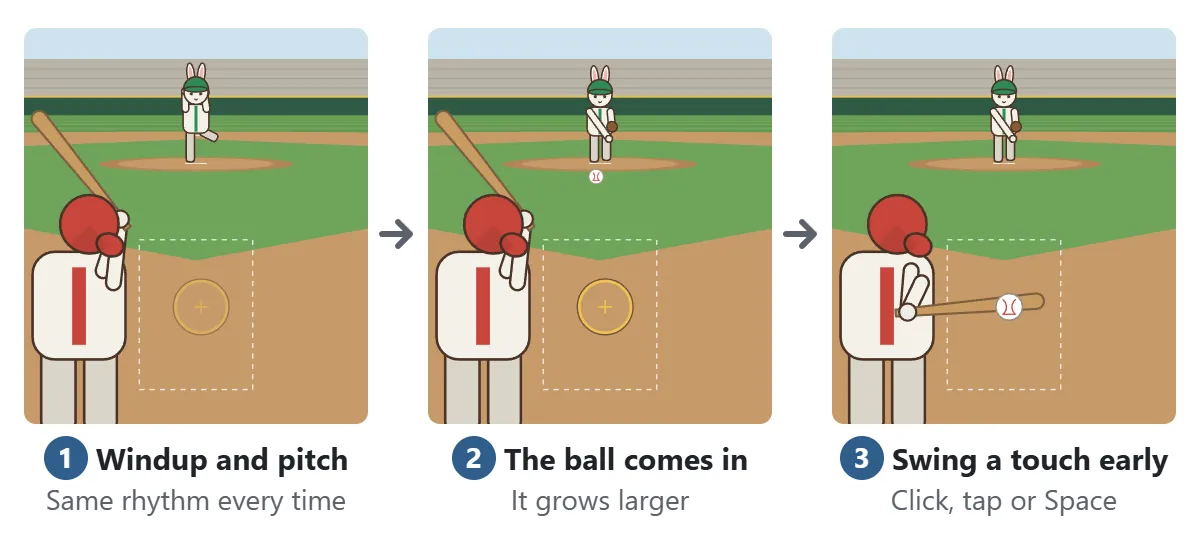
The pitcher winds up the same way every time and then releases the ball. Watch it get closer and larger. When it is about to reach the dotted box (a rough strike zone), swing: click or press Space on a computer, or tap the screen on a phone or tablet. The bat starts moving the instant you press and reaches the plate a split second later, so if you wait until the ball is already over the plate you will be late. Think “a little early” and you will be closer to right.
Early swings pull the ball, late swings go the other way
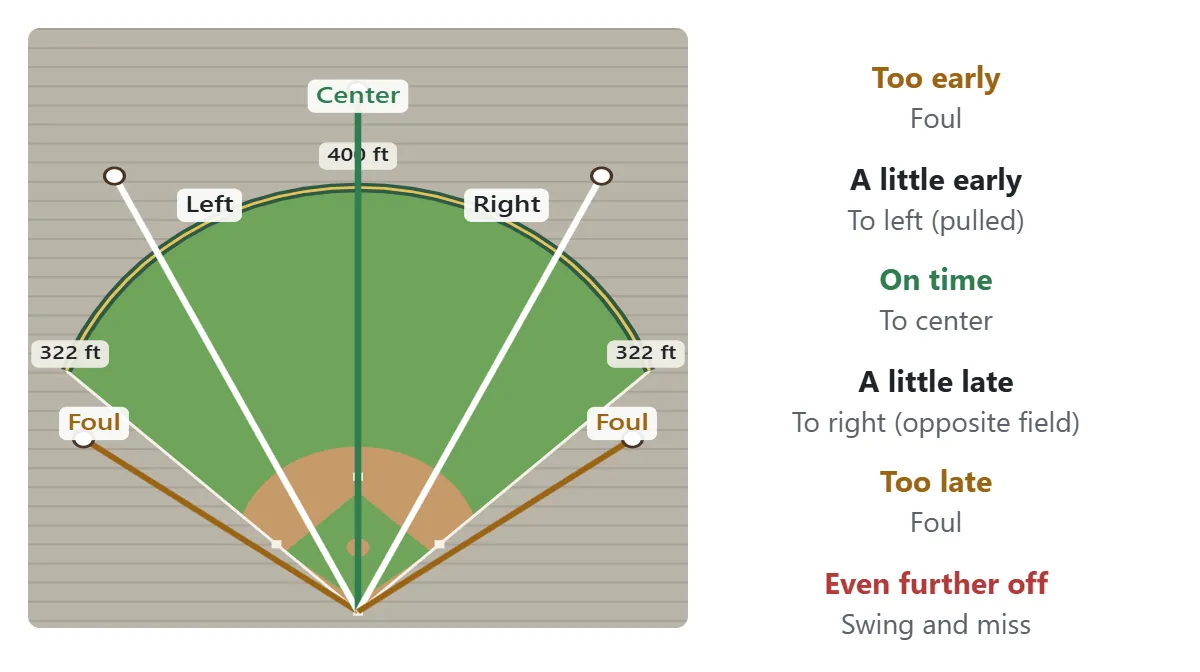
Your batter hits right-handed. Swing a little early and the ball is pulled toward left field. Swing a little late and it goes to right field. Swing on time and you get the strongest contact of all, straight back up the middle toward center field. If you are very early or very late, the ball curls outside the foul lines for a foul ball, and if you are further off still, you whiff. After every swing the game shows how early or late you were, down to the hundredth of a second, so you can correct on the very next pitch.
Where you put the bat decides the launch angle
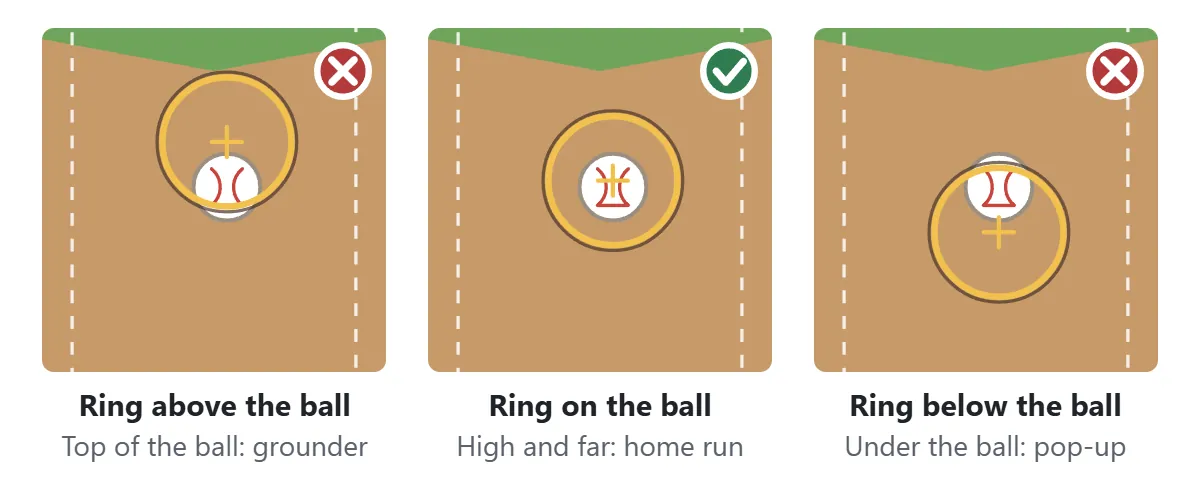
In the Timing + position swing mode, the yellow ring on the screen is where your bat will be. Move it with the mouse or the arrow keys (or W, A, S, D) and line it up with the ball as it comes in. On a touch screen, the bat goes to wherever you tap. Meet the ball in the middle and it leaves the bat at a good launch angle, high and far. If the ring is above the ball you chop the top of it into the ground; if it is below, you get under it and pop it up. Miss by too much and you swing through nothing. If you want to focus on timing alone, choose Timing only: the bat always meets the ball at the right height.
Pitchers mix up their pitches
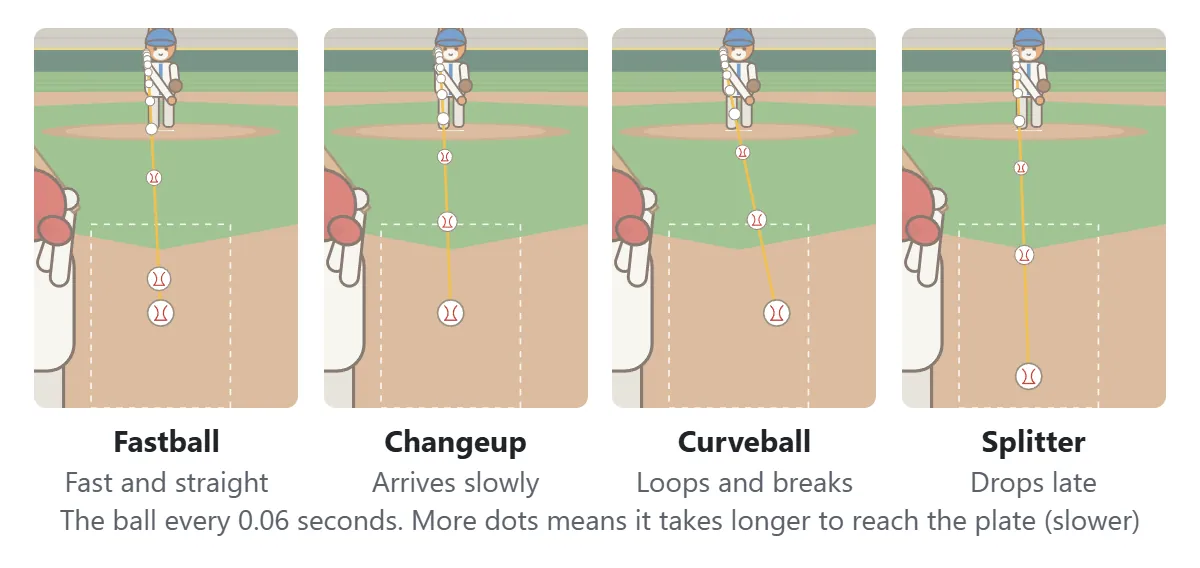
There are five pitches in the game. The fastball is straight and quick. The changeup comes out of the same arm action but arrives much more slowly, which is exactly why it fools you. The curveball loops up and bends down and away. The slider slides sideways with less drop. The splitter looks like a fastball most of the way, then falls off the table right in front of the plate. The pitch type and its speed in mph appear after each swing, so you can learn what beat you.
Clear the fence for a home run
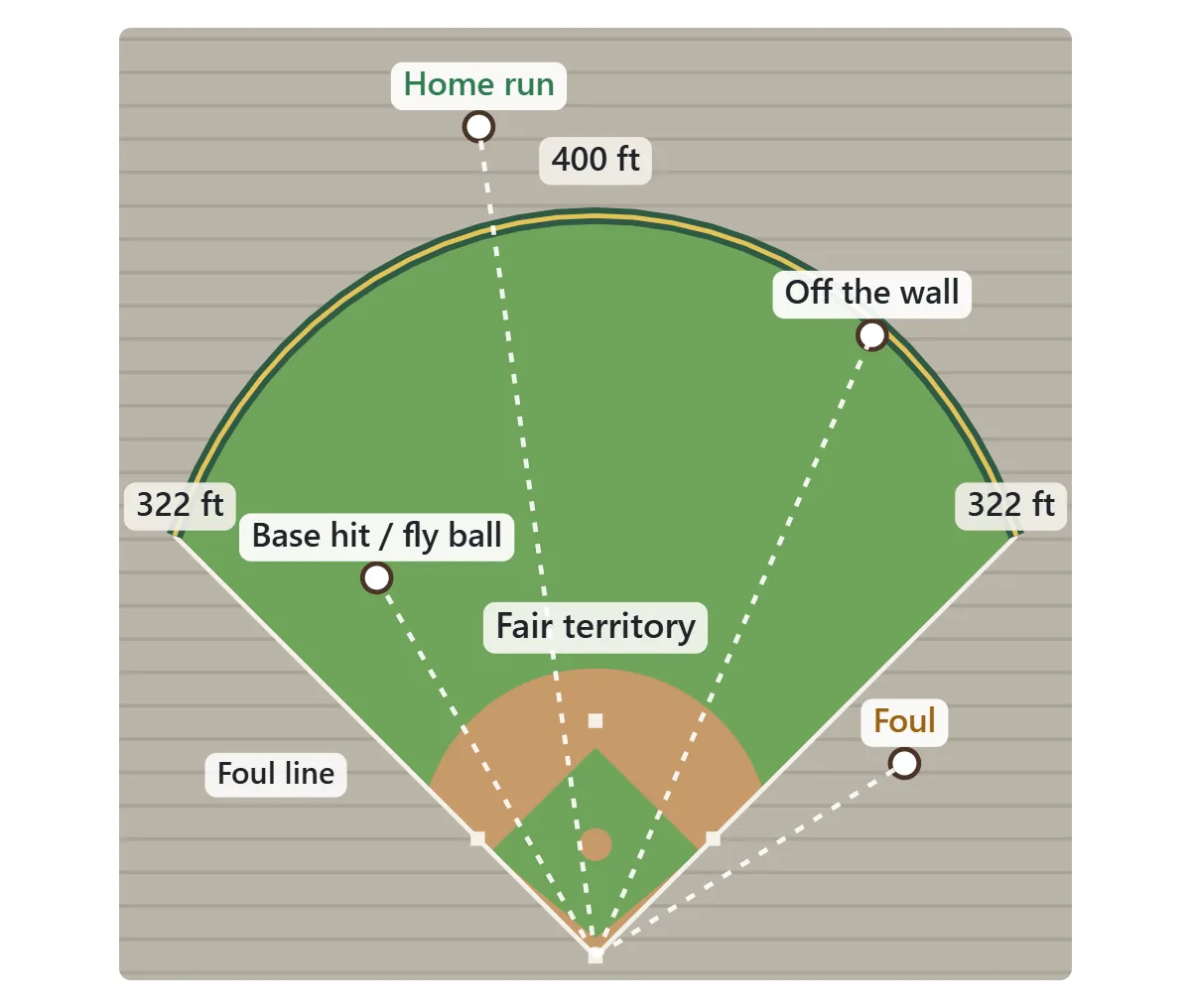
Once you make contact, the view switches to an overhead map of the field so you can watch the ball fly. The white lines running out from home plate are the foul lines; everything between them is fair territory. A ball that flies over the outfield fence in fair territory is a home run, and a ball that hits the foul pole counts too. The fence is about 320 feet away down the lines and 400 feet away in dead center, the same shape as a regulation big-league park. Balls that land short are shown as base hits or fly balls, and a ball that clangs off the wall is “off the wall.” None of those count toward your score. In a home run contest, only home runs matter.
Game modes and pitchers
| Mode | How it works |
|---|---|
| Ladder | Face the Rabbit, Tanuki, Fox, Bear and Eagle in order. Hit the target number of home runs in 10 swings to unlock the next pitcher. If you fall short, you can restart from any pitcher you have already beaten |
| Home Run Contest | Choose any pitcher and see how many you can hit in 10 swings. Your best home run count and total distance are saved for each pitcher |
| Daily challenge | A new pitcher each day throws the same 10 pitches in the same order to everyone. Play as often as you like; your best score of the day is kept |
| 2 players | Pass one device back and forth. Both players face the same pitcher and the exact same 10 pitches. Most home runs wins; if it is level, the longest home run breaks the tie |
| Pitcher | Pitches | What to expect |
|---|---|---|
| 1 Rabbit | Fastball only | About 50 mph, right down the middle. Learn your timing here (target: 2) |
| 2 Tanuki | Fastball, changeup | The occasional changeup messes with your timing (target: 2) |
| 3 Fox | Fastball, curveball, changeup | Adds a looping curveball (target: 3) |
| 4 Bear | Fastball, slider, changeup | A real jump in speed, about 65 mph, and moves the ball up and down (target: 3) |
| 5 Eagle | Fastball, splitter, curveball, changeup | The hardest thrower, with a splitter that dives late. The toughest out (target: 3) |
Tips for hitting more home runs
1. Use the windup as a metronome
The pitcher’s windup has the same rhythm every time. Count along silently, “one, two…”, and be ready to go on “three” as the ball leaves the hand. Hitters in real batting practice do something similar: they start their load with the pitcher’s motion so their swing is never rushed.
2. Commit before the ball is on top of you
There is a short delay between pressing and the bat reaching the plate, just as there is between a real hitter deciding to swing and the barrel getting there. If your misses keep saying “too late,” trust yourself and press noticeably earlier than feels natural.
3. Read the feedback after every swing
Each swing tells you why it went wrong: too early, too late, over the ball or under the ball. Fix one thing at a time. If you were early, wait a touch longer. If you swung over it, drop the ring slightly. Small corrections add up fast.
4. Stay back on the changeup
The changeup is thrown with the same motion as the fastball, so your body wants to swing at fastball speed. If the ball seems to take forever to grow, it is a changeup. Hold on for an extra beat before you swing.
5. Aim low for the splitter
The splitter drops sharply near the plate. Set the ring about one ball-width lower than where a fastball would be, and you will catch it on the barrel instead of swinging over the top.
6. Think center field first
Center field has the deepest fence, but it is also where your hardest contact goes, because it comes from perfectly timed swings. Aim to drive the ball back up the middle and the home runs tend to follow, to all fields.
Baseball batting game FAQ
Do pitches I don’t swing at count?
No. A round is 10 swings, and a pitch you take without swinging is not one of them. If a pitch looks awkward, feel free to let it go.
My taps feel late on my phone. Why?
The swing starts the moment your finger touches the screen, and the game uses the time your device registered the touch. Even so, some screens show the picture a little late. If you keep getting “too late,” simply press a little earlier than you think you should.
Can I stop and continue later?
Yes. On the same device and browser, press Continue to pick up where you left off, with your swings so far kept. A daily challenge can only be continued on the same day.
Can I pause the game?
Press the Pause button, or P or Esc on the keyboard. If you pause while a pitch is on its way, that pitch is thrown again when you resume. Switching to another tab or app pauses the game automatically.
How is this different from real baseball?
This is a home run hitting game, so there are no balls and strikes and no fielders. Anything that is not a home run, even a clean base hit, does not add to your score. The pitches are also much slower than in professional baseball, so that anyone can learn to time them.
Why are distances in feet?
Ballpark fences are usually marked in feet, so the English version shows distances in feet and pitch speeds in miles per hour. A 400-foot shot to center is a genuine blast.
About home run contests
A home run contest is about as simple as baseball gets: one hitter, one pitcher and a fixed number of swings or a time limit. Whoever hits the most balls over the fence wins. Contests like this are a favorite at all-star weekends, charity events and youth camps, because even people who do not follow the sport can enjoy the sight of a ball sailing out of the park. The usual rule is that every swing that is not a home run is an out, while a pitch you take does not count, and that is the rule this game uses.
In most real contests the pitcher is a friendly coach lobbing easy strikes. Here the pitchers are trying a bit harder: they change speeds and throw breaking balls, so to climb the ladder you need both timing and bat placement. Start with the Rabbit’s straight fastballs to find your rhythm, then work your way up to the Eagle and its late-diving splitter.