 Yorimichi Games
How to play Old Maid
Old Maid is one of the simplest card games there is, and one of the oldest that people still play. Everyone holds a hand of cards, and on your turn you take one card, unseen, from your neighbor. Whenever you have two cards of the same rank, you throw them away as a pair. Every card in the deck has a partner except one, so as the pairs disappear, a single unmatched card is left going round the table. Players drop out as their hands run empty, and whoever is left holding that last odd card at the end loses the game.
There is almost nothing to learn: if you can tell a 7 from a 9, you can play. What makes it fun is the little bit of bluffing at the end, when the odd card is somewhere in a hand of two or three cards and you have to guess which one to take. On this page you play against one to four computer opponents. You can use the classic rule, where one queen is taken out of the deck, the joker version that is popular in Japan and elsewhere, or a “hidden card” version in which nobody knows which card is the odd one.
The table
Old Maid rules
1. Deal everything, then discard your pairs
The dealer shuffles and deals the whole deck, one card at a time, starting with the player after the dealer. With some numbers of players the cards don’t divide evenly, so a few people get one extra card; that is fine. Once the deal is over, everyone looks through their hand and throws away every pair they already hold. A pair is two cards of the same rank, and the suits don’t matter. If you have three of a rank, discard two and keep the third. If you have all four, that is two pairs and they all go.
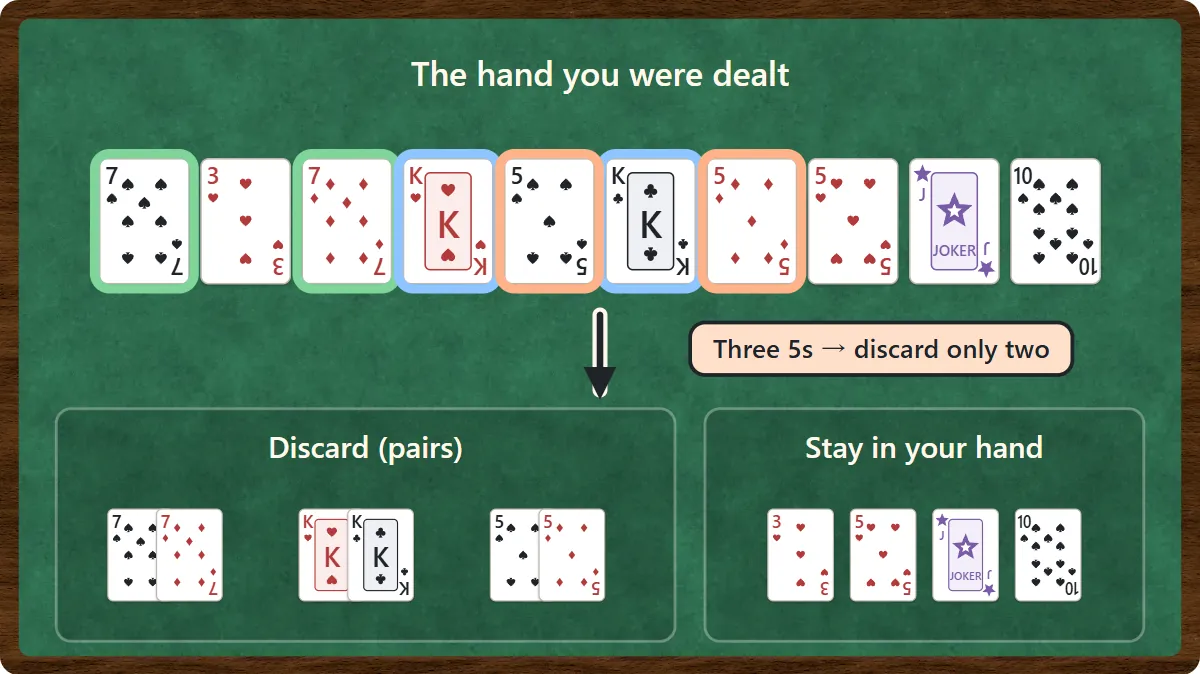
Very occasionally a player is dealt nothing but pairs and has an empty hand before play even begins. That player is out at once, in first place.
2. Take one card from your neighbor
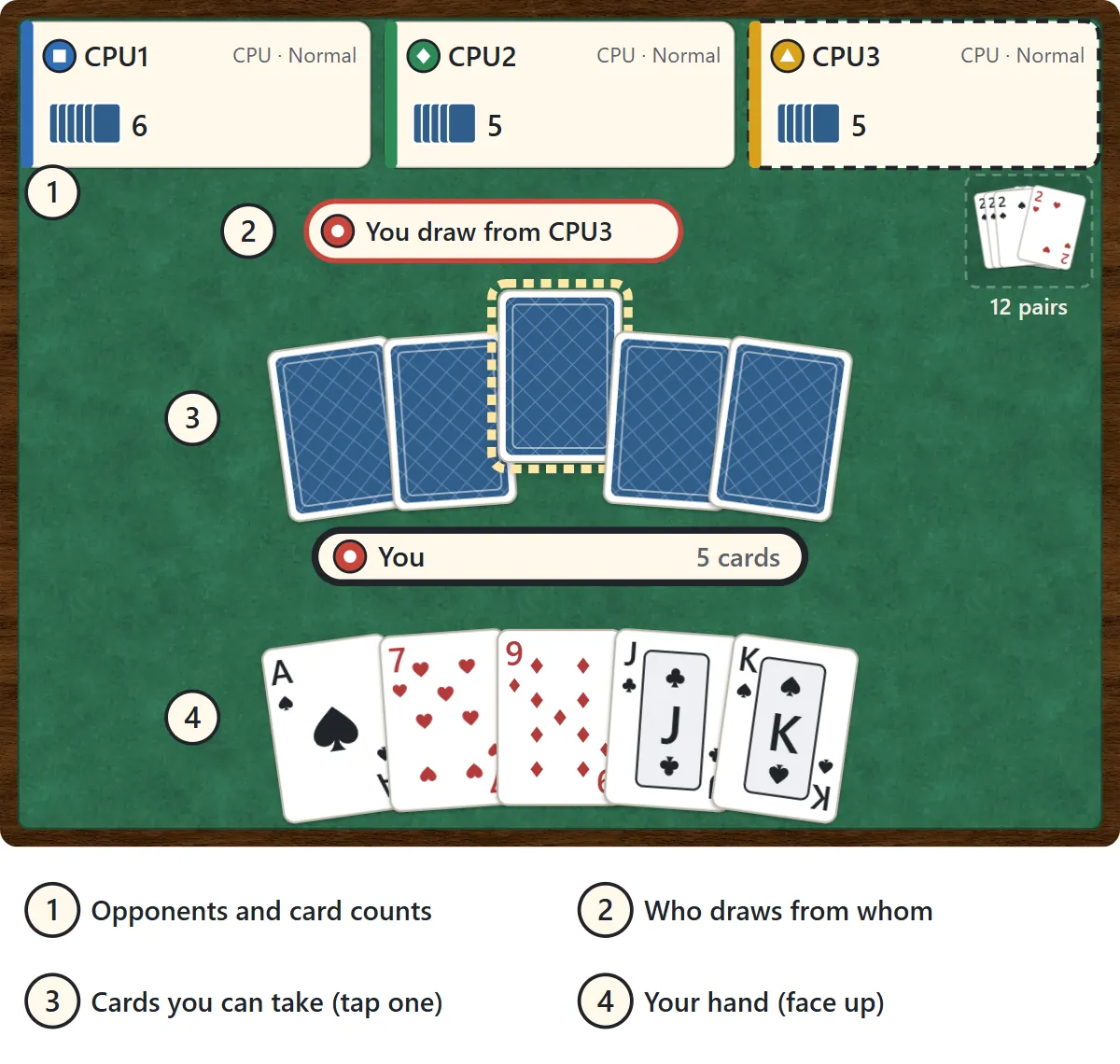
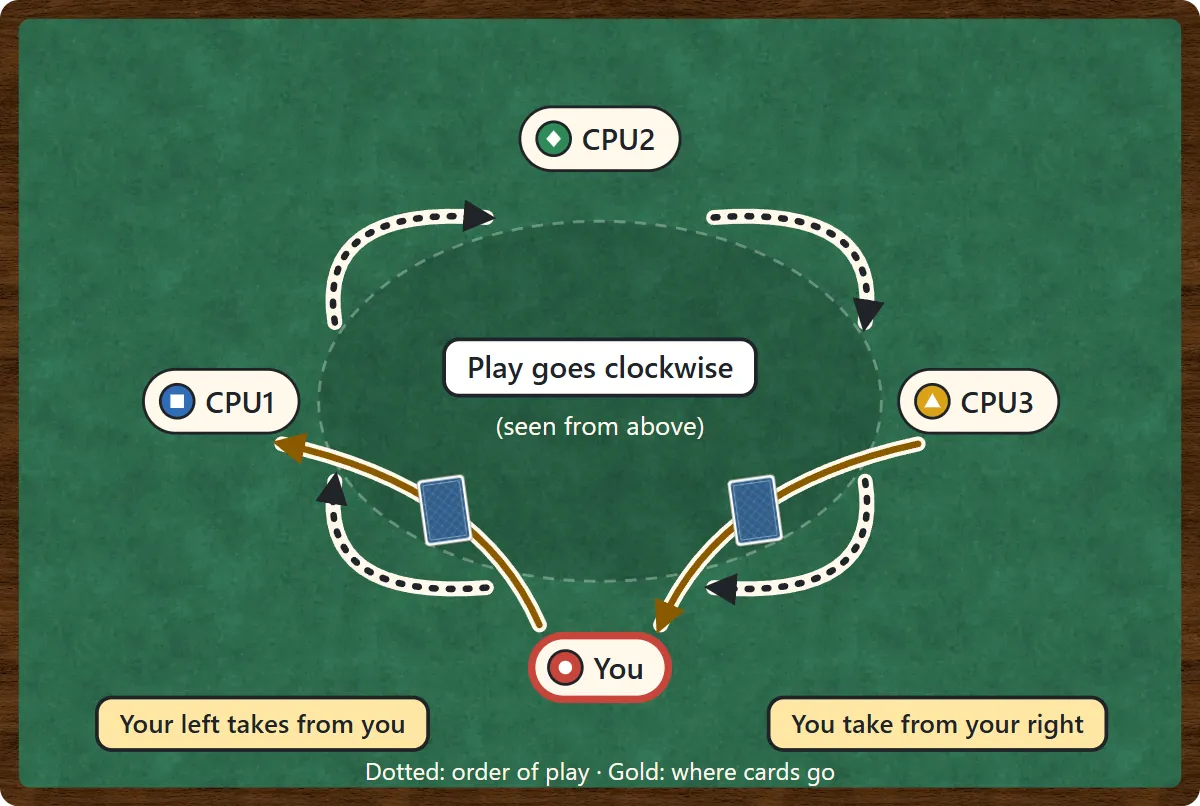
Play starts with the player after the dealer and goes clockwise. On your turn, you take one card, face down, from the hand of the player on your right, who is the player whose turn came just before yours. Your own hand, in turn, is taken from by the player on your left. The first player therefore takes a card from the dealer.
In this game the hand you are taking from is fanned out in the middle of the table. Tap the card you want. It lifts up, turns face up and flies into your hand. With a mouse, the card under the pointer lifts as you move across the fan, so you can hover and hesitate before you commit.
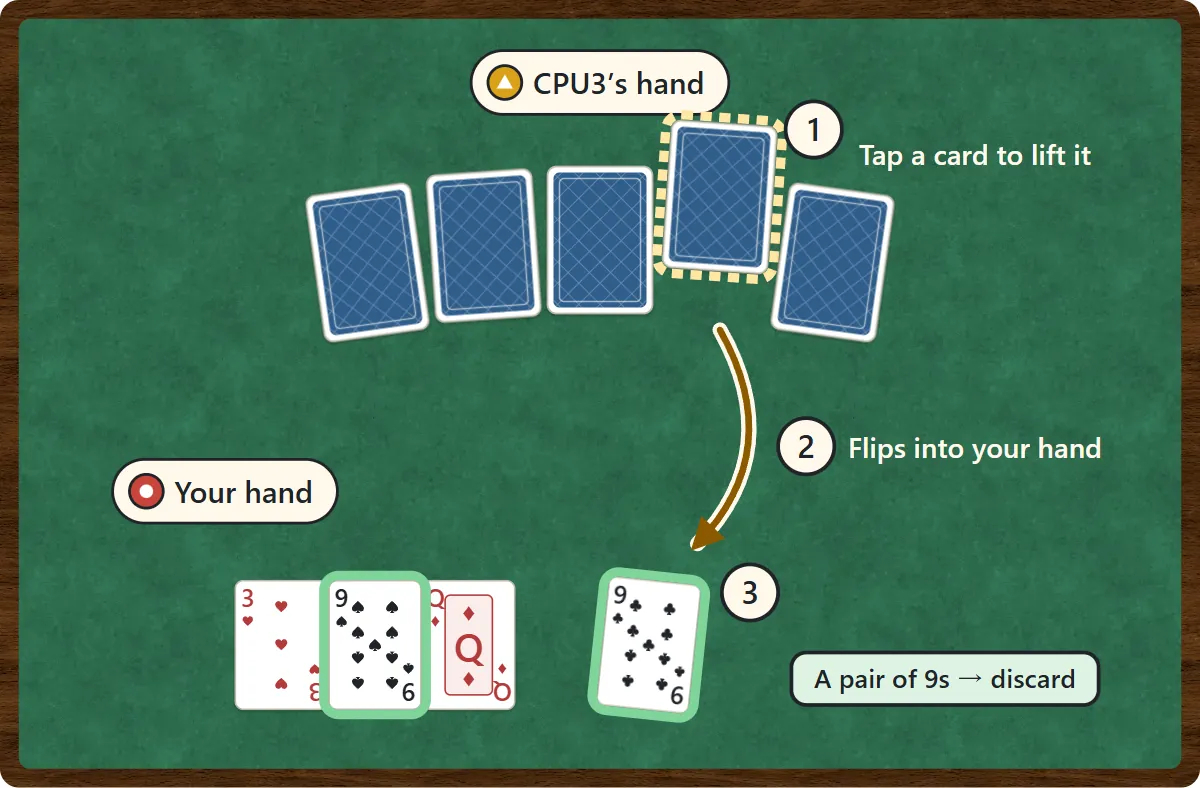
If the card you took pairs with one already in your hand, both are discarded at once. If not, it simply joins your hand and the turn passes. When a computer player takes a card, it hovers over a few of them before it decides, just like a real person would. When it takes from you, your own cards lift one by one, so you can watch it circle around the card you are hoping it will pick.
3. Empty your hand to go out
When you have no cards left, you are out: first place, second place, and so on, in the order players empty their hands. You also go out when somebody takes your very last card. Players who are out are skipped from then on.
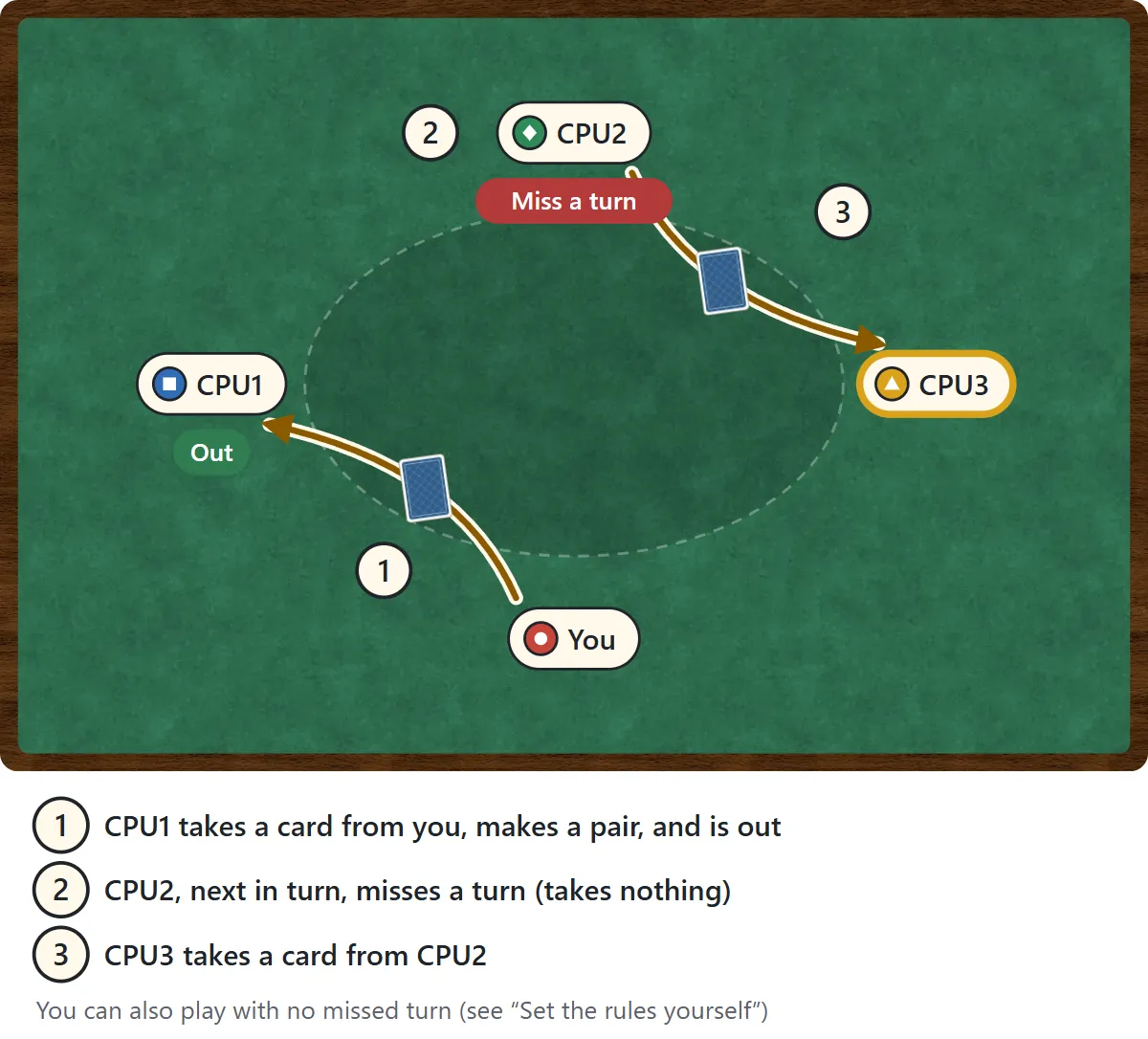
There is one small situation to know about. If the player who just took a card goes out by making a pair, the next player can’t take from them, because they have nothing left. In this game the next player then misses a turn, and the player after that takes from the one who missed. If you would rather the next player simply took a card from the player before, you can change that under “Set the rules yourself”.
4. The last player holding the odd card loses
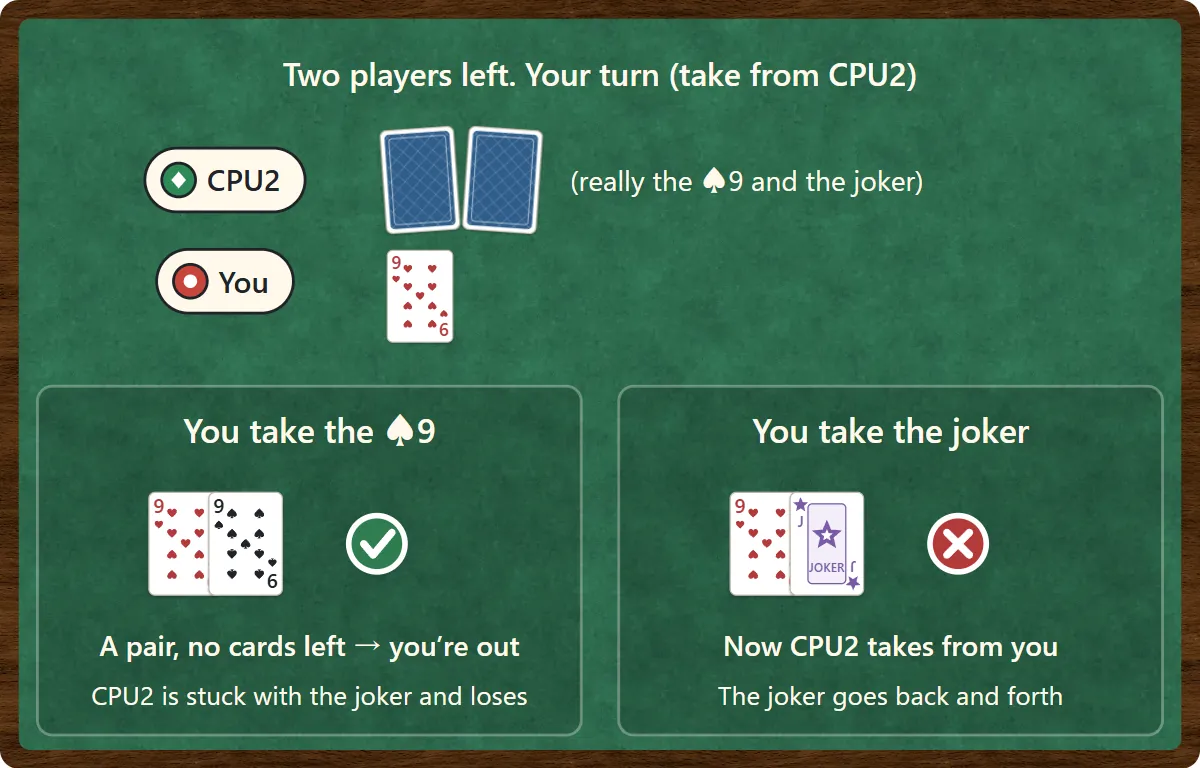
The game ends when only one player still has cards. What remains in that hand is the odd card, and that player loses; they are the “old maid”. The best moment comes when only two players are left. If your opponent holds two cards and one of them is the odd card, it is a straight fifty-fifty guess, and a wrong guess sends the odd card into your hand, ready to bounce back and forth.
Old Maid variations: queen, joker or hidden card
Everybody agrees on the pairs and the drawing, but not on which card is left over at the end. This game lets you pick from three well-known versions, or mix the rules yourself.
| Version | Deck | The losing card |
|---|---|---|
| Classic | 52 cards minus one queen (51) | The queen that can’t be paired |
| Joker | 52 cards plus one joker (53) | The joker |
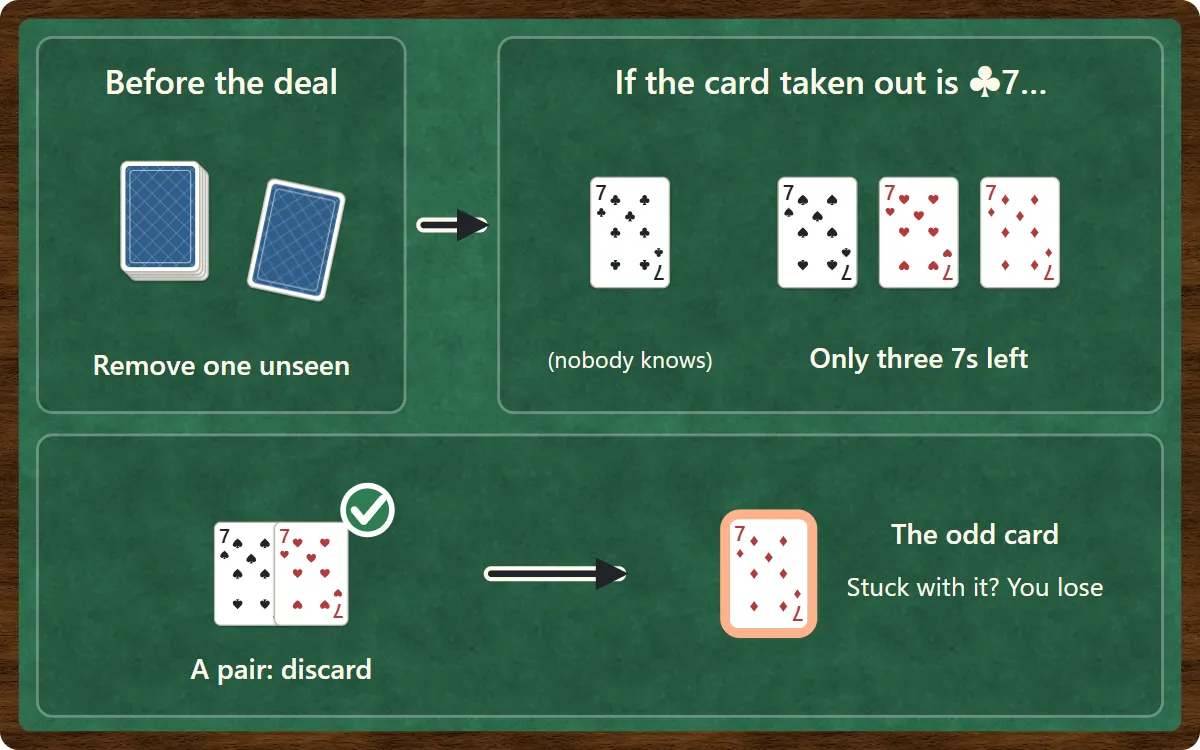
| Hidden card | 52 minus one card nobody sees (51) | The partner of the missing card, unknown until the end |
Classic Old Maid (one queen removed)
This is the original English and American game and the one this page starts with. Before the deal, one queen is removed, traditionally the queen of clubs. That leaves three queens, so two of them will pair up and the third can never be matched. Whoever holds that last queen at the end is the Old Maid. Once a pair of queens has been discarded, everyone at the table knows exactly which card to avoid.
Joker
Instead of removing a queen, one joker is added to a full deck. The joker matches nothing, so whoever holds it at the end loses. This is how the game is normally played in Japan, where it is called Babanuki, and many families elsewhere play it this way too, because the joker is easy to recognize for young players. The downside is that the person holding the joker always knows it, which makes their face worth watching.
Hidden card
No joker and no queen are removed on purpose. Instead, one card is taken out at random, face down, before the deal, and nobody looks at it. Its three partners go into play, two of them pair up, and the third one becomes the odd card. The trouble is that nobody knows which rank it is. The only clues are the pairs that have been discarded, and the answer may not be clear until the very last turn. In Japan this version is called Jiji-nuki. When the game ends, the hidden card is turned face up so you can see which rank it was.
Custom rules
Under “Set the rules yourself” you can change three things one at a time:
- The odd card: one joker, one card removed unseen, a joker plus one card removed unseen, or one queen removed. With the joker and a hidden card together there are two cards that can’t be paired, which makes for a long, tense game.
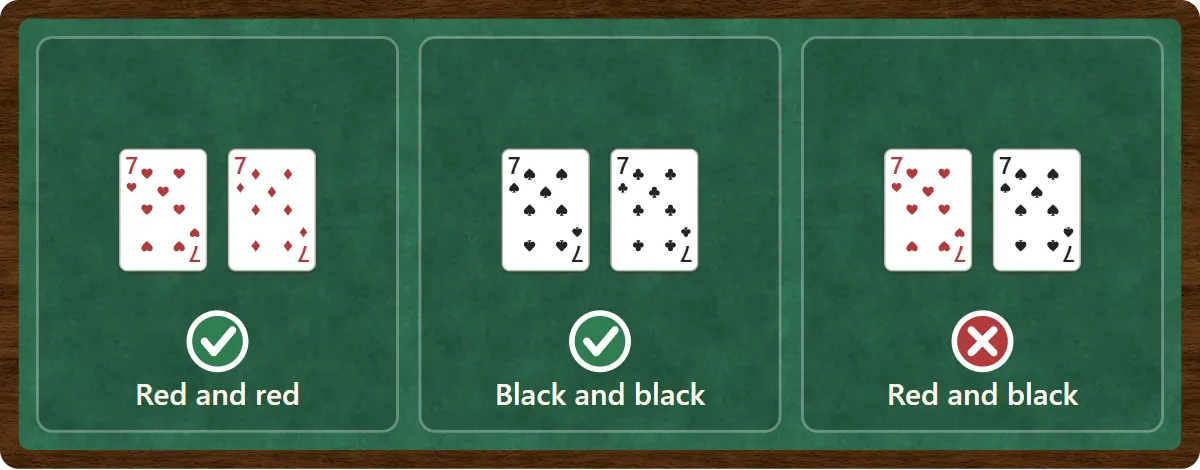
- What makes a pair: the same rank (the usual rule), or the same rank and the same color, so that red pairs with red and black with black. Some families play this way, and it makes games last longer because pairs are harder to complete.
- After a player goes out on a draw: the next player misses a turn (the default), or takes a card from the player before instead. Families differ on this, so choose whichever you grew up with.
One more difference you may notice: many English rule books have you offer your hand to the player on your left, while this game has you take from the player on your right. It is the same game either way. Only the direction the cards travel around the table changes.
Old Maid strategy and tips
Old Maid is mostly luck, but a few habits really do help, and they matter more against the Hard computer, which pays attention to how you play.
1. Shuffle your hand after you take the odd card
When the odd card lands in your hand, press Shuffle. Everyone can see where the new card went in, just from the backs of the cards. If you leave your hand as it is, a sharp opponent can remember the spot and avoid it. Shuffling puts the odd card anywhere again.
2. Don’t always pick the same spot
If you always take the card on the far right, or always the one in the middle, an opponent who notices can put the odd card somewhere you never pick. Vary where you take from: an end, the middle, somewhere in between.
3. Use the discards in the hidden-card game
With a hidden card, the discard pile is your best clue. If a pair of some rank has already been discarded and you are still holding a card of that rank, it could well be the odd card. Keep track of which ranks have been paired and how many of each could still be out there.
4. Watch the card counts
Each opponent’s card count is shown at the top of the table. The odd card never pairs, so it tends to stay behind while the other cards disappear. The fewer cards someone holds, the more likely it is that one of them is the odd card; a big hand makes it less likely.
5. Keep calm in the last two
If you hold the odd card with one opponent left, all you can do is let them take from you. Shuffle, so nothing gives away its position, and hope. If your opponent has it and holds only two cards, you have an even chance of going out on this turn.
Old Maid FAQ
How many players do you need?
Here you can play with two to five players: you plus one to four computers. Two-player games work, but you can usually work out what the other hand holds, so three or more players is more fun.
Do you take from the left or from the right?
It depends on who taught you. In this game turns go clockwise and you take from the player on your right, the one whose turn was just before yours. Many English books describe offering your cards to the player on your left, which is exactly the same thing seen from the other side. Nothing about the game changes.
What if I have three cards of the same rank?
Discard two of them and keep the third. With all four, you discard both pairs.
Which queen is removed in the classic game?
Traditionally the queen of clubs, though any one queen works just as well: the point is that the queens can’t all pair up. This game removes one queen for you before the deal.
Who starts?
The player after the dealer goes first and takes a card from the dealer. The dealer is chosen at random, and the game tells you who starts before the first turn.
Can I see the hidden card afterward?
Yes. It stays secret during the game, but it is turned face up at the end, next to the cards the loser was holding, so you can see how it all worked out.
How strong are the computer levels?
Easy is gentle and a good place to start. Normal takes cards more or less at random, like a casual player. Hard keeps track of the odd card after passing it on, and if you keep picking from the same spot, it will put the odd card there. Because the game is mostly chance, you will still beat every level often.
Can I play with a keyboard?
Yes. On your turn, use the left and right arrow keys to choose a card, then press Enter or Space to take it. Press M to shuffle your own hand.
Where Old Maid comes from
Old Maid has been played in English-speaking countries since at least the 1800s, and American card game books from the 1830s already describe a game of discarding pairs and avoiding the unmatched queen. Very similar games turn up all over Europe. In Germany it is Schwarzer Peter (Black Peter), in which the card to avoid is a special Peter card, and in France the same idea goes by names such as Vieux Garçon (“old boy”), with a jack as the card to avoid in some versions. These games were so popular that many were sold with special decks of illustrated cards made just for them.
The game reached Japan in the late 1800s, and it appears in Meiji-era books of games under a Japanese name meaning “removing the old woman”. Over time Japanese players took to using the joker as the odd card, and today the joker version, ババ抜き (Babanuki), is probably the first card game most Japanese children learn. The hidden-card version, ジジ抜き (Jiji-nuki, “removing the old man”), grew up alongside it. Whichever version you try here, the rules on this page will feel familiar within a round or two.