 Yorimichi Games
How to play air hockey
Air hockey is played on a smooth table with a goal slot at each end. Each player holds a mallet – a round handle with a flat base – and uses it to strike a light plastic disc called the puck. On a real table, thousands of tiny holes blow air upward, so the puck floats on a thin cushion and glides with almost no friction. This online version shows the table from directly above. Your mallet is the red one at the bottom; the computer (or your friend, in a two-player game) uses the blue mallet at the top. Put the puck into the goal at the far end and you score one point. Whoever reaches the chosen winning score first takes the match.
Move your mallet and hit the puck
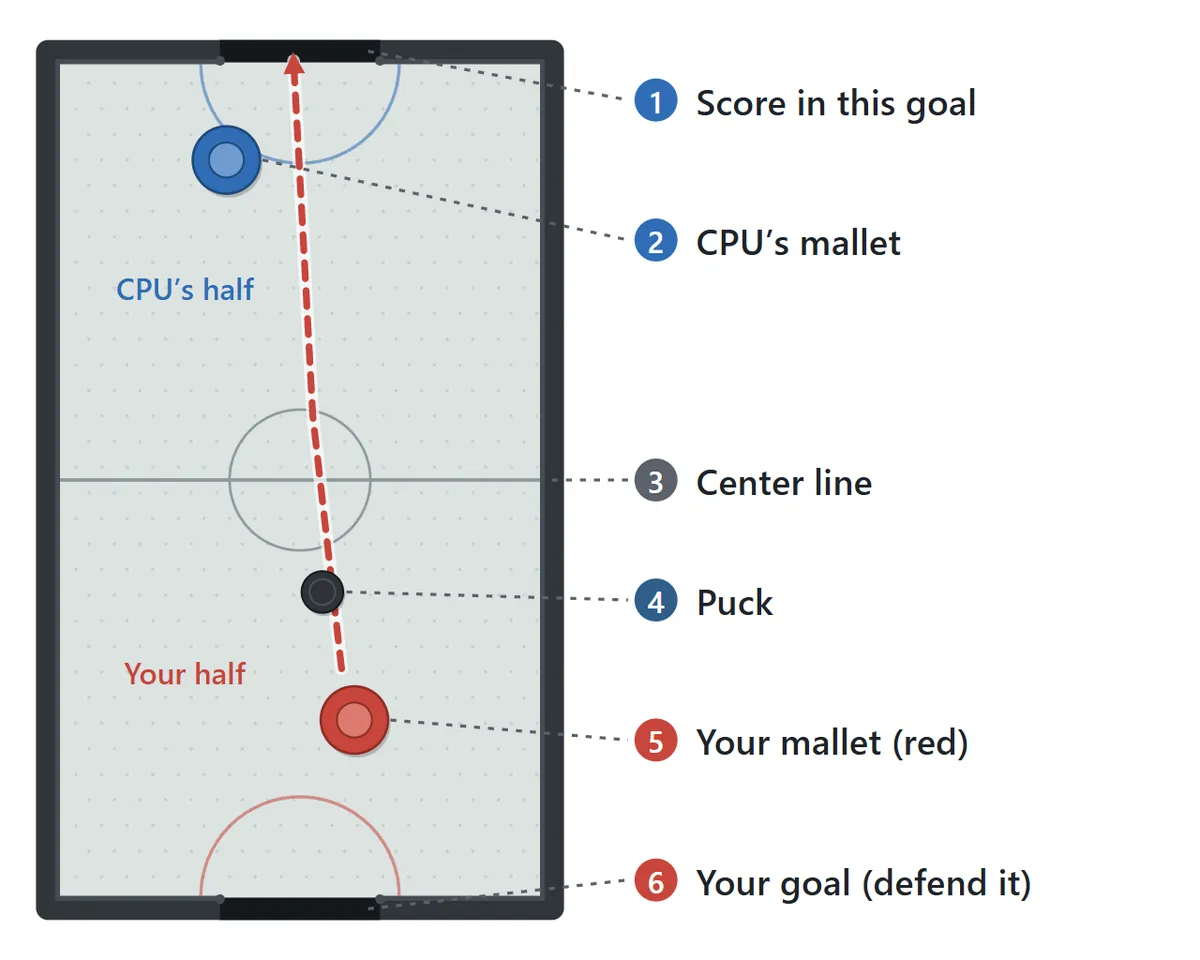
With a mouse, simply move the pointer over the table and your mallet follows it. On a phone or tablet, slide your finger anywhere on the screen. The mallet does not have to be under your finger – it moves by the same amount you slide, so your hand never hides the puck, and it keeps following until you lift your finger, even if you drift off the edge of the screen. On a keyboard, use the arrow keys or W, A, S, D. A mallet has a top speed, just like a real arm, so if you whip the mouse across the table the mallet will chase it for a split second rather than teleport.
Mallet speed becomes puck speed
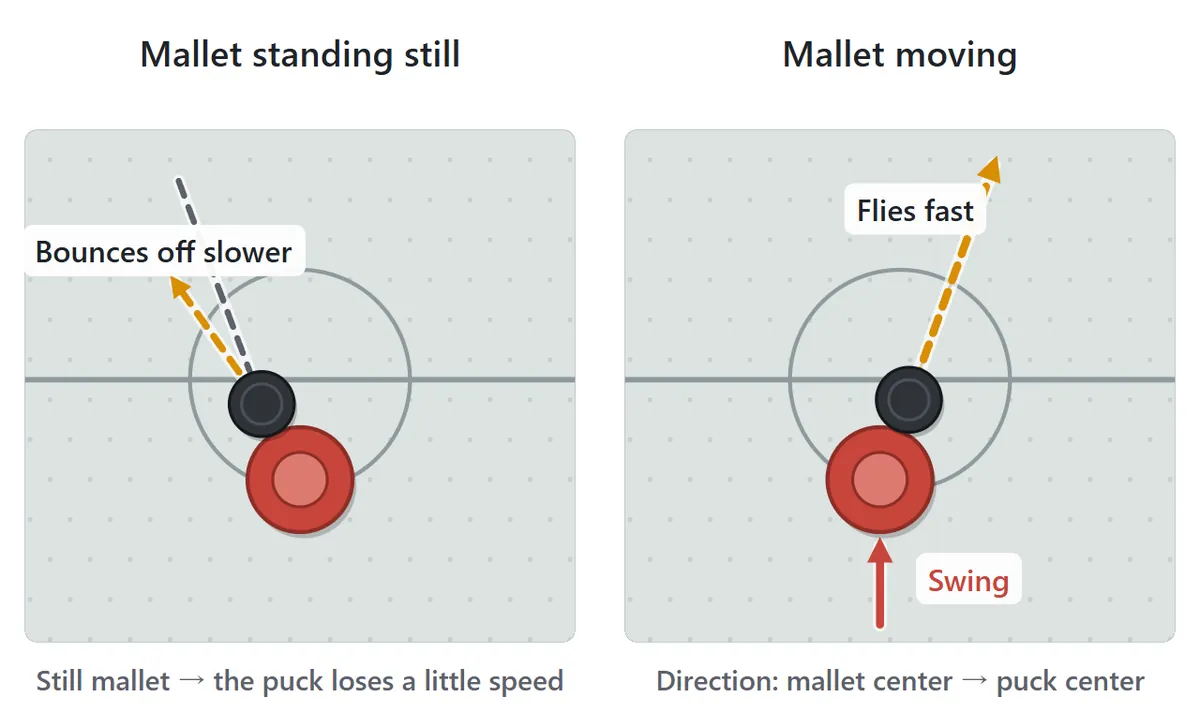
Where the mallet touches the puck decides where the puck goes. It always travels along the line running from the center of the mallet through the center of the puck, so hitting it squarely from behind sends it straight ahead, and catching it slightly off-center sends it at an angle. A mallet that is standing still acts like a soft wall: the puck rebounds and loses a little speed. A mallet that is moving toward the puck adds its own speed to the shot. That is the whole secret of a hard shot – swing through the puck instead of just touching it.
The puck bounces off the walls
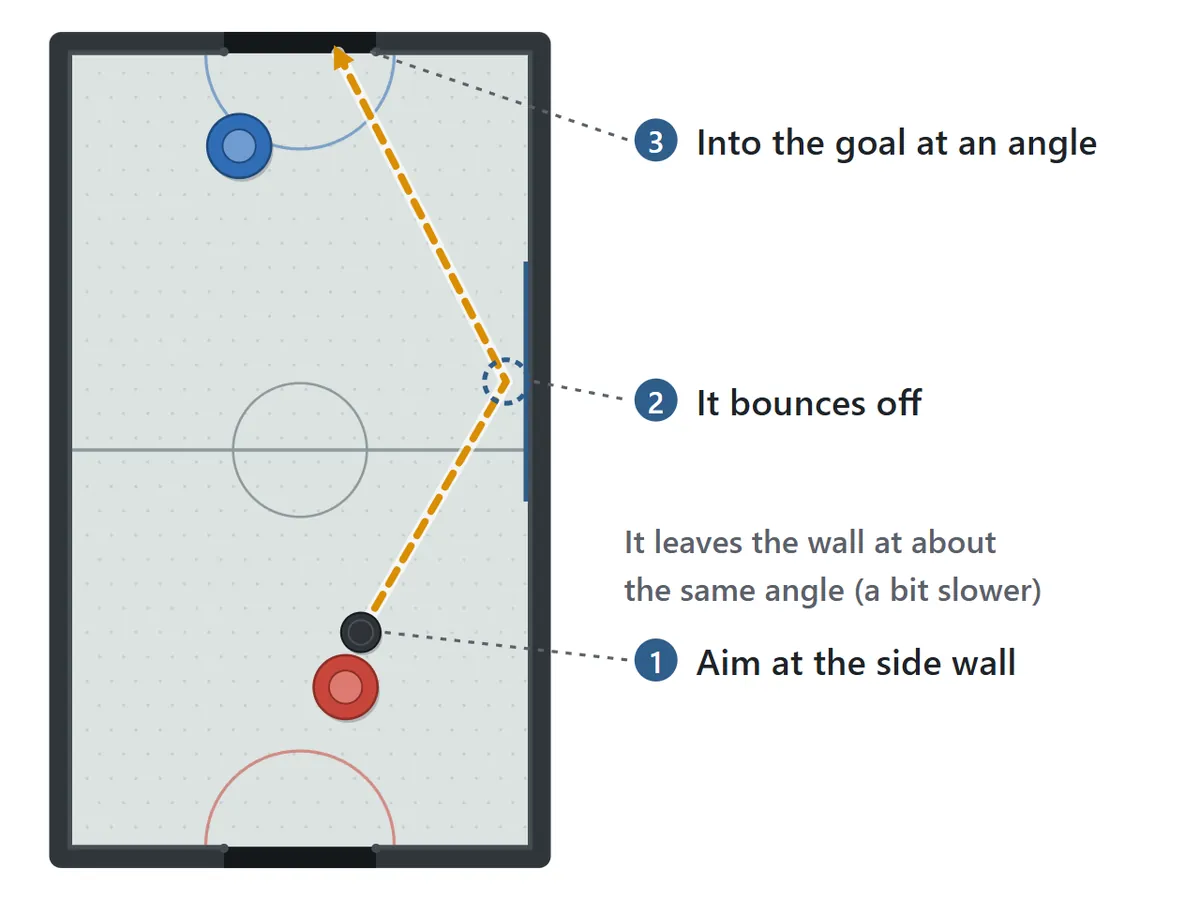
The table is surrounded by rails, and the puck bounces off them at roughly the same angle it came in. Players call a shot that uses a rail a bank shot. When your opponent is guarding the straight line to the goal, banking the puck off a side rail lets it arrive from an angle they are not covering. The surface is nearly frictionless, so the puck slows down only a little as it slides and rarely stops by itself.
Air hockey rules: your half and the 7-second rule
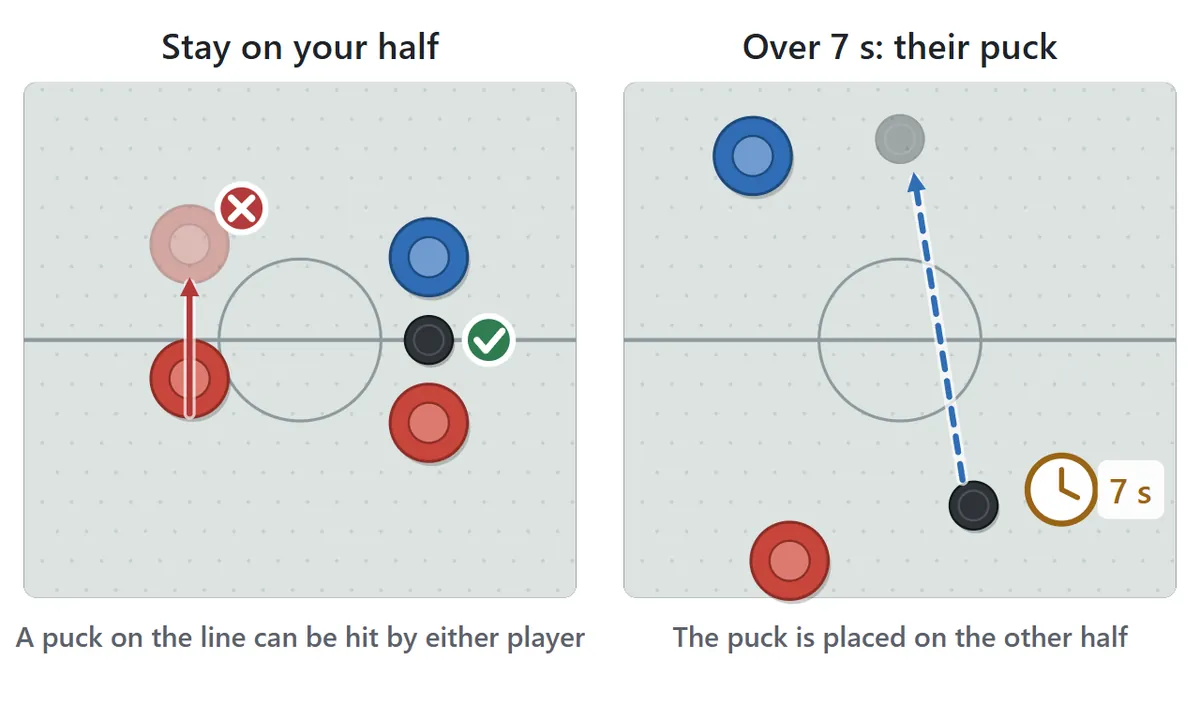
Your mallet can move only inside your own half of the table – the part between the center line and your goal. You cannot reach over to hit a puck that is on the other side; you have to wait for it to come back. A puck that is sitting exactly on the center line is fair game for both players. You also may not hold on to the puck. If it stays in your half for more than seven seconds without crossing the line, that is a foul and the puck is handed to your opponent. When three seconds remain, a countdown appears on the table and in the bar above it. Pinning the puck against a rail with your mallet counts toward the same seven seconds.
After a goal, the player who conceded restarts
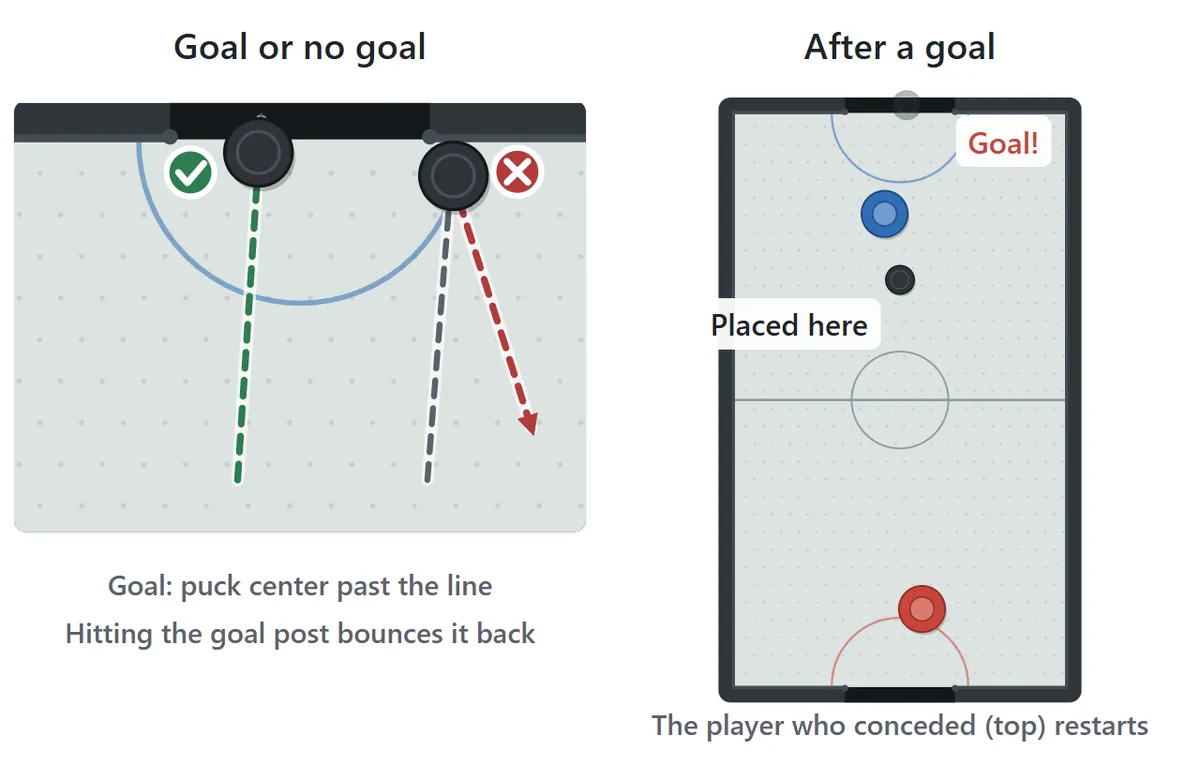
A goal counts as soon as the center of the puck passes the goal mouth. If you knock the puck into your own goal – even by accident, off a rebound – the point goes to your opponent. After every goal the puck is placed in the half of the player who was scored on, and that player puts it back into play (there is a ten-second limit to do so). At the very start of the match, a coin toss decides who gets the puck first.
Game options: CPU levels, 2 players and settings
| CPU level | What it feels like |
|---|---|
| Easy | A little slow to spot the puck and to get back in front of its goal. A good first opponent. |
| Normal | Tries to stop most shots and now and then plays a bank shot. For players who know the controls. |
| Hard | Returns to defense quickly, aims accurately and banks the puck often. A real test. |
Every level of the computer sometimes misreads a bounce, steps the wrong way or rushes forward and leaves the goal open, so keep shooting – chances will come. Choose “2 players” to play head-to-head on a single device: one person uses the bottom half of the screen and the other the top half. Put a phone or tablet flat on the table between you and each slide a finger on your own side; the game tracks both fingers at once. On a computer, the bottom player uses the mouse or arrow keys and the top player uses W, A, S, D. You can play to 3, 5 or 7 goals and pick a slow, normal or fast puck. Seven goals is the target used in most tournaments.
Air hockey tips and strategy
1. Wait in front of your goal
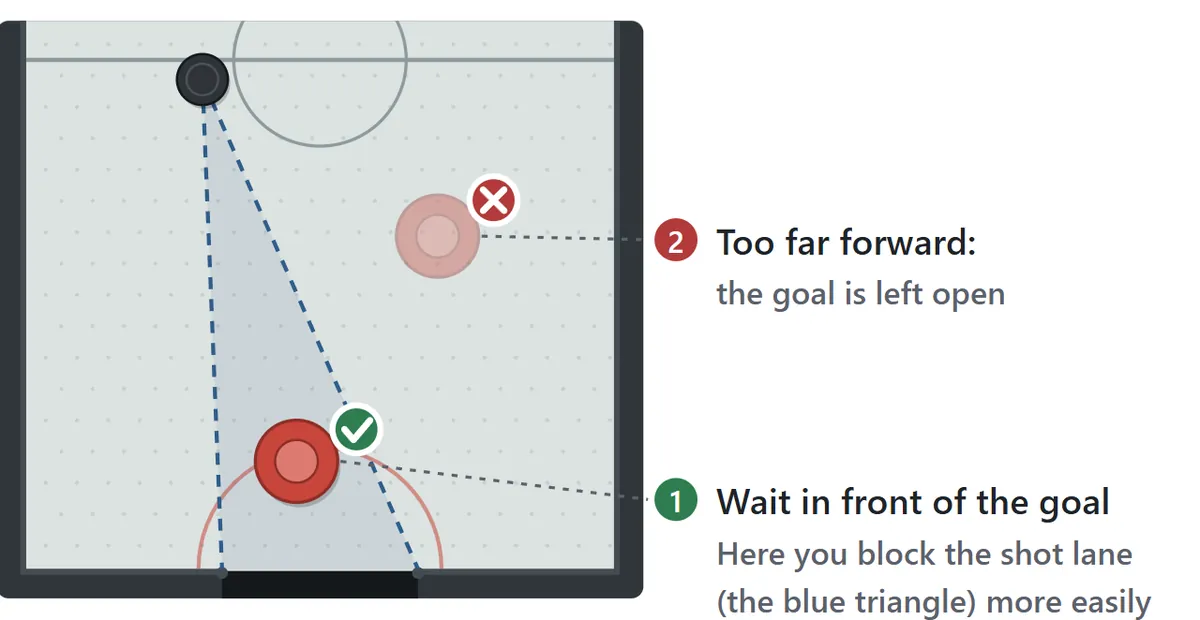
New players tend to chase the puck all over the table, and that is exactly when goals go in behind them. While the puck is in your opponent’s half, bring your mallet back to a spot a little in front of the middle of your goal. From there, a small step left or right is enough to block a straight shot. Think of it as a home position you return to after every hit.
2. Read where the puck is going
Instead of following the puck itself, watch its line and move to where it will arrive. With a rebound off a rail, picture the path after the bounce – once you can see the angle, you can get there early and meet the puck calmly rather than lunging at it.
3. Get behind a slow puck before you hit it
If you approach a slow or stopped puck from the front, you can easily push it back toward your own goal. Circle around so that you are between the puck and your goal, then move forward through it toward the far end.
4. Placement beats power
Even a very fast shot will be stopped if it goes straight at the other mallet. Aim for the side the defender is not covering, or for the corners of the goal. A medium-speed shot into open space scores more often than a rocket into the goalie.
5. Use the rails
When your opponent is sitting on the straight line, try a bank shot off a side rail so the puck arrives from an angle. Once you get a feel for how it rebounds, the number of targets you can hit grows a lot. Mixing straight shots and bank shots keeps the defender guessing.
6. Use your seven seconds
When the puck stops in your half, you do not have to hit it right away. It stays yours for seven seconds, so set up your mallet, pick a target and then shoot. Just remember to hurry once the three-second countdown appears.
Air hockey FAQ
Can the puck pass through a mallet?
No. Even when the puck and the mallets are moving very fast, their movement is checked in tiny steps, so if the puck touches a mallet anywhere along its path, it will hit it.
Why doesn’t the mallet stick exactly to my mouse or finger?
Mallets have a top speed. If you move the mouse or your finger in one jump, the mallet follows at that speed instead of appearing at the new spot – a real mallet can only move as fast as your arm, too. Start moving a moment earlier and you will be in place in time.
In a two-player game, what happens if my finger crosses into the other half?
The mallet you control is decided by where your finger first touches: the lower half moves the red mallet and the upper half moves the blue one. If your finger then slides into the other half or off the screen, it keeps moving your own mallet until you lift it.
Can I stop and continue later?
Yes. On the same device and browser, press “Continue” to pick up with the score as it was. The puck is placed in the half where it was when you stopped. You can pause at any time with the Pause button or the P or Esc key, and the game also pauses by itself when you switch to another tab or app.
Is there sound?
The game starts muted. Press “Sound: off” to turn on the click of the mallet, the knock of the rails and the goal sounds.
How is this different from a real table?
A few things are simplified for the screen. The puck never flies off the table, a coin toss replaces the face-off at the start, and of course you cannot top the puck with your mallet or touch it with your hand.
Where does air hockey come from?
Air hockey is usually credited to a group of engineers at an American company that made billiard tables, who worked on the idea around 1969 to 1972. Their goal was a table that floated a puck on air so that people could enjoy the quick back-and-forth of ice hockey on a tabletop. The game became a fixture of arcades, bowling alleys and game rooms all over the world, and many people remember their first match against a friend or a parent. In the United States there are associations and organized tournaments, where matches are commonly played to seven goals. This browser version keeps the core of that experience – a fast puck, rebounds off the rails and the race back to defend your goal – so you can play a quick game anywhere.