 Yorimichi Games

How to Play 2048
This is a single-player sliding tile puzzle played on a small grid of numbered tiles. Each move pushes every tile on the board in one direction. Whenever two tiles with the same number bump into each other, they merge into a single tile worth their sum: 2 and 2 make 4, 4 and 4 make 8, 8 and 8 make 16, and so on. Keep doubling and you will eventually build the 2048 tile, which is the goal on the classic 4×4 board. There are only three rules – slide, merge, and a new tile appears – so you can start playing in seconds. The depth comes later, once you start thinking about where your biggest numbers should live.
1. Slide every tile in one of four directions
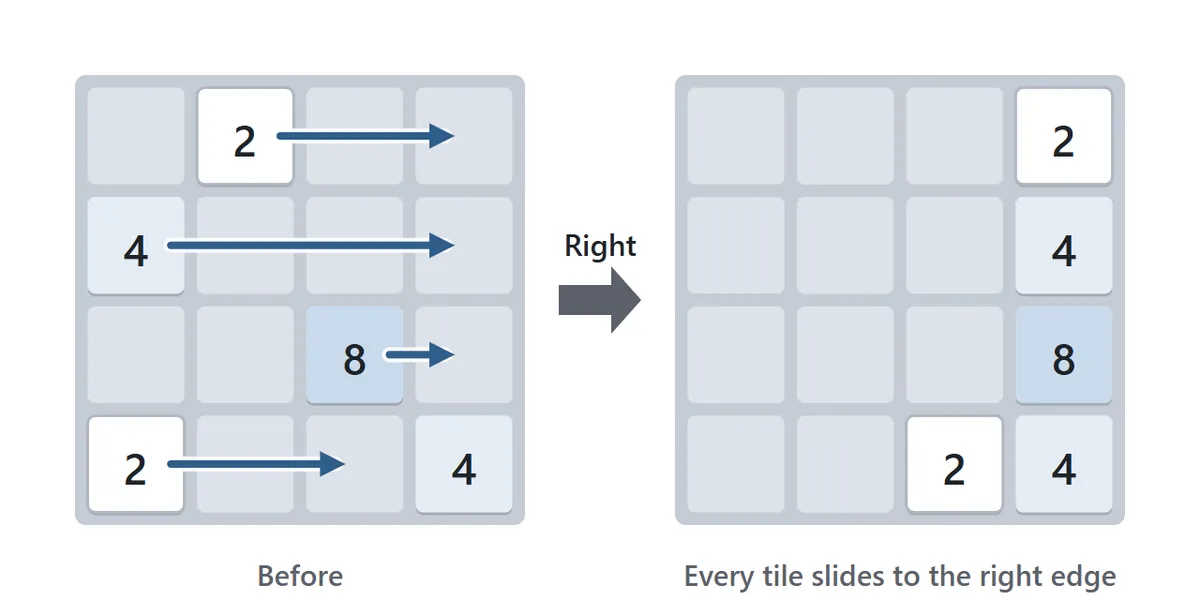
On each turn you choose up, down, left or right. All the tiles on the board move together in that direction until they hit the edge of the grid or another tile. You can’t move just one tile. On a phone or tablet, swipe across the board; on a computer, use the arrow keys or W, A, S and D. The four arrow buttons under the board work too, with a mouse or a finger.
A direction in which nothing can move is not a legal move. For example, if all the tiles are already packed against the left edge and no two neighbors match, sliding left does nothing. The board gives a little shake to tell you to try another direction, and no new tile appears.
2. Equal numbers merge into one
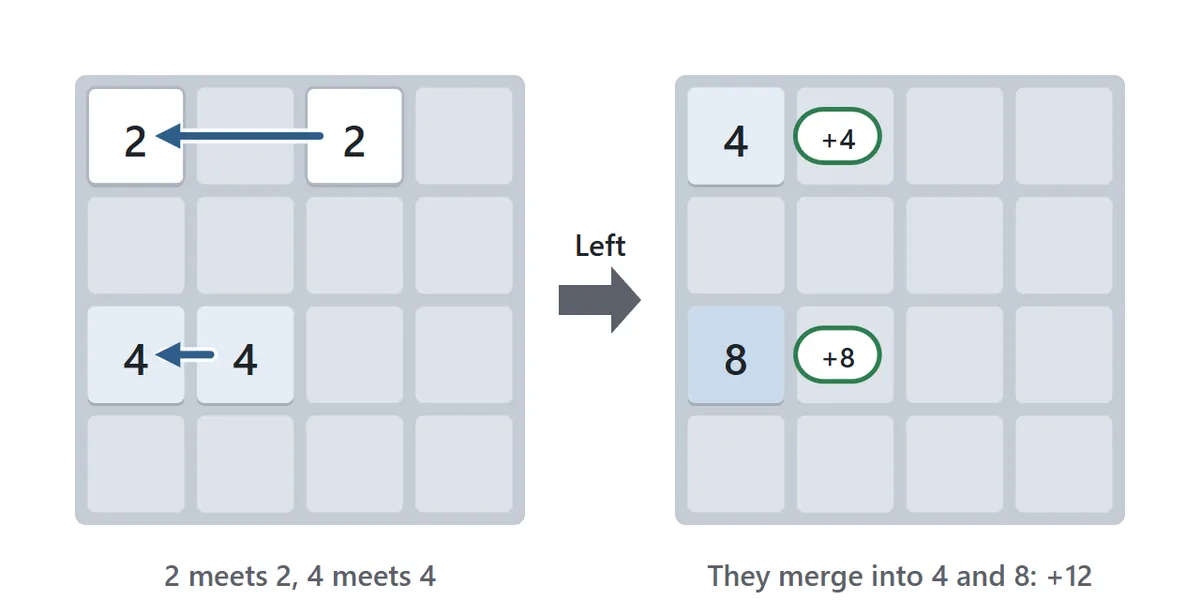
If two tiles with the same number collide as they slide, they combine into one tile with the total value – always exactly double. Empty squares between them don’t matter: as long as nothing different sits in the way, they slide together and merge. Tiles with different numbers never merge; they simply stop next to each other.
Every merge adds the value of the new tile to your score. Merging two 2s is worth 4 points, while merging two 512s is worth 1,024. The bigger the tiles you build, the faster your score climbs.
3. Three or four equal tiles in a row
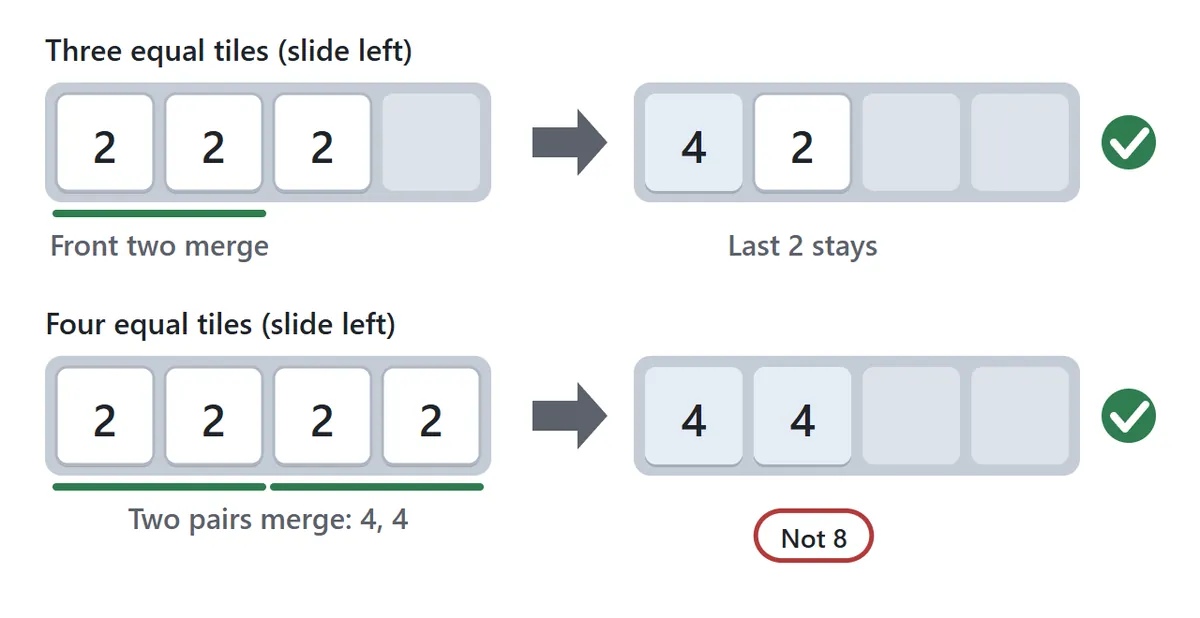
When a row or column holds three equal tiles, the two that are farthest along in the direction of the slide merge first, and the third one is left as it is. Slide left and the two on the left combine; slide right and the two on the right combine. The same row can give different results depending on the direction, so it is worth a second look.
With four equal tiles in a line, the front pair and the back pair merge separately, giving two tiles of the doubled value. A tile created by a merge can’t merge again in the same move, so sliding 2, 2, 2, 2 gives 4, 4 – never 8.
4. A new tile appears after every move
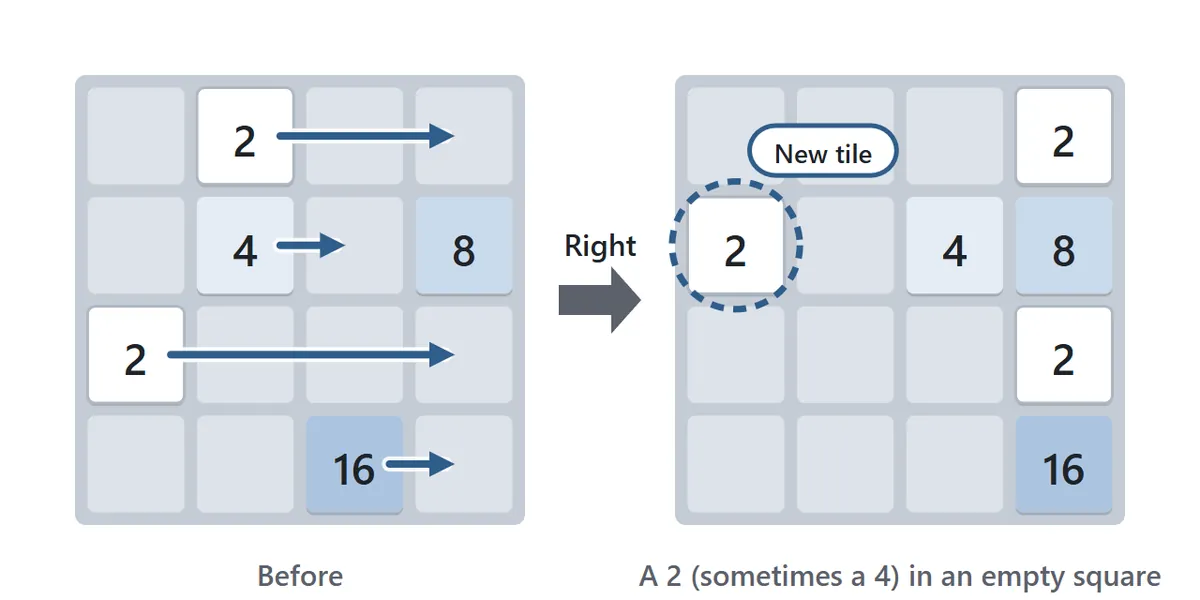
Every time something moves or merges, one new tile pops up in a randomly chosen empty square. It is a 2 about nine times out of ten and a 4 the rest of the time. You can’t choose where it lands, which is exactly what makes planning ahead so important. Each game starts with two tiles already on the board.
5. Make 2048 to win – then keep going if you like

Merge two 1024 tiles and you have 2048 – you’ve reached the goal. You can stop there, or press “Keep going” and carry on toward 4096, 8192 and beyond. Any tile that has reached the goal gets an ochre border so you can spot it at a glance.
6. The game ends when no move is left
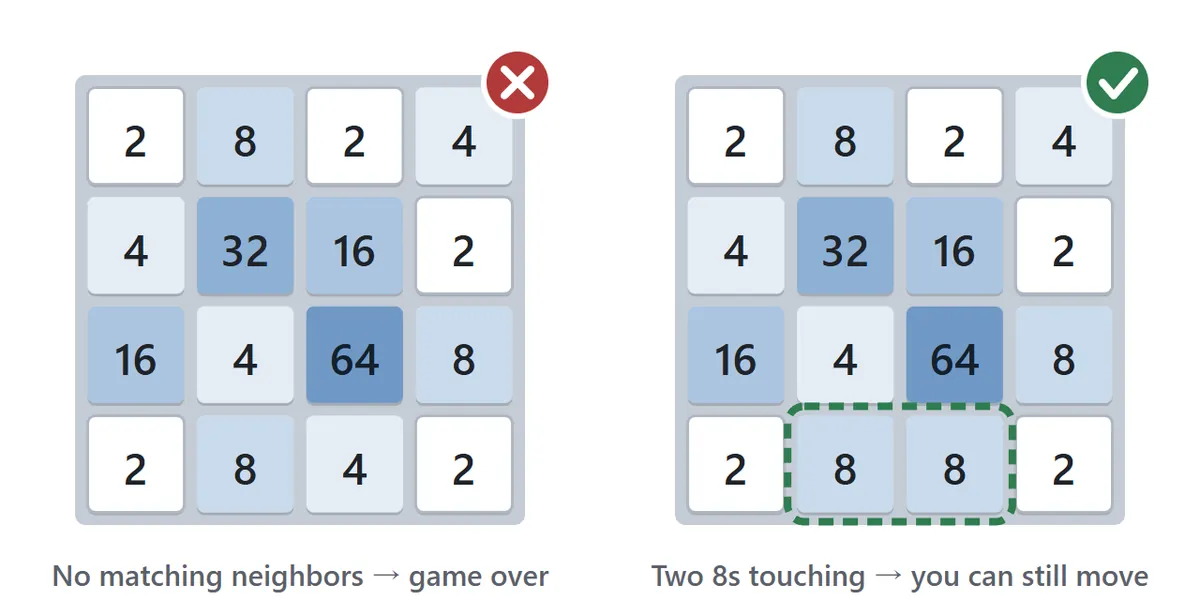
When every square is filled and no two neighboring tiles – side by side or one above the other – share a number, no direction can move anything and the game is over. A full board alone doesn’t end the game: if two matching tiles touch, you can merge them and free up space.
Board Sizes and Undo
| Board | Goal | What it’s like |
|---|---|---|
| 3×3 | 256 | Only 9 squares, so it fills up fast. 2048 can’t be reached on a board this small. For experts |
| 4×4 (classic) | 2048 | The standard board. You have to plan ahead to get there |
| 5×5 | 2048 | Much more room to breathe. A good way to enjoy your first win |
| 6×6 | 8192 | A huge board for long sessions. 2048 comes easily, so the goal is 8192 |
If you turn Undo on, you can take back your last move once per game – even after the game has ended, as long as you haven’t used it yet. Undo won’t let you fish for a better new tile, though: if you slide the same way again, the same number appears in the same square.
How to Get the 2048 Tile: Strategy and Tips
Sliding at random will usually stall somewhere around 256 or 512 on the 4×4 board. Reaching 2048 needs roughly a thousand moves and a score of about 20,000, so a steady plan matters far more than lucky merges. The tips below are the ones experienced players rely on, roughly in the order you should learn them.
Tip 1: Keep your biggest tile in a corner
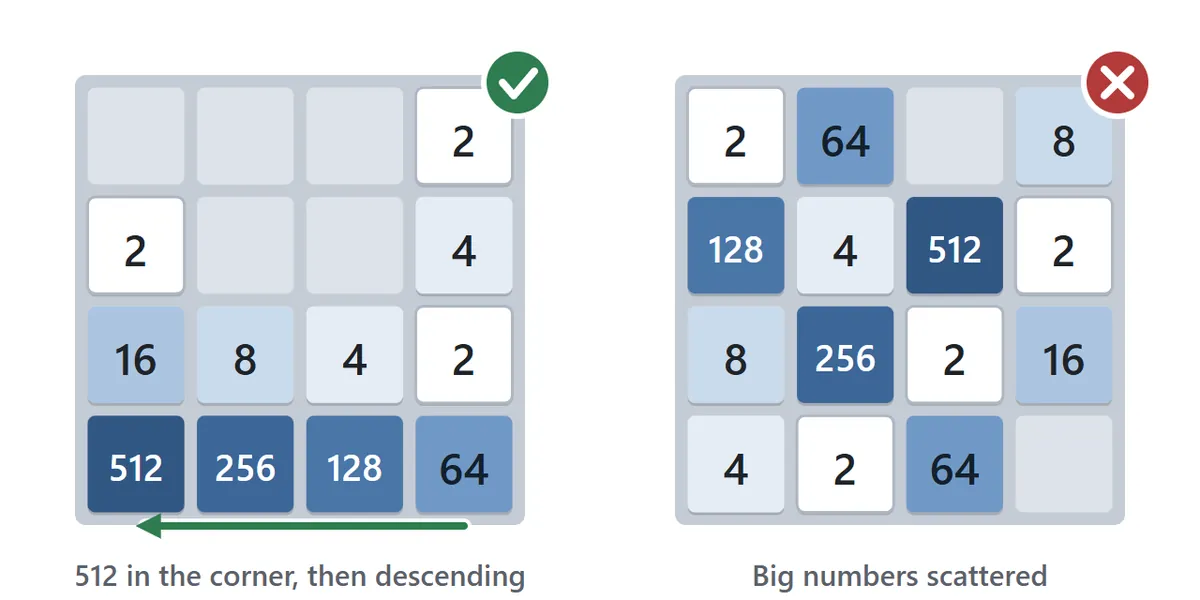
This is the single most important habit. A big tile in the middle of the board blocks the squares around it and leaves the small tiles nowhere to go. Pick one corner – many players like the bottom-left – park your biggest tile there, and try never to move it out again.
Tip 2: Use mostly two directions
Once you have chosen a corner, rely on the two directions that push toward it. With the bottom-left corner, that means mainly left and down. Use right only when you have to, and avoid up whenever possible: an up move can pull your corner tile away and drop a new 2 right where it used to be.
Tip 3: Build a chain in descending order
Line up the next-biggest tile beside the corner tile, then the next one after that: 512, 256, 128, 64 along the bottom row, for example. When the smallest tile at the end of the chain gets doubled, it merges with its neighbor, which merges with the next, and the whole row collapses into the corner in a satisfying cascade. When the bottom row is full, continue the chain on the row above in the opposite direction, so the line bends like a snake.
Tip 4: Keep the edge row full
If the row that holds your corner tile is completely filled, sliding sideways can’t shift it. A row with a gap in it is dangerous: one sideways slide can move your big tile out of the corner. Before you make a sideways move, check that the bottom row won’t move.
Tip 5: Don’t spread copies of the same number around
If three separate 8s are scattered across the board, it takes several moves to bring them together, and meanwhile the board fills up. Try to build new tiles close to the end of your chain so that each one can join the chain as soon as it grows.
Tip 6: Don’t grab every merge you see
An obvious merge can be a trap if it moves your corner tile or breaks your chain. Before each move, ask yourself what the board will look like afterwards and where the new tile could appear. Thinking just one move ahead makes a huge difference.
Tip 7: Protect your empty squares
Empty squares are your breathing room. The more of them you have, the less a badly placed new tile can hurt you. When the board starts filling up, stop building big numbers for a moment and merge whatever small tiles you can to win space back.
What to do if your corner tile gets knocked out
Sooner or later you will be forced to slide up (or away from your corner) and a 2 will land in the corner. Don’t panic. Usually the best fix is to slide straight back toward the corner at once, before the stray tile grows. If the corner is lost for good, it is often better to start a new chain from a different corner than to fight over the old one.
Try a bigger board first
If 2048 feels out of reach on 4×4, try 5×5. The extra space forgives mistakes and lets you practice the corner and chain habits. Once they feel natural, go back to the classic board – or test yourself on the tiny 3×3, where a goal of 256 is surprisingly tough.
FAQ
Can I move just one tile?
No. Every move slides all the tiles in the same direction. If you want only one tile to move, pick a direction in which all the others are already stopped by the edge or by a different number.
When I swipe on my phone, the page scrolls instead
While you are playing, swiping on the board doesn’t scroll the page; swiping outside the board does. If it still feels awkward, use the four arrow buttons below the board.
What happens after I make 2048?
A message tells you that you’ve reached the goal, and you can either finish or keep going. If you keep going, you can play until no move is left and your score keeps growing.
What is the highest possible tile?
On the 4×4 board, the largest tile that can ever exist is 131,072, and only if luck is on your side the whole way. For most players, 4096 or 8192 is already an excellent result. The 5×5 and 6×6 boards have room for even larger numbers.
How is the score calculated?
Each merge adds the value of the tile it creates. Building a 2048 tile from 2s is worth 20,480 points in total, which is why scores around 20,000 usually mean you have just reached the goal.
Can I stop and continue later?
Yes. Your board is saved automatically in this browser on this device. Next time, press “Continue” in the settings to pick up with the same board and score. Your personal best, your biggest tile, the number of games and how many times you reached the goal are also kept for each board size. There is no sign-up. Sound is off at first; press “Sound: off” to turn it on.
Where the Puzzle Comes From
Sliding number puzzles of this kind became a worldwide craze in 2014. Early that year, a mobile puzzle in which you slid cards and combined 1 and 2 into 3, then 3 and 3 into 6, drew a lot of attention, and quick variations appeared soon after. In March 2014 a young Italian web developer published a free browser version, reportedly built over a weekend, in which equal tiles doubled all the way up to 2048. It spread across the internet within days, and countless versions followed with bigger and smaller boards, undo buttons, and even three-dimensional grids. The simple doubling rule and the fact that each move takes only a moment have made it one of the most familiar number puzzles in the world.