 Yorimichi Games
How to play Telling Time
Telling Time is a free browser game for practicing how to read an analog clock, the kind with an hour hand and a minute hand. It starts with times on the hour, like 3 o’clock, moves on to half past, then to times in five-minute and one-minute steps, and finishes with a.m. and p.m. You can read the time from a clock, turn the hands yourself to show a time, or work out what time it will be 20 minutes later. It is a one-player game that runs in your browser on a computer, tablet or phone, with no sign-up and nothing to download.
Reading the hands and giving your answer
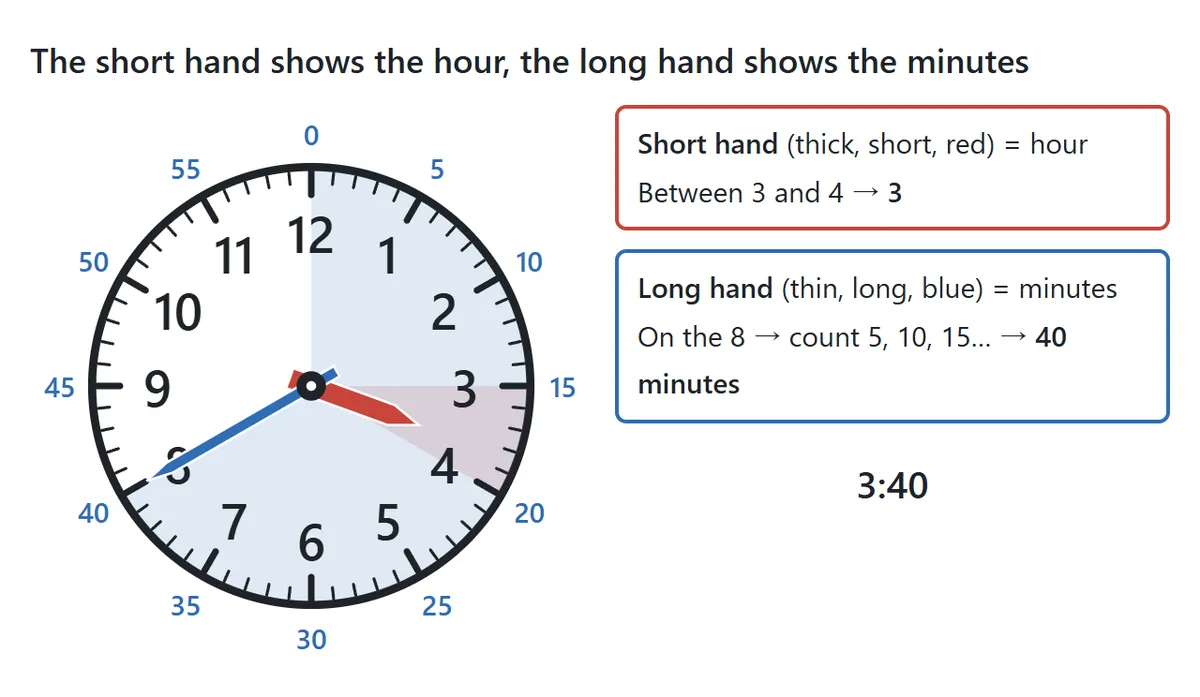
On every clock in the game, the short hand (red and thick) shows the hour and the long hand (blue and thin) shows the minutes. The hands differ in length and thickness as well as color, so you can tell them apart even if some colors are hard for you to see, or when you print in black and white. There are two ways to answer: choose one of four answers, or type the time. To type, enter the hour and the minutes with the number buttons and press “Enter”. On a computer, the number keys and the Enter key work too.
If you get one wrong, the game shows the right answer and explains how to read it. The clock is marked as well: the part where the short hand sits (for example, between 3 and 4) and the distance the long hand has traveled are shaded. Pick or type the right answer and you move on to the next question. After ten questions, the ones you missed and the ones where you used a hint come back once more. When you have answered them all, you see your results.
Four ways to practice
| Mode | What you do |
|---|---|
| Read the clock | Look at the clock and say what time it is, by choosing from four answers or typing the time |
| Set the hands | You are told a time, such as “Set the clock to 3:20”. Drag the round tips of the hands with your finger or mouse, or use the “Forward” and “Back” buttons or the arrow keys |
| Minutes later | Questions like “It’s 8:50. What time is it 20 minutes later?” Some ask for an earlier time instead. Easy, Normal and Hard |
| Tricky times | Up to ten questions you missed before. Get one right on the first try twice in a row and it leaves the list |

In Set the hands, the clock behaves like a real one. Turn the long hand all the way around and the short hand moves on to the next number. Turn the long hand halfway (30 minutes) and the short hand ends up halfway between two numbers. If you grab the short hand instead, it jumps one hour at a time and the minutes stay as they are.
Five levels, from o’clock to a.m. and p.m.
| Level | Times you will see |
|---|---|
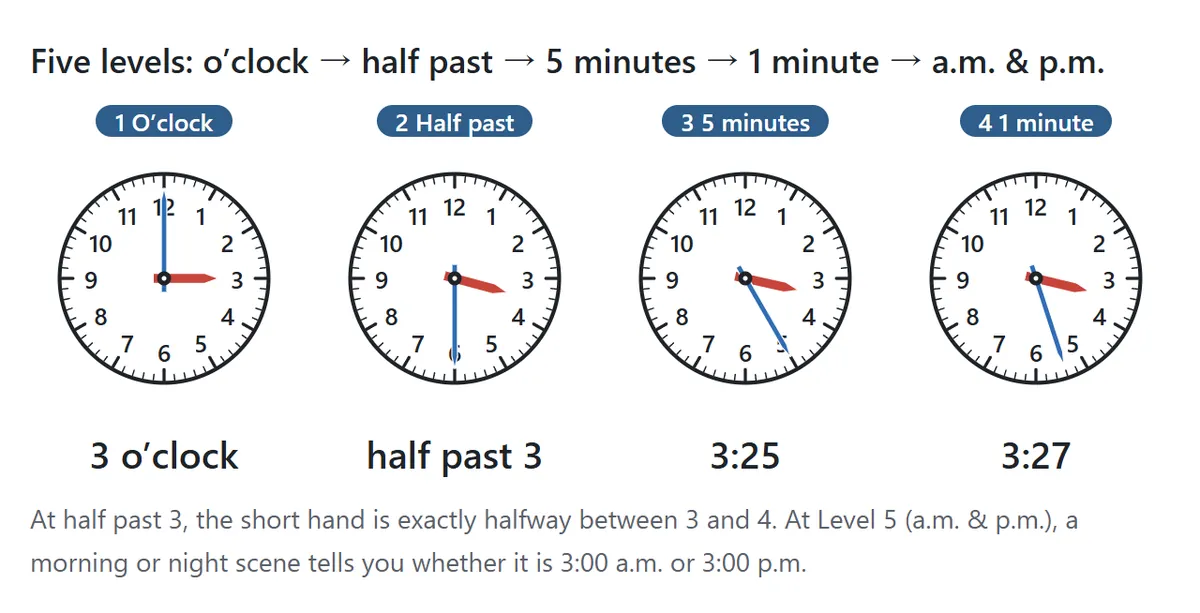
| 1 O’clock | Times on the hour, such as 3 o’clock or 10 o’clock |
| 2 Half past | On the hour and half past, such as half past 3 |
| 3 5 minutes | Times in five-minute steps, such as 3:25 |
| 4 1 minute | Any minute, such as 9:57. Times when the short hand is close to the next number come up more often |
| 5 a.m. & p.m. | A clock plus a scene such as “Wake up in the morning” or “Eat dinner”. Answer 7:00 a.m. or 7:00 p.m.; 12 o’clock in the daytime is noon |
This is the order most people learn to tell time in: first the hour, then half past, then counting the minutes in fives, then single minutes, and finally whether a time is in the morning or the evening. If analog clocks are new to you, start at Level 1 and move up when you can answer all ten questions right on the first try. A star appears next to each level you have cleared that way. In Minutes later, Easy uses half hours and whole hours, Normal stays within the same hour, and Hard crosses the hour, as in 8:50 plus 20 minutes.
Tips for telling time on an analog clock
1. Read the short hand first
Look at the short hand to find the hour, then read the minutes from the long hand. When the short hand is between two numbers, the hour is the smaller number (between 12 and 1, it is 12). At 3:40 the short hand is between 3 and 4, so the hour is 3.
2. When the short hand is almost at the next number
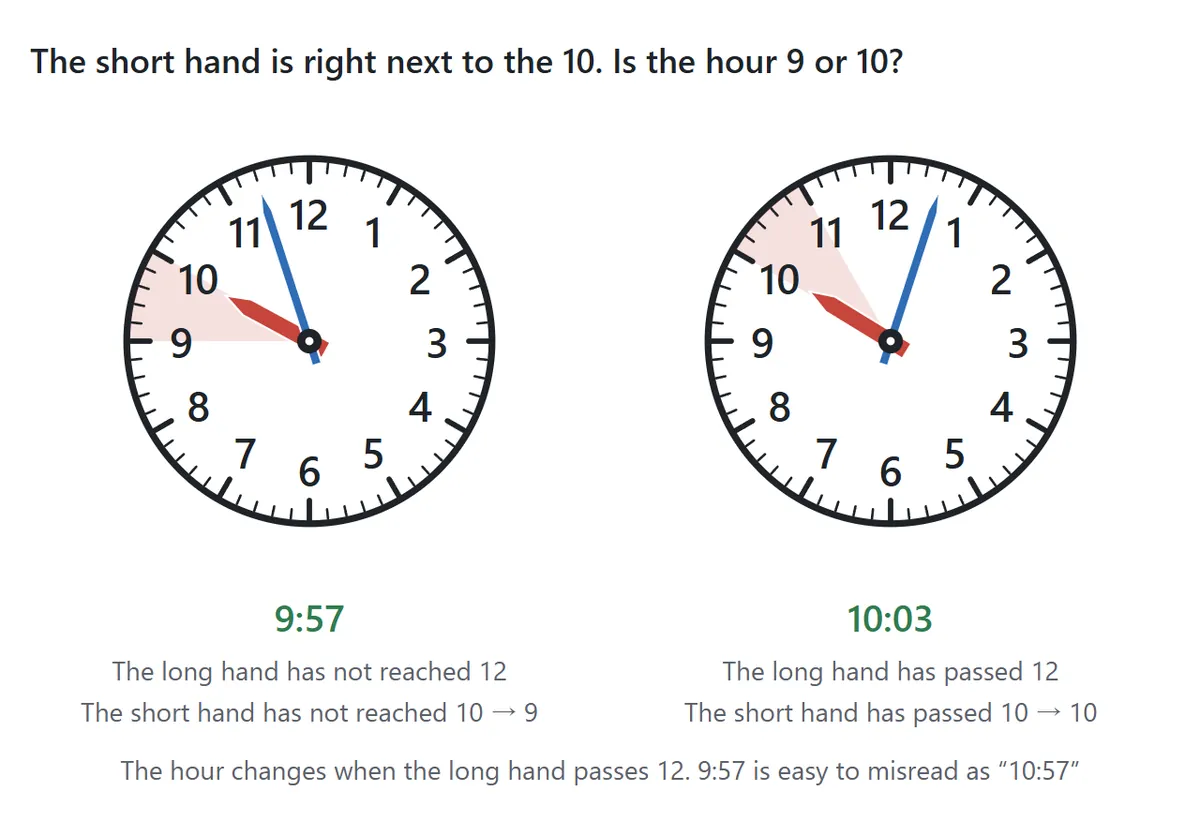
The most common mistake is a time like 9:57. The short hand looks as if it is pointing at 10, so it is easy to say “10:57”. But while the long hand is still before the 12, the short hand has not quite reached the 10. Remember that the hour only goes up when the long hand passes 12, and you can always check. Level 4 asks about times like this on purpose.
3. Count the long hand by fives
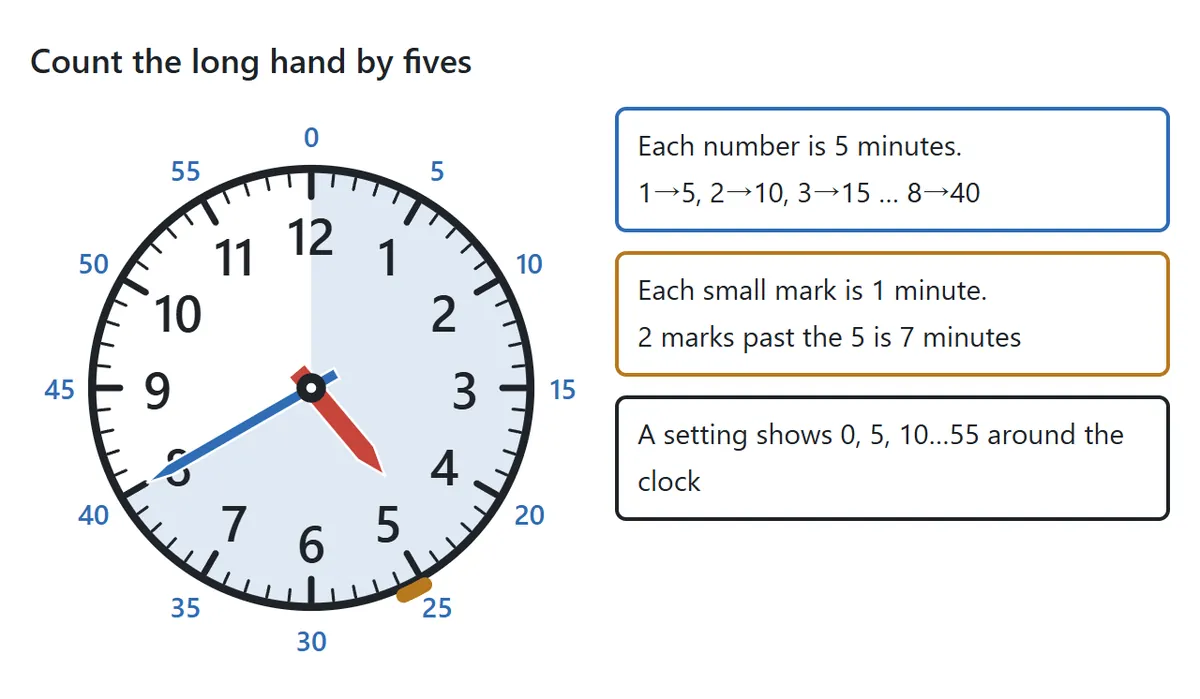
When the long hand points at the 8, it is not 8 minutes. Each number on the dial is worth five minutes, so count 5, 10, 15… until you reach the hand: 40 minutes. Between the numbers, count the small marks, one minute each. Two marks past the 5 is 7 minutes. While you are learning, turn on the minute numbers around the clock in the settings; they show 0, 5, 10…55 next to each number.
4. Half past means 30 minutes
Half past 3 and 3:30 are the same time, and the short hand sits exactly halfway between 3 and 4. Levels 1 and 2 write it as “half past 3”, and from Level 3 the game writes “3:30”. When typing, the “:30” button fills in 30 minutes for you.
5. Quarter past, half past and quarter to
In everyday English, people often say times in words: 3:15 is “a quarter past three”, 3:30 is “half past three”, 3:45 is “a quarter to four”, and 3:50 is “ten to four”. These all describe the same positions of the hands. To keep things clear, the game writes answers the way a digital clock shows them, like 3:15 or 3:45, except for “half past” in the first two levels. Once you can read 3:45 from the hands, saying “a quarter to four” is just another way of putting it.
6. Link a.m. and p.m. to your day
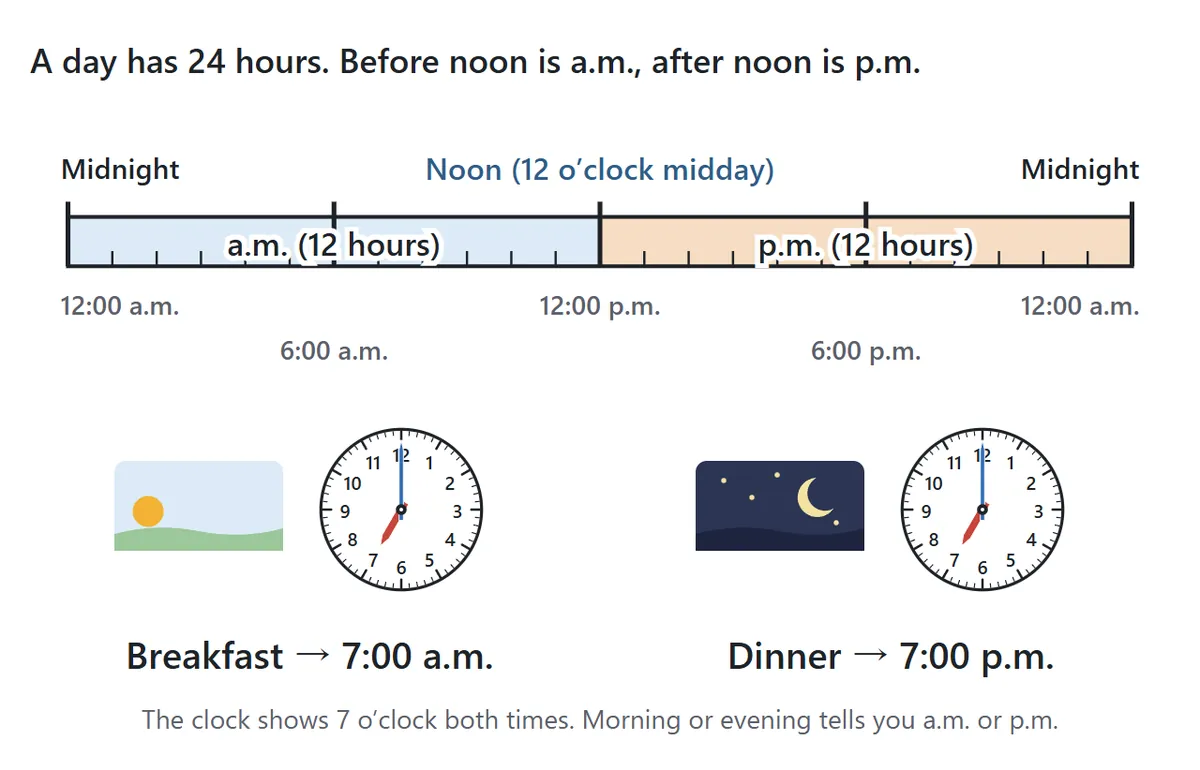
The hour hand goes around twice a day, so 7 in the morning and 7 in the evening look exactly the same on the clock. From midnight to noon is a.m., and from noon to midnight is p.m. At Level 5 each question comes with a scene, such as “Eat breakfast” or “Take a bath”, and a picture of the sky, so you decide between a.m. and p.m. from the flow of the day. Two of the four choices are a.m. and two are p.m., so you still have to read the clock carefully to get it right.
7. For “minutes later”, move the long hand in your head
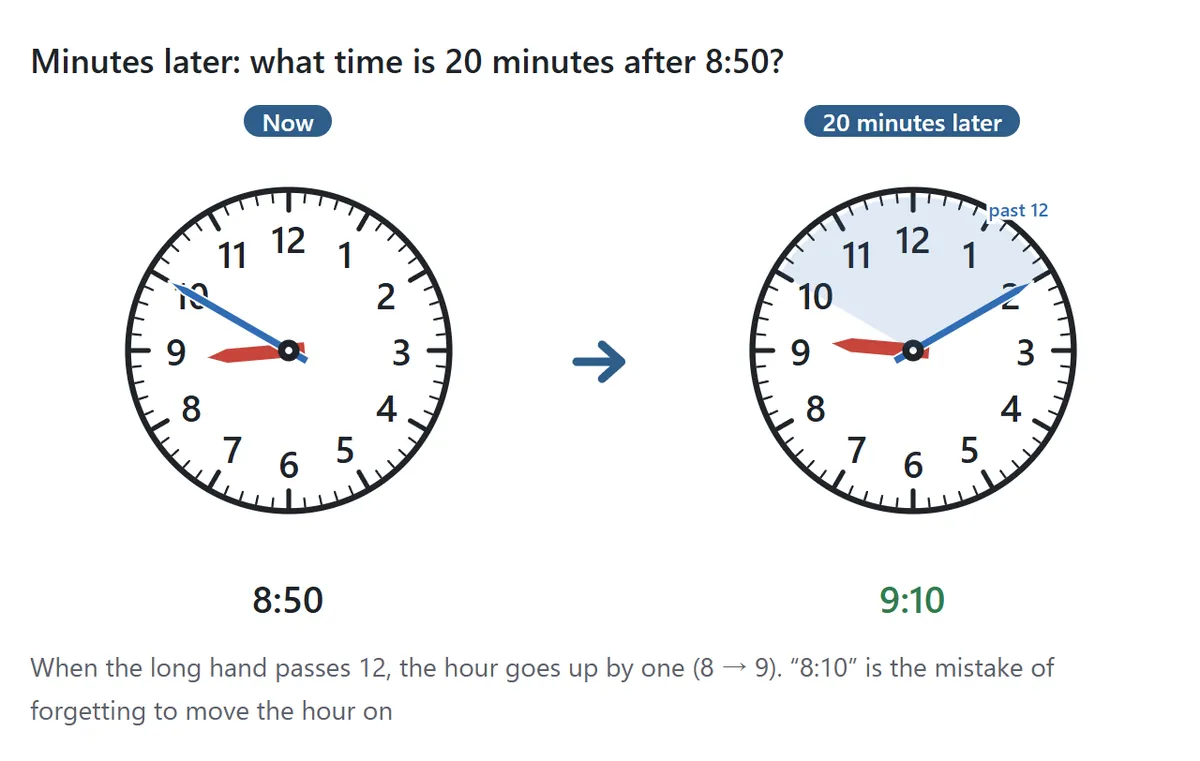
Twenty minutes after 8:50: move the long hand forward 20 minutes and it passes 12 and stops at the 2, which is 10 minutes, so the answer is 9:10. A common slip is to forget to move the hour on and answer “8:10”. After you answer, the hands on the clock actually move forward to the answer, so you can watch it happen.
Printable clock worksheets
The “Worksheets” button below the game opens printable telling time worksheets. There are three types: read the clock (write the time under each clock), draw the hands (draw the hands for a written time), and a mix of both. Choose any of the five levels and 6, 9 or 12 clocks per page, on US Letter or A4 paper, with an optional answer page. Press “New questions” for a fresh sheet as often as you like. In black and white, the short and long hands are still easy to tell apart by their length and thickness.
Telling time FAQ
Who is this game for?
Anyone who is learning to read a clock with hands, or who wants a quick review. If analog clocks are new to you, start with Level 1 in Read the clock. Level 4 and the Hard setting of Minutes later are good practice even after you can read most times.
Should I answer 12 o’clock or 0 o’clock?
A clock with hands has no 0 on it, so the hour at the top is always 12. If you type 0 as the hour, the game does not count it as a mistake; it reminds you that a clock shows 12 instead and lets you try again.
Is noon 12 a.m. or 12 p.m.?
In English, noon is 12 p.m. and midnight is 12 a.m. Because these are easy to mix up, the game writes them as “12:00 noon” and “12:00 midnight”. When you type the time at Level 5, enter 12 and p.m. for noon, and 12 and a.m. for midnight. Typing 0 instead of 12 also works.
Does the game use “quarter to” or “ten to”?
No. Answers use the digital form, so 9:57 is written as 9:57 rather than “three minutes to ten”. Saying times in words is easy to pick up once you can read the hands, and the tips above show how the common phrases match the clock.
Can it read the questions aloud?
If your device has an English voice installed, a “Read aloud” button appears below the game. Turn it on to hear each question and the answer time spoken. It is off at first. Sound effects are also off at first; press “Sound: off” to turn them on.
Where is my progress saved?
Your best scores and your Tricky times list are saved only in the browser on the device you play on. There is no account or login. If you stop partway through a round, you can pick it up again with “Continue”, as long as you use the same device and browser.
Where a.m., p.m. and the 12-hour clock come from
The abbreviations a.m. and p.m. come from Latin: ante meridiem means “before midday” and post meridiem means “after midday”. The word meridiem refers to the moment the sun crosses the meridian, the highest point of its path, which is where the idea of noon comes from. The first mechanical clocks in Europe, built in the 1300s, usually had only an hour hand. Minute hands became common after the pendulum clock, invented by Christiaan Huygens in 1656, made clocks accurate enough for minutes to matter. In Japan, the day was divided into 24 equal hours with a.m. and p.m. when the country switched to the Western calendar and timekeeping in 1872. Before that, Japan counted time in units whose length changed with the seasons.
Comments
Write a comment
No comments yet.