 Yorimichi Games

How to use this online soroban
The soroban is the Japanese abacus: a wooden frame with rows of beads that slide up and down on rods. This page puts a working soroban on your screen, so you can move the beads with a finger, a mouse or the keyboard and practice without owning a real one. It uses the modern layout found in Japanese schools and abacus classes today, with one bead above the bar and four below. It runs in any web browser on a computer, tablet or phone, with nothing to download and no account to create.
Parts of a soroban
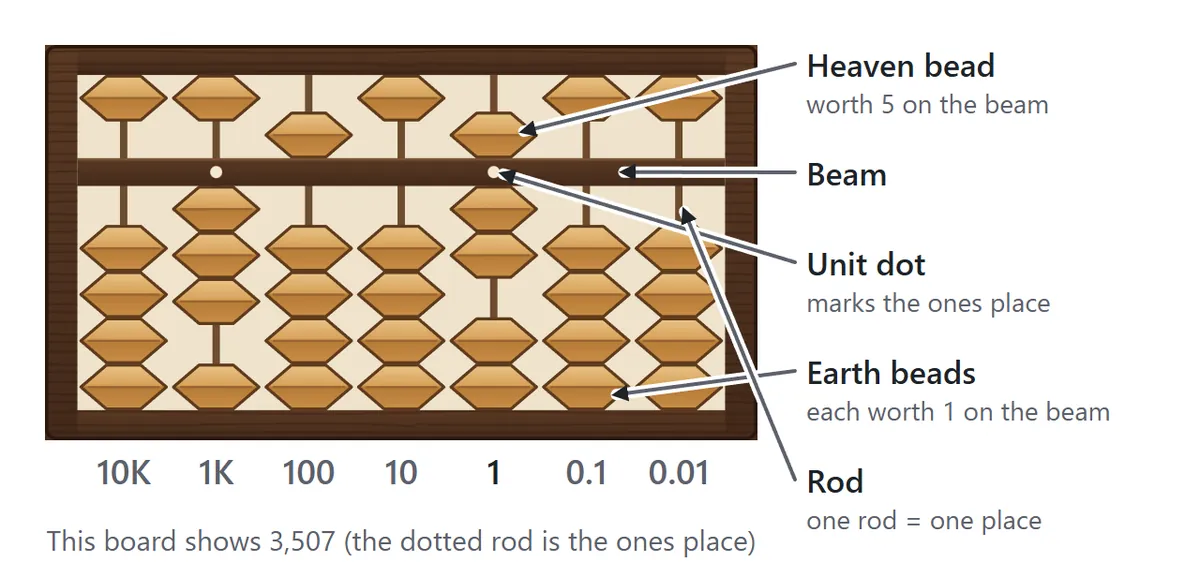
The bar that runs across the middle of the frame is called the beam (or reckoning bar; hari in Japanese). Above it, each rod has one heaven bead (godama), worth 5. Below it are four earth beads (ichidama), worth 1 each. Every vertical rod stands for one place value, just like the columns you use when you write numbers down. Small dots are marked along the beam; these are the unit dots (teiiten). Choose a dotted rod as the ones place, and the rods to its left become tens, hundreds, thousands and so on, while the rods to its right hold decimals.
How to show the numbers 0 to 9
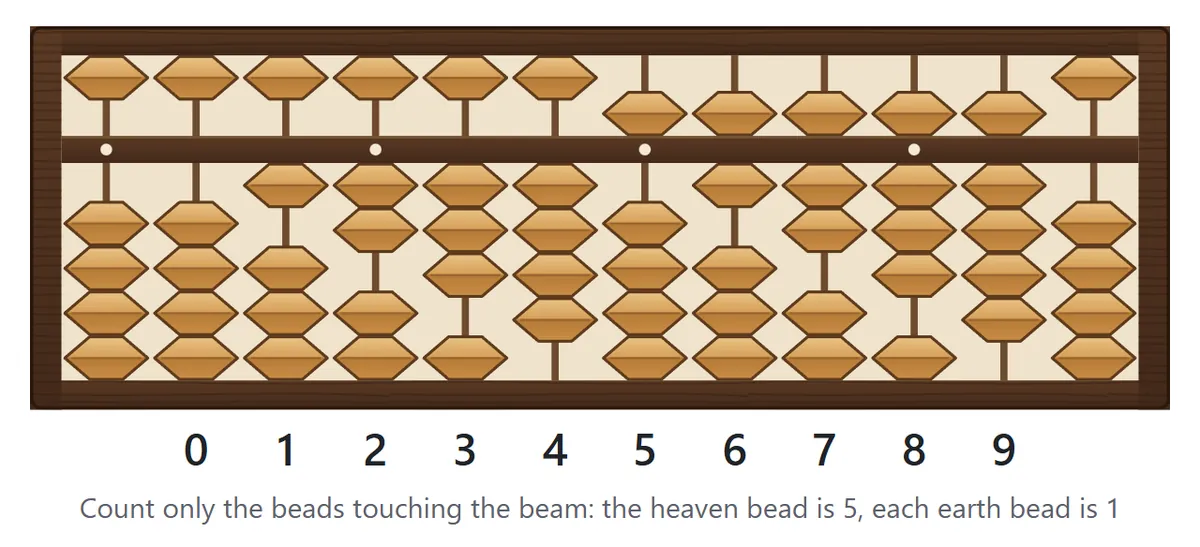
A rod’s value is the total of the beads pushed against the beam. The heaven bead adds 5 when it touches the beam, and each earth bead adds 1. So 7 is the heaven bead plus two earth beads, and 9 is the heaven bead plus all four earth beads. When no beads touch the beam, the rod reads 0. Because each rod can show any digit from 0 to 9, you set a number on the soroban one place at a time, exactly as you would write it.
Moving the beads on screen
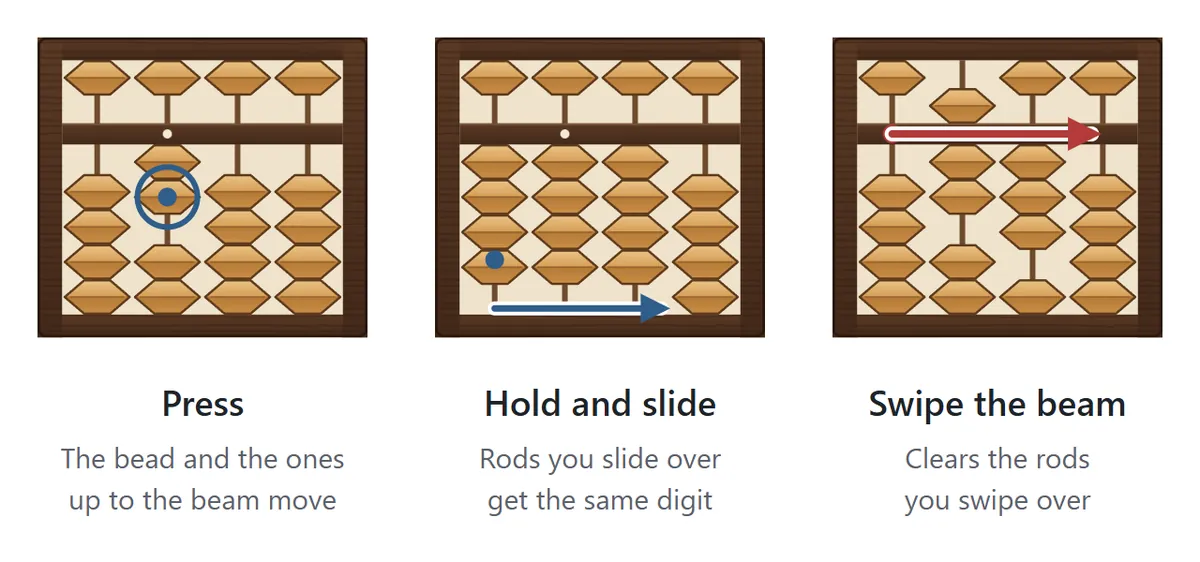
Press a bead and it moves toward the beam. Earth beads move as a group, just like on a real soroban: press the lowest earth bead and all four go up together. Press a bead that is already touching the beam and it moves away again, along with any beads outside it. You can also swipe a bead up or down. If you hold a bead and slide sideways, every rod you pass takes on the same digit, and if you swipe along the beam itself, the rods you pass are cleared. The Clear all button resets the whole board to zero – Japanese abacus users call this gohasan.
You can also use the keyboard. Choose a rod with the left and right arrow keys and type a digit: it is set on that rod and the selection moves one rod to the right. The up and down arrow keys move one earth bead; hold Shift to move the heaven bead instead. Escape clears the board and Enter checks your answer.
The unit dot and place value
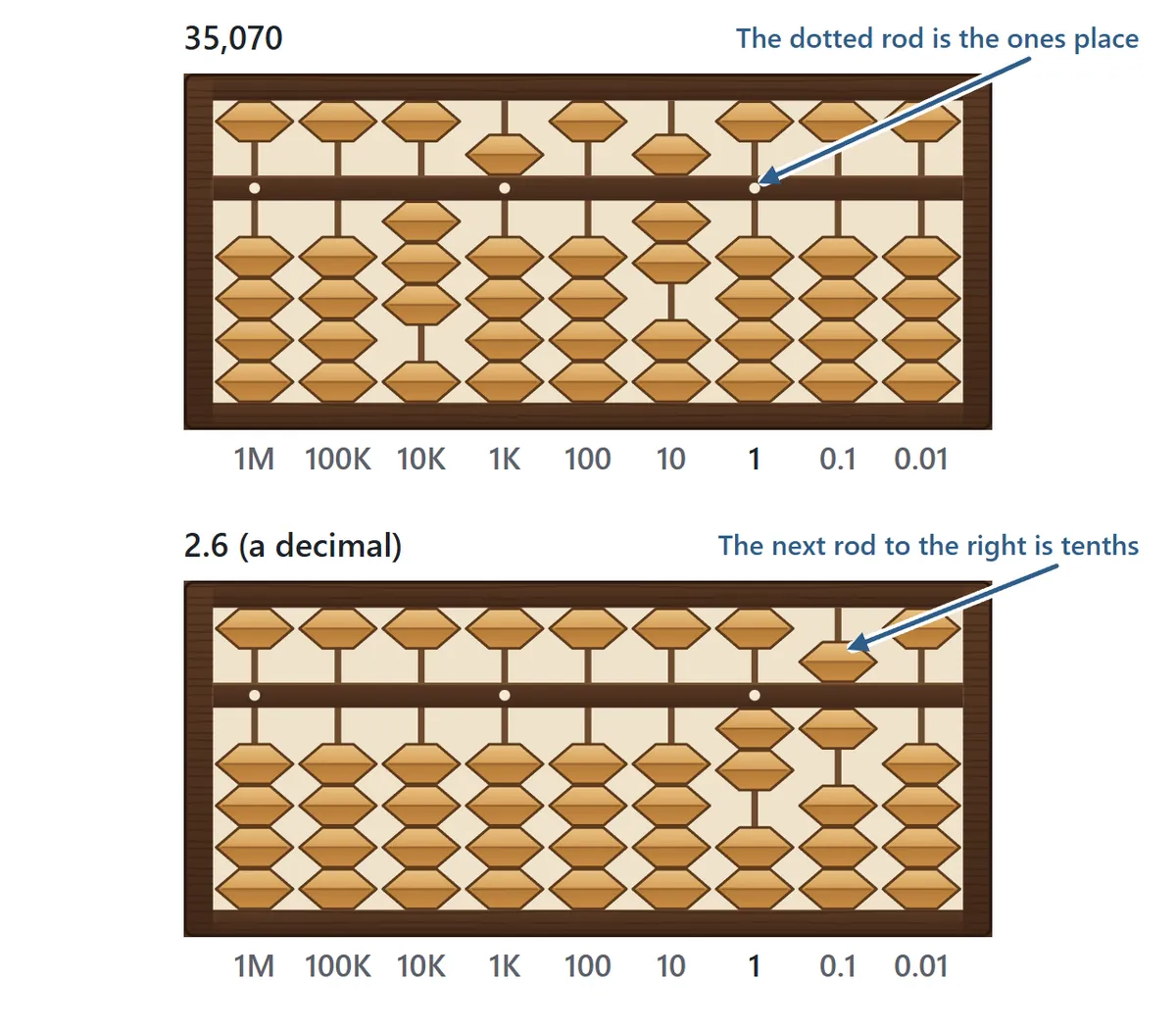
On this soroban, the dotted rod third from the right is the ones place. The dots are repeated every three rods, which matches the commas in a written number: the next dot to the left marks the thousands, then the millions. The two rods to the right of the ones place are the tenths and hundredths. Place labels (1, 10, 100, 1K and so on) are shown under the frame to help while you are learning, and you can turn them off in the settings once you know your way around.
Soroban finger technique
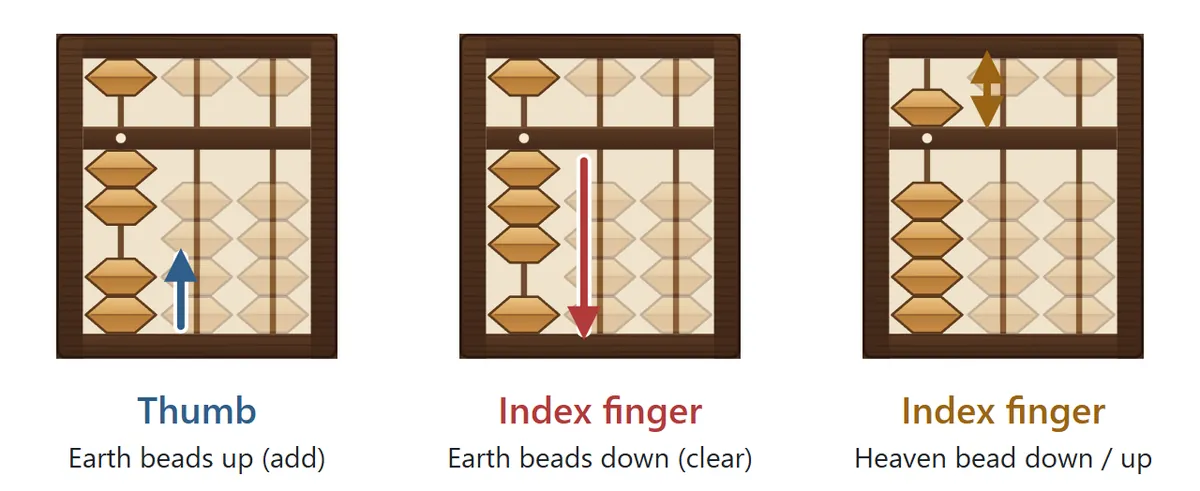
On a real soroban, you move the beads with the thumb and index finger of your writing hand, while the other hand rests on the frame to keep it still.
| Move | Finger | Meaning |
|---|---|---|
| Earth beads up | Thumb | Add 1–4 |
| Earth beads down | Index finger | Subtract 1–4 |
| Heaven bead down | Index finger | Add 5 |
| Heaven bead up | Index finger | Subtract 5 |
An easy way to remember it: the thumb only ever pushes earth beads up, and the index finger does everything else. Moving beads to the beam is called setting or adding; moving them away is called clearing. On screen you don’t need separate fingers, but the beads move in the same directions as on a real abacus, so picturing the finger movements while you press makes it easy to switch to a wooden soroban later.
Soroban addition and subtraction: five and ten complements
To calculate on a soroban, you set the first number, then add or subtract the second number starting from the highest place. This is the opposite of written arithmetic, where you usually start from the ones column. For 36 + 27, you add 2 to the tens rod first and then 7 to the ones rod. Working left to right means you can enter numbers in the order you read them.
Direct adding and subtracting
When the beads you need are free, you just move them. For 2 + 1, push up one more earth bead to make 3. For 7 − 5, push the heaven bead up and away from the beam to leave 2. Nothing else is needed.
Five complements
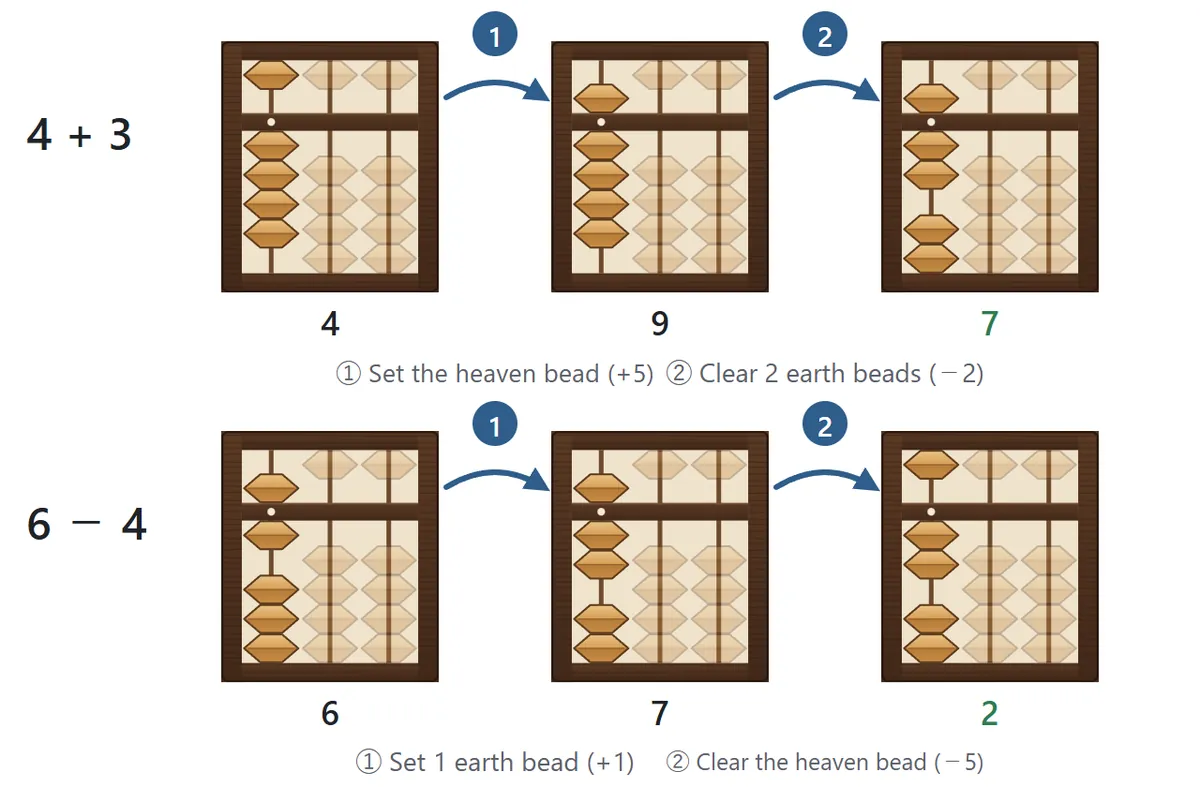
Try 4 + 3. With 4 already set, all four earth beads are touching the beam, so you can’t push up three more. Instead, think “3 is 5 minus 2”: set the heaven bead, then clear two earth beads. This is called using the five complement, because 3 and 2 add up to 5. Subtraction works the other way. For 6 − 4, there is only one earth bead to clear, so think “4 is 5 minus 1”: set one earth bead, then clear the heaven bead. If you know the pairs that make 5 (1 and 4, 2 and 3), your fingers will know what to do without stopping to think.
Ten complements (carrying and borrowing)
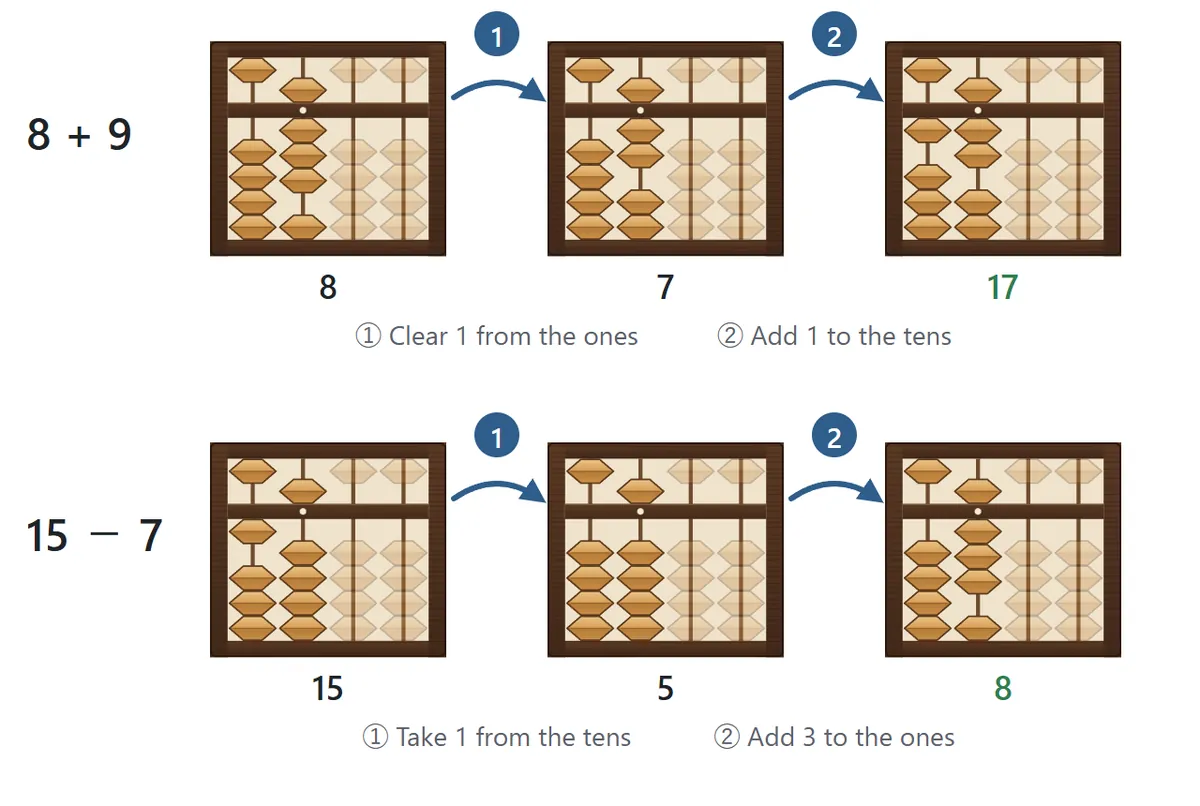
For 8 + 9, there is no room on the ones rod to add 9. Think “9 is 10 minus 1”: clear 1 from the ones rod and add 1 to the tens rod, giving 17. For 15 − 7, you can’t take 7 from the 5 on the ones rod. Think “7 is 10 minus 3”: take 1 from the tens rod and add 3 to the ones rod, giving 8. These are the ten complements – the pairs 1 and 9, 2 and 8, 3 and 7, 4 and 6, and 5 and 5. Some problems, such as 6 + 7, need both at once: a ten complement on one rod that itself uses a five complement.
Whenever you make a mistake in the practice modes, this page shows the correct bead pattern and a list of moves, such as “Ones: add 9 (ten complement) – clear 1 from the ones, then add 1 to the tens”. When you change the board to match the correct pattern, you move on to the next question.
Practice modes
| Mode | What you do |
|---|---|
| Free play | Move the beads however you like. The number you set is shown in large digits above the soroban |
| Set numbers | Set the number shown. Choose 1 to 5 digits or decimals (tenths) |
| Add & subtract | Set the first number, then add or subtract the second. Choose 1, 2 or 3 digits and addition, subtraction or both. The 1-digit level mixes direct moves, five complements and ten complements |
| Daily puzzle | Ten questions: two to set and eight to calculate. Everyone gets the same questions on the same day, so you can compare times with friends and family |
The practice modes offer 5 or 10 questions. If you set “First number” to “Already set”, each problem starts with the first number on the board, so you can focus on the adding and subtracting. Your time for a round with every answer correct is saved as your personal best.
Soroban tips for beginners
1. Master setting numbers first
Before you start calculating, learn the bead patterns for 0 to 9 and the position of the ones rod until they are automatic. Spend some time with 1- and 2-digit numbers in Set numbers until any number you read turns into beads without hesitation. It removes most of the confusion from calculation later.
2. Keep the ones place on the unit dot
The most common soroban mistake is a number with the right digits in the wrong place. Before setting a number, check that its ones digit will land on the dotted rod. If you set a number one rod too far over, this page tells you so: “The digits are right, but the ones place is 1 rod to the left of the unit dot.”
3. Learn the pairs that make 5 and 10
Five complements use 1 and 4 or 2 and 3; ten complements use 1 and 9, 2 and 8, 3 and 7, 4 and 6, and 5 and 5. Say the moves out loud while you practice – “add 4: set 5, clear 1”, “add 7: add 1 to the tens, clear 3 from the ones” – and they soon become second nature.
4. Always work from the highest place
For numbers with two or more digits, add the biggest place first. If you are used to written sums you may want to start with the ones, but on the soroban you go from left to right. Your fingers follow the order in which you read the number, so you don’t have to hold it in your head.
5. Compare your board with the correct pattern
After a mistake, the correct beads and the list of moves appear below the board, and the rods that differ are marked with red dotted outlines. Compare the two patterns, find the step where things went wrong, and then fix your board.
6. A few minutes every day
The daily puzzle has ten questions and takes only a few minutes. Practicing a little every day builds speed faster than a long session once a week, and the game shows how many days in a row you have played. Aim for all correct before you chase a faster time.
Soroban and mental math
People who practice the soroban for a long time often start to calculate with an imaginary abacus in their head. Instead of moving real beads, they picture the bead patterns and move them mentally, which is known in Japanese as anzan (mental calculation). It all starts with the basics on this page: setting numbers quickly, and knowing the five and ten complements without thinking. Once the patterns are familiar, try closing your eyes and picturing the beads for a simple sum before you check it on the screen.
Soroban FAQ
Why does a soroban have four beads on the bottom?
One heaven bead and four earth beads are exactly enough to show every digit from 0 to 9 on a single rod. Older abacuses had five earth beads, or two heaven beads, which allowed values above 9 on one rod. In Japan, the one-and-four design was adopted as the standard school abacus in the late 1930s and has been used ever since.
What is the difference between a soroban and a Chinese abacus?
The Chinese abacus (suanpan) traditionally has two beads above the bar and five below on each rod. The Japanese soroban simplified this to one above and four below, so each rod holds exactly one digit, and it uses flat, diamond-shaped beads that are quick to flick with a fingertip.
Can I learn the soroban on my own?
Yes. Setting numbers and the basics of addition and subtraction with five and ten complements can be learned alone with clear pictures and practice questions. Because this page shows the correct pattern and the moves whenever you make a mistake, you can check yourself as you go. For multiplication, division or speed training, an abacus class or dedicated workbooks are a good next step.
Is the soroban only for children?
Not at all. Adults use it to refresh skills they learned years ago, to get ready before teaching someone else, or simply as a satisfying way to practice arithmetic. Free play is also handy for exploring how large numbers are laid out across the rods.
Does it work on tablets, Chromebooks and phones?
Yes. It runs in the browser, and the number of rods adapts to the screen width – 23 rods on a wide computer screen and around 9 on a phone – so every rod stays visible without scrolling sideways. Sound is off at first; press “Sound: off” to hear the beads click.
Are there printable soroban worksheets?
Yes. The “Worksheets” button opens printable pages for reading beads, drawing beads and addition and subtraction problems, with optional answer pages, on US Letter or A4 paper.
A short history of the soroban
Counting boards and bead frames have been used in many parts of the world for thousands of years, and the form closest to the soroban developed in China. Exactly when the abacus reached Japan is unclear, but it was in use by the fifteenth century. During the Edo period most Japanese abacuses had two beads above the bar and five below. A single upper bead became common in the late nineteenth century, and the four-bead lower deck spread in the twentieth. For centuries the soroban was the everyday tool of merchants and bookkeepers, and it is still used in Japanese schools today to show how place value works.