 Yorimichi Games

How to play Make 10
Make 10 is a number game about one simple question: which numbers add up to 10? The board is filled with numbers from 1 to 9. You pick numbers whose total is exactly 10, and they disappear. It is a quick way to practice number bonds to 10, the pairs such as 3 and 7 or 4 and 6 that show up again and again in mental math. There are three ways to play: Practice, Puzzle and the Daily puzzle. If the pairs that make 10 still take you a moment to recall, start with Practice.
Number bonds to 10: the five pairs
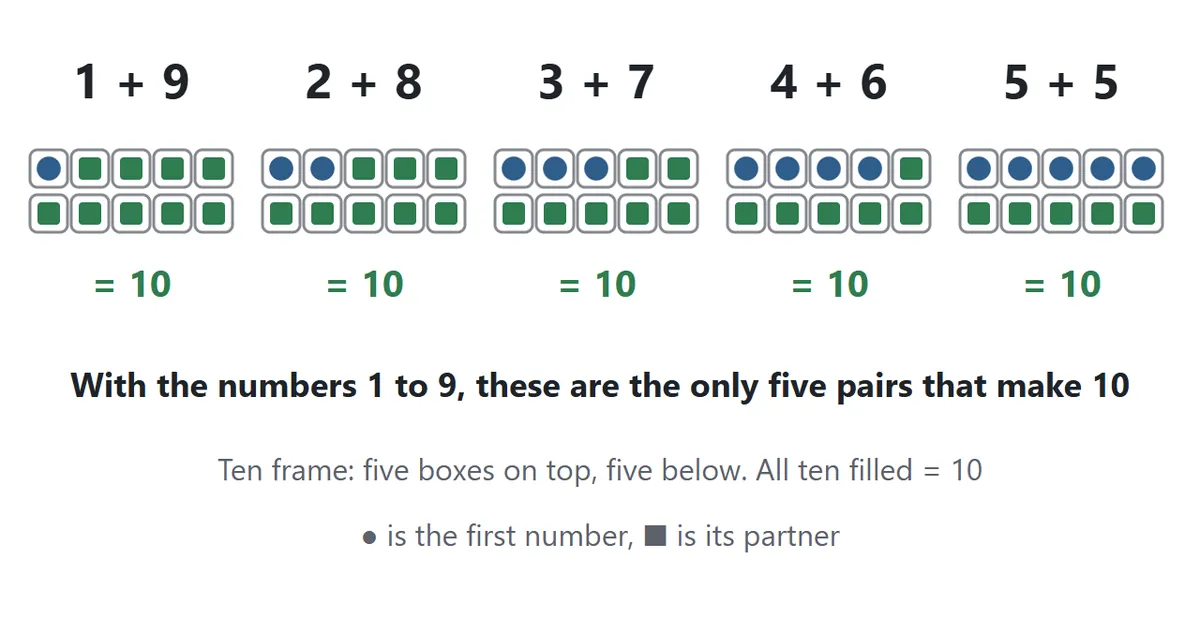
Using the numbers 1 to 9, there are just five pairs that make 10: 1 and 9, 2 and 8, 3 and 7, 4 and 6, and 5 and 5. The picture uses a ten frame, a grid of two rows with five boxes each. When every box is filled, you have exactly 10. Put 7 in the frame and it fills the top row and two boxes of the bottom row, leaving three empty boxes. That empty space is the answer: the partner of 7 is 3. The same ten frame appears under the board while you play and fills up as you pick numbers.
Practice mode: pick two numbers that make 10
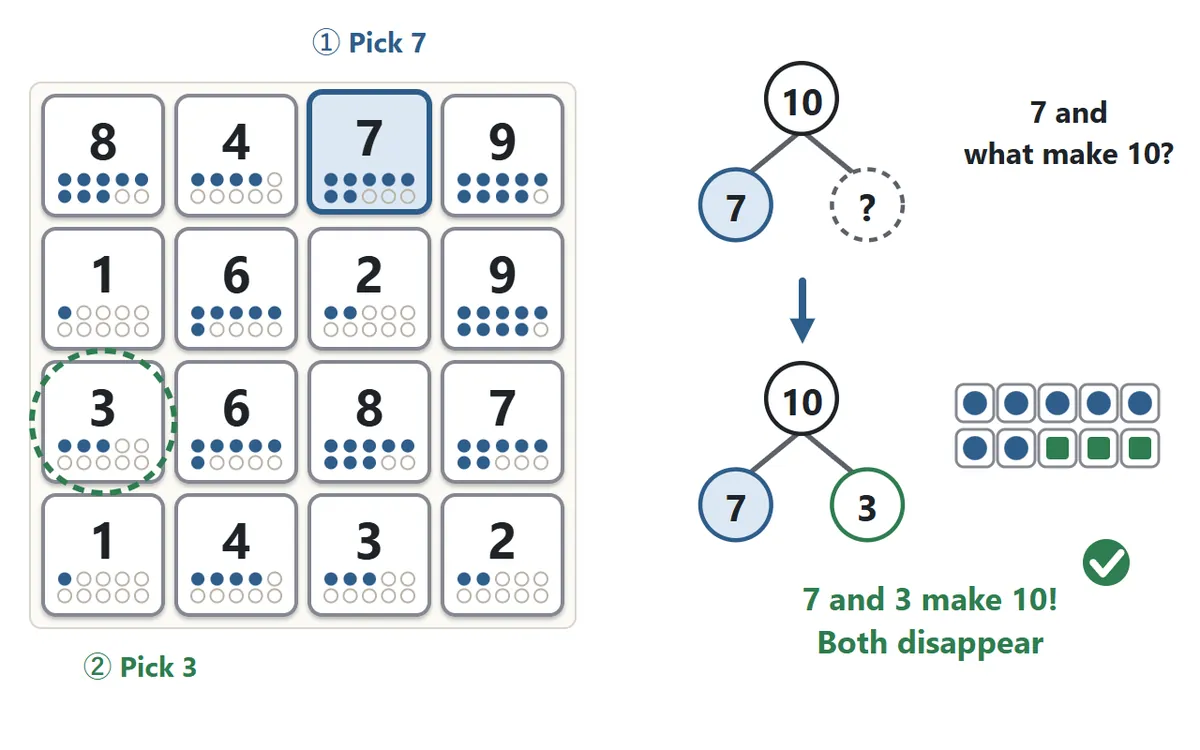
Practice uses a 4 by 4 board with sixteen numbers, which always form eight pairs that make 10. The numbers do not need to be next to each other. Pick any number and a number bond diagram appears below the board: the whole, 10, sits in the top circle, the number you picked is on the left, and the right circle shows a question mark. Think about what goes in the empty circle, then pick a second number. If the two numbers make 10, both disappear.
If they do not make 10, the game tells you how far off you are, for example “7 + 5 = 12. That is 2 more than 10” or “7 + 2 = 9. That is 1 short of 10.” Your first number stays selected so you can try again. After two misses with the same number, its partners start to glow. Clear all eight pairs to finish the round. There is no clock in Practice, so take as long as you like. Each number can also show dots laid out like a ten frame; you can switch them off in the settings once you no longer need them.
Puzzle mode: connect numbers and clear the board
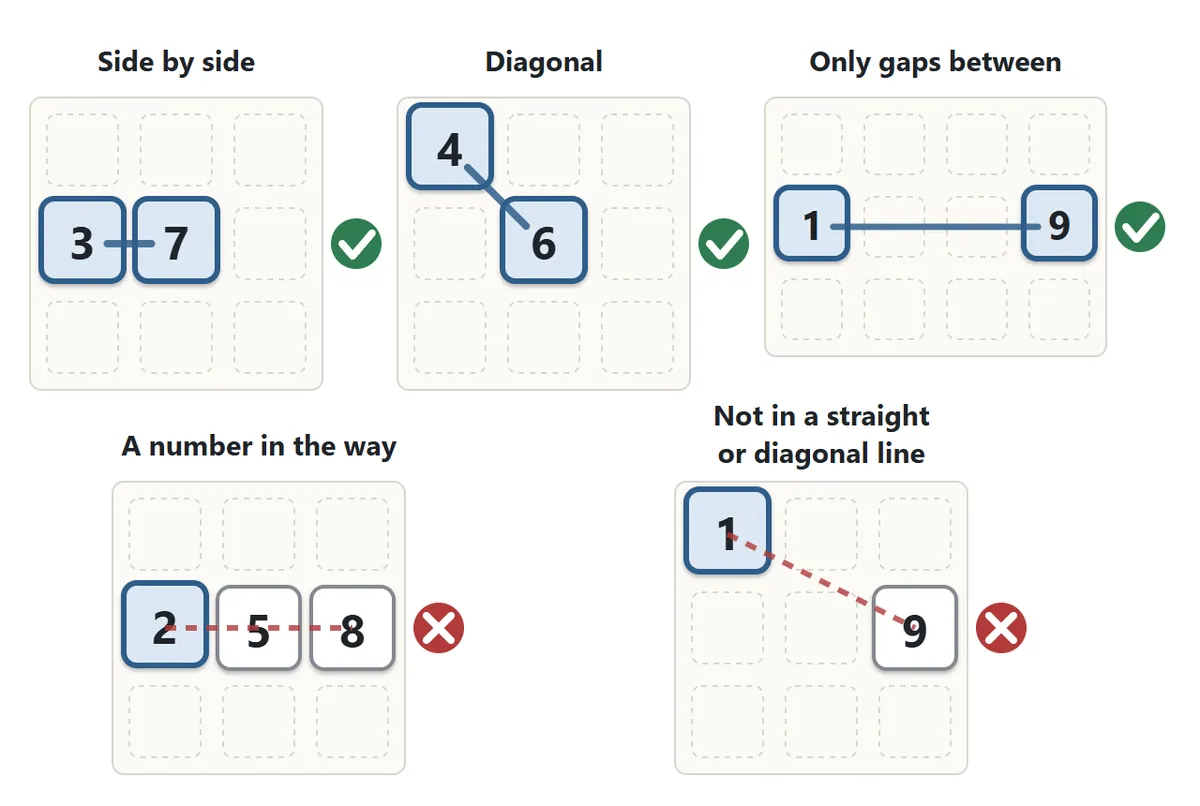
In Puzzle mode the goal is to clear every number on the board, and you can only link numbers that are connected. Two numbers are connected when they are neighbors in any of the eight directions, including diagonals. Once squares have been cleared, numbers can also connect across the gap: if two numbers sit in the same row, column or diagonal and every square between them is empty, they are connected no matter how far apart they are. A number in the way blocks the link, and a knight’s-move position is never connected.
When you pick a number, the numbers you can link to next get a dashed outline. Click or tap them one at a time, or drag your mouse or finger across them. The moment your chain adds up to exactly 10, it disappears. A number that would take you past 10 cannot be added. To change your mind, click the last number again to drop it, or press Esc to start over.
Making 10 with three numbers
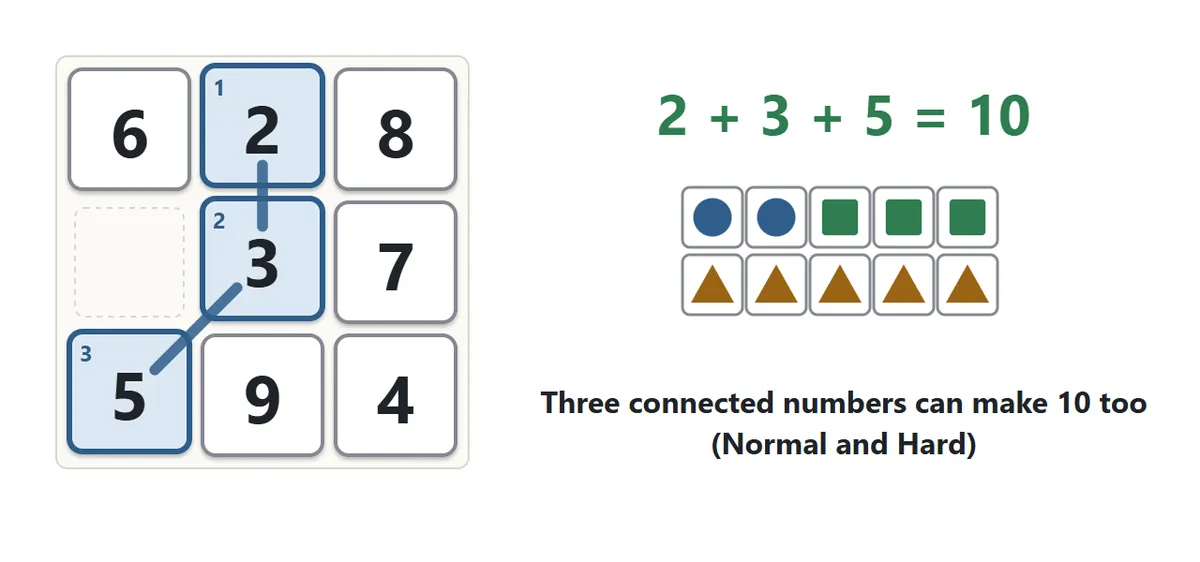
On Normal and Hard, you may also use three numbers, for example 2 + 3 + 5. The first must connect to the second and the second to the third. Some groups on these boards are built to be cleared only as a set of three, so pairing everything off is not always the right move.
When you get stuck
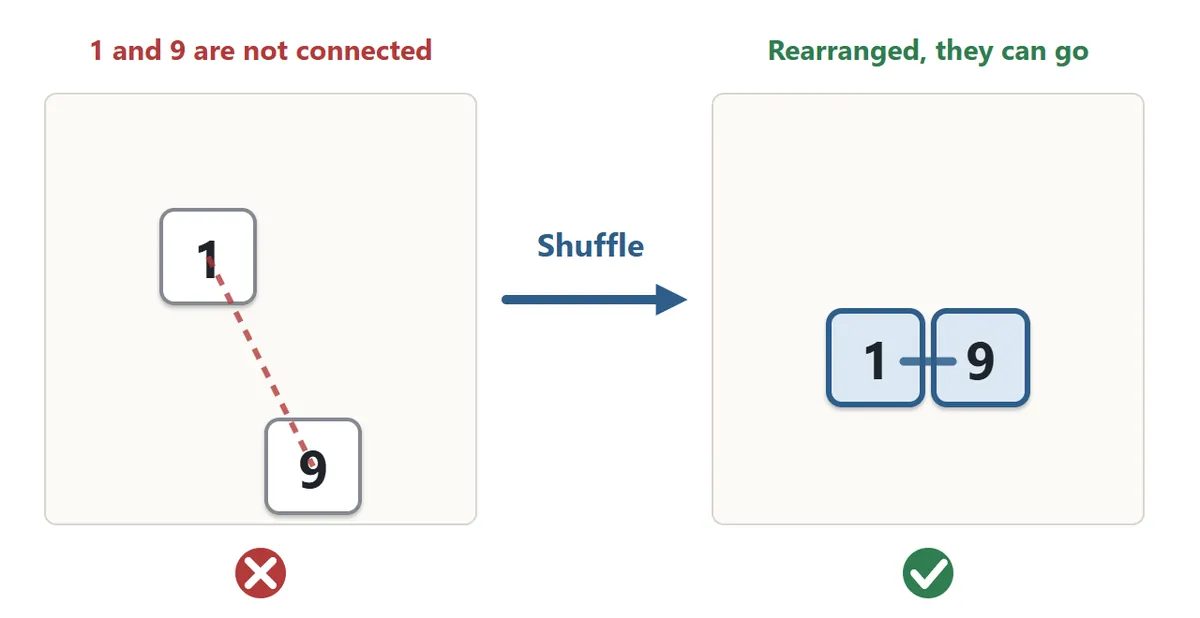
Sometimes numbers remain but none of them connect into a 10. You can then press Shuffle to rearrange the remaining numbers into a layout that can be cleared, or Undo to take back your last move. You get three shuffles on Easy, two on Normal and one on Hard. If an earlier group of three left numbers that can no longer be split into tens, shuffling will not help, and Undo is the way out.
Make 10 rules: scoring, difficulty and the daily puzzle
Every number you clear is worth 10 points. Clear the next group within four seconds and you build a combo that adds a bonus each time. Clearing the whole board earns 300 bonus points plus a time bonus for finishing quickly. A hint costs 30 points and an undo costs 20. The clock starts with your first pick and stops while the game is paused or you switch to another tab.
| Level | Board | Groups |
|---|---|---|
| Easy | 5×6, 3 shuffles | Pairs only |
| Normal | 6×7, 2 shuffles | Pairs or threes |
| Hard | 7×8, 1 shuffle | Pairs or threes |
The Daily puzzle is a Normal board that changes every day. Everyone who plays on the same day gets the same board, so it is easy to compare scores with friends or family. Your first score and your best score for the day are saved. Every board, daily or not, is built so that it can be cleared completely if you choose your groups well.
Make 10 strategy and tips
1. Think “how many more?”
When you look at a number, ask how many more it needs to reach 10. An 8 needs 2 more, a 6 needs 4 more. That turns a search for any pair into a search for one specific number, which is much easier to spot. Picturing the empty boxes in a ten frame works well too.
2. Clear the big numbers first
Large numbers like 9, 8 and 7 have small partners and are hard to fit into a group of three. Find their partners early and they will not be left behind at the end.
3. Save small numbers for groups of three
On Normal and Hard, small numbers such as 1, 2 and 3 are the building blocks for groups of three. If you use a 2 in a quick 2 + 8, the 3 and 5 that belonged with it may be stranded. When a number could go either way, picture what will be left before you choose.
4. Work from the edges and corners
Numbers on the edges and in the corners have fewer directions to connect in, so they are the ones most likely to get stuck. Numbers in the middle can usually still be reached later. Look for partners for the edge numbers first.
5. Empty squares are paths
Every cleared square becomes a path that can connect two numbers across the board. If two numbers look cut off from each other, check whether you can clear whatever sits between them.
6. Plan your combos
To score combo bonuses, spot a few groups before you start clearing, then clear them one after another without pausing to search.
Make 10 FAQ
What are number bonds to 10?
A number bond is a small addition fact you know by heart, such as 6 + 4 = 10. Number bonds to 10 are the pairs of numbers that add up to 10. They are the basis for many mental math strategies, such as “making ten” to add 8 + 5: move 2 from the 5 to the 8 to get 10 + 3 = 13.
What is the diagram under the board?
It is a number bond diagram, also called a part-part-whole diagram. The whole goes in the top circle and the two parts go in the circles below, joined by lines. In this game the whole is always 10 and the parts are the two numbers you picked.
Is there a time limit?
No. Practice has no clock at all. Puzzle mode measures your time from the first pick, but you never run out of time. Finishing faster simply earns a bigger bonus when you clear the board.
Can I stop and continue later?
Yes. On the same device and browser, Continue brings back your board, score and time. A Daily puzzle can only be continued on the same day.
Where are my scores saved?
Your best score and fastest clear for each level, the number of tens you made in Practice and your Daily puzzle results are stored on this device. There is no account or sign-up. Sound is off at first; use the Sound button to turn it on.
Where do make-10 games come from?
Finding pairs that make 10 has long been a favorite way to practice early arithmetic. Grouping into tens is the foundation of carrying in addition and borrowing in subtraction, so teachers in many countries use counters, cards and ten frames to practice it. In English the pairs are usually called number bonds to 10, and the diagram of one number splitting into two parts is common in many math programs. Puzzles in which you clear pairs that total 10 from a grid of digits have been played for a long time on paper, with playing cards and in apps, and this game brings the same idea to your browser.