 Yorimichi Games

How to play the Element Symbols Quiz
This is a free chemistry quiz for learning the element symbols, the element names and the layout of the periodic table. There are five kinds of questions: Symbol → name, Name → symbol, Type the symbol, Periodic table and Atomic number order, plus a Mixed setting that shuffles them together. You choose how many elements to work with, from the 19 most common ones up to all 118. It is a single-player quiz that runs in the browser, with nothing to download and no account to create.
After every answer a short fact card appears: the atomic number, the period and group, whether the element is a metal, a metalloid or a nonmetal, and whether it is a solid, liquid or gas at room temperature. For the handful of symbols that don’t match the English name, the card also tells you where the letters come from. Reading those cards as you go is a big part of how the quiz helps the symbols stick.
Symbol → name and name → symbol
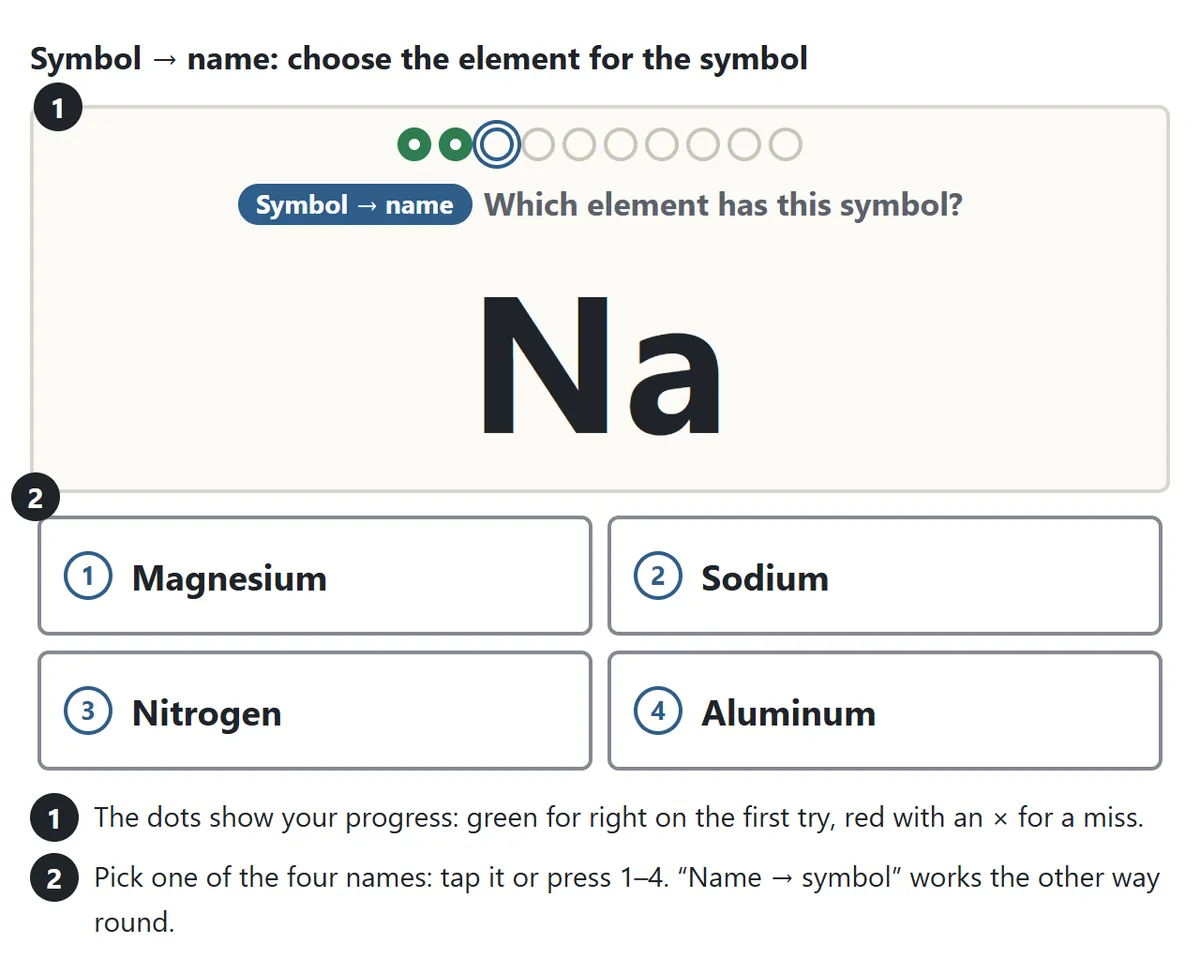
In Symbol → name you see a chemical symbol and pick the matching element from four names. Name → symbol is the reverse. The wrong answers are not random: the quiz prefers look-alikes, such as symbols that start with the same letter (Na, Ne and N) or elements with nearby atomic numbers. Sorting out these near misses is exactly what makes the difference on a chemistry test. When you have answered, press Next or the Enter key.
Type the symbol
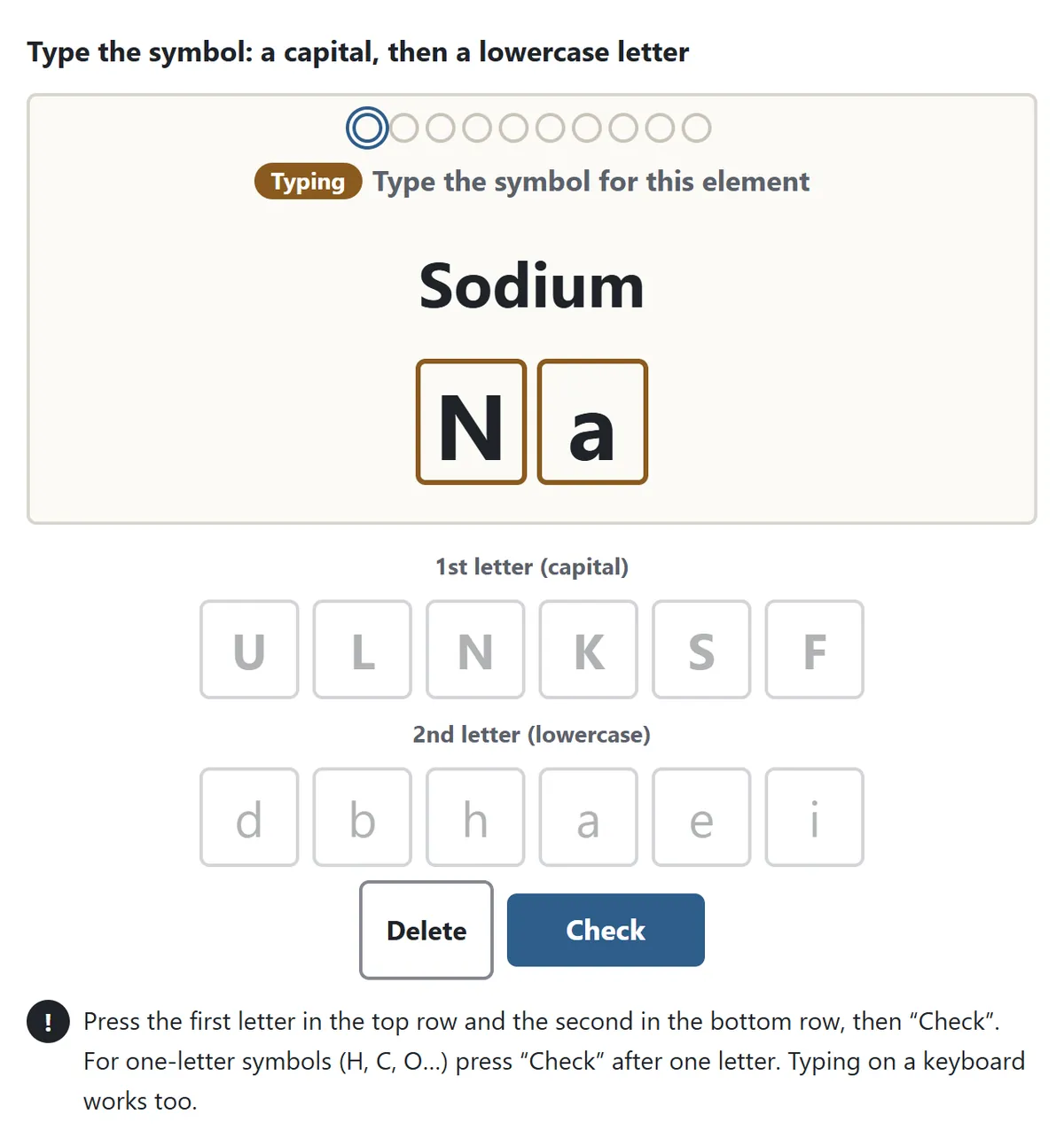
Here you see the element name and enter the symbol yourself. The top row of buttons gives the first letter (always a capital) and the bottom row the second letter (always lowercase). For one-letter symbols such as H, C or O, enter one letter and press Check. On a computer you can simply type; the quiz fixes the capitals for you. Capitalization still counts, though: Co is cobalt, while CO is carbon monoxide, a compound of carbon and oxygen.
Fill in the periodic table
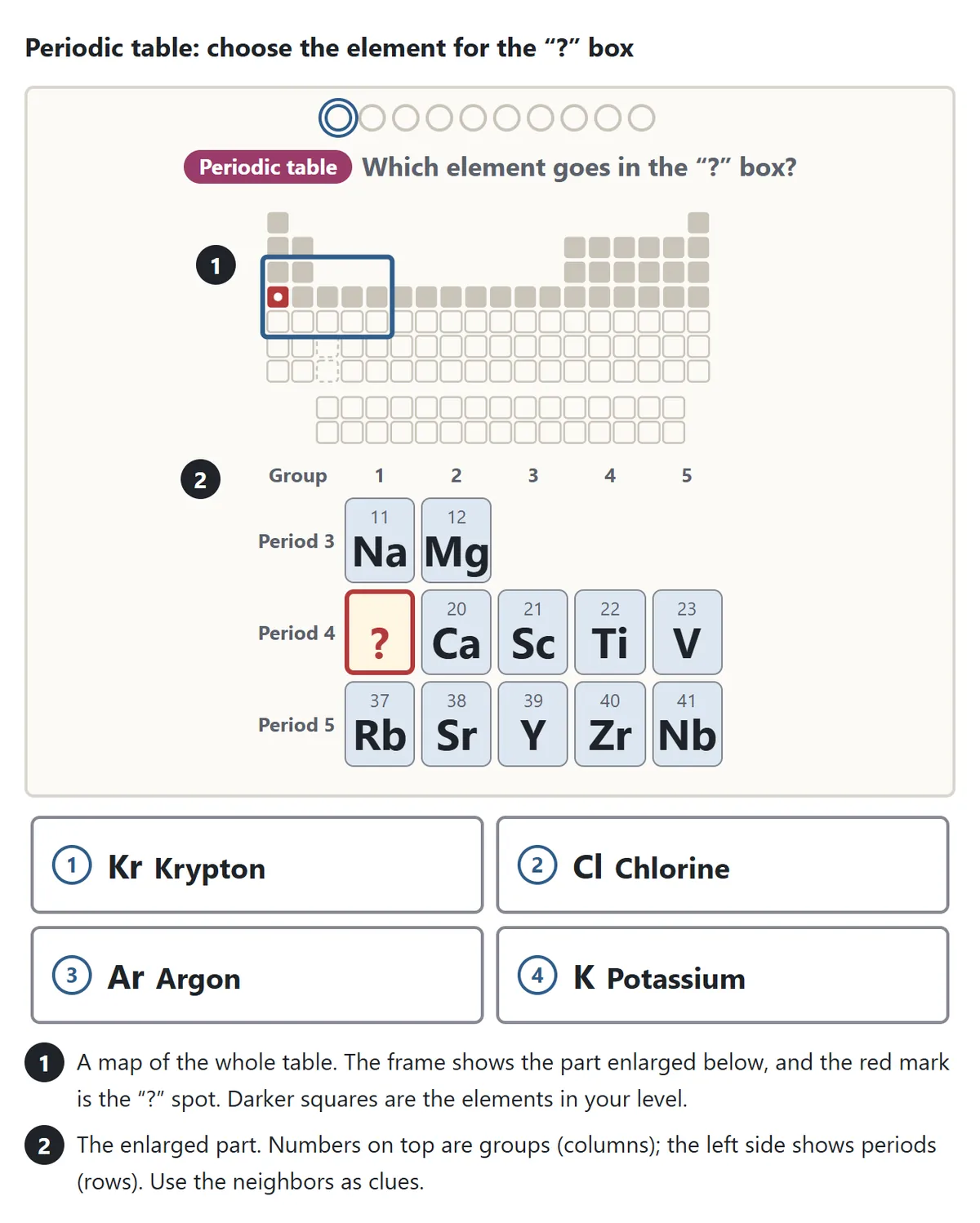
A section of the periodic table appears with one box replaced by “?”. Look at the neighboring elements, the group numbers along the top and the period on the left, and pick the element that belongs there. The small map above shows where on the whole table you are. Columns (groups) hold elements with similar chemistry, so knowing that potassium sits under sodium, or bromine under chlorine, gets you a long way.
Atomic number order
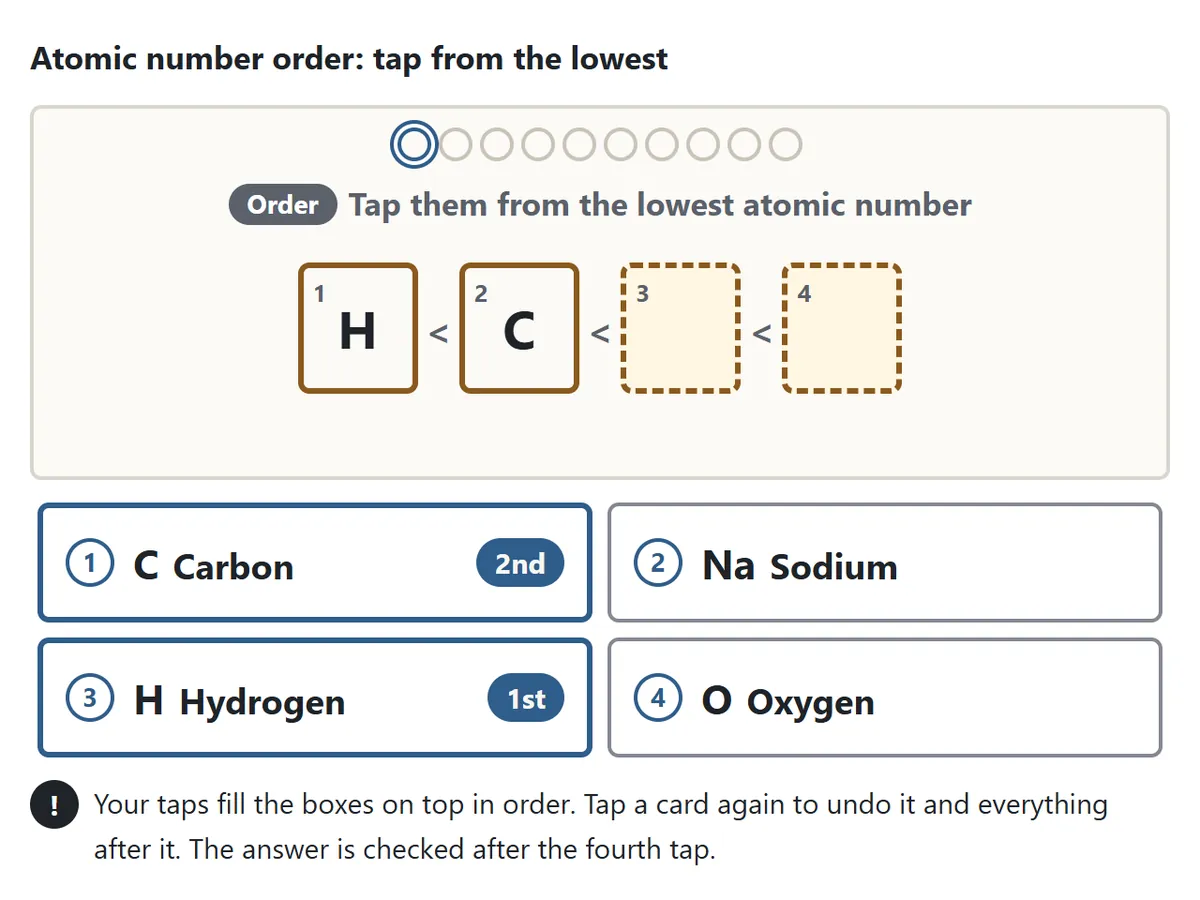
Four elements appear, and you tap them from the lowest atomic number to the highest. Your order fills the boxes on top. If you make a slip, tap the card again or press Backspace. After the fourth tap the quiz shows each atomic number so you can see where you went wrong. On the larger levels the four elements are always close together on the table, which makes this a real test of the order rather than a guess.
Mistakes, hints and the retry round
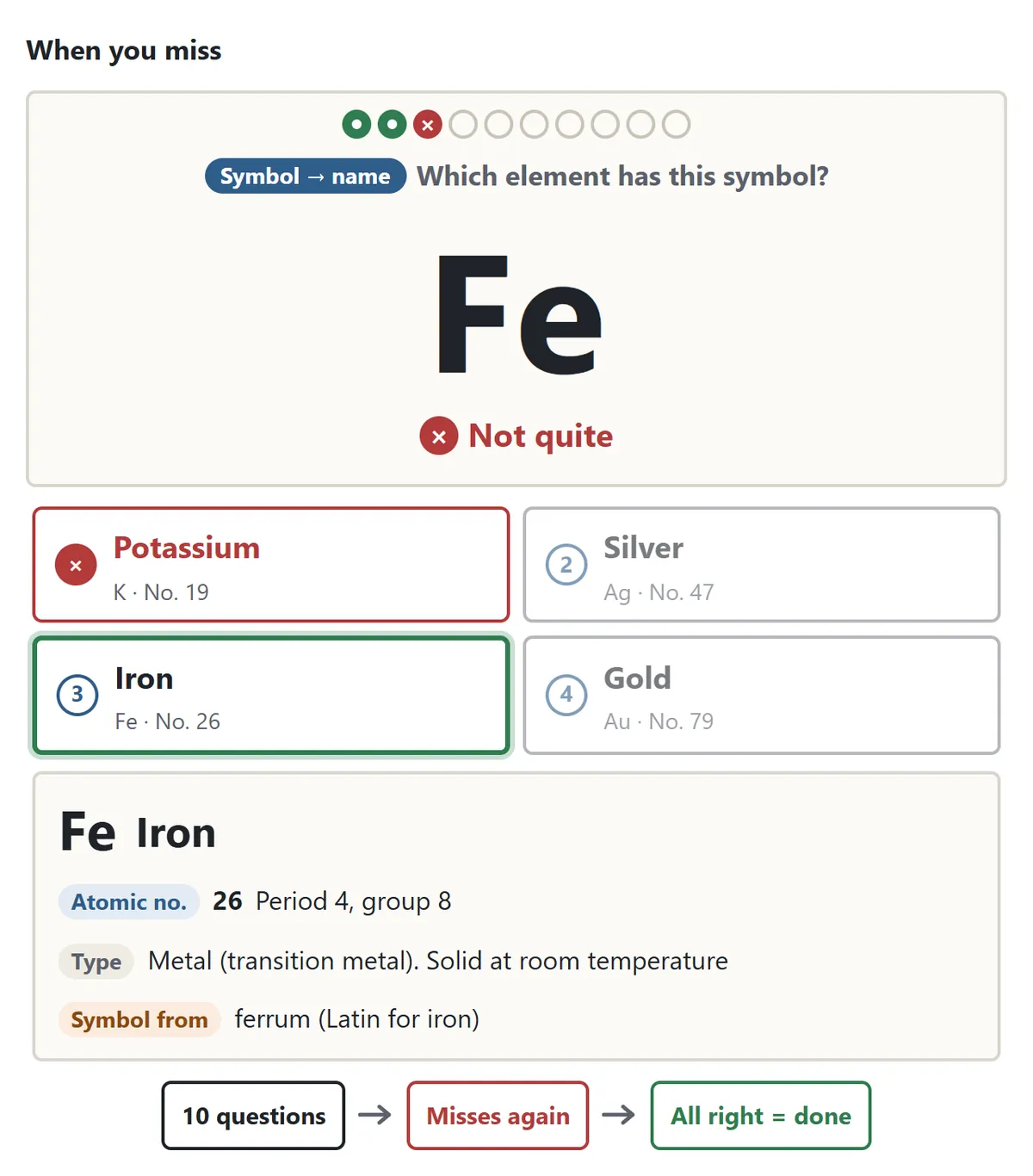
A wrong answer shows the right one in green, together with its fact card. When the main round ends, every question you missed, and every question where you used a hint, comes back once more, and the round finishes when you have got them all right. Missed questions are also saved as Weak spots on your device so you can drill them later; a question leaves the list after you answer it right on the first try twice in a row. The Hint button (or the H key) gives a clue such as the atomic number or the first letter of the symbol.
Four levels: from the common elements to all 118
| Level | Elements |
|---|---|
| Common 19 | Hydrogen, helium, carbon, nitrogen, oxygen, sodium, magnesium, aluminum, silicon, sulfur, chlorine, potassium, calcium, iron, copper, zinc, silver, barium and gold |
| Elements 1–20 | Hydrogen (1) to calcium (20): the first three rows and the start of the fourth |
| Elements 1–36 | Hydrogen to krypton (36): the top four rows, including the first row of transition metals |
| All 118 | Every known element, including the lanthanides, the actinides and the newest elements such as nihonium and oganesson |
The Common 19 are the elements you meet over and over when you first write chemical formulas and equations: the gases of the air, the elements in water and salt, and the everyday metals. If you are just starting, begin there. Elements 1–20 is the classic set that many chemistry classes ask you to memorize, and Elements 1–36 adds the transition metals from scandium to zinc. All 118 is a serious challenge even for people who studied chemistry.
Periodic table chart, Daily 10 and printable worksheets
The periodic table chart shows all 118 elements in the usual 18-column layout. Tap any element to see its fact card. Elements you have answered right on the first try get a check mark, and weak spots get an exclamation mark, so the chart doubles as a map of what you have learned. Metals, metalloids and nonmetals are told apart by both color and pattern, so the chart works without relying on color alone.
Daily 10 gives ten mixed questions chosen by the date. Everyone who plays on the same day gets the same set, which makes it easy to compare scores with a friend or a study group. The printable worksheets include a black-and-white periodic table, blank tables for writing in the symbols or the names, and twenty-question symbol and name tests with an answer page. They print on US Letter or A4.
How to memorize the element symbols: tips that work
1. Know the rules of the symbols
Every element symbol is one or two letters. The first letter is always a capital and the second is always lowercase. That is not just style: CO (carbon and oxygen) and Co (cobalt) are completely different things. Practicing with Type the symbol makes you get the capitals right every time.
2. Let the English name do the work
Most symbols come straight from the English name: hydrogen is H, carbon is C, oxygen is O, and chlorine is Cl. When two elements start with the same letter, the second letter is usually another prominent letter of the name, as in Mg for magnesium and Mn for manganese. Once you see the pattern, many symbols stop being something to memorize at all.
3. Learn the odd ones out as a group
Only a few symbols don’t match their English names, mostly because they come from Latin. These are the ones that catch people out, so it pays to learn them together:
| Symbol | Element | Comes from |
|---|---|---|
| Na | Sodium | natrium |
| K | Potassium | kalium |
| Fe | Iron | ferrum |
| Ag | Silver | argentum |
| Sn | Tin | stannum |
| Sb | Antimony | stibium |
| W | Tungsten | wolfram |
| Au | Gold | aurum |
| Hg | Mercury | hydrargyrum |
| Pb | Lead | plumbum |
Some of these live on in English words, which helps: a plumber once worked with lead pipes (plumbum), and ferrous metals contain iron (ferrum).
4. Make a mnemonic for the order
To remember the first twenty elements in order, many people string together a sentence where each word starts like an element: H, He, Li, Be, B, C, N, O, F, Ne and so on. A silly sentence you made up yourself tends to stick better than a famous one. Test it with Atomic number order on the Elements 1–20 level.
5. Learn the periodic table by columns
The groups are families. Group 1 (apart from hydrogen) holds the alkali metals, group 2 the alkaline earth metals, group 17 the halogens and group 18 the noble gases. Saying a column out loud, such as lithium, sodium, potassium, rubidium, cesium, is often easier than learning rows, and it is exactly what the Periodic table questions reward.
6. Connect elements to everyday things
Aluminum foil, copper wire, the zinc coating on a galvanized nail, the sodium and chlorine in table salt, the neon in old shop signs: tying an element to something you have touched or seen makes it much harder to forget.
Element symbols FAQ
How many elements are there on the periodic table?
There are 118 known elements, from hydrogen (1) to oganesson (118). The last four, nihonium, moscovium, tennessine and oganesson, received their names in 2016, which completed the seventh row of the table.
Why is sodium Na and potassium K?
Their symbols come from the Latin names natrium and kalium, which were in use when the symbols were set. The same is true of iron (Fe), silver (Ag), tin (Sn), gold (Au), mercury (Hg) and lead (Pb). Tungsten’s W comes from its other name, wolfram.
Is it aluminum or aluminium?
Both are correct. IUPAC and British English use aluminium (and caesium), while American English uses aluminum (and cesium). This quiz uses the American spellings and mentions the IUPAC spelling on the fact card. The symbols, Al and Cs, are the same everywhere.
Do I need to memorize all 118 elements?
For most chemistry courses, no. Knowing the common elements and the first 20 or 36 well is far more useful than knowing all 118 a little. The full set is there for when you want a challenge.
Is my progress saved?
Yes, on your own device. Your records, weak spots and an unfinished round are stored in your browser, so you can close the page and pick up later with Continue. There is no sign-in, and nothing is sent anywhere.
Does it work on a Chromebook, iPad or phone?
Yes. It runs in any modern browser, and every answer can be given by tapping, so a keyboard is optional. Sound effects are off until you turn them on.
A short history of element symbols and the periodic table
Early chemists drew elements as circles and alchemical signs, which were hard to print and easy to confuse. In the early 1800s the Swedish chemist Jöns Jacob Berzelius proposed using the first letter or two of each element’s Latin name instead, and that system is the one we still use. In 1869 the Russian chemist Dmitri Mendeleev arranged the known elements by their properties into a table with gaps for elements not yet found, and he predicted what those missing elements would be like. When gallium and germanium were discovered with properties close to his predictions, the periodic table was here to stay. New elements kept arriving through the twentieth century, mostly made in laboratories, until the 2016 names filled the last gaps in row seven.