 Yorimichi Games

How to play Price Learning Lab
Price Learning Lab is a six-round activity about changing prices, ownership cards, and arithmetic. A, B, and C are fictional organizations. Their cards represent a simplified fraction of ownership, rather than a product you consume. Everything uses learning units, which are not currency and cannot be exchanged outside the activity. You start with 30 available units and no cards. The initial card prices are 4, 6, and 3. Choose one transaction, observe the new prices, answer a calculation and an explanation question, and review the feedback. The activity always ends after six rounds. Your score comes only from the twelve learning questions. There is no competition to accumulate the largest value.
Buying, selling, and holding
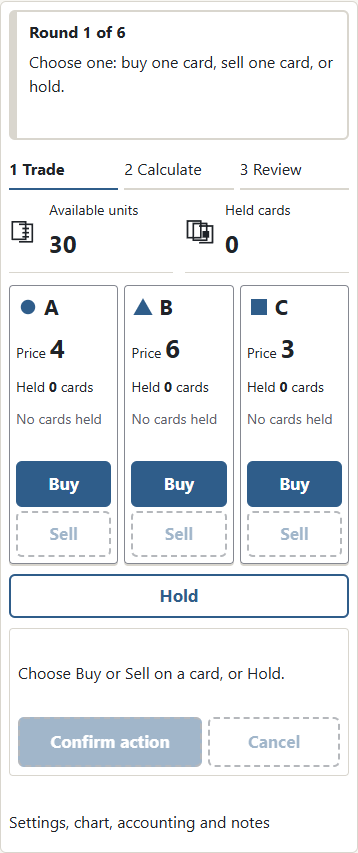
Each round permits exactly one action. Choose Buy, Sell or Hold to prepare it, check the preview of available units and card count, then select Confirm action. Tap the same choice again, use Cancel, click a blank area or press Escape to clear a preparation before committing. Buy transfers the displayed price from your available units into one ownership card. You need enough units to cover that price. Sell transfers one held card back to the teaching counterparty and adds its current price to your available units. You cannot sell a card you do not hold. Hold means making no transaction during that round. It is a valid choice, including when you want to observe without changing your holdings. Holding does not skip the lesson or extend the game. Transactions happen at the prices shown before the round update. The newly revealed prices do not change the cost of a transaction you have already made.
Understanding the price model
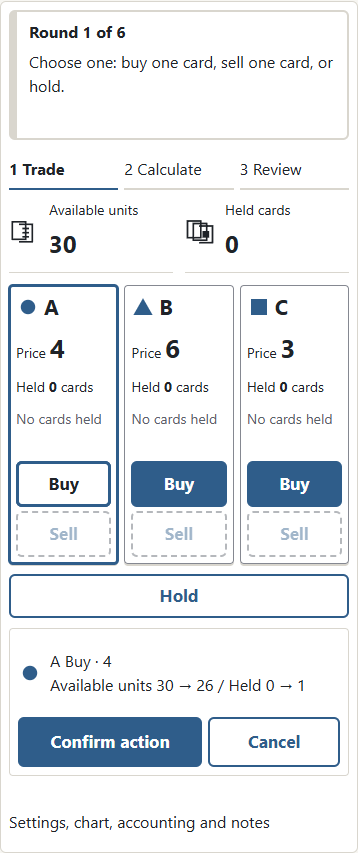
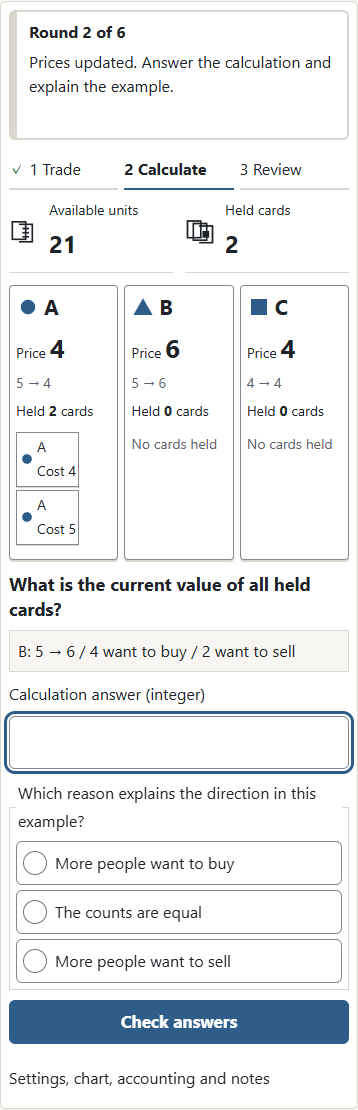
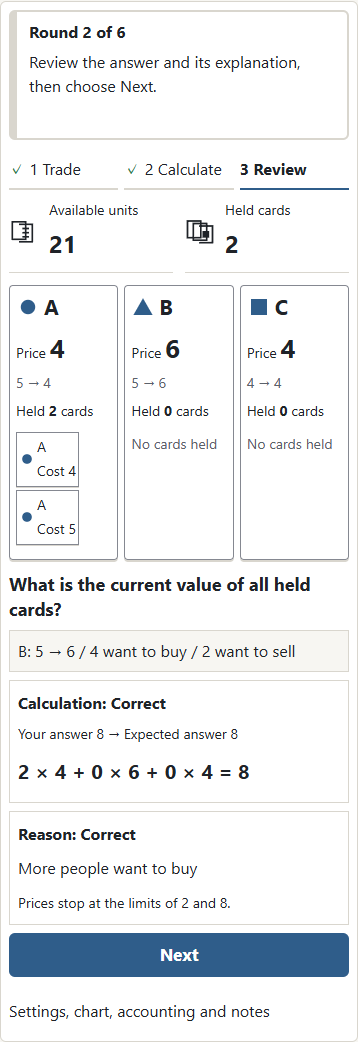
After your action, the activity shows an external example of people wanting to buy and people wanting to sell each card. More potential buyers moves its price up by one. More potential sellers moves it down by one. Equal counts leave it unchanged. Prices cannot move below 2 or above 8. At either boundary, a proposed move beyond the limit leaves the price at that boundary. These counts illustrate a simplified pressure on prices. They are not a real order book, and your action is not added to those counts. A fictional teaching counterparty accepts legal transactions at the quoted price. The cases are fixed in advance and do not change because of your actions, answers, or score.
Calculating the value of held cards
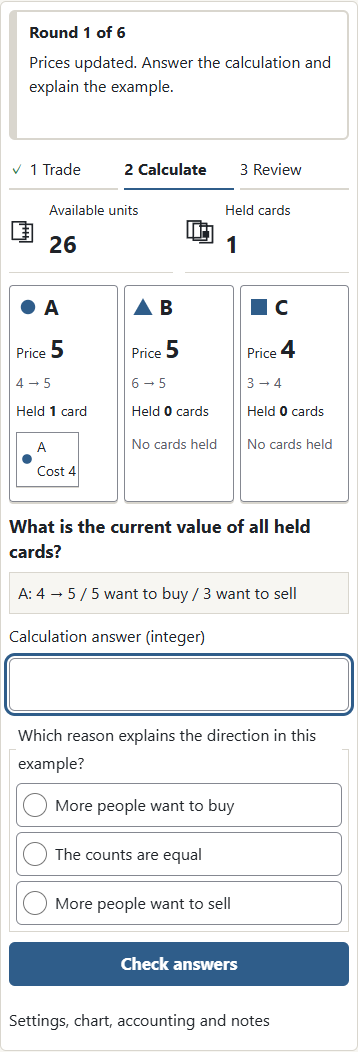
Holding value means the number of cards you hold multiplied by the current price, added across the three card types. Two A cards at a current price of 5 have a value of 10. A type with no cards contributes zero, even if its displayed price is high. Purchase cost is a separate quantity. If those two A cards were bought at 4 and 5, their combined purchase cost is 9. Their unrealized gain is therefore 10 minus 9, or 1. Always use current prices for current value and the recorded purchase prices for cost. A price update does not rewrite an earlier purchase. The purchase prices remain visible so you can check each part of your calculation.
Realized and unrealized gains and losses
A card bought at 4 and sold at 6 produces a realized gain of 2. A card bought at 7 and sold at 5 produces a realized loss of 2, displayed as minus 2. If you bought several cards of one type at different prices, this activity sells the earliest purchase first. For purchase prices of 4 and then 5, the first sale uses a cost of 4. That card is removed from the held purchase costs. The difference between its selling price and its cost enters realized gain or loss. Unsold cards remain in unrealized gain or loss, based on the current quote. This comparison is not an additional payment into available units.
Checking the accounting identity
The activity displays an identity throughout the lesson: available units plus holding value minus the initial 30 equals realized gain or loss plus unrealized gain or loss. At the beginning, both sides are zero. Buying a card reduces available units while adding a card of the same current value. A later price change affects the value of cards you still hold. Selling exchanges current holding value for available units, while moving the appropriate gain or loss from the unrealized category to the realized category. There are no fees, taxes, dividends, or other flows in this model. That is why this particular identity can be used without extra terms. Less available units alone does not demonstrate a loss.
Three calculation levels
Easy asks for the price change of a named card: new price minus old price. Normal asks for the current value of every card you hold, added together. Hard asks for the unrealized gain or loss of all held cards: current value minus their combined purchase cost. All three levels use the same initial conditions and price cases. The explanation question asks which side of the displayed example has more people, or whether the counts are equal. It tests your reading of the example, rather than predicting an unknown market. You may hold at every level. With no cards, holding value and unrealized gain or loss are zero. Trying a purchase as well gives you additional arithmetic to compare.
Answering and reviewing the questions
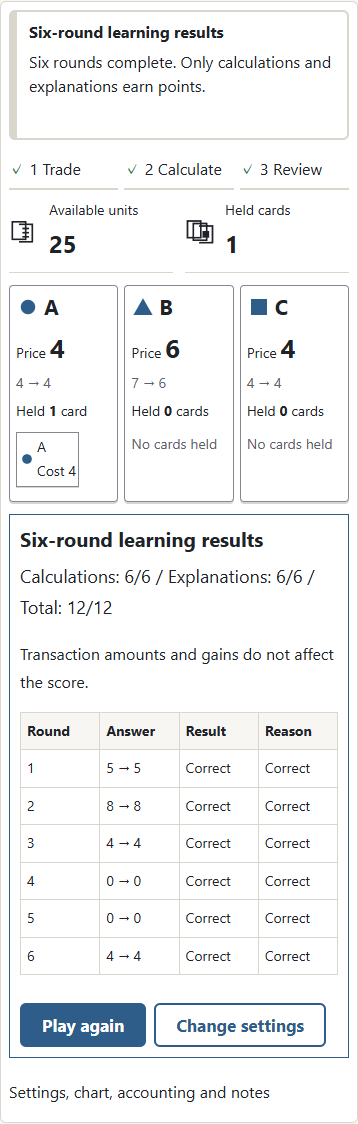
Enter an integer for the calculation and select one explanation. For a negative change or loss, put a minus sign before the number. Choose Check answers to see your entry, the expected number, the relevant calculation method, and the explanation of the count difference. Each correct calculation earns one point, and each correct explanation earns another point. An incorrect answer still allows the lesson to continue. You cannot repeat the same question to add more points. Choose Next after reviewing the feedback. At the end, the results separate calculations from explanations and show every round for review. Transaction value and gain do not enter this score, so holding and answering correctly earns the same points.
How this model differs from real markets
Real prices can reflect business results, expectations, order quantities and conditions, broader economic events, and many other factors. A difference between two counts does not provide a reliable formula for the next real price. Moving exactly one step and using a range from 2 to 8 are rules created for this activity. Automatic transactions with a teaching counterparty also simplify the exchange process. An organization earning a business profit is different from a participant realizing a gain on its ownership card. These quantities should not be treated as interchangeable. The activity contains no real companies, securities, currencies, or live data. It does not recommend financial products or offer financial advice. Its purpose is understanding arithmetic and categories.
Saving progress and using the controls
Use touch or a mouse to select the buttons. Keyboard users can move with Tab and activate a focused button with Enter. Progress is saved in this browser after each completed action or answer. On returning, choose Continue to restore the original level and the same point in the lesson. Opening Settings does not erase progress. Starting a new lesson replaces the current saved lesson. Progress does not transfer automatically to another device. If storage is unavailable, a notice explains that you can still play in the current page but cannot retain progress after closing it. The final round does not automatically sell remaining cards. Their value and unrealized gain or loss remain separate from realized results.
Questions to ask after the lesson
Try describing price change, current holding value, purchase cost, and realized gain as four different quantities. If held cards currently have a value of 12 but their purchase cost was 14, their unrealized gain or loss is minus 2, not 12. If you sell them at that quote, available units increase by 12 and the loss becomes realized. You have not created a second loss. For another check, change the numbers and repeat the calculation without looking at the screen. Explain why an equal count leaves the example unchanged and why a boundary can stop a move despite unequal counts. These tasks assess understanding; a large gain during the activity does not demonstrate learning or real investment skill.
Using the activity as a short exercise
The six-round limit makes it possible to review a complete sequence rather than continuing indefinitely. Take time between rounds to explain a calculation, compare the two sides of the accounting identity, or describe what an unsold card means. There is no countdown and no reward for answering faster. For a group exercise, participants can compare arithmetic even when they made different legal choices. Different holdings can produce different correct answers to the value questions. Classroom suitability and learning effectiveness require their own review; the presence of a score does not prove either. The linked public educational resources cover wider topics. This small original exercise addresses only its stated price and gain/loss concepts.
Calculation level comparison
| Level | Calculation |
|---|---|
| Easy | New price minus old price |
| Normal | Current value of all held cards |
| Hard | Current value minus held purchase costs |
Resources: J-FLEC / JPX / Financial Services Agency