 Yorimichi Games
How to play Spider Solitaire
Spider Solitaire is a patience game for one player that uses two standard decks, 104 cards with no jokers. The cards are dealt into ten columns, and your goal is to arrange them into complete runs: thirteen cards of the same suit, in order from king down to ace. Each complete run is lifted off the table, and when all eight runs are gone, you win. Most of the cards start face down, so a big part of the fun is uncovering them bit by bit and deciding which column to dig into next.
The rules fit in a few sentences, but the game rewards careful planning, especially with more suits in play. Here is everything you need to know, step by step.
The layout
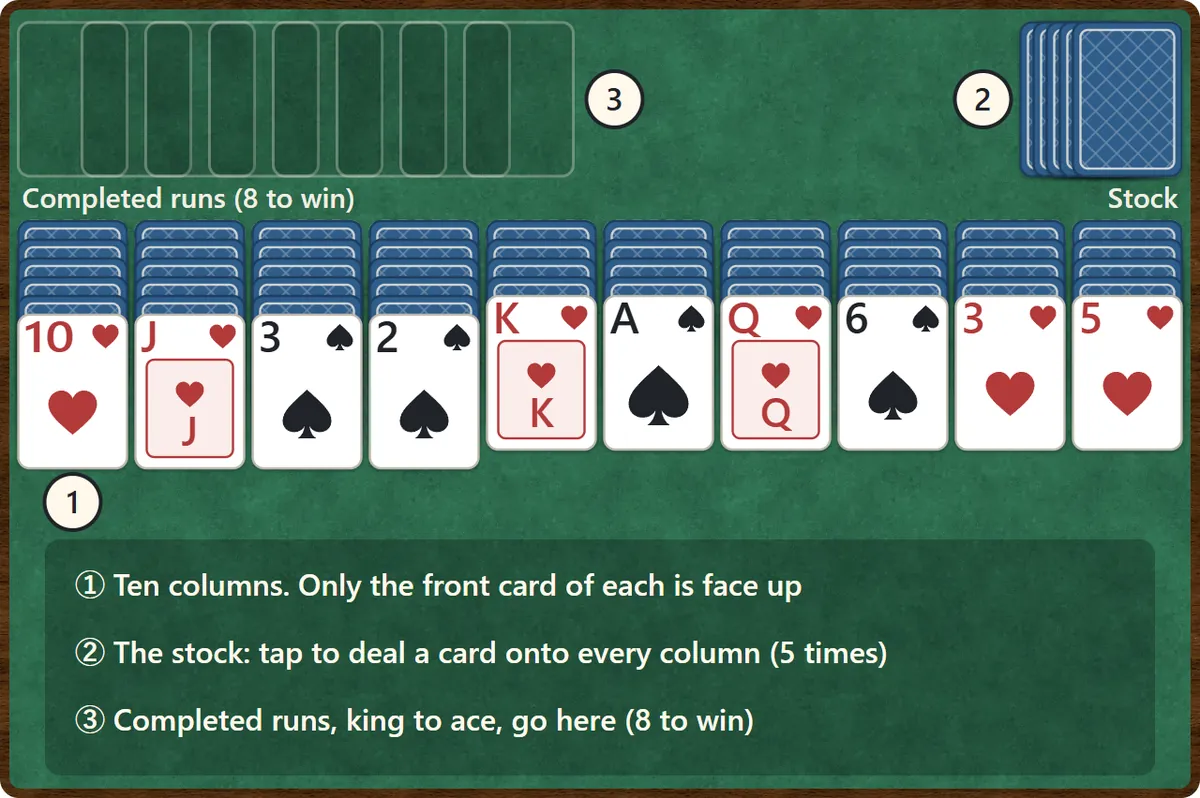
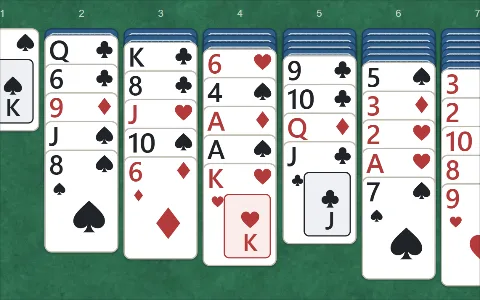
At the start, 54 cards are dealt into ten columns: six cards in each of the four columns on the left and five in each of the six on the right. Only the front card of each column is face up. The remaining 50 cards form the stock in the top right corner, which you will deal out later, ten cards at a time, in five rounds. The eight spaces at the top left collect your completed runs, one run per space.
Spider Solitaire rules for moving cards
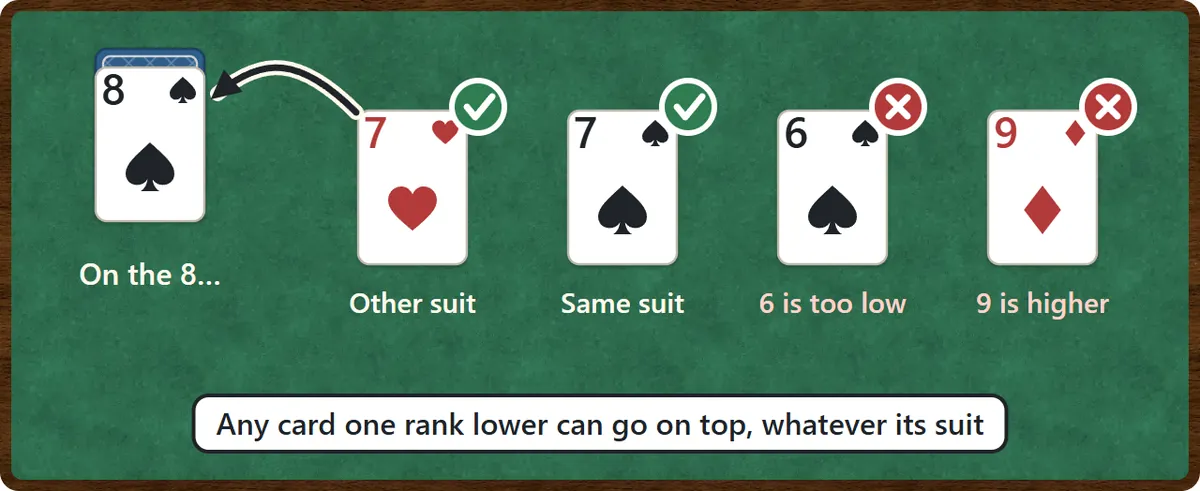
The front card of a column can be moved onto the front card of another column if that card is exactly one rank higher. Suit and color don’t matter for this. On the 8 of spades you can put the 7 of hearts or the 7 of spades, but not the 6 of spades (two lower) or the 9 of diamonds (higher). Nothing can go on an ace, and a king can’t go on any card at all.
Only same-suit runs move together
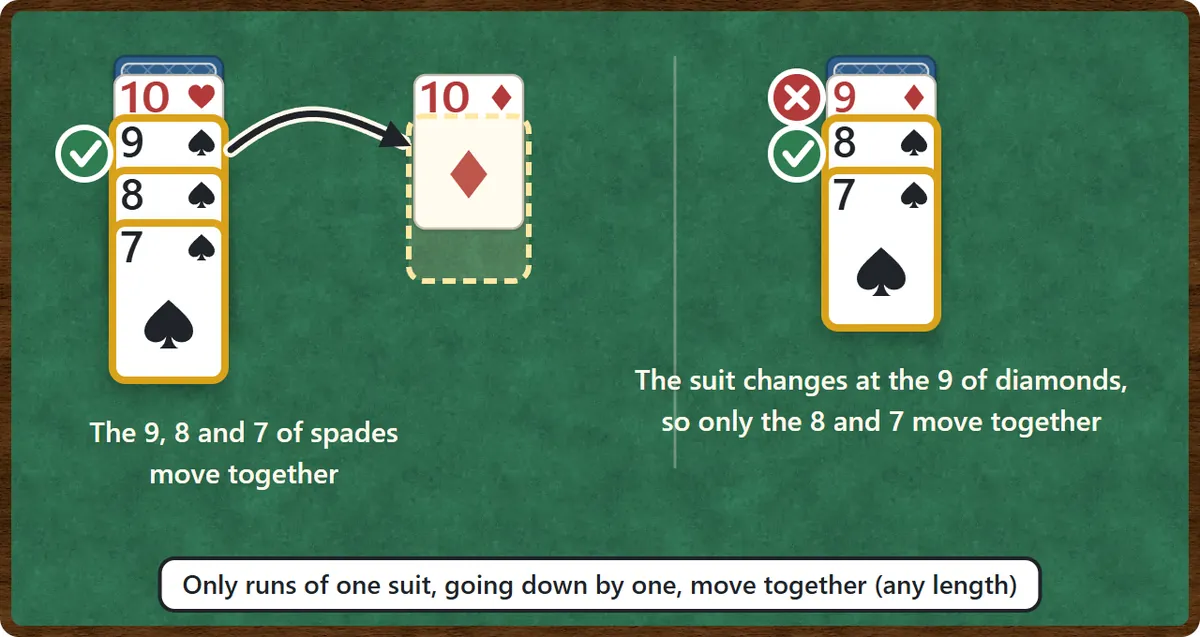
This is the rule that makes Spider Solitaire different from other patience games. You may place a card on any suit, but you can only move several cards at once if they are all the same suit and go down one rank at a time. If a column ends with the 9, 8 and 7 of spades, you can move all three together to another column, and there is no limit on how long such a run can be. If the column ends with the 9 of diamonds followed by the 8 and 7 of spades, the suit changes at the 9, so only the 8 and 7 can move as a group.
Any card can go in an empty column
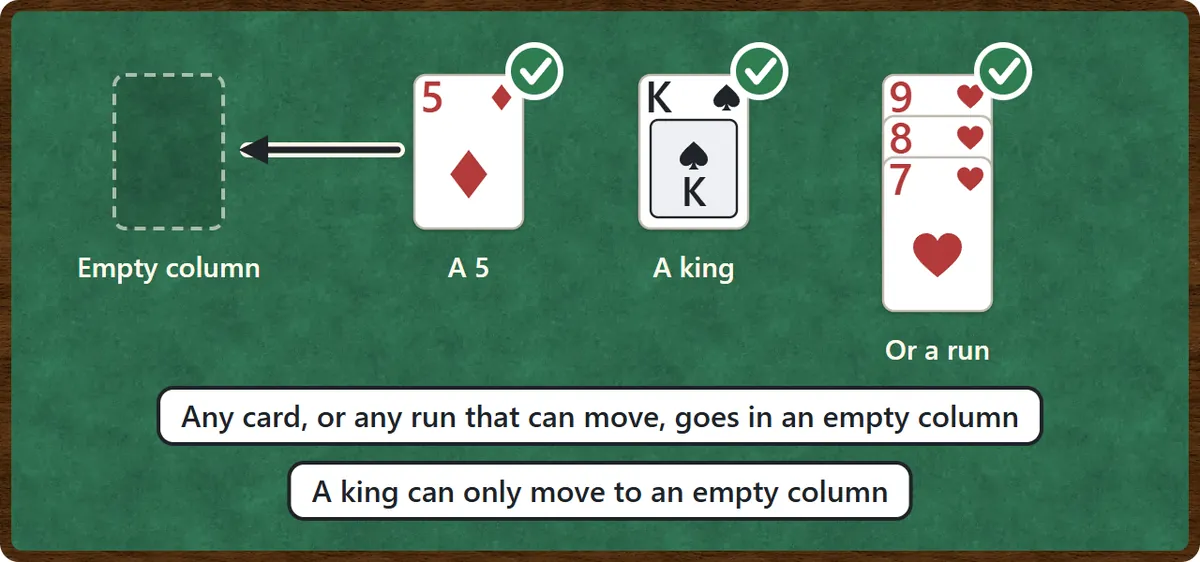
When you move every card out of a column, it becomes empty. You can put any single card there, or any group of cards that can move together. An empty column is also the only place a king can ever go.
Dealing from the stock
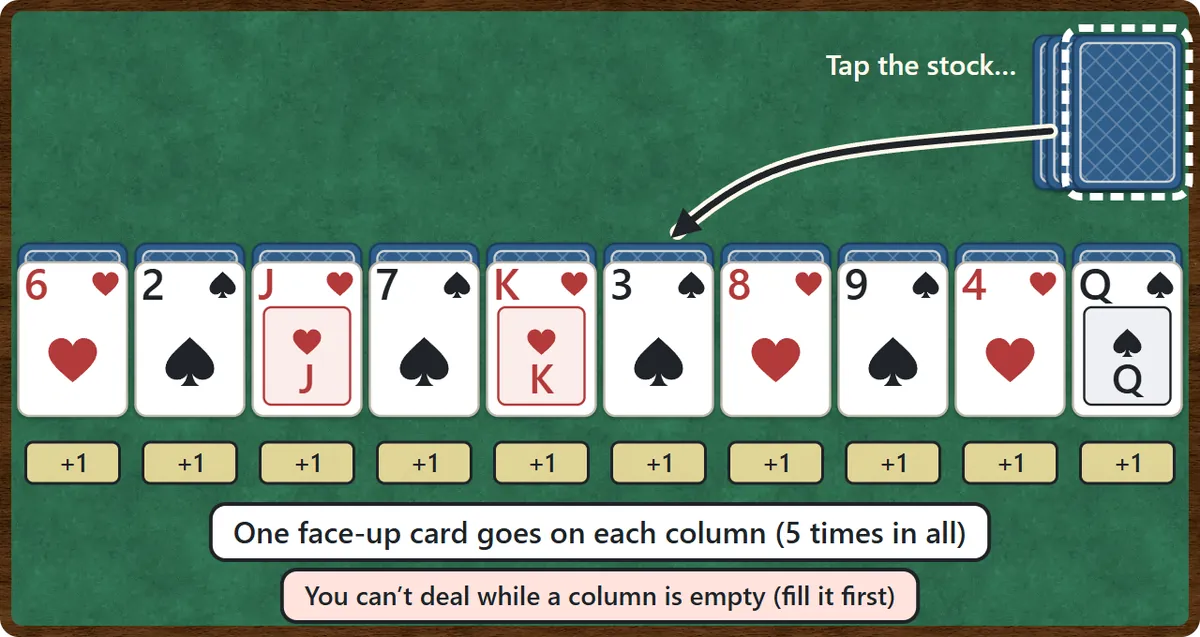
When you run out of useful moves, tap the stock in the top right. One card is dealt face up onto each of the ten columns, and you can do this five times in all. Under the standard rules, you can’t deal while any column is empty, so fill every gap with a card first. If you prefer, choose the relaxed rule in the settings, which lets you deal even when a column is empty.
Completing a run from king to ace
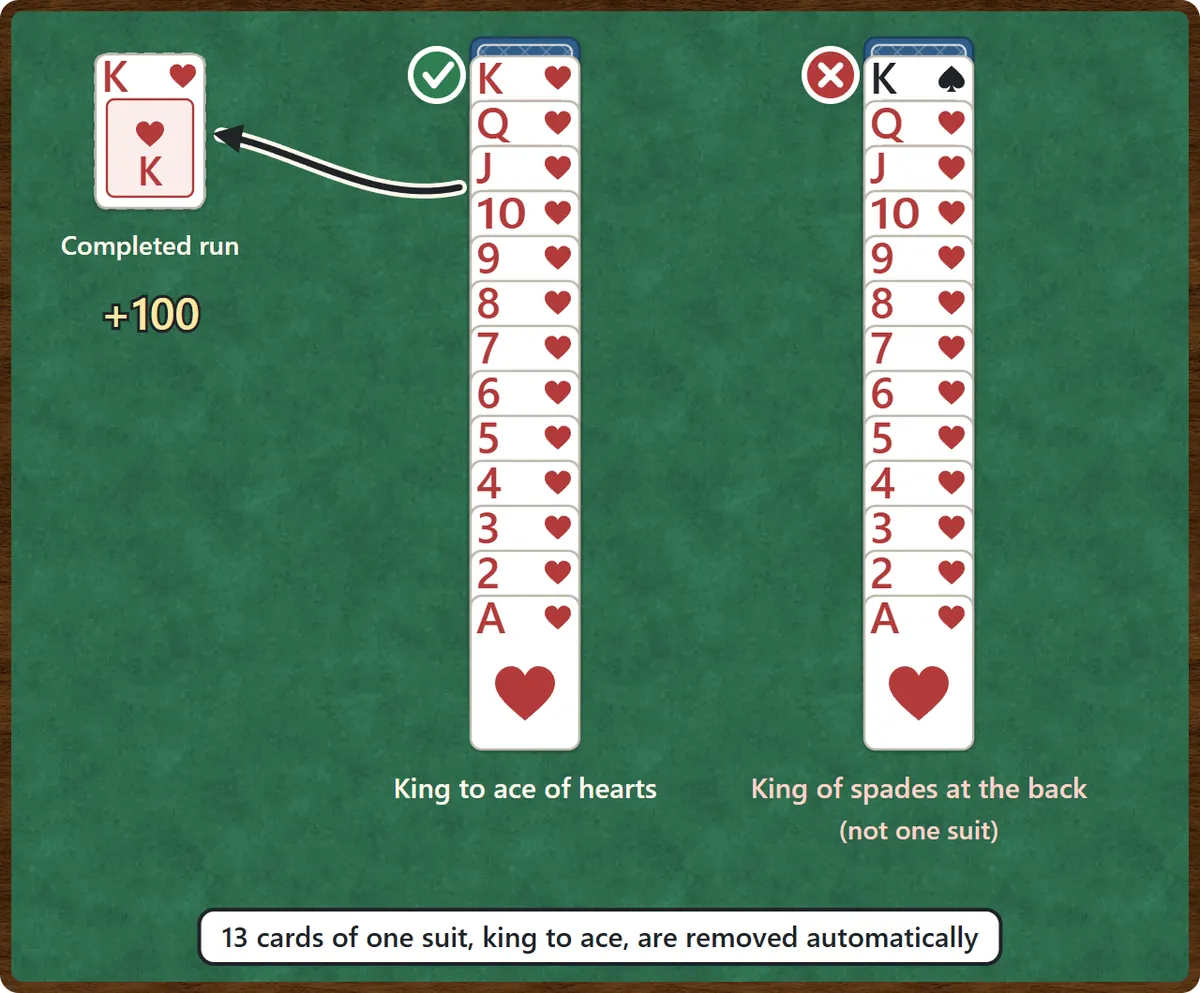
As soon as a column contains thirteen cards of the same suit in order from king to ace, those cards are removed and placed in one of the spaces at the top left. If even one card of another suit is mixed in, the run doesn’t count. Complete eight runs and you win.
How scoring works
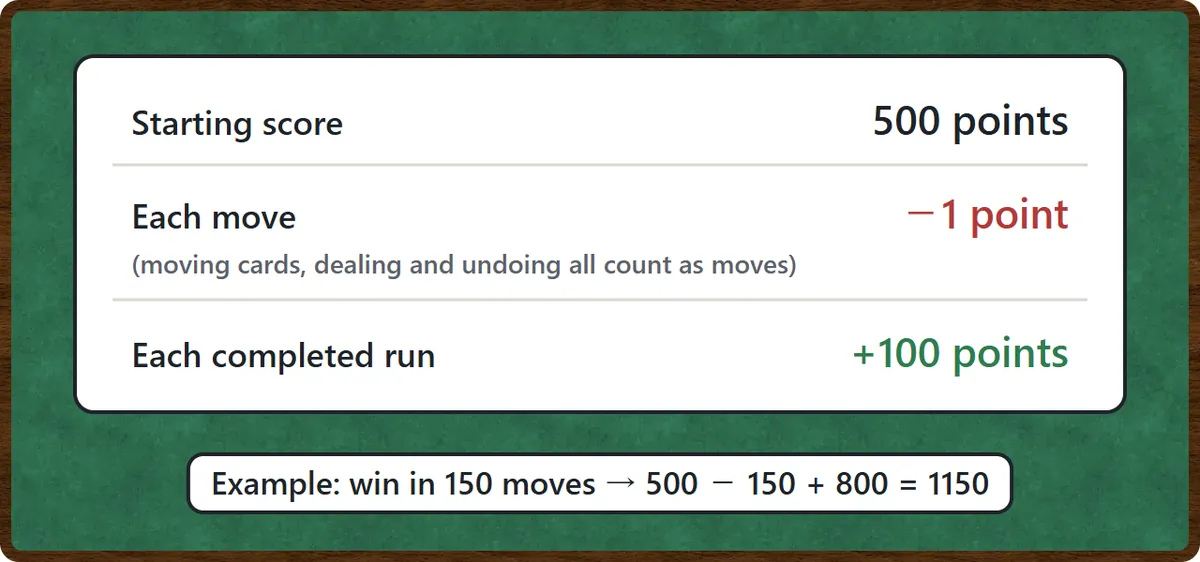
You start with 500 points and lose one point for every move. Moving cards, dealing from the stock and using Undo all count as moves. Each completed run is worth 100 points, so a win scores 1,300 minus the number of moves you made. Win in fewer moves and your score goes up.
How to use this game
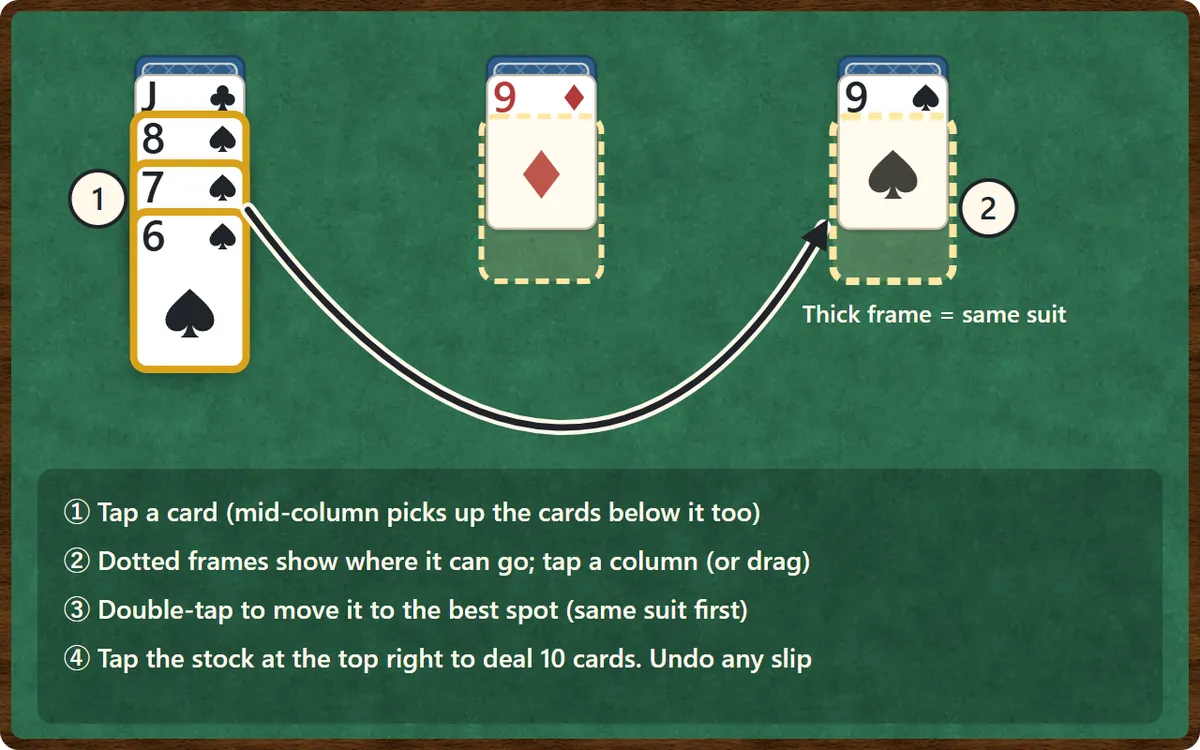
Click or tap a card to pick it up, and dotted frames appear on every column where it can go. A thick frame means the card would land on the same suit. Click a framed column to move the card there. If you tap a card in the middle of a column, you pick up that card and everything below it. You can also drag cards with your finger or the mouse, and a quick double-click or double-tap moves the card to the best spot, preferring a card of the same suit. When a move isn’t allowed, the game tells you why, for example “Only a 9 can go on the 10 of hearts (any suit).”
Undo takes back as many moves as you like (each undo counts as a move), and Hint shows a good next move with an arrow. On a keyboard, press 1–9 and 0 to choose a column, D or Space to deal, Z to undo and H for a hint.
1 suit vs 2 suits vs 4 suits: which should you play?
The number of suits changes Spider Solitaire more than any other setting. There are always 104 cards; with fewer suits, the same cards simply appear more often. Every deal in this game has been checked by a computer and has at least one way to win.
| Suits | Cards used | What it’s like |
|---|---|---|
| 1 suit (easy) | Spades only, eight of each rank | Every card one rank lower continues a run, so almost any stack can move together. The best place to learn the game or to practice winning in fewer moves. |
| 2 suits (medium) | Spades and hearts, four of each rank | You start to care about which suit you build on. This is the level most regular players choose. |
| 4 suits (hard) | All four suits, two of each rank | Same-suit runs are hard to build, and using empty columns well decides the game. Very satisfying when you win. |
If you are new to the game, start with 1 suit until you can win comfortably, then move up. The jump from 2 suits to 4 suits is bigger than it looks, because with four suits you often have to build on the wrong suit and sort it out later.
| Game | What it is |
|---|---|
| Random deal | A new deal with the number of suits you picked. Your wins and your best score and time are kept for each number of suits. |
| Daily Deal | One 2-suit deal for each date. Everyone gets the same deal on the same day, so you can compare scores with friends and family. |
| Deal by number | Choose the number of suits and a deal from 1 to 10000. The same number always gives the same cards, so you can replay a deal that got away. |
Spider Solitaire strategy: tips to win more games
1. Turn over face-down cards first
Face-down cards are what keep you stuck. When you can choose between several moves, pick the one that turns a card face up. Columns with only a few hidden cards are the quickest to clear, so work on them early.
2. Build on the same suit whenever you can
Placing a card on a different suit breaks the run, and those cards will no longer move together. If a same-suit spot is available, use it. Build on a different suit only when it achieves something clear, such as uncovering a hidden card or emptying a column.
3. Aim to empty a column
An empty column is the most valuable space in the game. It lets you park cards temporarily, swap the order of runs, and dig out cards buried in the middle of a column. When you spot a short column, think about how to clear it.
4. Do everything you can before dealing
A deal from the stock drops a card on top of every column, covering the runs you have built. Before you deal, turn over every card you can and join up as many same-suit runs as possible. Because you can’t deal with an empty column, also decide in advance what you will put there.
5. Keep kings at the back of a column
A king can’t go on any other card, so a king in the middle of a column is often in the way. Once you have an empty column, moving a king and the run below it there creates a column that never needs to be broken up. Don’t rush, though: an empty column has other uses, so make sure a king is the best use of it.
6. When you’re stuck, go back
If you hit a dead end, undo a few moves and try a different order. Hint shows a good next move, and when there is no longer a way to win from the current position, it tells you how many moves to go back.
Is every game of Spider Solitaire winnable?
Not every possible deal can be won, but far more can than most players expect. If you could see every card, including the face-down ones and the order of the stock, almost every 1-suit and 2-suit deal could be solved, and so could a large majority of 4-suit deals. Real players can’t see the hidden cards, so luck plays a part, and at 4 suits even experienced players lose a good share of their games.
In this game you never have to wonder whether a deal is possible. Every deal offered has already been solved by a computer, so if you get stuck, a way through exists. The Hint button can help you find it, at the cost of that game not counting toward your personal best.
Spider Solitaire FAQ
Why can’t I deal when a column is empty?
The traditional rule says every column must have at least one card before you deal from the stock, and most versions of Spider Solitaire follow it. If you would rather play without it, turn on the relaxed rule in the settings. Games played that way are recorded separately from standard games.
Can I move a mixed-suit stack?
Not in one move. You can build a stack of alternating suits by placing cards one at a time, but only the cards at the front that are all the same suit can be picked up together. That is why building on the same suit matters so much.
Can I keep a completed run on the table?
No. When the king to ace of one suit are lined up, they are removed automatically. Nothing can be placed on a complete run anyway, so removing it never costs you anything.
How is my score counted?
You start with 500 points, lose one for every move, deal or undo, and gain 100 for each completed run. Your score and time count as a personal best only when you win without using hints.
What is the Daily Deal?
The Daily Deal is one 2-suit deal chosen for each date. Everyone who plays on the same day gets the same cards, so it is a fair way to compare scores. Win it on consecutive days to build a streak.
Can I stop and continue later?
Yes. Open the game again on the same device and browser and press Continue. Your undo history is saved too, so you can still go back to earlier moves. The game starts with the sound off; press “Sound: off” to hear sound effects when you move and deal cards.
Does it work on a phone, tablet or Chromebook?
Yes. The game runs in any modern browser with a mouse, a keyboard or a touch screen. On a phone the cards are small, so you may find it easier to play in landscape or to use the double-tap shortcut.
Where Spider Solitaire comes from
Spider Solitaire is one of the best-known patience games played with two decks. It has been played with paper cards since at least the first half of the twentieth century, and card-game writers of that era praised it as one of the finest of all solitaire games. The name is often said to come from a spider’s eight legs, matching the eight runs you need to complete. In the late 1990s the game was included with software for home computers, and it soon became one of the most played computer card games in the world. The choice of one, two or four suits dates from that time and is still how most people play today. Slowly turning hidden cards face up while long runs take shape is a big part of why the game has stayed so popular.