 Yorimichi Games
What is Six Card Golf?
Six Card Golf is a card game about reducing the score of a small layout. Every player has six cards in two rows of three. You draw a card, decide whether it helps, and replace a card in your layout or discard the draw. A low card is often useful, but a matching vertical pair can be even better. The aim is the lowest total after the agreed number of holes. A hole means one deal or round; there is no ball or playing field. This game is different from Golf Solitaire, in which you clear a layout by moving cards in sequence.
Play against the computer when you are on your own, or choose pass-and-play for two to four people sharing one device. Computer play supports one human and up to three opponents. Easy, Normal and Hard use the same rules and the same shuffled deck. For a first game, choose two players, Basic rules and one hole. Once the turn sequence feels familiar, try nine holes and see how your decisions work across several deals. Three holes is a useful shorter match, and eighteen offers a longer session.
Deal six cards and turn up two
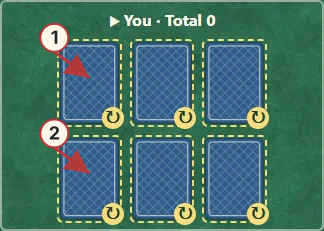
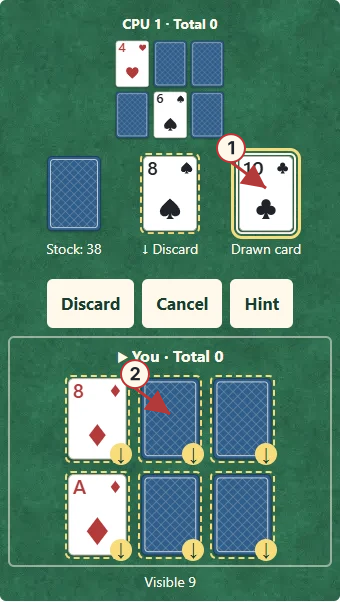
Each player receives six face-down cards. Arrange three above three, without looking at the hidden faces. The remaining cards form the stock, and its top card starts a face-up discard pile. Each player turns up any two positions before normal turns begin. On this screen, positions one, two and three are the top row; four, five and six are below them. The vertical columns are one with four, two with five, and three with six.
A face-down card is unknown even to its owner. You cannot inspect it before deciding to replace it. All face-up cards are public information. The computer sees those public faces, the discard pile, and a card it has just drawn on its own turn. It does not see the stock order or anyone’s face-down cards. Your opening choice can put two cards in the same column for a definite column score, or reveal cards in separate columns to create more potential matches. Neither choice guarantees a better deal.
Drawing, replacing and discarding
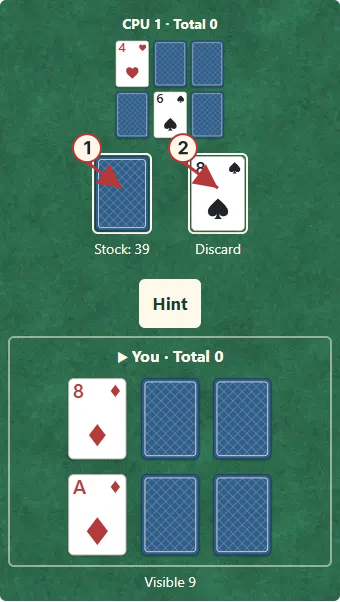
On your turn, draw the top card from the face-down stock or the face-up discard pile. The stock offers a new unknown card. The discard is visible, so you can decide whether it has a clear use before taking it. To keep your drawn card, choose one of your six positions. The new card stays face up there, and the old card goes face up onto the discard pile. If you replace a hidden card, you commit to the position before discovering what you gave away. During normal play, only the top card of the discard pile can be taken. Undo on this screen returns to the same drawn card; it does not provide a new draw.
After a stock draw, you may discard the drawn card instead of changing your layout. In Basic rules, this does not require turning up another card. A card taken from the discard pile must be used in Basic and Jokers. Immediate scoring allows you to discard it again, following the more permissive wording of that preset’s reference. The current rule summary stays on screen, so you do not have to remember which option you selected.
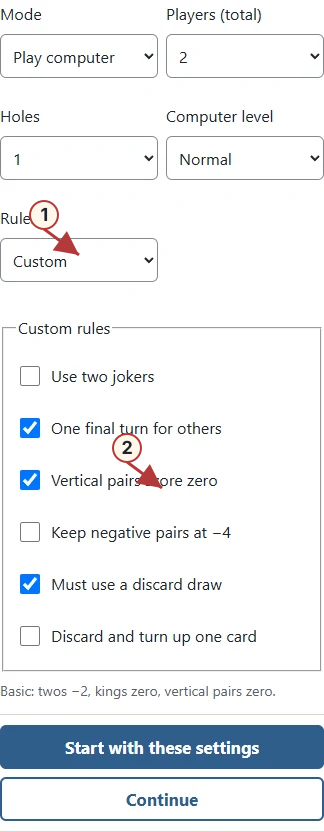
Face-up cards can be replaced again on later turns. A completed pair is useful but is not locked. Custom rules also offer a discard-and-turn-up option. When it is enabled and you still have a hidden card, press Discard drawn card and then choose a hidden position to reveal. Press Back if you want to return to choosing a replacement instead. This option changes the pace because rejecting a draw still exposes another position.
Card values and vertical pairs
In Basic rules, aces score one, twos score minus two, cards three through ten score their printed number, jacks and queens score ten, and kings score zero. Suits and colours do not affect scoring. Two cards of the same rank in a vertical column make that entire column score zero. An eight of hearts and an eight of clubs match. A jack and a queen do not match, even though both have a value of ten. Horizontal neighbours and diagonal cards do not cancel each other.
For example, put eight, king and two across the top, with eight, ace and five below. The left column is a pair worth zero. The middle column is zero plus one, worth one. The right column is minus two plus five, worth three. The whole layout scores four. In the default pair rule, a column of two twos also scores zero. Their individual negative values are cancelled, rather than adding to minus four. Keeping negative cards in different columns can therefore be better than pairing them.
The Jokers preset adds two jokers for a fifty-four-card deck. Twos then score positive two, and jokers score minus two. Both jokers count as the same rank for a vertical pair. By default their pair is zero; the custom Negative pairs option keeps it at minus four. The same option keeps a pair of twos at minus four when jokers are absent. Turning off vertical pairs makes every column a simple addition. The Visible number under your layout counts only revealed cards and completed revealed pairs. It is not a prediction of your final score.
Ending a hole and counting final turns
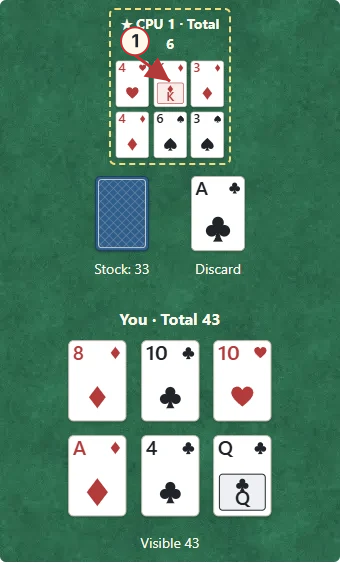
A player exposing all six of their cards triggers the end of the hole. In Basic and Jokers, every other player gets exactly one final turn, in seat order. The player who triggered the finish gets no further turn. If someone else exposes their final hidden card during this closing sequence, the sequence does not restart. Once the other seats have acted, all remaining hidden cards are revealed and every layout is scored.
Immediate scoring is different: the hole ends as soon as the first complete layout is face up. Opponents do not receive another turn. This can make the final replacement more urgent. Before exposing your last card, compare your known score with the other public layouts. Hidden cards might be low, high, or part of an unexpected pair. You often have to decide without knowing who will ultimately score best.
When the stock runs out, this version keeps the top discard in place and shuffles the older discards into a new stock. It uses that recycling method for every preset. To keep a hole from continuing indefinitely, a hole also ends after two hundred and forty completed turns. All layouts are then revealed and scored, and the screen states the reason. If there are genuinely no drawable cards, scoring happens immediately. These limits are stated here because they affect play; they are not extra scoring penalties.
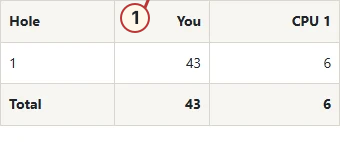
After the selected number of holes, add each player’s hole scores. The lowest total wins. If several players share the lowest total, they share the win rather than playing an automatic extra hole. One-hole games use that hole’s score alone. The starting seat rotates for each new hole, and each deal uses a freshly shuffled complete deck. The score table keeps every hole and the running total visible.
Six Card Golf strategy for beginners
Begin by looking for obvious improvements among your visible cards. Replacing a lone queen or ten with a king cuts a large amount from the score. However, if that high card already forms a vertical pair, its column is zero. Breaking the pair to insert a lower individual card may make the column worse. Compare the whole column rather than judging only the card you plan to remove.
Watch the discard pile for a rank you already have face up. An eight below another eight can remove sixteen points from an unpaired column. A jack can pair with a jack, but not with a queen. Negative cards need special care: in the default rule, pairing two negative cards raises their combined value from minus four to zero. The Negative pairs setting changes that calculation. The rule summary helps you check which scoring method applies.
Replacing a hidden position also gives you information and moves your layout towards the finish. Do not throw away an unknown card merely because you feel obliged to keep a poor draw. Discarding is a real choice. On the other hand, endlessly adjusting only visible cards delays the end and gives opponents more opportunities to improve. If another player has just one hidden position left, think about which unknown column is most important to resolve. The Hint button suggests a move from public information. It cannot tell you what is under a face-down card, and it does not promise that a suggested move will win.
Presets, controls and saved games
Tap a pile to draw, then tap one of your six cards to replace it. The yellow frame marks your drawn card; dashed frames and down arrows mark legal targets. Tap the drawn card again, the felt, or Escape to cancel selection. The card stays drawn, and tapping it selects it again. Undo restores the most recent replacement or discard with the same drawn card, including the following computer turn. It cannot redraw the stock, reverse the opening reveals, or rewind a result. Drawing your next card ends this undo window. In pass-and-play, undo is available only before the next player confirms the handover.
Choose Basic, Immediate scoring, Jokers or Custom before you start. Custom offers independent switches for jokers, final turns, vertical pairs, keeping negative pairs, requiring use of a discard draw, and revealing a card when discarding. This is the six-card layout game. Four-card, eight-card and nine-card layouts, special action cards, penalties for calling the end, four-card block bonuses and multiple-deck versions are outside this version. Families often use different house rules, so agree on the options before the first deal.
Tap or click a card to turn it up or replace it. On a keyboard, one through six select positions (top row left to right: 1–3; bottom row: 4–6), D draws from the stock, P takes the discard, and X discards your draw. Enter confirms a handover or advances to the next hole. A focused form field or button keeps its normal keyboard behaviour. Controls are explained below the table from the moment the page opens. Sound starts off. The display follows your device’s light or dark preference.
Your progress is saved in this browser on this device. Opening Settings pauses play; Continue resumes the saved match, including a draw you have not yet placed. The Japanese and English pages share the same save. In pass-and-play, hand the device to the next player before confirming the handover. Public layout cards stay visible, while a newly drawn stock card belongs to the current player’s decision. Clearing browser storage removes the saved game. Moving to another device or another browser does not transfer it automatically. The computer match record counts solo and shared wins separately, so a tied result remains clear.