 Yorimichi Games

How to play Chain Drop Puzzle
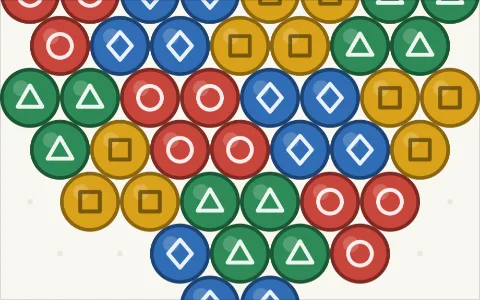
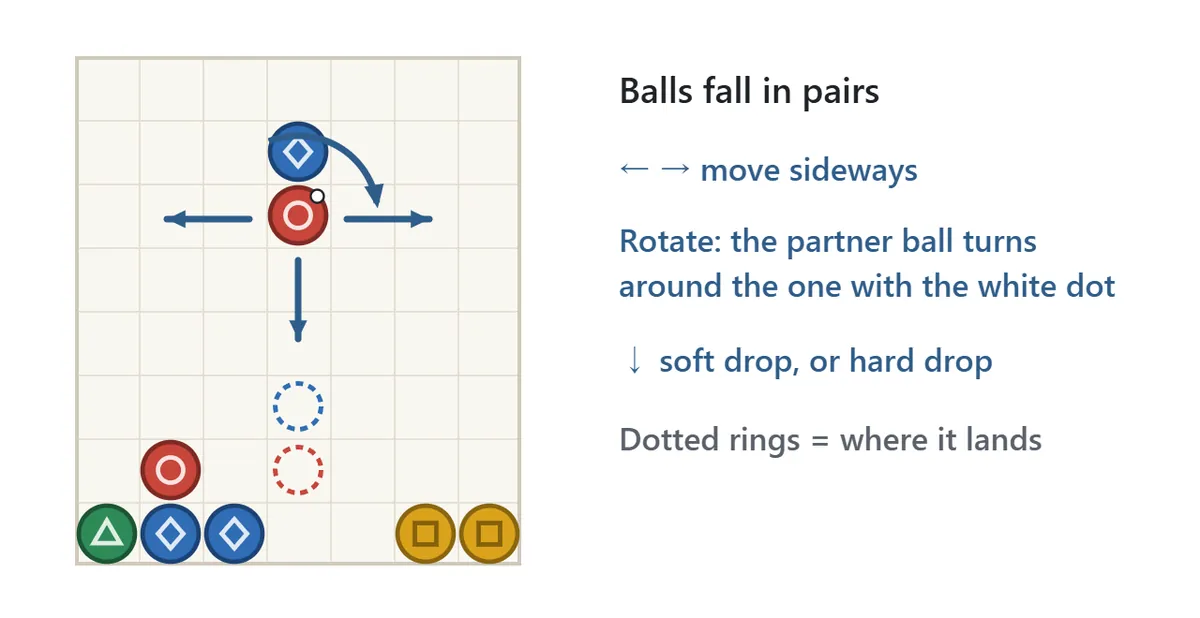
Chain Drop Puzzle is a falling puzzle game played with colored balls. Balls drop from the top of the board in pairs. While a pair is falling you can slide it left and right and rotate it, then set it down on the pile below. When four or more balls of the same color touch each other up, down, left or right, they clear. The balls sitting above them then fall into the gap, and if the falling balls make a new group of four, that group clears too. That second clear is a chain. Every extra step adds to the chain count: a 2-chain, a 3-chain, a 4-chain, and so on.
The game runs right in your browser. It is free, there is nothing to install, and you don’t need an account. It works with a keyboard and mouse on a computer, and with touch on phones and tablets.
Chain Drop Puzzle rules
- The board is 7 columns wide and 13 rows tall. New pairs appear at the top of the middle column.
- A pair falls one row at a time. When it lands on the floor or on other balls it locks after a short moment, and you can still slide it during that moment.
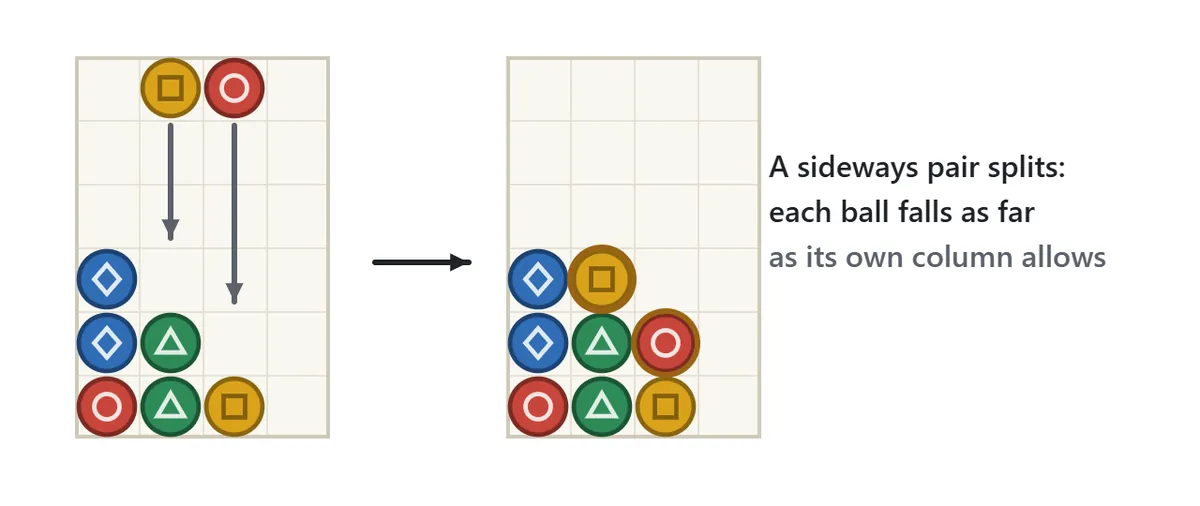
- If you drop a pair sideways over uneven ground, it splits: each ball keeps falling in its own column until it lands.
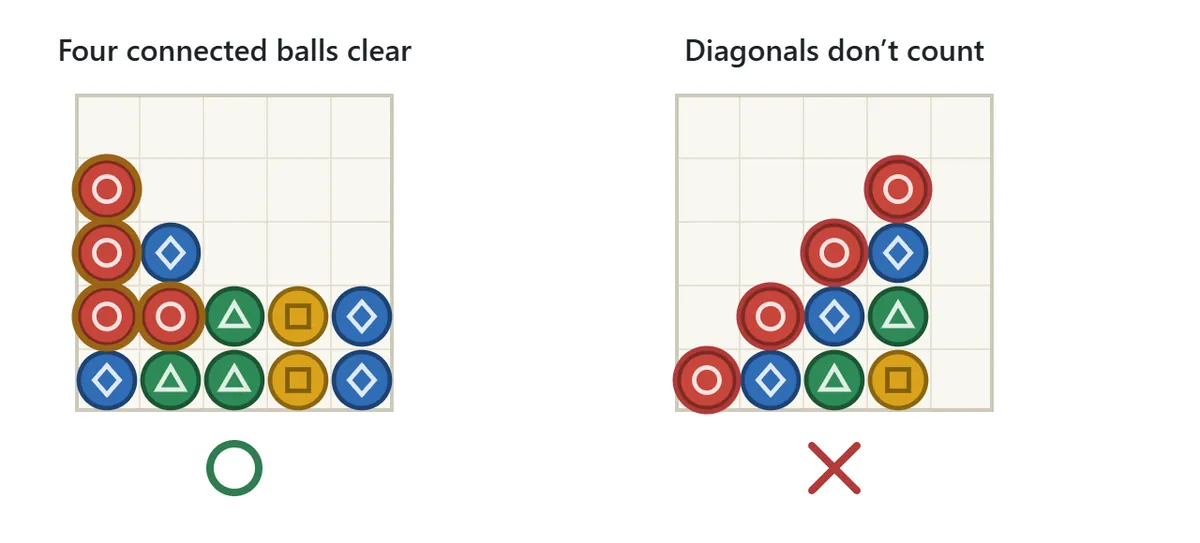
- Four or more balls of the same color that touch vertically or horizontally clear. Diagonal neighbors don’t count.
- If two colors, or two separate groups, clear at the same moment, they count as a single step of the chain.
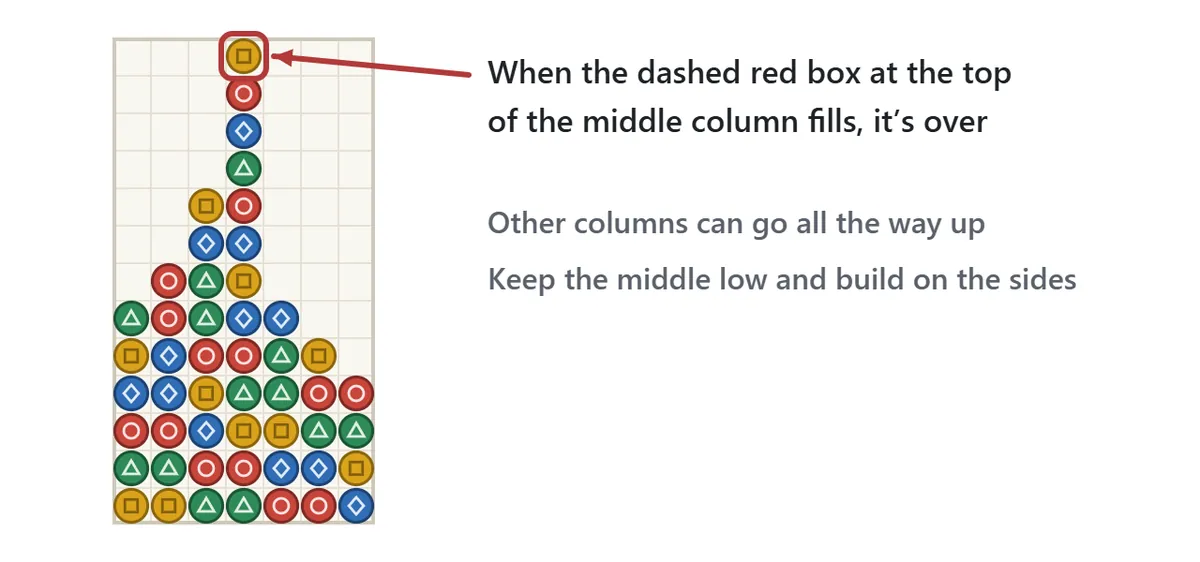
- The game ends when the top cell of the middle column (the dashed red box) is filled. The other columns may be stacked all the way to the top.
How chain reactions work
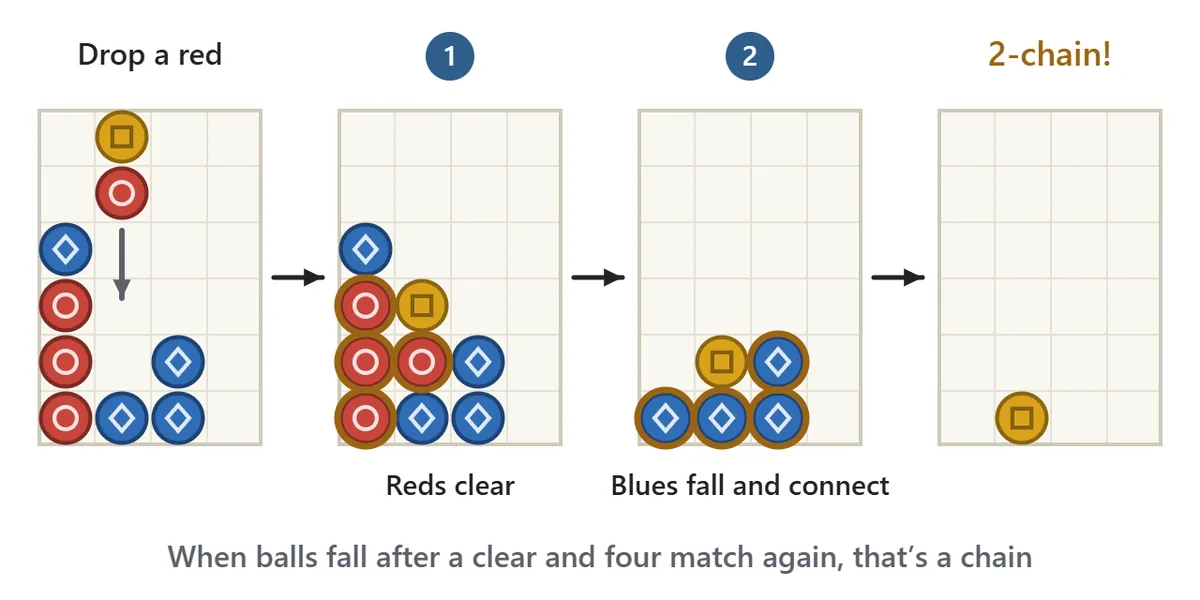
A chain happens because cleared balls leave holes, and gravity pulls everything above them down. In the picture below, dropping a red ball completes a group of four reds, which clears (step 1). The blue ball that was sitting on top of the reds falls and lands next to three blues, so the blues clear as well (step 2). That is a 2-chain. Points grow quickly with each step, so building a setup and clearing it all at once scores far more than clearing groups one at a time.
Game modes
| Mode | What you do |
|---|---|
| Solo | Endless play for a high score. The pieces fall a little faster every 25 pairs. Choose the speed (slow, normal or fast) and 4 or 5 colors. With 5 colors, matching balls are harder to gather. |
| Chain practice | Start from a set board with set pairs and make the target chain. Pieces don’t fall until you drop them, so you can think as long as you like. There are six lessons plus a new daily puzzle every day, and a Hint button that outlines where to drop the pair. |
| vs CPU | Clears and chains drop gray rocks on the other board. Fill the CPU’s middle column to win. Three levels: Easy, Normal and Hard. |
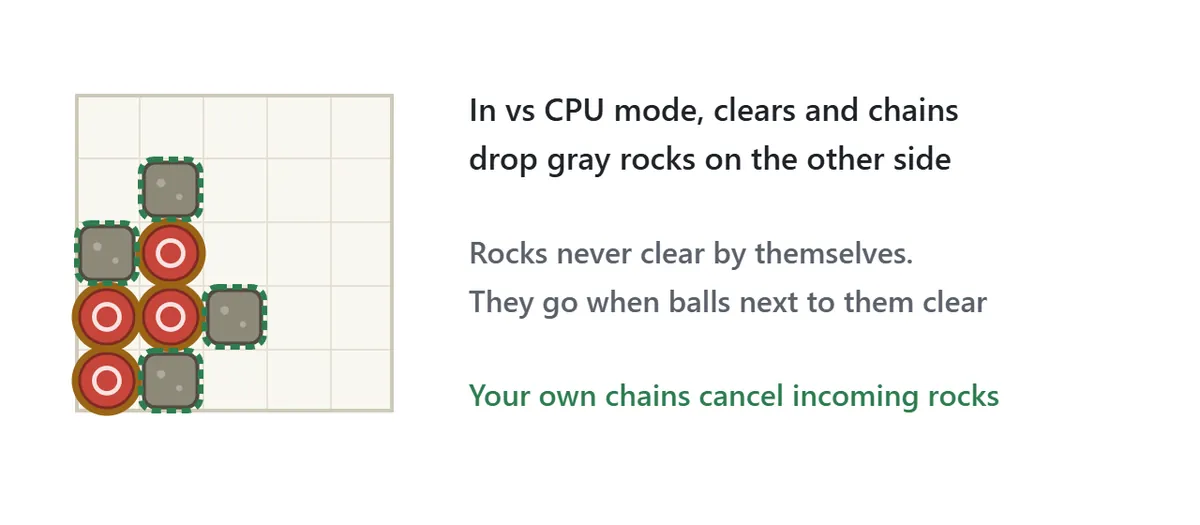
In a match, the more balls you clear at once and the longer your chain, the more rocks you send. When rocks are headed your way, a tag above your board says how many are coming. They land after you set down your next pair, but if you make a chain first, it cancels the incoming rocks, and whatever is left over goes to the CPU instead. At most 21 rocks (three full rows) land at once; the rest arrive later. As the match goes on, the pieces fall faster for both players, so long matches don’t drag on.
On Easy, the computer takes its time and often misses matches, so a new player who simply keeps making groups of four will usually win. Normal builds small 2- and 3-chains and fires them, so you need a chain of your own to keep up. Hard saves up for 3-chains or longer before firing, so you’ll want a setup of similar size, or a quick small chain to break its plans.
Chain Drop Puzzle strategy and tips
1. Keep the middle column low
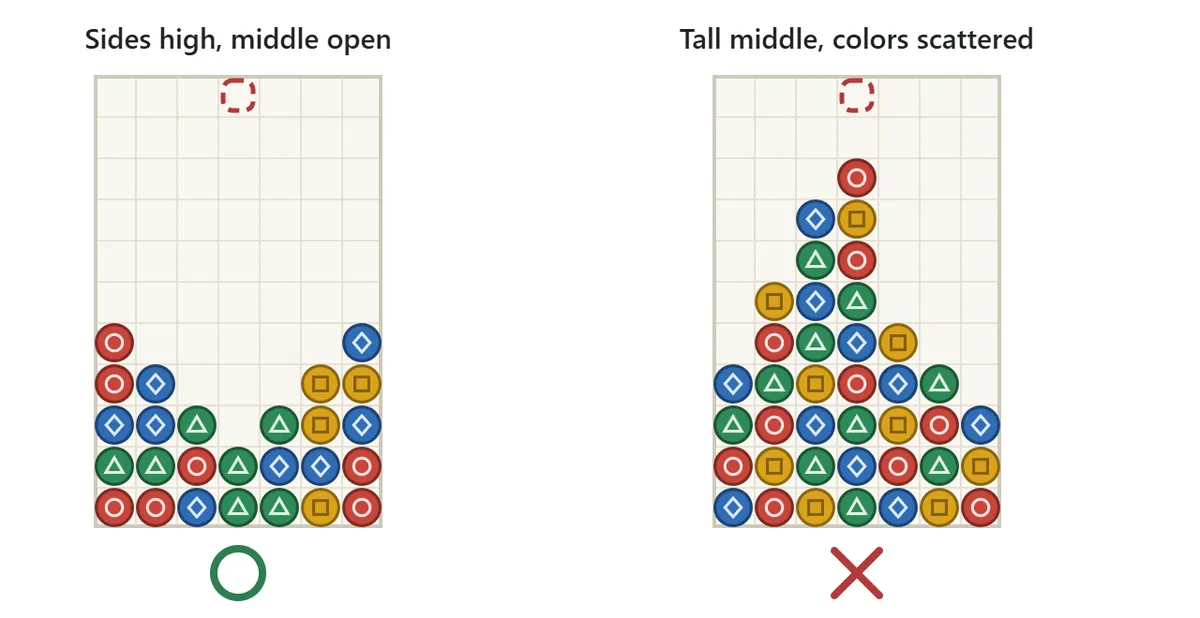
New pairs enter from the middle, and the game ends when the middle column reaches the top. A tall middle column also blocks you from carrying pairs to the sides. Build on the left and right edges first and leave the middle open as long as you can.
2. Collect three and wait
It is tempting to clear every group of four the moment it forms. To build chains, collect groups of three instead and leave them waiting for their fourth ball. The more “one ball away” spots you have, the more chances a single clear has to set off the next one.
3. Stack colors in steps (a staircase shape)
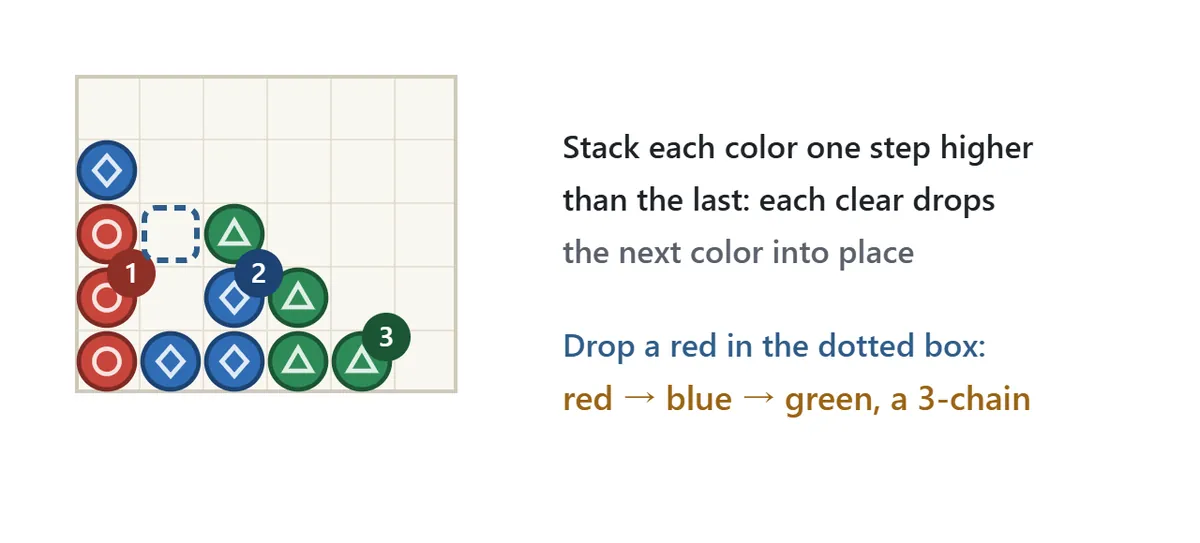
The easiest chain to learn stacks each color one step higher than the last. In the picture below, clearing the reds in the left column drops the blue ball one row, where it joins the other blues. Then the green above falls and joins the greens. Each clear lets the next color walk down a step, which makes 3- and 4-chains much easier. Lesson 3 lets you try this shape.
4. Leave room to fire
A setup is useless if you can’t reach the spot that starts it. Keep the space above the first group, the one that needs just one more ball, clear. Keeping the neighboring column low also lets you fire from the side, as in Lesson 5.
5. Plan with the next pairs
The Next box shows the upcoming pair and the one after it. Knowing which colors are coming makes it easier to decide where the current pair belongs. If the color you need isn’t on its way, park the pair somewhere out of the way near an edge.
6. In a match, don’t save up too long
If you only chase huge chains against the CPU, its rocks may land before your setup is ready and ruin it. Watch the other board: when rocks are coming, a small chain to cancel them can be the best move, and firing first can throw the CPU off balance.
Chain Drop Puzzle FAQ
The pair doesn’t land where I expect.
Watch the dotted rings on the board. They show exactly where each ball will stop if you drop the pair as it is now. Line them up, then press hard drop. Remember that a sideways pair splits if one side has more space below it.
I can’t rotate next to a wall.
If a rotation would hit a wall or another ball, the pair shifts one column away and then turns. In a one-column gap with balls on both sides, it can’t turn sideways, so the two balls swap top and bottom instead.
How do I play on a phone or tablet?
Slide left or right on the board to move the pair and tap the board to rotate it clockwise. Flick down to drop it at once, or drag down slowly to speed it up. The six buttons under the board do the same things. On a computer, use the arrow keys, Z, X and the space bar.
Can I stop and come back later?
Solo games are saved in your browser each time a new pair appears, so you can pick up where you left off with Continue. In chain practice you can restart the puzzle you were on. A match against the CPU can be resumed from Settings while the page stays open.
When does the daily puzzle change?
A new puzzle appears when the date changes on your device. Everyone gets the same board and the same pairs on the same day, so you can compare notes with friends.
Where falling puzzles come from
Puzzles where shapes fall from the top and pile up became a popular kind of video game in the late 1980s. Games about gathering matching colors and chaining clears, where falling pieces keep setting off new matches, spread widely in the 1990s, and many designers have made their own versions since then.
Chain Drop Puzzle builds on those familiar rules with its own board size, scoring, rock rules and practice puzzles. Try the lessons to learn the shapes, then see how long a chain you can pull off against the computer.