 Yorimichi Games
How to play the Japanese History Quiz
This is a free quiz for learning the key dates of Japanese history: the year each event happened, the period it belongs to and the people involved. There are five kinds of questions, Event → year, Year → event, Event → period, Person → event and Order, plus a Mixed setting that shuffles them together. The quiz covers 143 events, from the king of Na receiving a gold seal from Han China in 57 to the Great East Japan Earthquake in 2011, and 57 historical figures. It is a single-player game that runs in your browser, with nothing to download and no account to create.
After every answer, a short explanation appears: the period, the people involved and what happened. You do not need to read Japanese. Names are written the way the English Wikipedia writes them, such as Ōnin War, Battle of Sekigahara, Tokugawa Ieyasu and Heian period, and Japanese terms without a neat English equivalent, such as shugo and jitō, come with a short gloss in brackets. Reading those notes as you go is what turns a list of numbers into a story you can remember.
Event → year and year → event
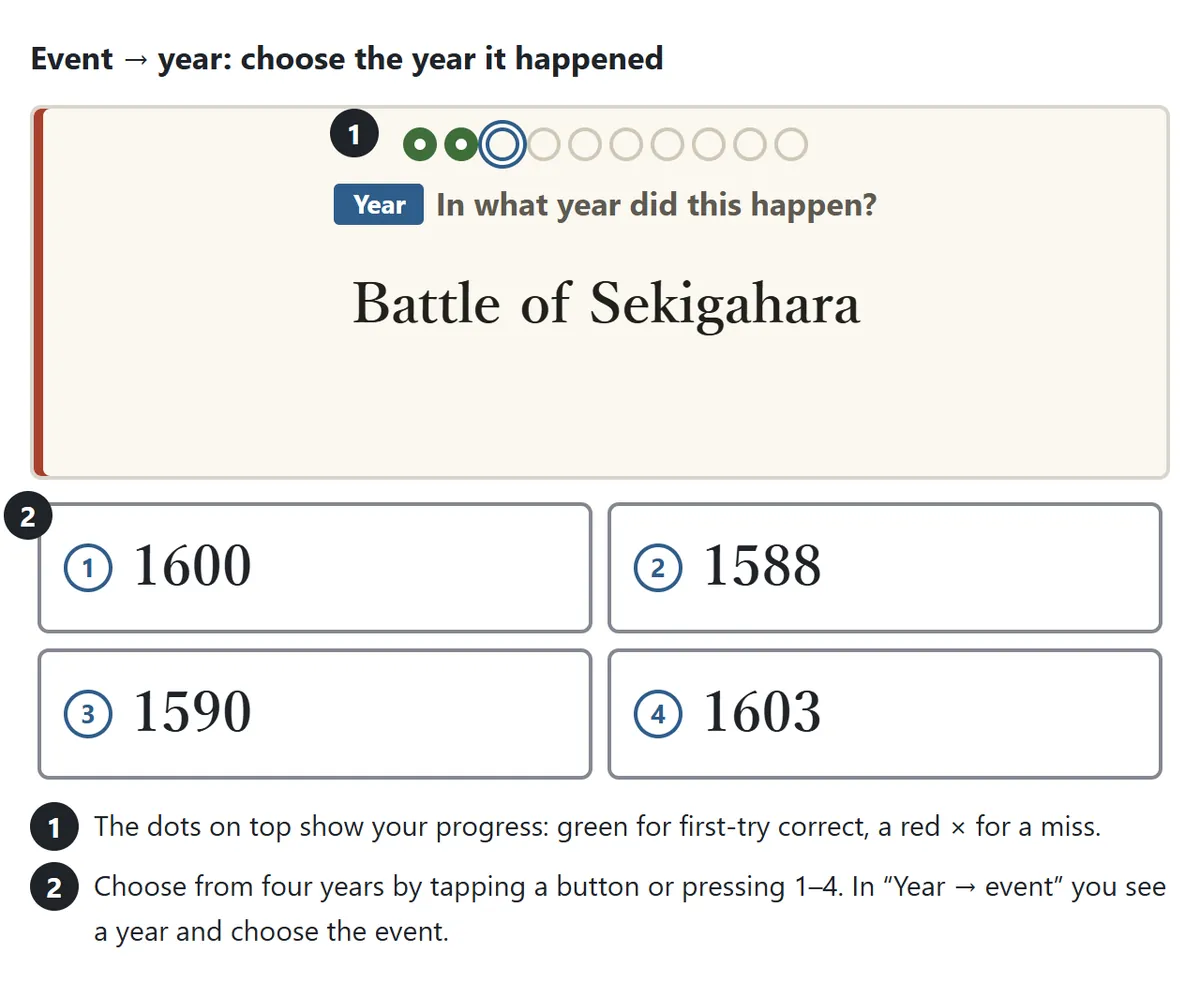
In Event → year you see an event and pick the year it happened from four choices. The wrong answers are chosen to be tricky: some are the years of other events from around the same time (1603, when Tokugawa Ieyasu became shōgun, next to 1600 for the Battle of Sekigahara), and some are near misses such as one year off, ten years off or two digits swapped (1476 for 1467). Year → event works the other way round: you see a year and choose the event that happened in it. The other options are events from nearby years, so you need a feel for the sequence, not just a lucky guess. When you have answered, press Next or the Enter key.
Event → period
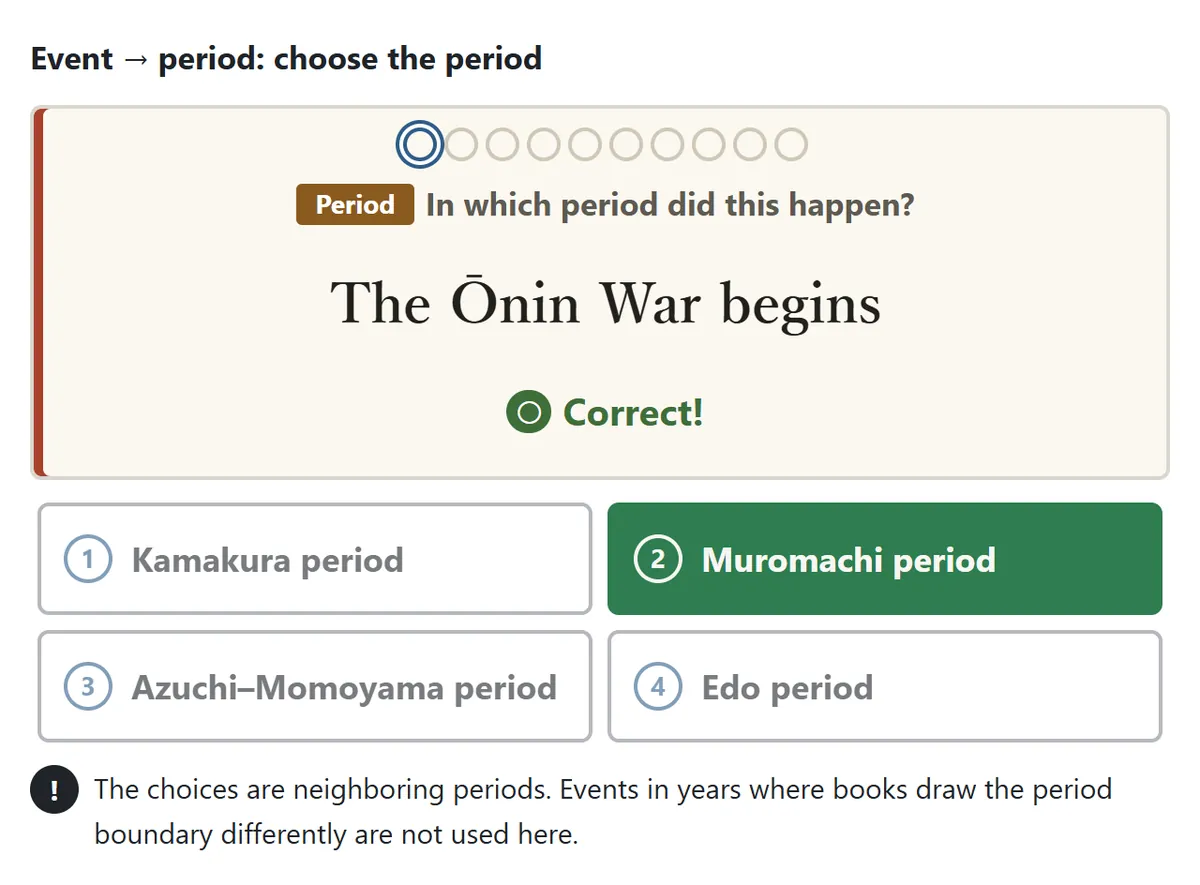
Here you see an event and choose which period of Japanese history it belongs to. The choices are neighboring periods, so this is a good way to learn the overall order: Yayoi, Kofun, Asuka, Nara, Heian, Kamakura, Muromachi, Azuchi–Momoyama, Edo, then the Meiji, Taishō, Shōwa and Heisei eras. Even if you have forgotten the exact year, you can often reason it out: was this the age of the court nobles in Kyoto, or the age of the warriors? Events that fall right on a boundary that historians draw in different places, such as the Battle of Dan-no-ura or the Battle of Sekigahara, are left out of this question type because there is no single right answer.
Person → event
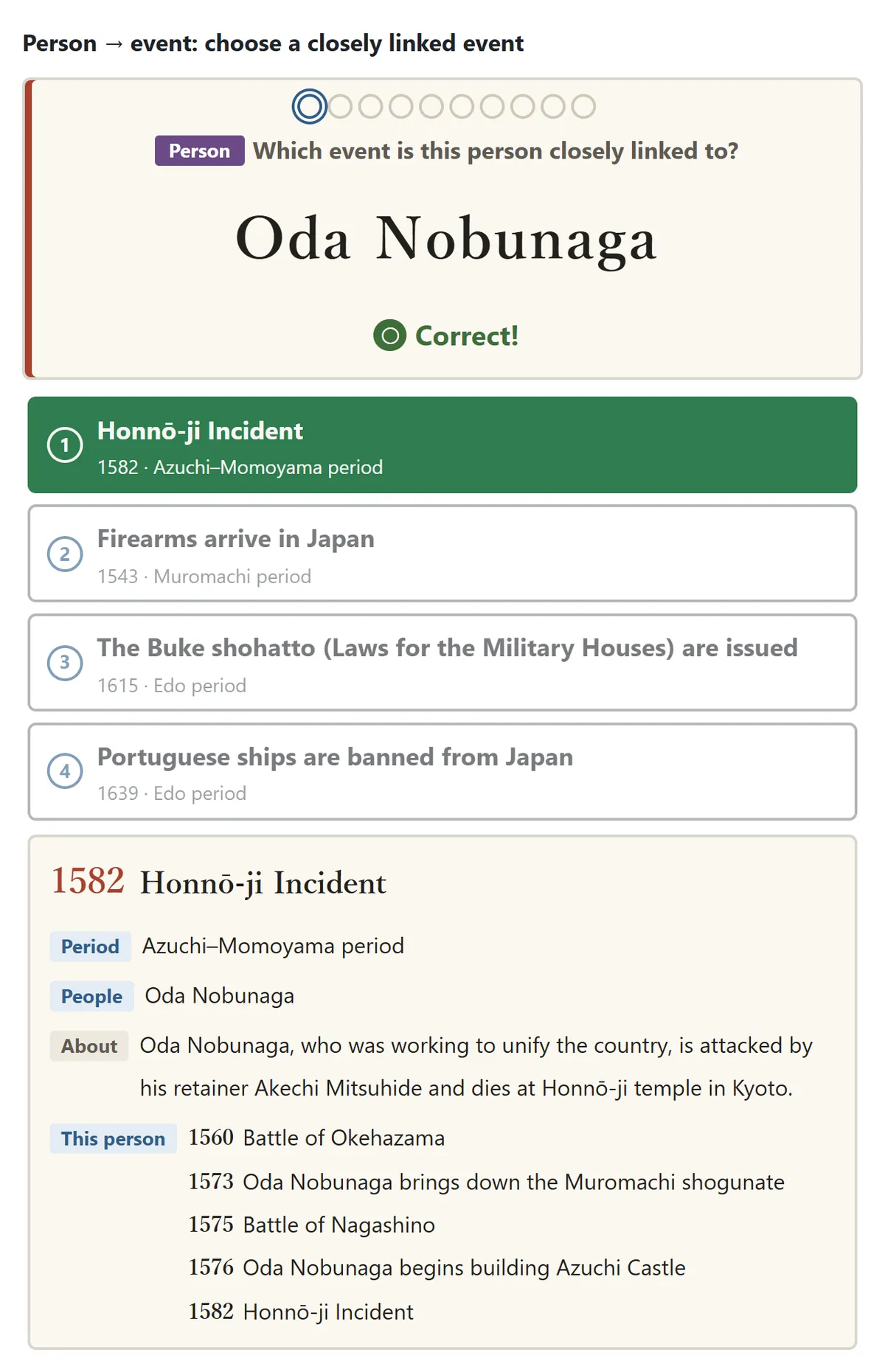
You see the name of a historical figure and choose the event they are most closely linked to. The wrong choices are events more than 15 years away from anything that person is linked to in the quiz, so you will not be stuck between two events that both involve them. After you answer, every event in the quiz connected to that person is listed by year. That list is a quick way to build a mini-timeline for figures like Oda Nobunaga, Toyotomi Hideyoshi, Tokugawa Ieyasu or Itō Hirobumi.
Order
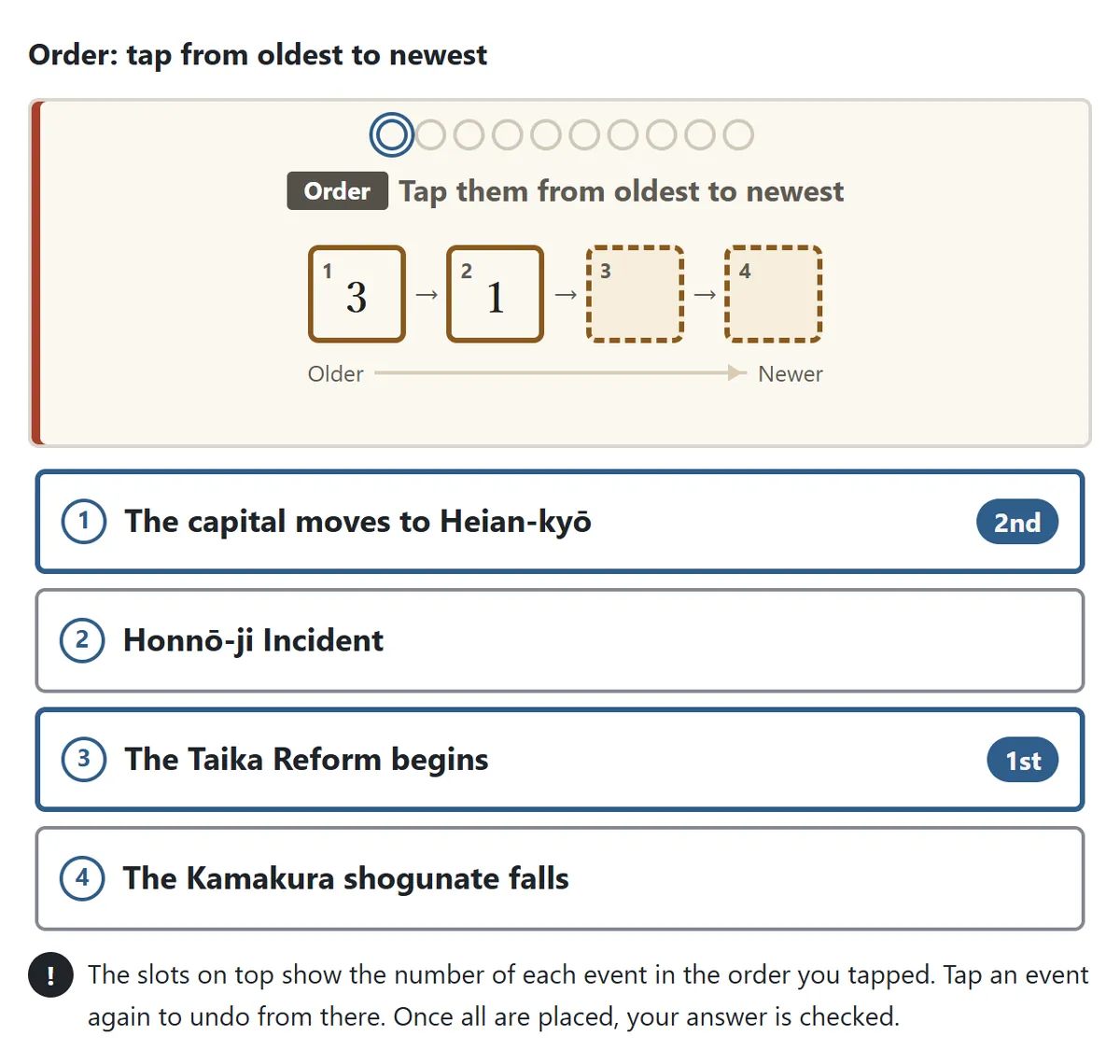
Three to five events appear, and you tap them from oldest to newest (you choose how many in the settings). The slots at the top show the order you have tapped so far. If you slip, tap the same event again or press Backspace to undo. Once all of them are placed, the quiz checks your order and shows the year of each event. With the wider ranges, the events come from the same stretch of the timeline, so you really need to know which came first.
Mistakes and hints

When you get one wrong, the right answer is framed in green and the explanation appears. At the end of a round, the questions you missed, plus any where you used a hint, come back until you get them all right. Missed questions are also saved on your device as Weak spots, and you can practice just those later. A question leaves Weak spots after you answer it right on the first try twice in a row. The Hint button (or the H key) tells you the period and century of an event, the period a person was active in, or which event is the oldest.
The six ranges
| Range | What it covers |
|---|---|
| Basic | The best-known people and events: Himiko, Prince Shōtoku, the Taika Reform, Heian-kyō, the Mongol invasions, the arrival of firearms and Christianity, Sekigahara, Perry, the Meiji reforms, the wars with Qing China and Russia, the Constitution of Japan, the 1964 Tokyo Olympics and more |
| All | Every event in the quiz, including codes of law, uprisings, the Edo-period reforms, the Freedom and People’s Rights Movement and events of the Taishō and Shōwa eras |
| Ancient | From the Yayoi period to the Heian period (up to 1184) |
| Medieval | The Kamakura and Muromachi periods (1185–1572) |
| Early modern | The Azuchi–Momoyama and Edo periods (1573–1867) |
| Modern | From the Meiji era to the Heisei era (from 1868) |
Start with Basic if Japanese history is new to you. It has 87 events and 36 people, enough to sketch the whole story from beginning to end. All adds the details that fill in each period, and the four period ranges let you focus on one part of the timeline at a time.
Events with more than one date
For some events, books disagree about the year. Where a single answer cannot be fixed, this quiz either accepts both years or leaves the question out.
| Event | How the quiz handles it |
|---|---|
| Start of the Kamakura shogunate | Not asked as such. Instead, “Minamoto no Yoritomo appoints shugo and jitō” (1185) and “Minamoto no Yoritomo becomes shōgun” (1192) are separate events |
| Buddhism arrives from Baekje (538 or 552) | Both years are correct. It is not used in Year → event questions |
| Himiko sends envoys to Wei (239; the Chinese source gives 238) | 239, as in Japanese textbooks. 238 is never offered as a wrong answer |
| Firearms arrive in Japan (1543; some say 1542) | 1543, as in Japanese textbooks. 1542 is never offered as a wrong answer |
For a long time, 1192, the year Yoritomo became shōgun, was taught as the start of the Kamakura shogunate. Today many textbooks put more weight on 1185, when he placed military governors and stewards across the country. Period boundaries are similar: the start of the Azuchi–Momoyama period (1568, 1573 and other years) and of the Edo period (1600 or 1603) vary from book to book, so events close to those lines are not used in Event → period questions.
Daily 10
The Daily 10 is a set of ten questions chosen by the date, mixing all five question types. Everyone who plays on the same day gets the same questions in the same range, so you can compare scores with friends. The quiz also keeps your streak of days in a row. Practice lets you pick one question type and a range, with 10 or 20 questions, and keeps a record of how many times you have played each combination and how often you got every question right on the first try.
Tips for remembering dates in Japanese history
1. Learn the period boundaries first
Fix a few turning points first: 794 (the capital moves to Heian-kyō), 1192 (Yoritomo becomes shōgun), 1338 (Ashikaga Takauji becomes shōgun), 1603 (Tokugawa Ieyasu becomes shōgun) and 1868 (the start of the Meiji era). Every other event then has a place: you only need to know which two boundaries it sits between. The Event → period questions are a good way to practice this.
2. Anchor on dates you already know
Most people already know a few dates from world history, such as the start of World War I (1914) or World War II (1939). Japanese events that are tied to them, such as Japan declaring war on Germany in 1914 or the Tripartite Pact in 1940, are easy to place once you link them to those anchors.
3. Connect causes and results
Events come in chains. Perry arrives in 1853, and the Convention of Kanagawa follows in 1854. The First Sino-Japanese War begins in 1894, and the Treaty of Shimonoseki ends it in 1895. When you learn one date, learn what came just before and just after it, and the numbers stop floating around on their own.
4. Use Order to check the flow
Even if you cannot recall an exact year, knowing which of two events came first means you understand the flow of history. Try the Order questions with events from the same stretch of time. When you get one wrong, compare the years shown afterwards to see where you mixed things up.
5. Follow one person through their events
Group events by person: Oda Nobunaga has the Battle of Okehazama, the Battle of Nagashino, Azuchi Castle and the Honnō-ji Incident; Toyotomi Hideyoshi has the land survey, the sword hunt and the unification of Japan. After every Person → event question, the quiz lists that person’s events in date order, so you can review them together.
6. Switch between years and centuries
1600 belongs to the 16th century; the 17th century starts in 1601. Books often say “in the 12th century” rather than giving a year. The hints for Event → year tell you the century, so practicing with them helps you move easily between the two.
Japanese History Quiz FAQ
Who is this quiz for?
Anyone curious about Japan’s past: people planning a trip to Kyoto, Nara or Tokyo, students of Japanese language and culture, readers of historical novels and fans of samurai dramas. Basic is a gentle introduction, while All in Mixed mode or Order with five events is a real challenge even if you know the period well.
Are the years given in the Western calendar?
Yes, all years are Western calendar years. Older events were originally recorded with Japanese era names, months and days. Like Japanese textbooks and dictionaries, this quiz converts the Japanese year directly into a Western year, so an event late in a Japanese year can fall in the following year by today’s calendar. The textbook year is the one counted as correct.
I learned that the Kamakura shogunate began in 1192. Is that wrong?
No. Minamoto no Yoritomo became shōgun in 1192, and that year was long given as the start of the shogunate. Today, many put more weight on 1185, when he placed shugo and jitō throughout the country. This quiz does not ask about “the start of the Kamakura shogunate” and instead asks about the 1185 and 1192 events separately.
How were the dates checked?
Every year in the quiz was checked against at least three reference sources, including encyclopedias and dictionaries of Japanese history. The short explanations were written for this quiz.
Where is my progress saved?
Your records and weak spots are saved only in this browser on this device. There is no sign-up or login. If you stop partway through a round, open the page again in the same browser and press Continue.
Does it work on a phone or tablet?
Yes. It runs in any modern browser, on phones, tablets and computers. You answer by tapping buttons, so a keyboard is optional. Sound effects are off at first; turn them on with the sound button.
About Japanese era names and dates
For most of its history, Japan counted years with era names (gengō) such as Taika or Meiji, and the Taika of the Taika Reform is regarded as the first of them. For events before the start of the Meiji era, the Western year is worked out from the era-name year in the records. That is why some events have more than one possible year, and why the year can depend on what you count as the beginning. Learning dates is really a way of checking what came before what, and how events are connected. Try to remember not just the number, but what happened that year and what happened next.
Comments
Write a comment
No comments yet.