 Yorimichi Games
How to play Counting Money (Japanese yen)
Counting Money is a free browser game for practicing Japanese money. You count yen coins and bills, pay an exact price, and work out how much change you should get back. The game uses the yen just as it is used in Japan, with the same six coins and three bills you would find in a wallet there, so it can be handy if you are getting ready for a trip to Japan, living there, or learning Japanese and want to get comfortable with the money. The skills themselves are the same in any currency: grouping coins, adding from the largest value, using the fewest pieces, and counting up to make change. It is a one-player game with no sign-up and nothing to download, and it works on computers, tablets and phones.
There are three ways to play. In Count, you add up the coins and bills on the screen. In Pay, you tap coins and bills to lay out an exact price. In Change, you work out the change after paying for something. A fourth option, Tricky questions, brings back questions you got wrong before.
The coins and bills in the game
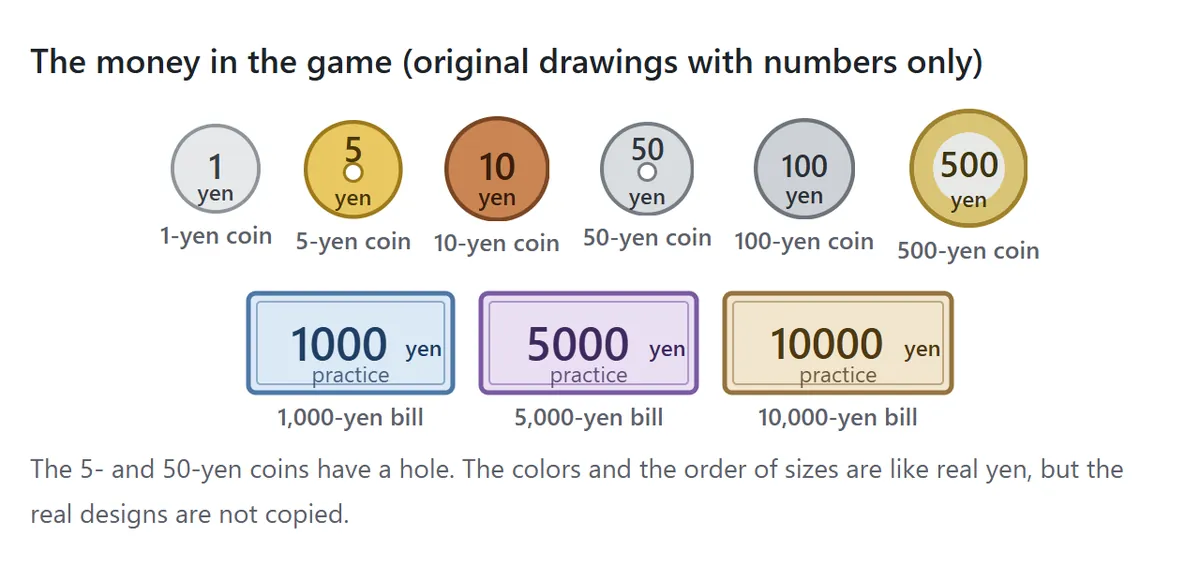
The money on the screen is not a photo of real currency. It is a set of simple drawings made for this game: round coins and rectangular bills with the value written in large numbers, plus the word “yen”. The bills also say “practice”. Pictures of people, buildings and patterns from real money are left out on purpose, so the drawings cannot be mistaken for the real thing. The colors are close to the real coins, which helps when you later handle actual yen: the 1-yen coin is a pale silver, the 5-yen coin is gold-colored, the 10-yen coin is copper-colored, the 50- and 100-yen coins are silver, and the 500-yen coin has a gold rim. Just like real Japanese coins, the 5-yen and 50-yen coins have a hole in the middle. Because every piece carries its number, you can tell them apart even if colors are hard to see or the page is printed in black and white.
| Coin or bill | Look in the game | Good to know |
|---|---|---|
| 1-yen coin | Pale silver, small | The smallest unit; often left out at the easiest step |
| 5-yen coin | Gold-colored, hole | Easy to confuse with the 50-yen coin |
| 10-yen coin | Copper-colored | Five of them make 50 yen |
| 50-yen coin | Silver, hole | The other coin with a hole |
| 100-yen coin | Silver | Ten of them make 1,000 yen |
| 500-yen coin | Gold rim, largest | The biggest coin in value and size |
| 1,000-, 5,000-, 10,000-yen bills | Pale blue, purple and tan | Bills get a little longer as the value goes up |
Three ways to play: count, pay and make change
| Mode | What you do |
|---|---|
| Count | Add up the coins and bills on the screen and give the total. Pick one of four answers or type the number. |
| Pay | A price tag such as “Pencil ¥68” appears. Tap the money buttons to place coins and bills in the box until it matches the price exactly, then press Pay. Tap a piece in the box to take it back. |
| Change | Answer questions like “The notebook costs ¥320 and you pay ¥500. How much change do you get?” Pick from four answers, type the amount, or hand over the change with coins and bills. |
| Tricky questions | Practice up to 10 questions you missed before. Get one right on the first try twice in a row and it comes off the list. |
Each round has 10 questions. When you make a mistake, the game shows the right answer and explains why. In Count, the money is regrouped by kind with a subtotal under each group, such as “×2 = ¥200” under two 100-yen coins. Once you choose (or type, or lay out) the right answer, you move on. After the 10 questions, the ones you missed and the ones where you used a hint come back once more, and the results appear when you have finished them all. Your best score for each mode and level is kept on your device.
Difficulty levels
| Level | Money used | Amounts |
|---|---|---|
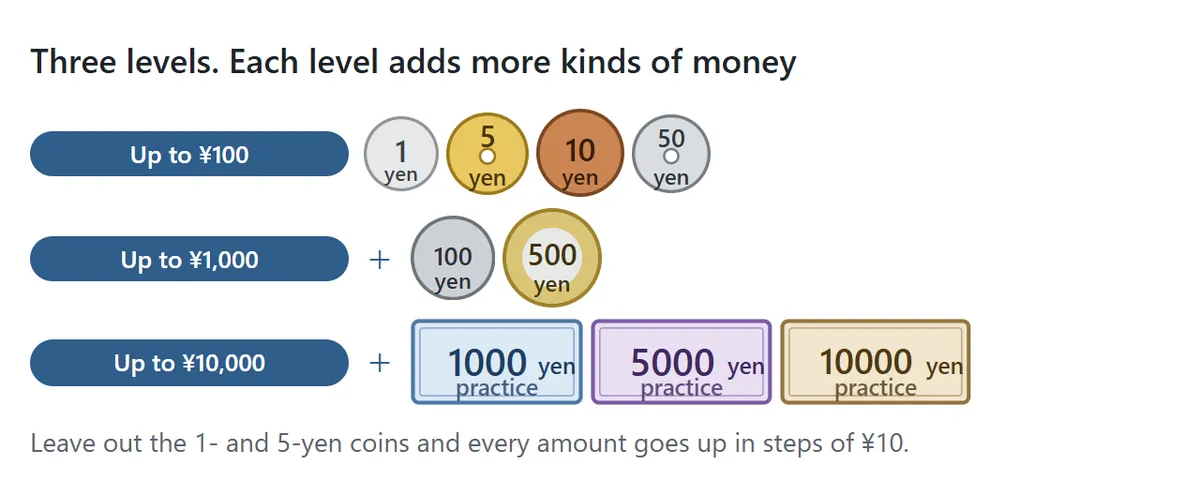
| Up to ¥100 | 1-, 5-, 10- and 50-yen coins | Under ¥100 |
| Up to ¥1,000 | Adds 100- and 500-yen coins | Under ¥1,000 |
| Up to ¥10,000 | Adds 1,000-, 5,000- and 10,000-yen bills | Up to ¥10,000 |
If you choose to leave out the 1- and 5-yen coins, every amount is a multiple of 10 yen. That is a gentle way to start: get used to 10- and 50-yen coins first, then switch the small coins back on. For Count, you can also choose how the money is laid out. “Grouped by kind” puts matching coins together from the largest value down, while “Mixed up” scatters them, so you have to sort them in your head before you add.
Tips for counting Japanese money
1. Group the coins and start with the largest
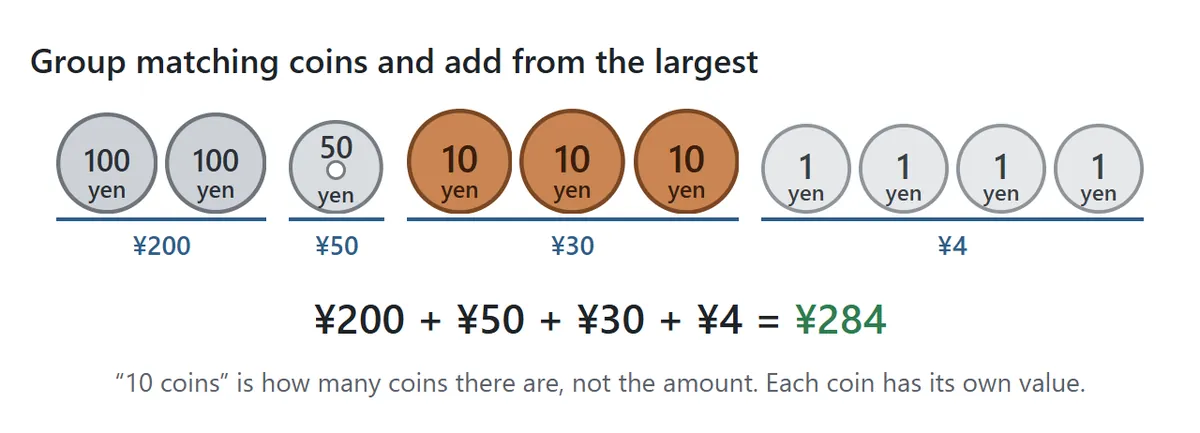
When there is a lot of money, first gather coins of the same kind, then add from the largest value down. Two 100-yen coins make ¥200, one 50-yen coin brings it to ¥250, three 10-yen coins to ¥280, and four 1-yen coins to ¥284. Adding each group to the running total keeps mistakes down. A very common slip is to answer with the number of coins instead of the amount; ten coins are not ten yen, because each one has its own value.
2. Don’t mix up 5, 50 and 500
The 5-yen and 50-yen coins both have a hole, and 50 and 500 look alike at a glance. Count the zeros before you decide which coin you are looking at. The four answer choices in this game are not random: they include the totals you would get by missing one coin, counting a coin twice or mixing up 5 and 50, so guessing rarely works.
How to pay with the fewest coins and bills

To pay ¥368, start with the hundreds: three 100-yen coins. For the 6 in the tens place, use one 50-yen coin and one 10-yen coin. For the 8 in the ones place, use one 5-yen coin and three 1-yen coins. Deciding from the largest coin down gives you the fewest pieces, nine in this case. If you set “Number of pieces” to “Fewest possible”, a payment that adds up correctly but could use fewer pieces is not accepted, and the game shows the shortest way. It is good practice in trading up: five 1-yen coins can become one 5-yen coin, and five 10-yen coins can become one 50-yen coin.
How to make change: counting up from the price
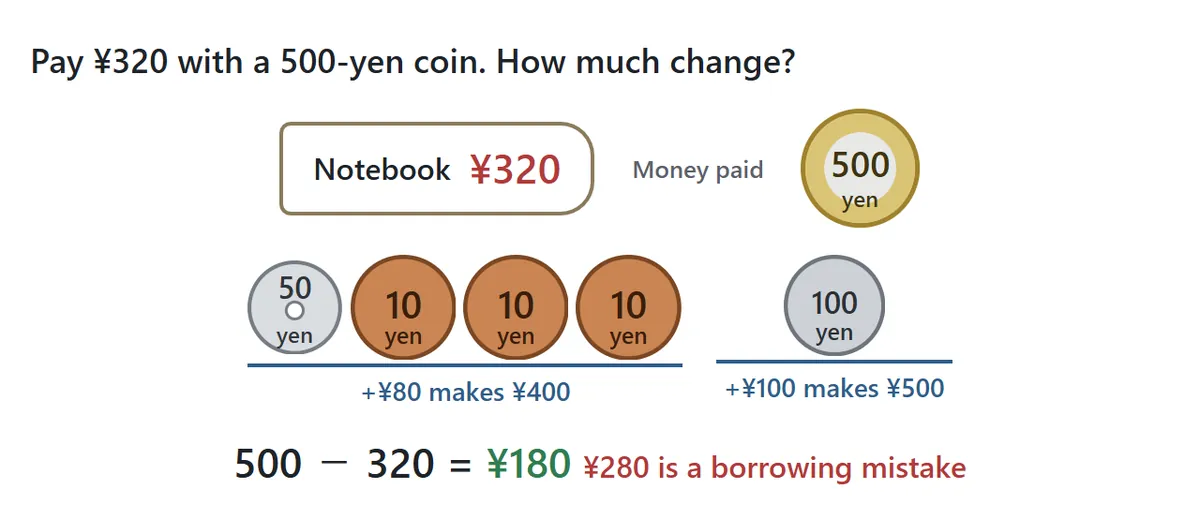
Change is the amount paid minus the price. For ¥500 − ¥320, you cannot take 2 from 0 in the tens place, so you borrow 1 from the hundreds. A frequent mistake is forgetting to lower the hundreds digit from 5 to 4 and writing ¥280 instead of ¥180. If you are unsure, count up from the price, the way a cashier counts change back: ¥320 plus ¥80 makes ¥400, and ¥100 more makes ¥500, so the change is ¥80 + ¥100 = ¥180. In Change mode, after you answer, the game also shows the change laid out with the fewest coins and bills.
Printable money worksheets
The Print button under the game opens a worksheet page. You can print four kinds of worksheet: Count (write the total shown by the coins and bills), Pay (fill in a table with how many of each coin and bill you would use for a price, using the fewest pieces), Change (write the change from the price and the money paid), and a mix of all three. Choose the level, whether to include 1-yen coins, and 6, 8 or 10 questions per page, and add an answer page if you like. The paper size is US Letter by default, and A4 is available too. Press “New questions” for a fresh set. The money on the worksheets is drawn in black and white outlines with numbers only, so it cannot be confused with real money.
Counting Money FAQ
Why does the game use yen instead of dollars?
It is a game for practicing Japanese money specifically, so the coins, bills and amounts are the real yen denominations. Yen amounts have no cents, which makes them a clear way to practice place value: ¥368 is three hundreds, six tens and eight ones. The habits you build here, such as grouping coins, adding from the largest value and counting up to make change, work with any currency.
Is the 2,000-yen bill included?
No. The 2,000-yen bill exists but is rarely seen in everyday shopping, so the game uses the 1,000-, 5,000- and 10,000-yen bills only.
Can I print the money and cut it out for playing shop?
The worksheets are made for practice questions, not as play money to cut out. The drawings are kept simple and number-only on purpose. For playing shop, please use store-bought toy money.
What does “fewest possible” mean?
The same amount can be paid in many ways. Ten 10-yen coins and one 100-yen coin are both ¥100, but one coin keeps your wallet lighter. With this setting, a payment that matches the price but could use fewer pieces is marked as “you can use fewer pieces”, and the game shows an example with the fewest.
Where is my progress saved?
Your best scores and your tricky questions are saved only in this browser on this device. There is no account and no login. If you stop in the middle of a round, you can pick up where you left off with “Continue” on the same device and browser. Sound effects and read aloud are off at first. Read aloud uses a voice installed on your device, and the button only appears when a voice for the page’s language is available.
Are the coins and bills real designs?
No. They are original drawings with only the number, the word yen and, on the bills, the word “practice”. The colors and the order of sizes are similar to real yen so the game is useful practice, but none of the actual artwork is reproduced.
Where the yen came from
Japan’s currency became the yen with the New Currency Act of 1871. Before that, money was counted in units called ryō, bu and shu, where 4 shu made 1 bu and 4 bu made 1 ryō, so the units did not step up by tens. The yen was decimal from the start: 1 yen was divided into 100 sen, and 1 sen into 10 rin. That is why counting yen today works exactly like the base-ten place value you use in math. In Japanese, the currency is written with the character 円, which means “circle” or “round”, and it is pronounced “en”. The English spelling “yen” is usually explained as coming from older ways of writing Japanese in the Latin alphabet. The sign ¥ goes before the number, as in ¥500.
Comments
Write a comment
No comments yet.