 Yorimichi Games
How to play the Times Tables game
The times tables are the 81 basic multiplication facts from 1×1 up to 9×9. Once they are memorized, almost every other kind of arithmetic gets easier: long multiplication, division, fractions, percentages and mental math all lean on them. This game is a simple way to practice those facts. A multiplication problem appears on a card, you type the answer with the big number buttons or your keyboard, and the game keeps track of what you got right on the first try. It is a single-player game that runs in your browser, with nothing to download and no account to create.
The game covers the tables from 1 to 9, the classic 9×9 multiplication table. Many people also learn the 10, 11 and 12 times tables, but those follow easy patterns once the first nine are solid, so this game focuses on the 81 facts that take the most practice.
The game screen

Type the answer to the problem on the card using the number buttons below it. Because the largest answer in the times tables is 81, a two-digit answer is checked the moment you press the second digit. For a one-digit answer (such as 2×3 = 6), press the number and then “Enter”. On a computer you can use the number keys and the Enter key instead. On a phone or tablet, the “Keyboard” button opens your device’s own number pad if you prefer it to the on-screen buttons.
The row of dots above the card shows how far you are through the round. A problem you answered correctly on the first try turns into a green dot. A problem you missed, or one where you looked at the hint, gets a red cross. The blue ring marks the problem you are on now.
When you get one wrong, and the review at the end
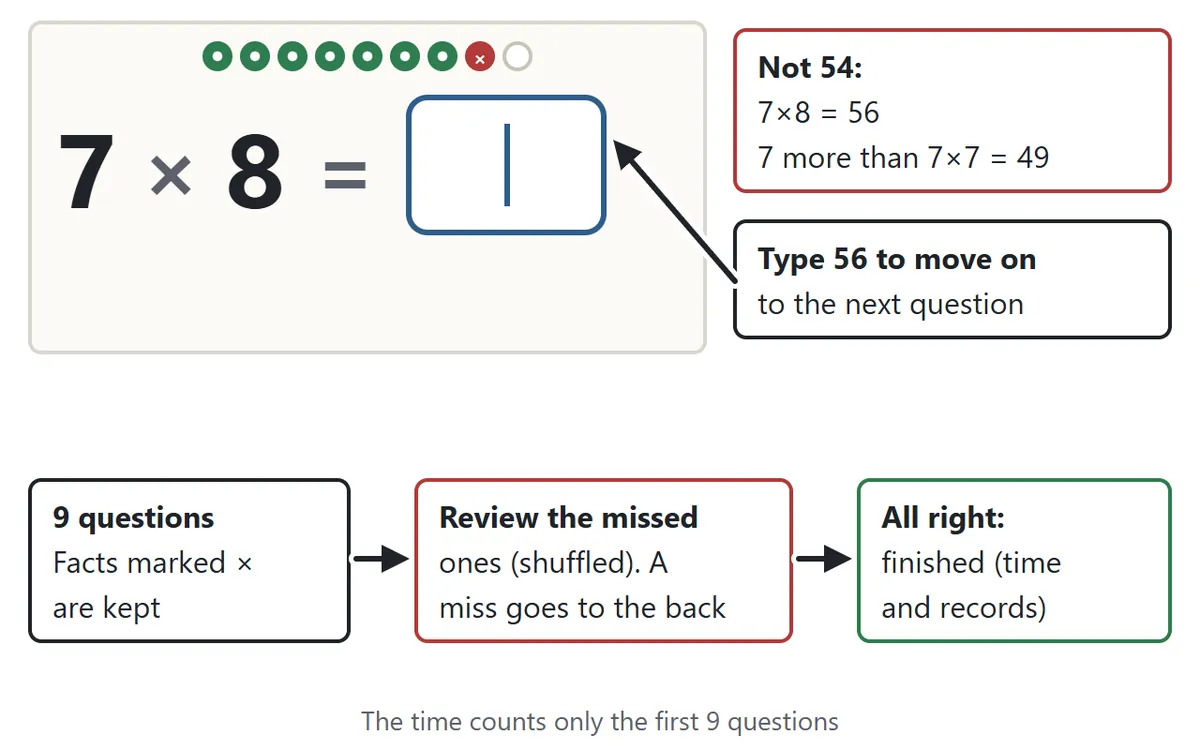
If you type a wrong answer, the game shows the correct one along with a clue to help you remember it next time. The clue works from the fact just before it, for example “7 more than 7×7 = 49”. Type the correct answer to move on to the next problem. The clock keeps running, so there is no penalty other than the time it takes.
When all the problems in the round are done, the facts you missed and the facts where you used a hint come back one more time, shuffled. If you miss one again in this review, it goes to the back of the line, and the round ends when every one of them is right. Anything you missed is also saved on your device as a “tricky fact”, so you can practice it later in the Tricky facts mode. Each time you get a tricky fact right on the first try, it gets closer to coming off the list; two first-try answers in a row and it is gone.
The dot picture hint
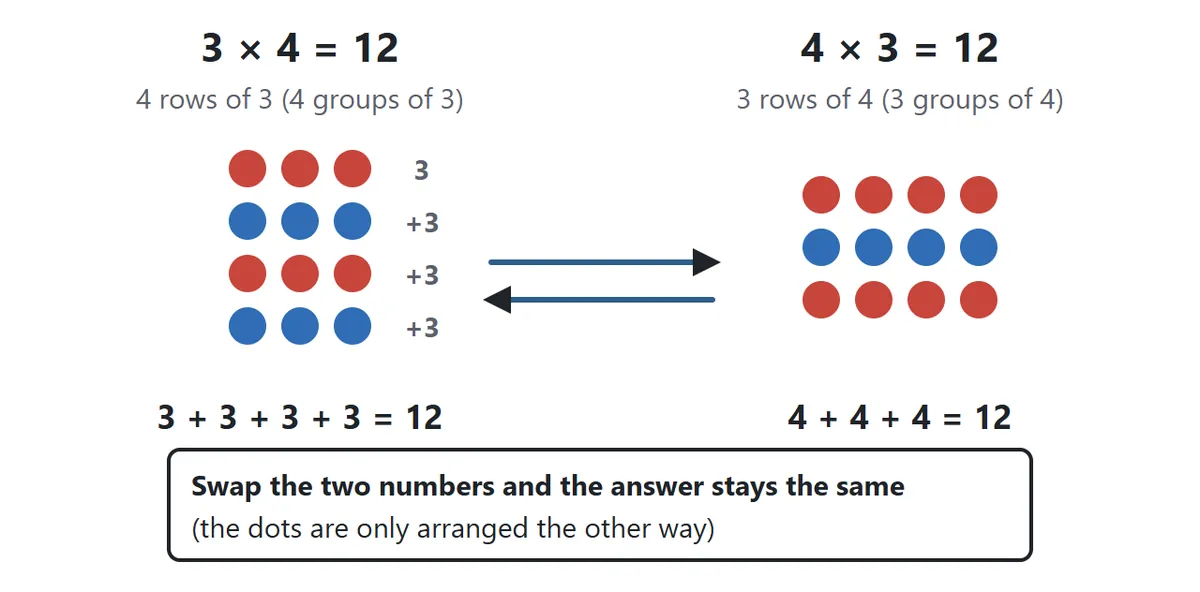
If you can’t remember an answer, press “Hint” (or the H key) to see a dot picture. For 3×4, you get four rows of three dots. Multiplication is repeated addition, so 3×4 is the same as 3 + 3 + 3 + 3, and you can count or add the dots to find the answer. A problem where you used the hint does not count as right on the first try, even if your answer is correct, and it joins the review at the end of the round.
Four ways to practice the multiplication tables
| Mode | What you do | Records |
|---|---|---|
| One table | Pick one table from 1 to 9 and answer its 9 facts, in order (×1 first), in reverse (×9 first) or at random. | Plays, perfect rounds and your fastest perfect time for each table. Tables you have cleared get a ★. |
| Time Attack | 10, 20 or 30 facts mixed from all the tables, with no repeats. The 1 times table shows up less often because it is so easy. | For each length: best time for a perfect round and the most right answers. |
| Multiplication chart | Fill in all 81 squares of the 9×9 chart. Go in order, in reverse or at random, or tap any empty square to fill it next. | Best time for a perfect chart and the fewest misses. |
| Tricky facts | Up to 20 of the facts you have missed before, and nothing else. | How many tricky facts are left. |
“One table” in order follows the usual sequence (7×1, 7×2, 7×3 …), which makes it a good place to start with a new table. The catch is that a table learned only in order can be hard to use: if someone asks for 7×8 out of the blue, you may find yourself counting up from 7×1. Once a table feels comfortable, switch to Reverse or Random, and then to Time Attack, where every table is mixed together. That is the real test of whether you know each fact on its own.
Times tables tips and strategies
1. Each step adds the same number

If you forget 7×8 but remember 7×7 = 49, add 7 and you have 56. This is skip counting, and it is exactly how the clues work when you make a mistake. It is especially useful in the bigger tables (6, 7, 8 and 9), where a fact you know well is usually only one step away from the one you are stuck on. It works in the other direction too: 7×9 is 7×10 minus 7, which is 70 − 7 = 63.
2. Swap the numbers
3×4 and 4×3 are both 12. In the dot picture, the dots are simply arranged the other way round; the number of dots does not change. Mathematicians call this the commutative property, but you don’t need the name to use it. If the 7 times table gives you trouble, remember that 7×3 is the same as 3×7 = 21, which you may already know from the 3 times table. Thanks to this rule, the 81 facts are really only 45 different ones to learn.
3. Find the patterns in the multiplication chart

As you fill in the 81 squares in the Multiplication chart mode, patterns start to appear. The numbers on either side of the diagonal from the top left to the bottom right mirror each other. Answers in the 5 times table always end in 5 or 0. Add the 2 times table and the 3 times table together, square by square, and you get the 5 times table. The digits of every answer in the 9 times table add up to 9 (1 + 8, 2 + 7, 3 + 6 …), and the tens digit goes up by one while the ones digit goes down by one. Spotting patterns like these yourself gives you a quick way to check an answer you are not sure about.
4. Say it out loud
Saying the fact as you answer it, like “seven eights are fifty-six” or “seven times eight is fifty-six”, uses your ears as well as your eyes, and many people find the facts stick better that way. In Japan, Korea and China the times tables are traditionally learned as a short rhythmic chant, one line per fact, and chanting is a time-tested way to memorize them in any language.
5. Focus on your tricky facts
Everyone has a different set of facts that keep tripping them up. For many people they are in the 6, 7 and 8 times tables, such as 6×7, 7×8 and 8×6, but yours may be different. The Tricky facts mode collects exactly the facts you have missed and nothing else, so a few minutes there goes much further than repeating the tables you already know.
6. Accuracy first, speed later
Time Attack records your speed, but at the start it is better to go slowly and get every answer right on the first try. Speed comes naturally once the facts are secure. To encourage this, a best time is only recorded for a perfect round with no misses and no hints.
Times Tables FAQ
Why does the game stop at 9×9 instead of 12×12?
The game follows the classic 9×9 multiplication table, the 81 facts that cover every pair of single digits. Multiplying by 10 just adds a zero, and multiplying a single digit by 11 repeats it (11×4 = 44), so those tables take little practice. The 12 times table is mostly useful for older measurements like inches and dozens. Multiplying by 0 is not included either.
In “the 7 times table”, which number is 7?
In this game the 7 times table means 7×1, 7×2 and so on up to 7×9: the first number stays at 7 and the second number goes from 1 to 9. In the multiplication chart, the numbers down the left side are the tables and the numbers across the top are what they are multiplied by. Since the order of the two numbers doesn’t change the answer, some people write the same table as 1×7, 2×7 … 9×7, and that is fine too.
What happens when I use a hint?
You see a dot picture and a clue. A problem where you used the hint does not count as right on the first try, even if you then answer it correctly, and it comes back in the review at the end of the round. Personal best times are only recorded for rounds with no hints and no misses.
Where are my records saved?
Your records and tricky facts are stored only in the browser on the device you are playing on. There is no sign-up or login. If you open the game again on the same device and browser, you can pick up an unfinished round with the “Continue” button in the settings. Records do not carry over to other devices.
Is there sound?
Sound is off at first. Press “Sound: off” below the game to turn on short sound effects for right and wrong answers. There is no voice reading the facts aloud.
Does it work on tablets and Chromebooks?
Yes. The game runs entirely in the browser, so it works on Chromebooks, iPads, Android tablets and phones as well as on Windows and Mac computers. With a keyboard you can answer using only the number keys, and on a touch screen you can use the large number buttons.
A short history of the times tables
Multiplication tables are among the oldest tools in mathematics. In China, a table of products up to 9×9 has been found written on bamboo slips more than 2,000 years old, and the table is still known there as the “nine-nine table”. It traveled from China to Korea and Japan, where it is called gugudan and kuku (九九) respectively. In Japan, wooden tablets with the multiplication table written on them have been dug up at the site of the 8th-century Heijō Palace in Nara, so the table was already in use well over a thousand years ago. The name “nine nines” is said to come from the old habit of starting the chant from the top, with “nine nines are eighty-one”; starting from 1×1, as we do today, came later. In Europe, the grid-shaped multiplication chart was long known as the Pythagorean table, named after the Greek mathematician, although there is no evidence that he actually drew it. Whatever it is called, the same 81 facts have been learned by heart in many languages for centuries.
Comments
Write a comment
No comments yet.