 Yorimichi Games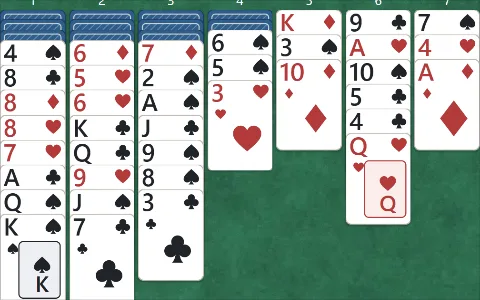
How to play Klondike Solitaire
Klondike is the card game most people simply call “solitaire.” You play it alone with one standard 52-card deck (no jokers). The goal is to move every card onto four foundation piles, one for each suit, in order from ace up to king. To get there, you rearrange the seven columns of the tableau, stacking cards down in alternating colors so that the face-down cards underneath can be turned over and brought into play.
A game takes about five to fifteen minutes. The rules fit in a paragraph, but the choices you make along the way decide whether a deal comes out, which is why Klondike has stayed popular for more than a century.
The layout
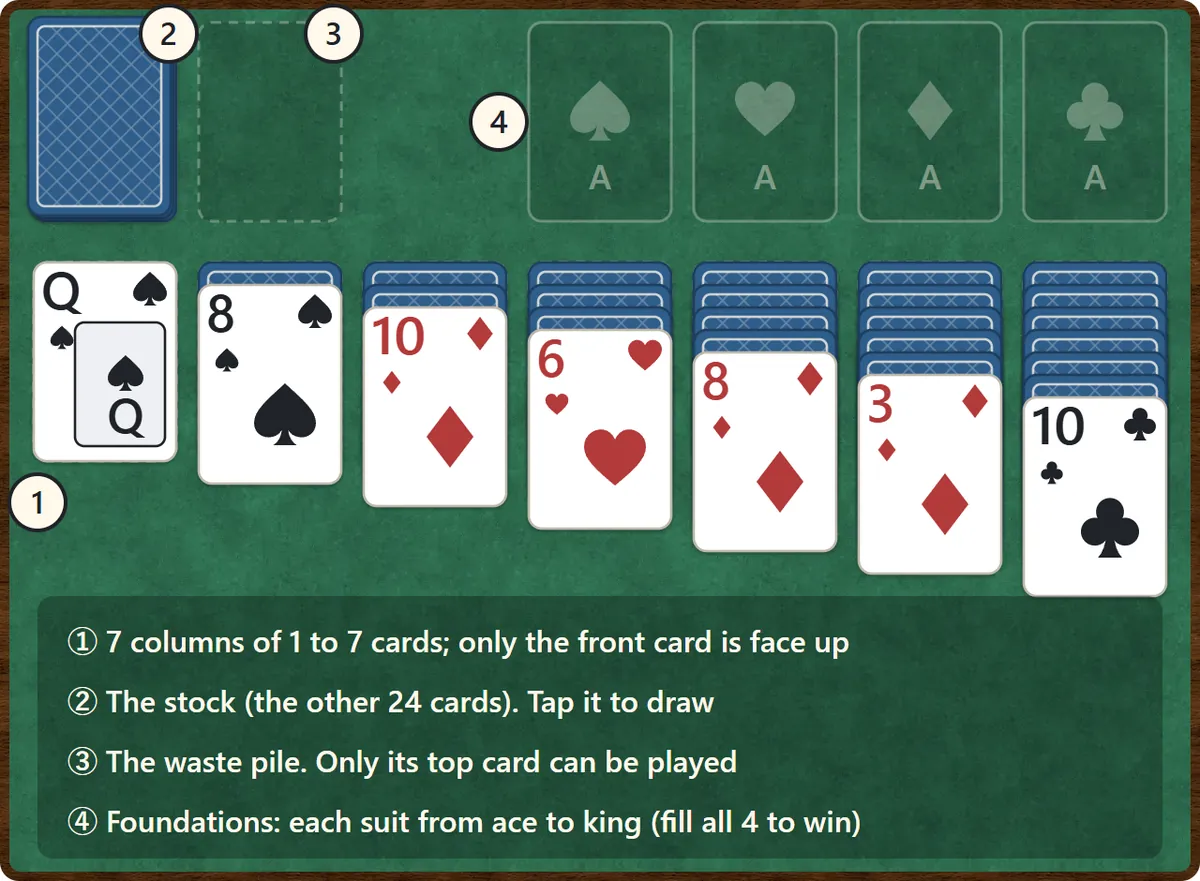
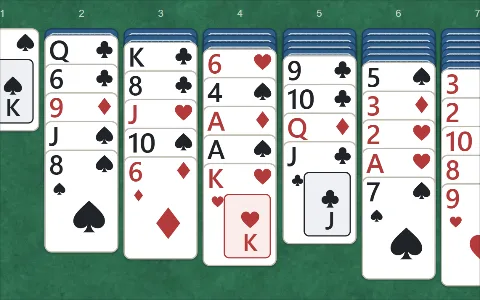
Twenty-eight cards are dealt into seven columns. The first column on the left has one card, the second has two, and so on up to seven cards in the last column. Only the front card of each column is face up. The other 24 cards form the stock in the top left corner. Cards you turn over from the stock land face up on the waste pile next to it, and the four empty spaces on the right are where the foundations are built.
Build down in alternating colors
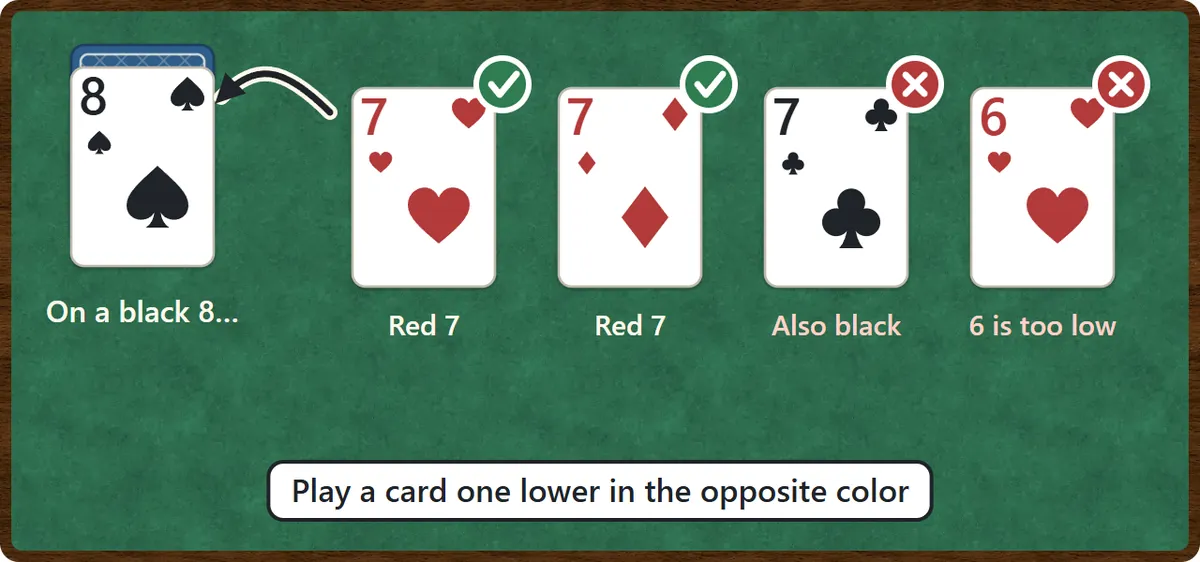
On the face-up card at the front of a column you can place a card that is one rank lower and the opposite color. A red 7 (hearts or diamonds) can go on a black 8 (spades or clubs). The 7 of clubs can’t, because it is black too, and neither can the 6 of hearts, because it is two ranks lower. Nothing can be placed on an ace. The top card of the waste pile follows the same rule when you move it into a column.
Move several cards at once
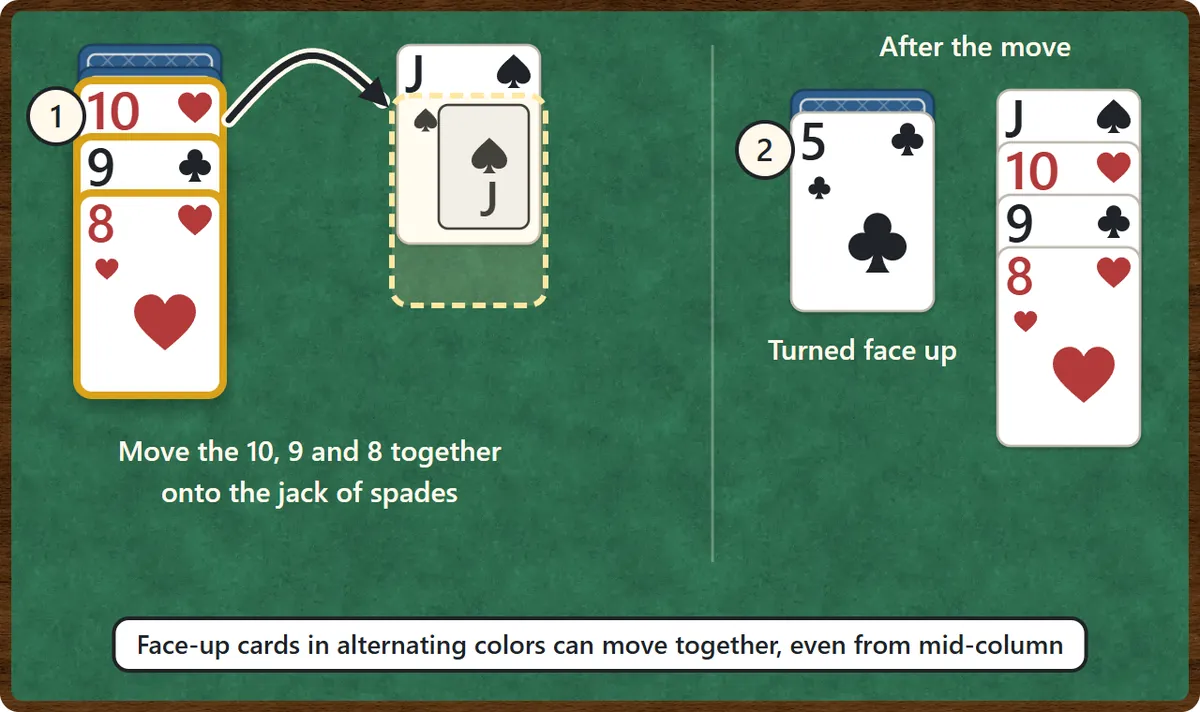
Face-up cards that already run down in alternating colors can be moved together to another column, as many as you like. You can also split a run and move only the lower part of it. When you move away every face-up card in a column, the face-down card underneath is turned over. Uncovering face-down cards is the heart of the game: every hidden card you reveal gives you new moves.
Only a king can fill an empty column
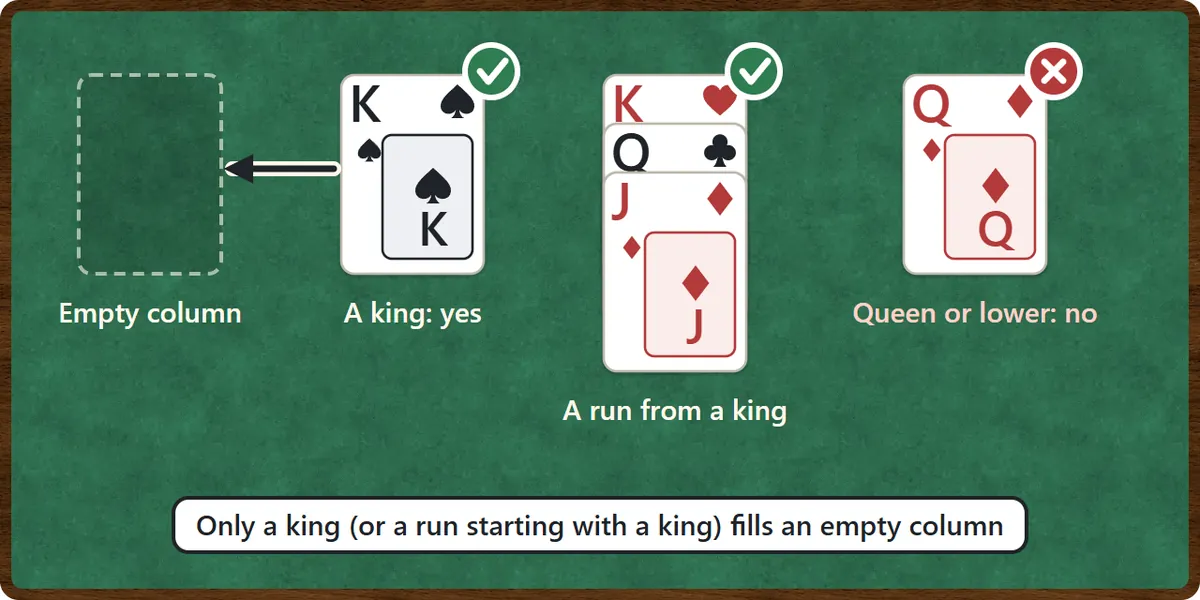
When a column runs out of cards, it becomes an empty space. Only a king can go there, either on its own or at the head of a run. A queen or any lower card can’t, so think of an empty column as a place to start a new pile with a king.
Draw from the stock and redeal
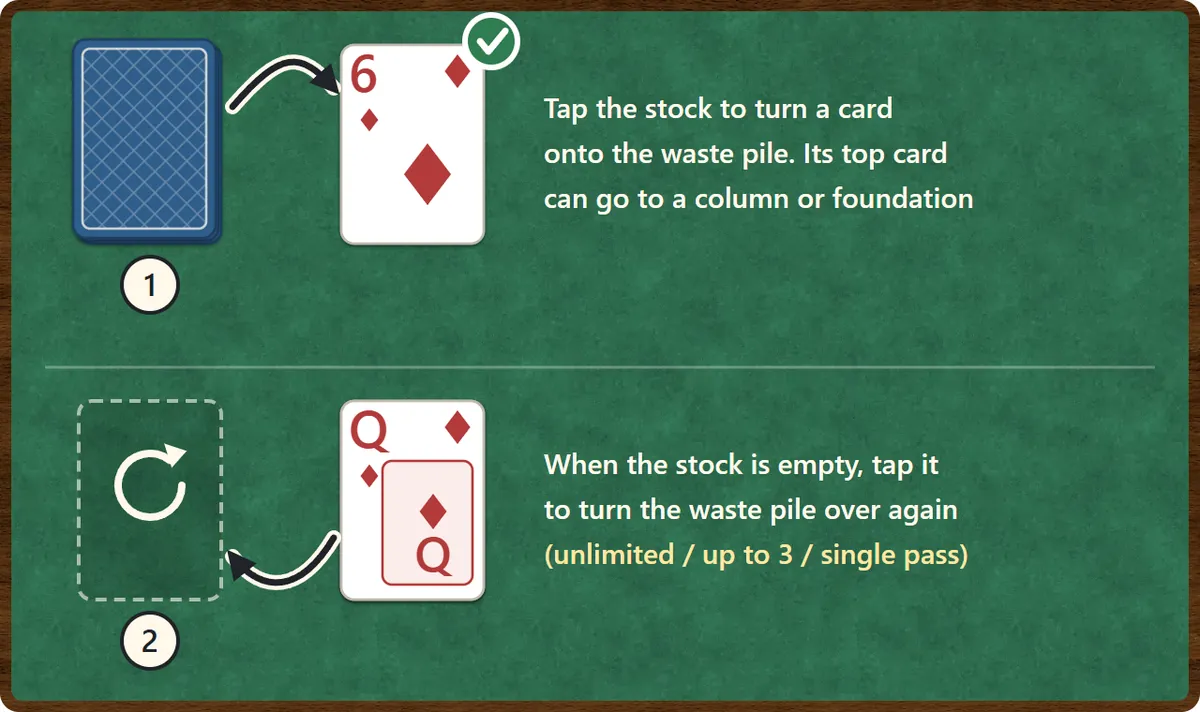
When you have nothing useful to move, tap the stock in the top left to turn over a card. It lands face up on the waste pile, and only the top card of the waste pile can be played to a column or a foundation. When you reach the end of the stock, tap the empty stock to turn the waste pile over and go through it again. How many times you may go through the stock depends on the rules you pick: unlimited, up to three passes, or a single pass.
Draw 3
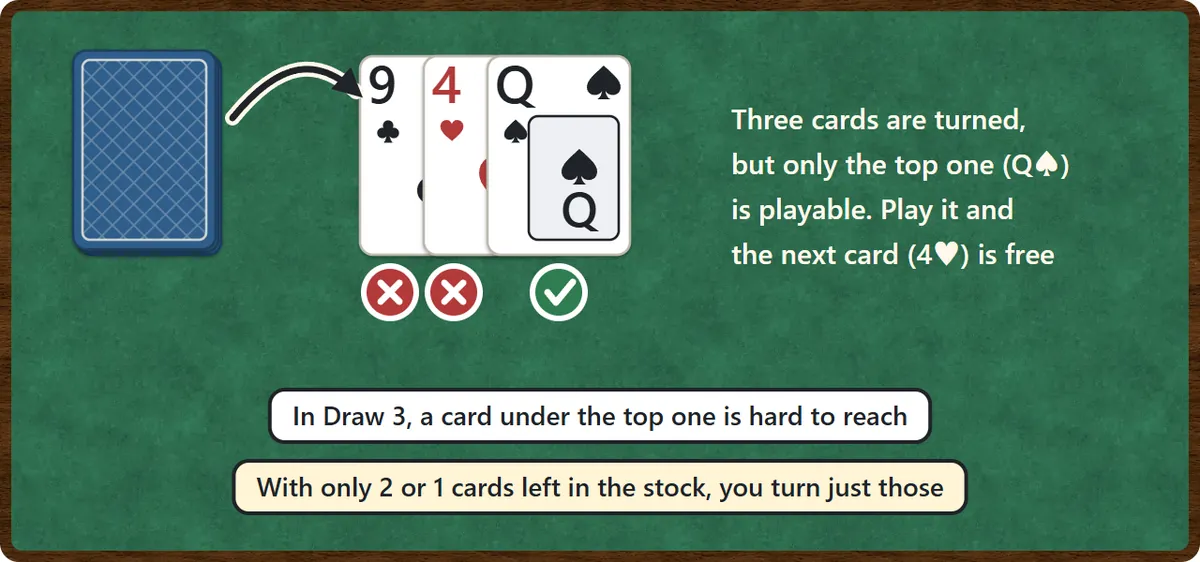
In the Draw 3 version, each tap turns over three cards at once. You can see all three, but only the top one is playable. Once you play it, the card beneath it becomes available. If the card you need is buried at the bottom of a group of three, it can take several passes to reach it, which makes Draw 3 much harder than Draw 1.
Build the foundations
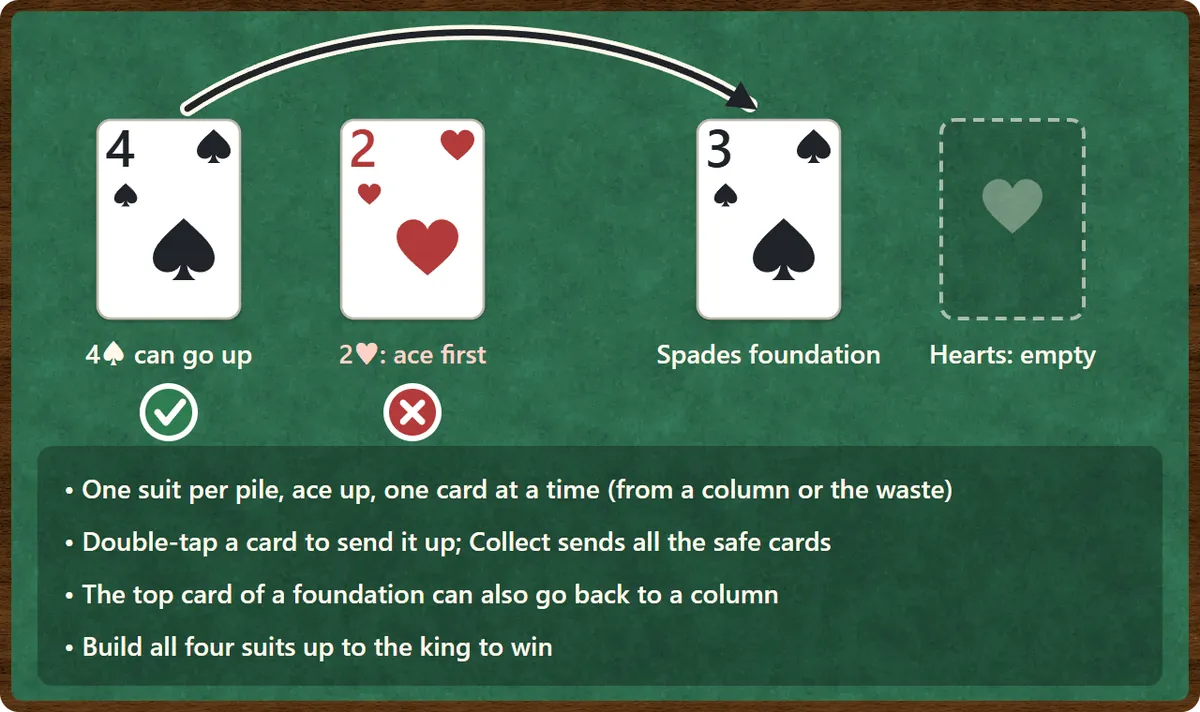
As soon as an ace appears, you can move it to one of the foundation spaces at the top right. Each foundation holds one suit, built up in order from the ace: ace, 2, 3 and so on up to the king. You can move cards there from the front of a column or from the top of the waste pile. You may also move the top card of a foundation back into a column when you need it there. When all four suits are complete from ace to king, you win.
How to use this game
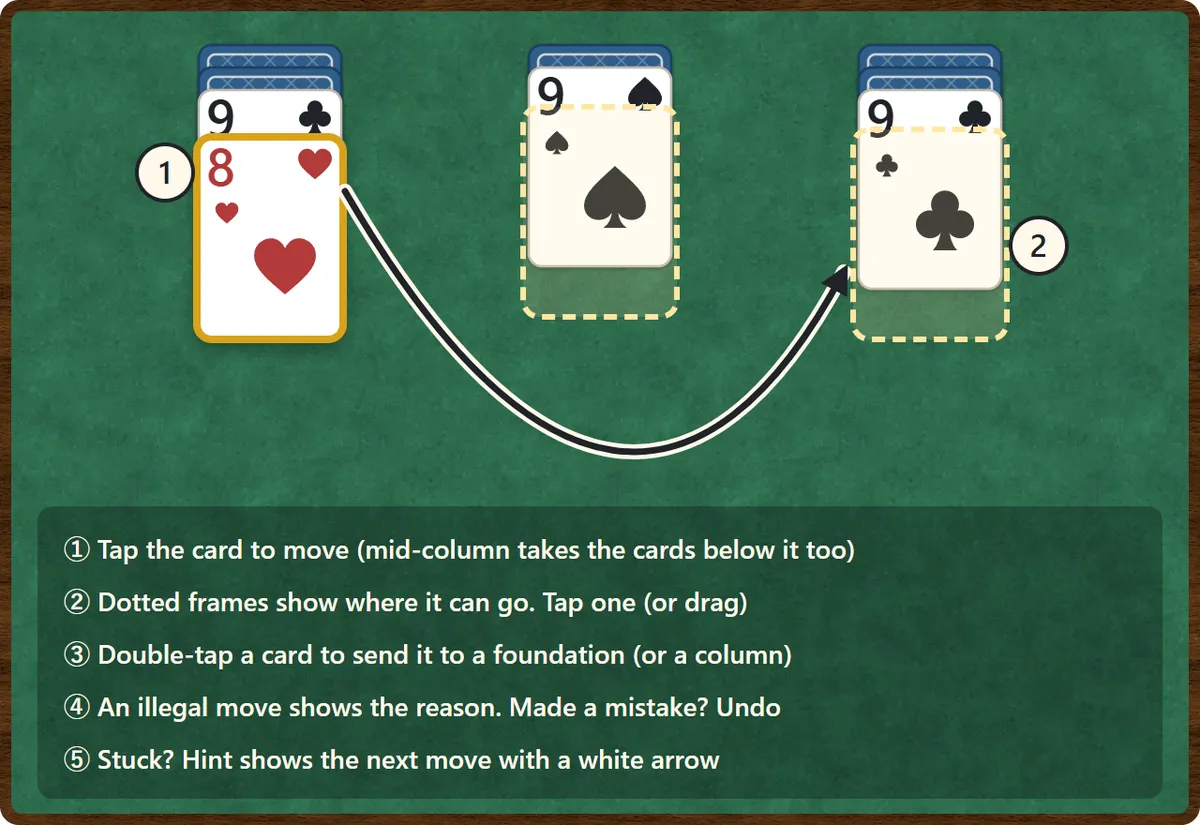
Click or tap a card to pick it up, and dotted frames show every place it can go. Click a framed spot to move it there. If you tap a face-up card in the middle of a column, you pick up that card and everything below it. You can also drag cards with your finger or mouse, and a quick double-click or double-tap sends a card to its foundation (or, if it can’t go there, to the best column). When you try a move that isn’t allowed, the game tells you why, for example “Only a red (hearts or diamonds) 7 can go on the 8 of spades.”
Collect sends every card that is safe to move up to the foundations. Turn on “Automatically move safe cards to the foundations” to have this happen after every move. Undo takes back as many moves as you like, and Hint points to a good next move with an arrow. On a keyboard, press 1–7 for a column, W for the waste pile, F to send to a foundation, Space to draw, Z to undo and H for a hint.
Klondike solitaire rules: the options
Klondike is played with several small rule differences, mostly about how you draw from the stock and how many times you can go through it. This game lets you combine the following.
| Setting | Choices | What changes |
|---|---|---|
| Cards per draw | Draw 1 / Draw 3 | In Draw 1 every stock card comes up in turn, so it is the best place to start. In Draw 3 only the top card of each three is playable, which makes it much harder. |
| Passes | Unlimited / up to 3 / single pass | The fewer passes you have, the more carefully you need to plan which stock cards to use. A single pass is for experienced players. |
| Winnable deals only | On / off | When it is on, every deal has been checked to have a way to win. Turn it off and, as with a real deck, some deals can’t be won. |
| Keep score | On / off | With scoring on, the same deal can earn different scores depending on how you play it (see the table below). |
| Game | What it is |
|---|---|
| Random deal | A new deal with the rules you picked. Your wins, current streak, and best time, moves and score are kept separately for each set of rules. |
| Daily Deal | One winnable deal for each date, played Draw 1 with unlimited passes. Everyone gets the same deal on the same day, so you can compare moves and times with friends and family. |
| Deal by number | Pick a deal from 1 to 5000. The same number always gives the same cards, so you can replay a deal that got away. |
How Klondike scoring works
With “Keep score” turned on, points are counted as follows. The score never goes below zero, and using Undo takes back the points as well.
| Move | Points |
|---|---|
| Waste pile to a column | +5 |
| Waste pile to a foundation | +10 |
| Column to a foundation | +10 |
| Turning over a face-down card in a column | +5 |
| Foundation back to a column | −15 |
| Redealing the waste pile in Draw 1 | −100 |
A card from the waste pile earns 15 points if you play it to a column first and then to a foundation (5 + 10), which is 5 more than sending it straight to the foundation. There is no time bonus: the clock only records how long you took.
Klondike solitaire strategy: tips to win more games
1. Turn over face-down cards first
Whether a deal comes out depends mostly on how quickly you can uncover the hidden cards. When you have a choice of moves, prefer the one that turns a card face up. Columns on the right start with the most face-down cards, so working on them early usually pays off.
2. Play from the tableau before the stock
Before you draw, check whether any card in the columns can move. A move inside the tableau that uncovers a card opens up more options than playing a card from the stock. Moving a waste card into a column also makes that column longer, which can bury the cards you still need to reach.
3. Don’t rush cards to the foundations
Aces and 2s can always go up right away. Higher cards, though, are often needed as a place to put other cards. If you send a red 6 to its foundation, for example, you lose one of the spots where a black 5 could go. A good rule of thumb: a card is safe to send up when both lower cards of the opposite color are already on the foundations.
4. Empty a column only when a king is ready
An empty column only takes a king. Clearing a column before you have a king to put in it rarely helps. Wait until a king (ideally with some cards under it) can move, then clear the column and bring it over. Choose between a red and a black king by thinking about which color of queen you want to build on next.
5. In Draw 3, learn the order of the stock
In Draw 3, playing one card from the waste shifts which cards will be on top the next time through. Think about which card to use so that the card you need comes up on top. With a limited number of passes, treat the first pass partly as a chance to see what’s there and remember the order.
6. When you’re stuck, go back
If you run out of moves, use Undo to go back a few steps and try a different order. Hint shows you a next move, and if the current position can no longer be won, it tells you how many moves to undo to get back to one that can.
Klondike solitaire win rate: how often can you win?
Klondike is a game of skill with a large share of luck, and the odds depend heavily on the rules. Published estimates give a rough picture. If you could see every card, including the face-down ones, about 82% of Draw 3 deals with unlimited passes could be won. Real players don’t see the hidden cards, and a skilled player is estimated to win around 43% of those games. At the strict end, playing Draw 1 with a single pass through the stock, an old rule book puts the odds at about one game in thirty.
In practice, Draw 1 with unlimited passes is the most forgiving version, and most players win it far more often than Draw 3. If you want every game to be winnable, turn on “Winnable deals only”: you will still need to find the way, but you know one exists.
Is every game of Klondike winnable?
No. Some deals can’t be won no matter how you play, because the cards you need are trapped under each other. Even if you could see every card, roughly one Draw 3 deal in five or six would have no solution. With “Winnable deals only” turned on, this game only gives you deals for which a computer search has already found a way to win, so every deal can be solved, although the hidden cards still make some of them tricky.
Klondike Solitaire FAQ
Is Klondike the same as solitaire?
“Solitaire” is really the name for any card game you play alone, and there are hundreds of them. Klondike is by far the best-known one, so in the United States it is usually just called solitaire. In the UK the same game is often called “patience.”
Should I play Draw 1 or Draw 3?
Both are common. Card-game books usually describe dealing one card at a time, and computer versions normally let you choose. If you are new to the game, start with Draw 1 and unlimited passes, then move on to Draw 3 once you feel comfortable.
Can I move a card back from a foundation?
Yes. The top card of any foundation can be moved back to a column. Some people play without this, but most versions allow it. With scoring on, it costs 15 points.
Is my time recorded?
The clock starts with your first move, and your time is saved when you win. Your best time, moves and score are recorded only for games you win without using a hint. The score itself does not change with time.
What is the Daily Deal?
A single winnable deal that changes every day and is the same for everyone. Your result and your streak of daily wins are saved on your device.
Can I stop and continue later?
Yes. Open the game again on the same device and browser and press Continue. Your Undo history is saved too, so you can still go back to earlier moves. Sound is off at first; press “Sound: off” to hear effects when you move cards.
Does it work on a phone, tablet or Chromebook?
Yes. The game runs in any modern browser with no download or account. You can play with touch, a mouse or the keyboard, and the table resizes to fit a phone screen.
Where Klondike comes from
Klondike became popular in North America around the start of the twentieth century. It is often linked to the Klondike Gold Rush in Canada in the late 1890s, but nobody knows for certain where the name comes from. Rules close to the ones we play today appear in card-game books from the early 1900s, and dealing the stock one card at a time was described a few years later. The game reached a huge new audience in 1990, when it came preinstalled on personal computers, and it is often said to have helped many people learn how to use a mouse. Turning up hidden cards one by one and watching all four foundations fill up at the end is part of why it has stayed a favorite for so long.