 Yorimichi Games
How to play Kings in the Corner
Kings in the Corner is a multiplayer card game with eight shared piles. Your aim is to empty your hand before the other players by building shared piles in descending rank and alternating colors. Kings open the four corner spaces. The piles belong to the table, so a card you play can become a useful landing place for an opponent. This page offers two to four players, either against computers or sharing one device. It is the competitive shedding game, rather than the single-player placement puzzle sometimes sold under a similar name.
The deal and the eight spaces
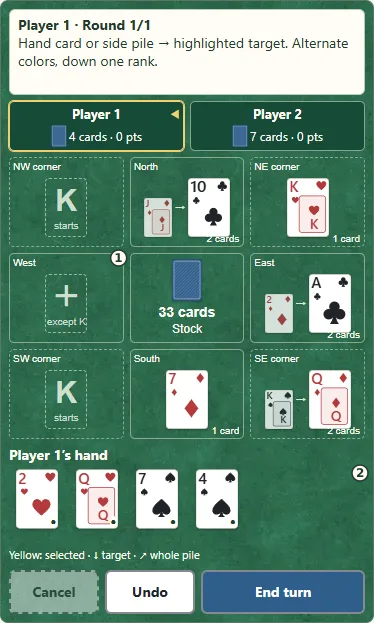
Use a standard deck of fifty-two cards without jokers. Each player receives seven cards. Four more cards become the starting side piles, arranged north, east, south and west around the stock. Four diagonal corner spaces begin empty. Under the standard rules here, draw one card at the start of your turn before making any play. That card joins your hand and is available immediately. The first starter is selected at random; later rounds rotate the starter. Opponents’ hands remain hidden, although their hand sizes and the stock count are visible. Think of the layout as eight shared destinations, with different restrictions only when a space is empty.
Descending rank and alternating color
Hearts and diamonds are red; clubs and spades are black. A black eight fits on a red nine, and a red seven then fits on that black eight. Matching suits is unnecessary. Matching colors is illegal, and skipping a rank is illegal. The order runs from king through queen, jack and ten down to two and ace. Ace is low and does not wrap around to king. Select a hand card, then tap a highlighted destination to move it immediately. Tap the same card, blank felt or Escape to cancel.

Opening a king corner
Only a king can start an empty corner. Once the king is there, that pile accepts an opposite-color queen, then a jack, and so on. Everyone can extend a corner pile. In the standard preset, playing an available king is your choice. Look for a queen or a longer run that you can follow immediately. Opening a corner with no follow-up may give another player a useful place instead. The draw-last preset requires playable kings to be placed before other moves. Its drawn-king exception is explained below. A king cannot be placed in an empty side space on this page.

Playing several cards in one turn
After the initial draw, you may make several plays, including moves that become available only after an earlier card has changed the layout. You may also stop even when a legal move remains, except for a required king under the appropriate setting. End turn finishes your actions; Next player confirms the handover. This gives you time to inspect the table rather than rushing immediately into the next player’s hand. If no card fits, end the turn. There is no rule allowing you to draw repeatedly until a suitable card appears.
Moving an entire pile
With pile moves enabled, you can move a whole side pile onto another pile. Compare the first card of the moving pile with the exposed last card of the destination. The first card must be exactly one rank lower and the opposite color. For example, a pile beginning with a black eight and ending with a red seven can move onto a red nine. Comparing only that final seven would be wrong. Tap a side pile marked ↗, then an outlined destination. The whole pile moves; tap the same pile again to cancel. You cannot split a pile or move cards out of a corner pile.

Using an empty side space
A successful merge leaves the source side space empty. Fill it with any non-king card from your hand, then continue building if you can. That vacancy can turn a stranded six into the start of a useful run. An initial king in a side pile stays there in the standard setup. Its entire pile may be moved into an empty corner, opening the side space. Moving a side pile into another empty side space does not create a new kind of destination, so this page omits that purely positional relocation. Genuine merges and king transfers remain available.
Draw-first and draw-last rules
The standard preset draws one card before you play. In the draw-last preset, you play first and draw once when ending the turn. An ordinary card drawn at the end is kept for a later turn. If that card is a king under the required-king setting, place it in an empty corner immediately, then hand over without drawing again. You do not continue playing ordinary cards after that final king. If you empty your hand during normal play, the round ends immediately and no ending draw is required. Simple mode draws first, disables pile moves, and relocates opening kings to corners while replacing the four side cards.

Going out and an empty stock
The round ends as soon as a player has no cards. When the stock is empty, players continue without drawing. If everyone is unable to play, including unable to make an allowed pile move, the round ends blocked. A cycle of voluntary passes does not end a round if a legal move still exists. In a one-round game, the player who goes out wins. In a blocked round, lowest remaining penalty wins, with equal lowest values sharing the result. You do not recycle completed piles into a new stock in the rules used here.

Multiple rounds and remaining-card scores
Choose one round for a quick game, or three or five for an accumulated-score match. At the end of each round, every remaining king counts ten penalty points and every other remaining card counts one, regardless of its face value. The next round shuffles all fifty-two cards and starts a fresh layout. Lowest total after the selected number of rounds wins. This is a penalty-score format, not the commercial chip-pot format that awards a winner collected chips toward a hundred-point target. This page uses cards and scores only. It does not introduce betting or chip contributions.
Rule presets and household differences
Standard means draw first, allow whole side-pile moves, optional kings and opening kings retained in side piles. Draw last means ending draws, pile moves and required kings. Simple means draw first, no pile moves and automatic relocation of opening kings. Custom settings let you combine the drawing, merging, king obligation and opening-king options independently. Some sources say to make as many plays as possible, while others expressly permit stopping. This page permits stopping, subject to the selected king obligation. Before a local match, agree on the preset rather than assuming that every family has learned the same rule.
Six strategy tips
First, find alternating-color runs within your own hand. A sequence of three cards can be more useful than three unrelated legal cards. Second, inspect the follow-up to a king. A corner is most productive when you can play a queen and perhaps a jack during the same turn. Third, consider a pile move before assuming that no hand card fits. The resulting empty side space may take a difficult card immediately. Fourth, compare the first and last cards of a pile carefully; they serve different purposes during a merge. Fifth, watch opponents’ hand counts. An unnecessary new landing place may help someone who needs to discard only one card. You cannot know their hidden card, but you can notice the risk. Finally, remember that an ace finishes a downward run. Once that ace is exposed, direct building on that pile stops, so examine the other piles rather than repeatedly trying to add another card.
Saving, mobile play and local privacy
Progress is stored in the same browser on the same device. Opening settings preserves your current match. Continue restores it, while starting a fresh game replaces it. Japanese and English pages share the saved position; the cards and rules do not depend on language. On a phone, hand cards wrap into rows. A dot marks playable cards. Undo reverses your card plays and pile moves before the handover. For a shared-device game, the next player’s hand remains hidden until they take the device and reveal it. Ask the previous player to look away. Sound begins off and there is no timer. Tab and Enter operate the controls on a keyboard; Escape cancels selection, Z undoes a move and P pauses. Leaving the tab also pauses computer play until you continue.
Frequently asked questions
Can a queen open a corner? No, only a king. Can a king fill an empty side pile? Not in this page’s rules; it belongs in a corner. Can a heart follow a diamond? Both are red, so not directly. Can I move only the exposed end of a pile? No, a side-pile move carries the whole pile. Must I play every available card? You may stop in the standard preset, but required kings must be played under the relevant rule. What happens to an ending draw that is not a king? Keep it and pass the turn. Can I move a completed corner? No. Corner piles stay anchored, even when their exposed card is an ace.
Computer levels and the familiar name
Easy leaves more opportunities by overlooking useful plays. Normal considers short runs and useful vacancies. Hard looks further ahead within its own hand and weighs the order of pile moves, while still sometimes overlooking a choice. The shuffle is the same for every level, and the computer does not inspect your hidden cards. Kings in the Corner and Kings Corner are common names for this shared-layout card game. The original numbered card drawings here do not reproduce a branded deck, a commercial holding tray or another game’s interface. At a real table, an ordinary deck and clearly separated side and corner spaces are enough.
References and artwork
Bicycle Cards / JAX manufacturer instructions / GoodSoft developer rules
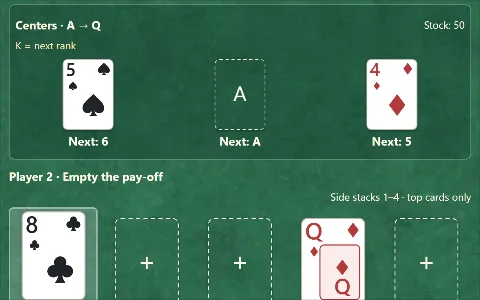
Cards and felt are original site artwork. The guide uses actual game screenshots with numbers and arrows. Sound effects are original site sounds.