 Yorimichi Games
How to play the Werewolf game
Werewolf is a social deduction game. A few werewolves are hiding in a village, pretending to be ordinary villagers, and everyone else has to find them by talking. The players are split into two teams, the Village team and the Werewolf team, and at the start you only know your own role. During the day, everyone discusses who seems suspicious and then votes to exile one player from the village. At night, the werewolves secretly attack one player. The Village team wins by exiling every werewolf; the Werewolf team wins when the werewolves are as many as everyone else.
At a table, Werewolf is usually played by anywhere from five to a dozen or more people, with one extra person acting as the moderator who runs the nights and announces what happened. On this page the game itself is the moderator, and you play alone with 5–9 CPU animals, so the village has 6–10 players in total. The CPU players claim roles, report their Seer readings and say who they suspect and why. You join the discussion by choosing what to say with buttons, so there is nothing to type. A game takes about 10 to 15 minutes.
Reading the screen

Under each villager’s picture you can see the role they have claimed and the day they left the village. If you are the Seer, your own readings are shown under the pictures too, visible only to you. The “What we know” box at the bottom collects who claimed which role and what results they announced. When you are not sure who to believe, compare the claims there.
1. Roles are dealt
At the start, every player gets one role at random. Nobody can see anyone else’s role. In this game you can also choose your own role before you start, which is handy when you want to practice one role in particular.

2. Night: the special roles act in secret
When night falls, the village goes to sleep and only the players with special roles act. The werewolves choose one player who is not a fellow werewolf and attack them. The Seer divines one player and learns whether that player is a werewolf. The Bodyguard picks one player to protect from the werewolves. The Medium learns whether the player exiled that day was a werewolf. On the very first night, the werewolves do not attack anyone.

3. Morning: the victim is revealed
In the morning, the player attacked during the night is announced and leaves the village. If the werewolves attacked the player the Bodyguard was protecting, nobody is lost and the village wakes up to a “peaceful morning”. Players who have left the village can no longer talk or vote.
4. Day: the discussion
During the day, all surviving players talk. The Seer says something like “I divined Tanuki, and Tanuki is human”, and the village uses these results to hunt for the werewolves. The catch is that players on the Werewolf team can also claim to be the Seer and announce fake results. Deciding whose story to believe is the heart of the game.
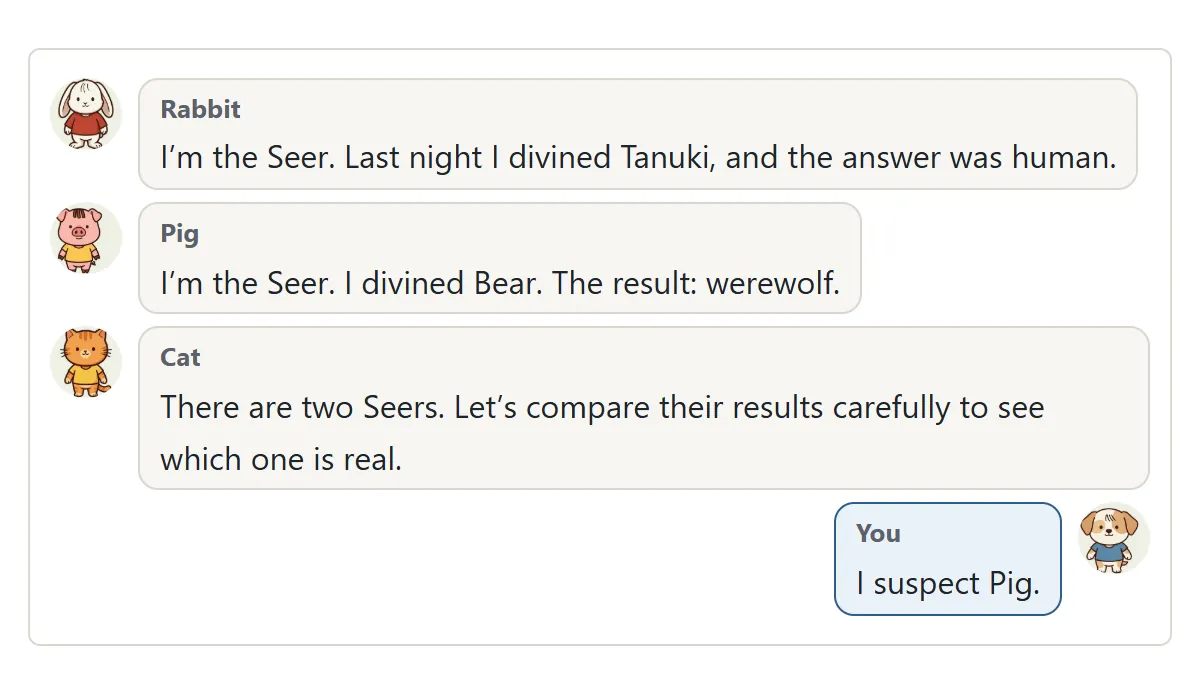
In this game there are two or three rounds of discussion per day, and in each round every player speaks in turn. On your turn you can claim a role, report a Seer reading, name a suspect, name someone you trust, or say who you will vote for. You may also claim a role you do not have, in other words lie. In the last round of the day, most players announce their vote.
5. Voting and exile
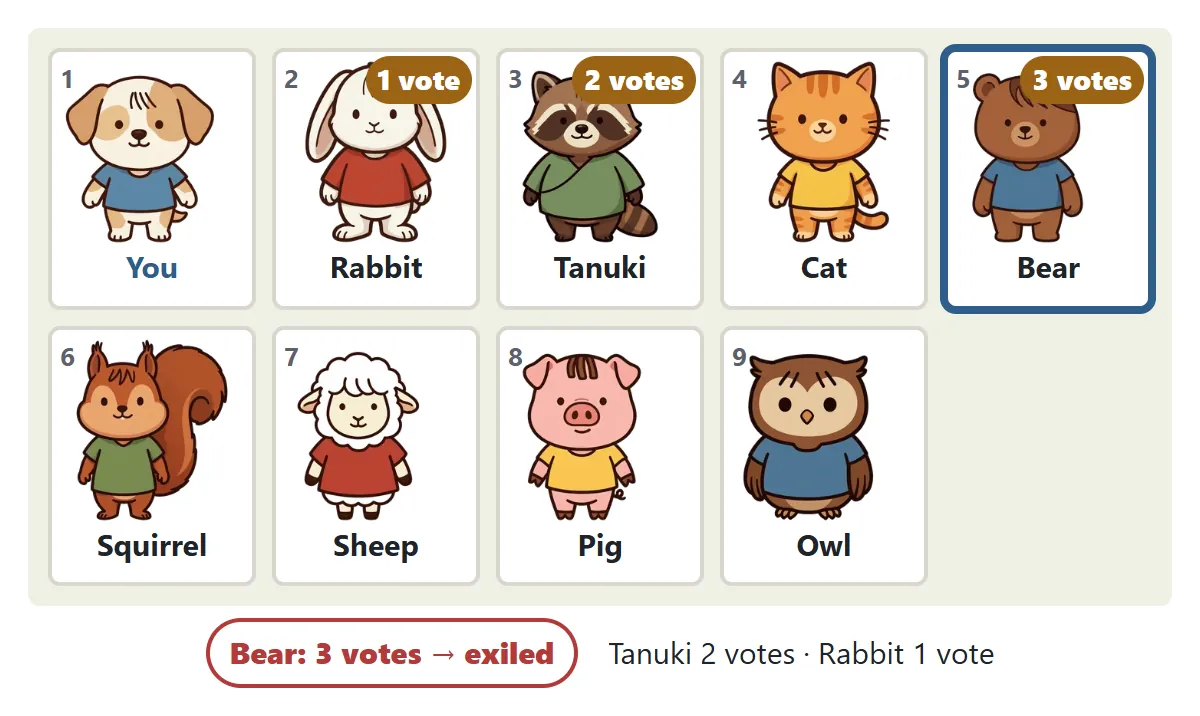
After the discussion, every player casts one vote for the player they think is a werewolf. The player with the most votes is exiled from the village. If two or more players tie for the most votes, there is a runoff vote among them, and if they are still tied, the exile is decided by lot. You cannot vote for yourself.
6. Winning and losing
The cycle of night, morning, discussion and vote repeats until one team wins. When every werewolf is gone, the Village team wins. When the surviving werewolves are equal to or more than the other surviving players, the Werewolf team wins. For this count, the Madman is counted as a human, not as a werewolf.

When the game ends, you see everyone’s role and a night-by-night review of who divined, protected and attacked whom. Checking things like “was that Seer real?” is the fastest way to get better for the next game.
Werewolf roles and strategy
Villager
Villagers have no special power, but they are the largest group in the village, and their votes decide where it goes. Watch for claims and results that contradict each other and for players who keep defending the same person, and vote for whoever’s story does not add up. If the werewolves think you are a sharp player, expect to be attacked at night.
Seer
Each night the Seer divines one player and learns whether they are a werewolf. Claiming early and sharing your results moves the discussion forward, and if you find a werewolf, say so right away. Claiming makes you a target for the werewolves, so whether the Bodyguard can protect you matters a lot. As a rule, divine players who have not been divined yet and have not claimed a role.
Medium
At night the Medium learns whether the player exiled that day was a werewolf. When two players claim to be the Seer and the village exiles one of them, the Medium’s result shows which one was real. Medium results also let the village count how many werewolves are still alive.
Bodyguard
Each night the Bodyguard protects one player from the werewolves, but cannot protect themselves. Under this game’s standard rules, the Bodyguard also cannot protect the same player two nights in a row. Protecting the Seer who looks real is the basic play, but the werewolves expect that too, so switching targets now and then can pay off. If you are about to be exiled, you can claim Bodyguard to save yourself, but once you claim, you become an easy target at night. In some groups this role is called the Guard or the Doctor.
Werewolf
Werewolves attack one player each night and pretend to be human during the day. When there are two or more werewolves, they know who their partners are. Defending a partner too hard is a classic giveaway, so be careful. Common plans are to attack the real Seer early, to claim Seer yourself and confuse the village, and to add your vote to whoever the village already suspects.
Madman
The Madman is a human who sides with the werewolves. The Seer and the Medium see the Madman as human, and the Madman does not know who the werewolves are. The typical play is to claim Seer and announce fake results so that the village starts doubting the real Seer. If the Werewolf team wins, the Madman wins too, even after being exiled. Some groups call this role the Traitor.
Role setup by number of players
This game uses the role setups below. They are chosen so that neither team wins too often at any player count.
| Players | Standard (6 roles) | Simple (4 roles) |
|---|---|---|
| 6 | Villager 2, Werewolf 1, Seer 1, Bodyguard 1, Madman 1 | Villager 2, Werewolf 2, Seer 1, Bodyguard 1 |
| 7 | Villager 1, Werewolf 2, Seer 1, Medium 1, Bodyguard 1, Madman 1 | Villager 3, Werewolf 2, Seer 1, Bodyguard 1 |
| 8 | Villager 2, Werewolf 2, Seer 1, Medium 1, Bodyguard 1, Madman 1 | Villager 4, Werewolf 2, Seer 1, Bodyguard 1 |
| 9 | Villager 3, Werewolf 2, Seer 1, Medium 1, Bodyguard 1, Madman 1 | Villager 5, Werewolf 2, Seer 1, Bodyguard 1 |
| 10 | Villager 4, Werewolf 3, Seer 1, Medium 1, Bodyguard 1 | Villager 6, Werewolf 2, Seer 1, Bodyguard 1 |
Under “Customize the rules” you can also choose how the Seer’s first night works (a revelation of one human, a free reading, or no reading at all) and whether the Bodyguard may protect the same player two nights in a row. A free reading on the first night lets the Seer start finding werewolves earlier, which gives the Village team a small edge.
Werewolf tips: how to win
1. Line up the claims and results
Keep track of how many players claim Seer and whom each of them called human or werewolf. Lies start to show once the results are side by side. In this game, the “What we know” box at the bottom of the screen does this for you.
2. A player who was attacked was not a werewolf
Werewolves do not attack werewolves, so anyone attacked at night was human. The werewolves also prefer to attack the real Seer or Medium, so when a player who claimed one of those roles is attacked, that claim was most likely true.
3. Look back at the votes
Werewolves rarely vote for each other. On the other hand, a player who voted for someone already known to be human looks a little suspicious. After each exile, check who voted for whom.
4. Count the players left
The werewolves win as soon as they equal the humans in number. On a day when one wrong exile would lose the game, vote for the player you are most certain about.
5. As a werewolf, stay low-key
As a werewolf, the basics are to vote with the village’s main suspect and not to defend your partners too much. Claiming Seer is a strong play, but if your results clash with the Medium’s, you will be caught.
Werewolf terms
- Claim (CO)
- Revealing your role, as in “I claim Seer.” Japanese players call this CO, short for “coming out”. In this game it is the “Claim a role” button.
- Counter-claim
- When someone claims a role and another player claims the same role. With two Seers, one of them is lying.
- White and black
- A player whose Seer or Medium result came out human is “white”; a werewolf result is “black”. Players also call a suspicious person “black”.
- Roller
- Exiling every player who claimed the same role, one after another. The real one goes too, but the liar is sure to be caught.
- Grey
- A player who has not been divined and has not claimed a role, so they are neither white nor black yet.
- Lynch
- An older word for exiling a player by vote, still used by many groups. This game simply calls it exile.
- Wolf line
- A link between werewolves. You find lines by watching who defends whom and who votes together.
Werewolf FAQ
Can I play Werewolf alone?
Yes. The other players are CPU animals and the game itself acts as the moderator. You can choose a village of 6 to 10 players, including you.
Do I have to type what I say?
No. You choose from buttons such as “Claim a role”, “Report a reading” and “Name a suspect”, and your choice is added to the discussion as your statement. The CPU players work out who is suspicious from the claims, the results and the votes, and they give a reason when they speak.
How do the CPU levels differ?
The level applies to the CPU players on the other team. Easy CPUs sometimes defend their partners or misread results, so their lies are easier to see through. Hard CPUs remember what was said and how everyone voted, and they are good at making false claims. CPU players on your own team always think at the Normal level. No CPU ever peeks at anyone else’s role.
Can I stop and continue later?
Yes. On the same device and browser, a “Continue” button appears the next time you open the page.
What happens if I am exiled or attacked?
You can no longer take part in the discussion, but you can keep watching the village until the game ends. If your team wins, you win. Press “Skip to the result” to see the result right away.
Can the Bodyguard protect themselves?
Not in this game. Some groups allow it, but this game follows the rules most commonly played in Japan.
Where the Werewolf game comes from
Werewolf grew out of Mafia, a party game in which citizens try to find the mafia hidden among them. According to Andrew Plotkin, who wrote about the game’s history on his website, Mafia was invented by Dimitry Davidoff in 1986, when he was studying at the psychology department of Moscow State University. Plotkin learned the game as Mafia in 1997 and changed the theme to werewolves, and the werewolf version spread from there. The game later became especially popular in Japan, where it is known as 人狼 (jinrō, “werewolf”) and where many of the terms above come from. Role names vary from group to group: the Bodyguard is also called the Guard or the Hunter, and the Medium is sometimes called the Spirit Medium.
Comments
Write a comment
No comments yet.