 Yorimichi Games
How to play Rock Paper Scissors Roulette
Rock Paper Scissors Roulette is a game of rock paper scissors against a machine. The machine counts “Rock, paper, scissors…”, you press one of its three big buttons, and on “Shoot!” it lights up the hand it chose. Win and a ring of lamps starts spinning like a roulette wheel; wherever the light stops, those points go on your score. A tie means you throw again. A loss costs you a chance, and when your chances run out, the game is over. The goal is simple: build the biggest score you can before the machine beats you.
It plays like the coin-operated rock paper scissors machines that used to sit in arcades and on department store rooftops, but here there are no coins, medals or prizes – just points, streaks and your own high score.
A tour of the machine
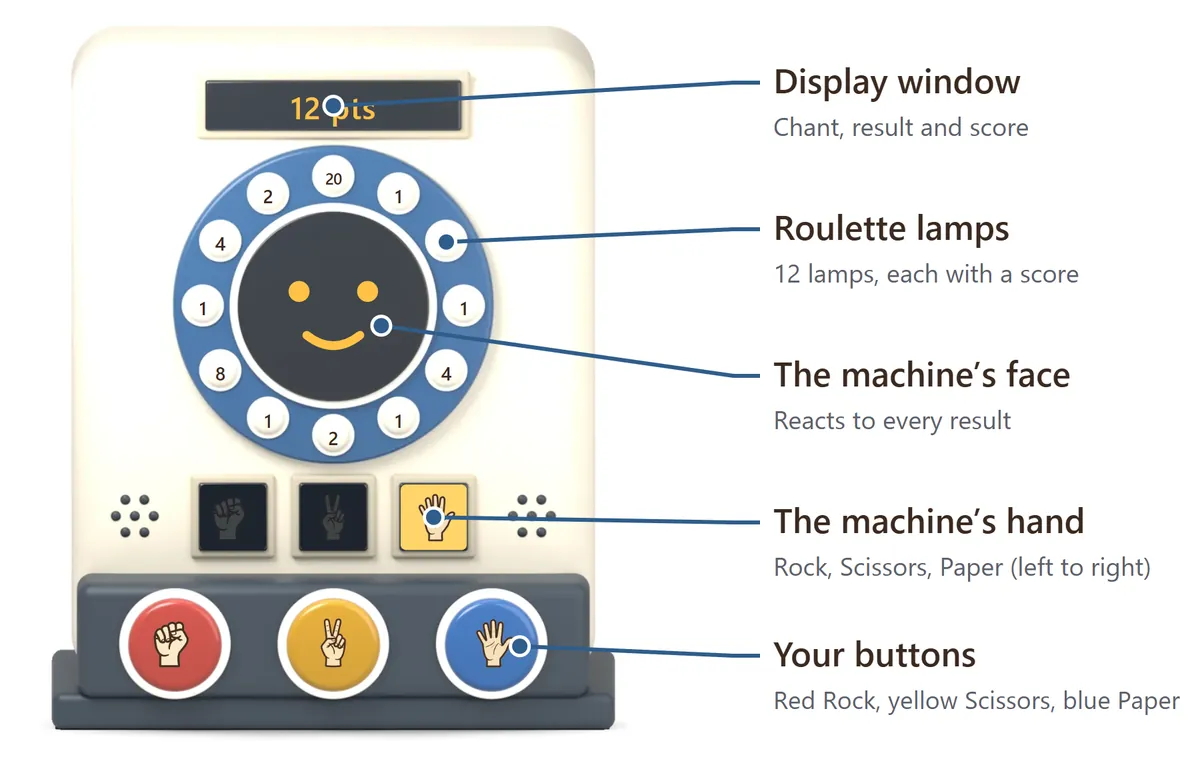
The narrow window at the very top is the display. It counts out the chant, tells you whether you won, and shows your score between rounds. The round screen in the middle is the machine’s face, and it pulls a different expression for every result – it is not very happy when you beat it. The twelve lamps around the face are the roulette, and each one is marked with a number of points. Under the face are three small windows for Rock, Scissors and Paper, from left to right; on “Shoot!” the window for the machine’s hand lights up and is tagged “CPU”. The three big buttons at the front are yours: red is Rock, yellow is Scissors and blue is Paper.
One round, step by step
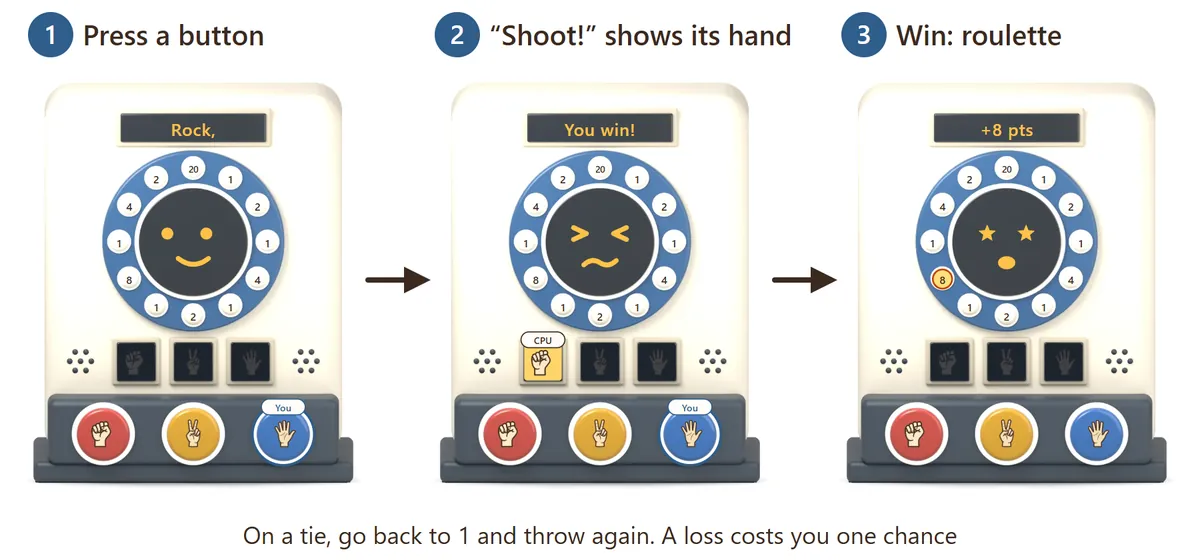
You can press your button any time during “Rock, paper, scissors…”. Your choice is locked in with a blue ring, and both hands are revealed together on “Shoot!”. There is no rush: if you haven’t pressed yet, the machine simply waits for you. This is a game of reading and guessing, not of reflexes.
One thing to know up front: the machine picks its hand before you press anything. It never peeks at your button and switches – there is no way for it to “throw late”. If it seems to read your mind on Hard, that’s because it has been studying your earlier throws, not because it saw this one.
Rock paper scissors rules: what beats what
The rules of the hand game itself are the ones you already know. Rock is a fist, Paper is an open hand and Scissors is two fingers in a V.
| Your throw | Beats | Loses to |
|---|---|---|
| Rock | Scissors (rock crushes scissors) | Paper |
| Scissors | Paper (scissors cut paper) | Rock |
| Paper | Rock (paper covers rock) | Scissors |
If you both throw the same hand, it’s a tie. Nothing changes – no points, no lost chance – and the machine counts “Tie… Shoot!” so you can throw again right away.
Win, and the roulette spins
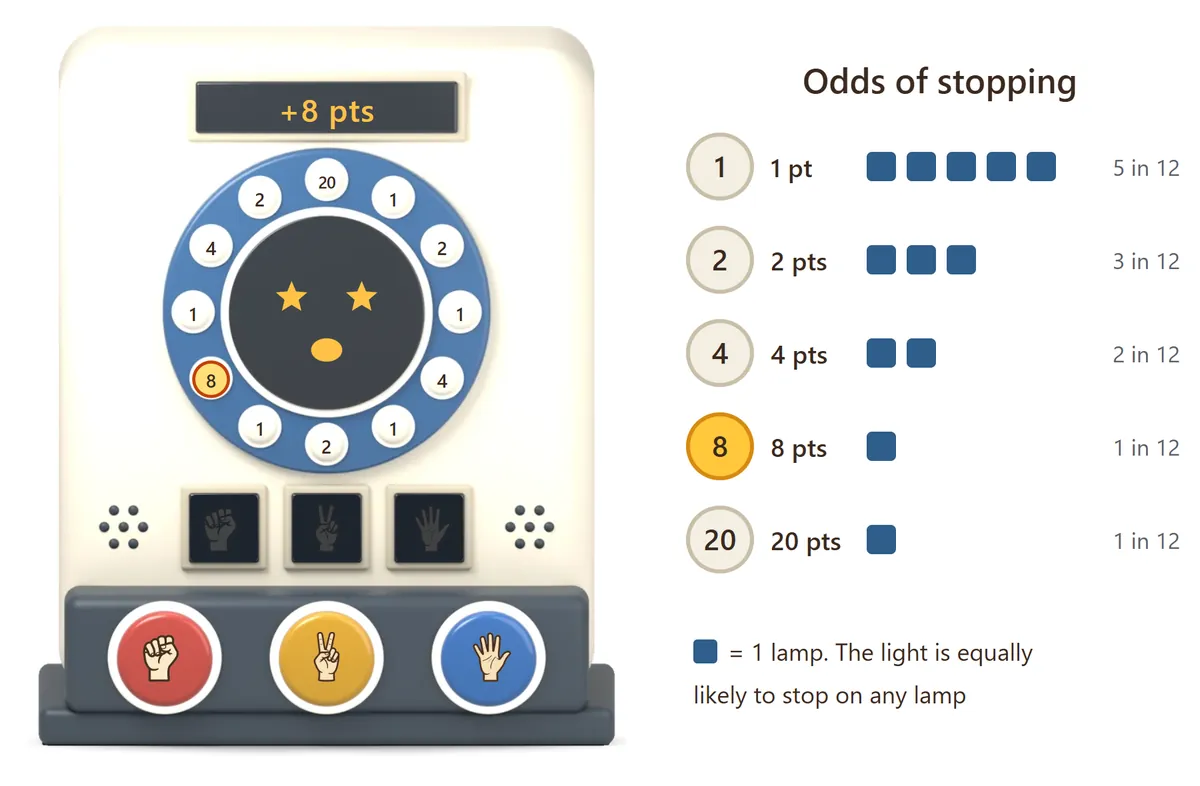
Every time you win a throw, the light races around the ring of lamps, slows down and stops. The number on that lamp is added to your score, and then the next throw begins. Points you have won are never taken away, so a long winning run adds up quickly.
| Lamp | Number of lamps | Chance of stopping |
|---|---|---|
| 1 point | 5 | 5 in 12 |
| 2 points | 3 | 3 in 12 |
| 4 points | 2 | 2 in 12 |
| 8 points | 1 | 1 in 12 |
| 20 points | 1 | 1 in 12 |
The light is equally likely to stop on any of the twelve lamps, so what you see is exactly what you get: the odds of each prize match the number of lamps it has. The big 20 at the top comes up about once every twelve wins. On average, a spin is worth a little under 4 points.
Ties and losses
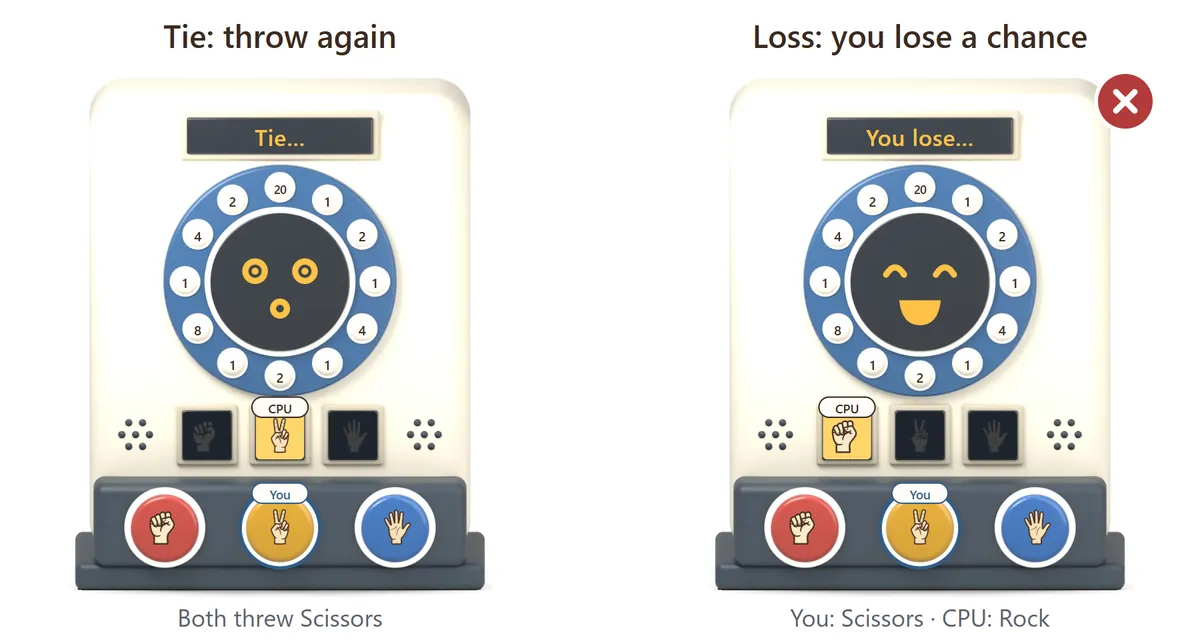
A tie is harmless: the chant changes to “Tie… Shoot!” and you go again. A loss resets your winning streak to zero and uses up one chance. The dots in the bar above the machine show how many chances you have left. With the classic setting of one chance, a single loss ends the game.
Choosing your number of chances
| Chances | Game ends after | Good for |
|---|---|---|
| 1 | 1 loss | The all-or-nothing arcade feel |
| 3 | 3 losses | Building a steady score |
| 5 | 5 losses | Long games and big totals |
When the game ends you see your score, your wins and ties, your best streak and your high score. Records are kept on this device for each combination of difficulty and chances. You can also play with a keyboard: 1 is Rock, 2 is Scissors and 3 is Paper (J, K and L work too).
Rock paper scissors strategy: how to beat the computer
Against a truly random opponent, no strategy can win more than a third of the time. But people are not random, and neither is this machine on every level. Here is how to tilt the odds.
1. Don’t fall into a favorite
Most players have a hand they like – many beginners lean on Rock – and they come back to it more than they realize. On Normal and Hard, the machine keeps count of what you throw and plays the hand that beats your favorite. Spread your throws around, and every now and then repeat a hand on purpose to break your own pattern.
2. Watch what you do after a win or a loss
Two habits are very common: sticking with a hand that just won, and switching after a loss – often to the hand that would have beaten the last one. The Hard machine looks at your previous throw and whether it won or lost, and bets on you doing what most people do. If you catch yourself following the pattern, do the opposite.
3. Find the machine’s habit
On Easy, the machine has a habit of its own: it throws one particular hand more often than the others. Play a few rounds and watch which window lights up most. Once you have spotted it, throw the hand that beats it.
4. Don’t sweat the roulette
How you press the button, and when, has no effect on where the light stops. Every lamp has the same chance. You can’t aim for the 20, so put your energy into winning more throws – the points follow.
5. Chasing a streak? Play with one chance
With one chance, every throw matters, and your best streak is a clean record of how many wins you strung together. If you want to set a streak you can be proud of, that is the mode to try.
Rock paper scissors FAQ
Does the machine see my button before it throws?
No. The machine’s hand is decided before you press anything. On Hard it wins more often because it predicts your next throw from your past ones, not because it cheats.
Which difficulty should I choose?
Start with Easy. The machine has an obvious favorite hand, so it is the best place to get a feel for the game. Normal plays mostly at random and sometimes goes after your favorite hand. Hard reads your habits every single throw and is a real challenge.
Why do I hardly ever get 20 points?
There is only one 20 lamp out of twelve, so it comes up about once in every twelve spins. The light is equally likely to stop anywhere – the big prizes are rare only because there are fewer of them.
Can I win anything?
No. Points exist only inside the game. Chase your high score and your best streak for fun.
Can I stop and continue later?
Yes. Open the page again on the same device and browser and choose “Continue” to pick up with the same score and chances.
Is there sound?
Sound is off at first. Press “Sound: off” to hear a tick for each beat of the count, a pop on “Shoot!” and sound effects for wins, losses and the roulette.
Is it free?
Yes. Rock Paper Scissors Roulette is free to play in your browser on a computer, tablet or phone, with no download and no sign-up.
Where rock paper scissors comes from
Hand games where three signs beat each other in a circle have been played in East Asia for centuries, and the rock, paper and scissors version became popular in Japan, where it is called janken. Players there count “Jan, ken, pon!” and throw on “pon”, and a tie is replayed with “Aiko de sho!” – which is where this machine’s quick “Tie… Shoot!” comes from. From Japan the game spread around the world in the twentieth century. In English it has a whole family of names – Rock-Paper-Scissors, Scissors-Paper-Stone, and in parts of the United States, Roshambo – and people use it to settle everything from who goes first to who gets the last slice of pizza.
Arcade machines that played rock paper scissors against you, with a spinning ring of lights to reward a win, were a familiar sight in Japanese game centers and on department store rooftops. This game takes that feel and turns it into a free browser game with a fair roulette and a machine that gets smarter the more you play.