 Yorimichi Games

How to play the flag raising game
The flag raising game is a simple reaction game with a sneaky twist. You hold a red flag and a white flag, and a caller shouts commands: “Red up!”, “White down!”, “Both up!” Your job is to raise or lower the right flag, and only that flag. That is the whole rule. What makes it hard is speed and the trick commands that start with “Don’t”: when the commands come quickly, your hands want to move before your brain has finished reading.
In Japan the game is known as hata-age (旗揚げ, “raising flags”), and in Korea a version called cheonggi baekgi (“blue flag, white flag”) is a party favorite. This online version keeps the classic red and white flags. There is no voice: the commands appear on screen as text, one chunk at a time, much as a caller would say them. It is a one-player game that runs in your browser on a phone, tablet or computer, with nothing to install and no account to create.
Move only the flag you are told to
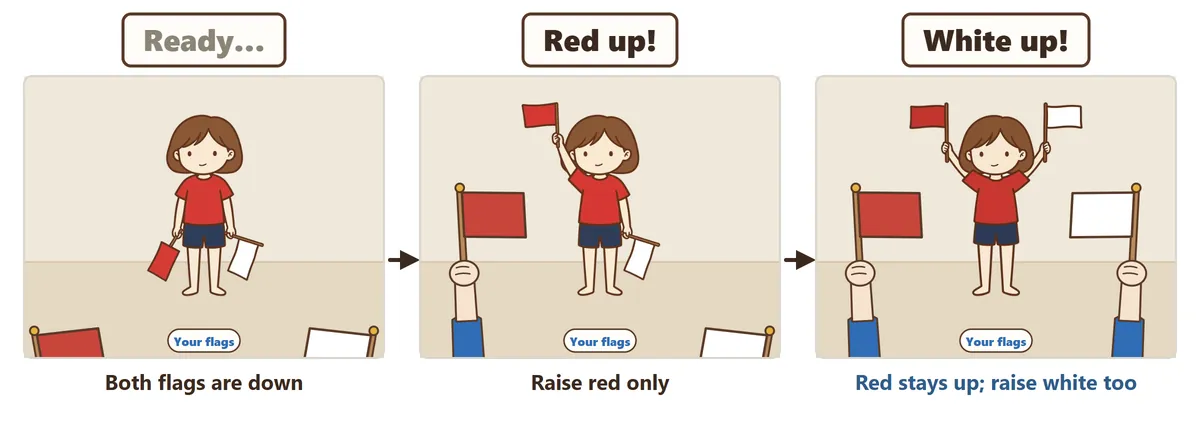
Every round starts with both flags down. When a command appears, move only the flag it names. The most important habit is to leave the other flag exactly where it is. If red is already up and the command is “White up!”, you keep red up and raise white as well, so both flags end up in the air.
On this screen the red flag is always on the left and the white flag is always on the right. That is true for the caller standing in the back, for “your flags” in the front, and for the four buttons under the picture: “Red up” and “Red down” on the left, “White up” and “White down” on the right. On a keyboard, W and S move the red flag and the ↑ and ↓ arrow keys move the white flag.
“Don’t” means leave it alone
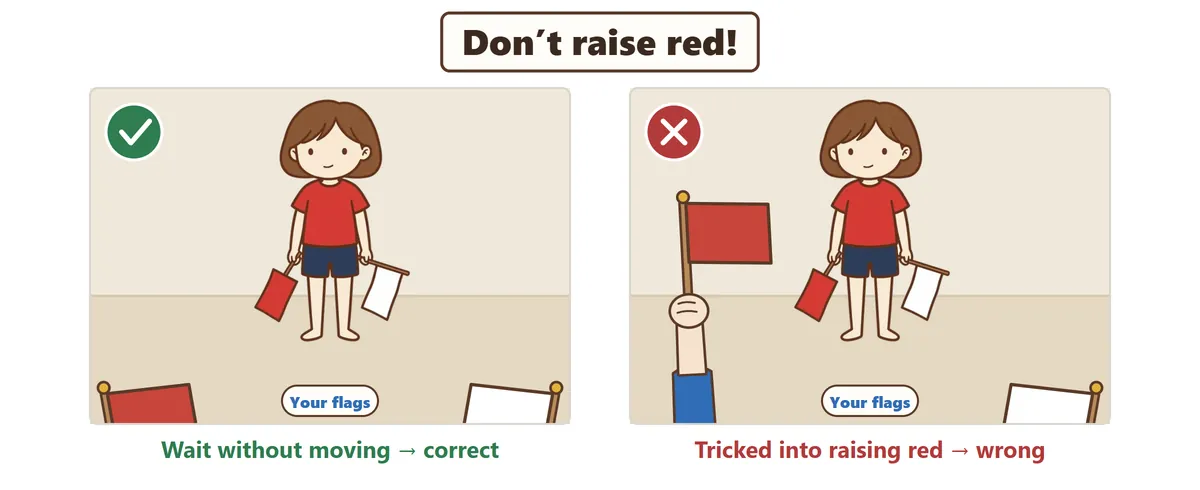
The signature trick of the flag game is the negative command. “Don’t raise red!” means the red flag must not move. If you see “raise” and “red” and your thumb jumps, you have been tricked. The same goes for “Don’t lower white!” – the white flag stays up.
To keep things fair, a “Don’t” command only appears when the flag is in the position that tempts you to move it: “Don’t raise red!” comes when red is down, and “Don’t lower red!” comes when red is up. So in every case the right answer is the same – do nothing with that flag. The commands are revealed piece by piece, and on Normal and Hard there is sometimes a short pause before the last piece, so you never know exactly when the command is complete. Read it to the end before you move.
Double commands
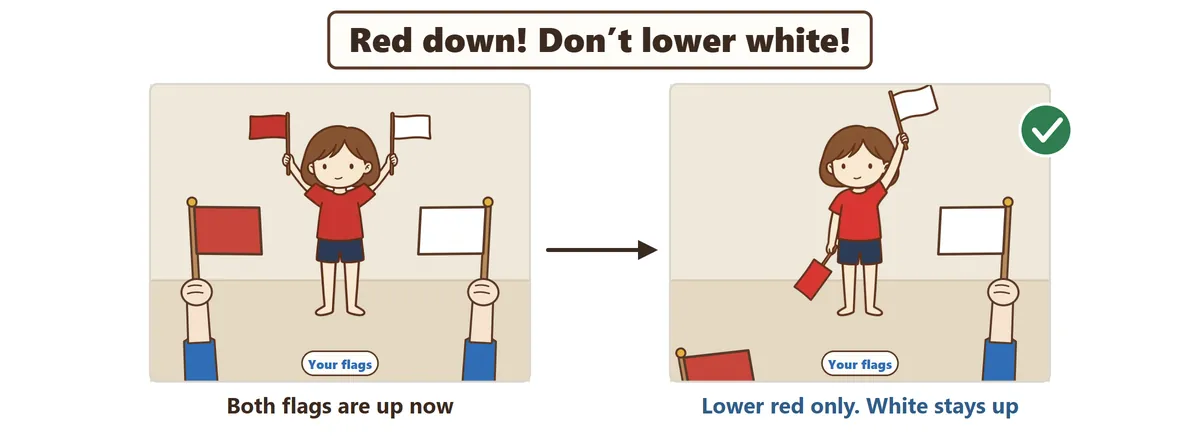
Once you are warmed up, two commands start to arrive back to back, such as “Red up! Don’t lower white!” You may act on the first part as soon as it is complete. Then deal with the second part in the same way. What counts is the final position: if both flags are where they should be when the time runs out, the answer is correct. “Both up!” and “Both down!” also turn up from time to time; they move the two flags together.
What counts as a mistake
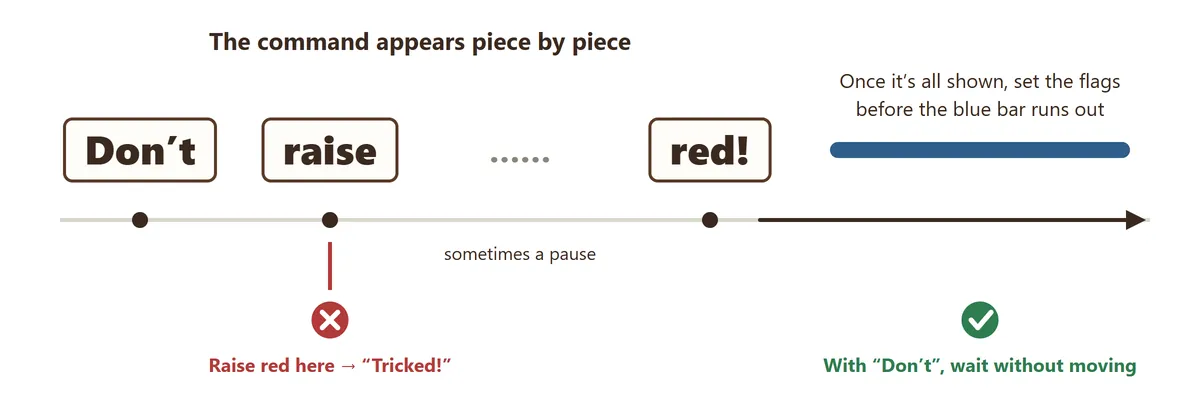
There are two ways to miss. The first is moving a flag the wrong way: as soon as a flag moves into a position that doesn’t match the command, the game shows “Tricked!” and counts a mistake. The second is being too slow: after the full command has appeared, a blue bar under it shrinks, and if the flags are not right when it runs out, you get “Too slow!”
Pressing “Red up” while red is already up does nothing, and it is not a mistake. Now and then the game will even ask you to raise a flag that is already up – in that case, the correct answer is to leave it. After a miss, the correct position appears at the caller’s feet, your flags are reset to it, and the next command follows.
Flag game rules: difficulty levels and modes
| Level | Speed and time | Tricks and the caller |
|---|---|---|
| Easy | Slow commands, one at a time; plenty of time to move | A few “Don’t” tricks. The caller shows the right pose a moment later |
| Normal | Fast commands, sometimes two in a row; normal time | Regular tricks. The caller shows the answer after each command |
| Hard | Very fast, often two in a row; short time | Lots of tricks. The caller sometimes fakes a move to lure you |
On every level, the commands speed up a little each time you get five in a row right, and they drop back to the starting speed when you make a mistake. You can choose between three modes: “Out after 3 mistakes”, “Sudden death” (one mistake and the game is over, just like the elimination style where anyone who slips has to sit down) and “20 commands”. In “20 commands” the game always runs to the end, even if you miss, which makes it a good warm-up and an easy way to count how many you can get right out of twenty.
Flag game tips: how to build a longer streak
1. Wait for the last word
The most common mistake is moving as soon as you see a color and a direction. Make it a rule not to move until the command is finished – until the exclamation mark appears. That single habit protects you from almost every trick.
2. Keep the current position in your head
“Don’t lower red!” only shows up while red is up. If you always know which flags are up right now, you can tell instantly what the next command will change and what it will leave alone. Glance at “your flags” in the front of the picture whenever you are unsure.
3. Give each flag its own finger
On a computer, rest your left hand on W and S and your right hand on the ↑ and ↓ keys, so you never have to look down. On a touch screen, use your left thumb for red and your right thumb for white. Fixed fingers mean one less decision when the pace picks up.
4. Don’t copy the caller
On Hard, the caller sometimes raises or lowers a flag before the command is finished, as if she had fallen for the trick herself. People naturally mirror what they see, but the right answer depends only on the text. When you play on Hard, keep your eyes on the command, not on the caller.
5. Think in final positions
When double commands come fast, picturing the end result is easier than handling each part one by one. “Red up! Don’t lower white!” simply means: white stays as it is, red ends up high. Once you know the final picture, you only ever need to press one or two buttons.
Flag game FAQ
What should I do on “Don’t raise red”?
Nothing. Leave the red flag where it is and wait. In this game, “Don’t raise red!” only appears while red is down, and “Don’t lower red!” only while red is up, so the answer is always to keep that flag still.
Can I hear the commands instead of reading them?
Not at the moment – the commands are shown as text. Each piece appears with a gap, roughly the rhythm of a spoken command, so it feels close to listening. The only sounds are short effects for the buttons and results, and they are off until you press “Sound: off” to turn them on.
Which level should I start with?
Start with Easy if you are new to the game. The commands come slowly, one at a time, and the caller demonstrates the answer. When you can get about ten in a row, move up to Normal. Hard is fast enough to trip up most adults, so it makes a good challenge to come back to.
Where are my records saved?
Your best streak for each level is stored in this browser on this device, along with your best score out of 20 in the “20 commands” mode. If you close the page in the middle of a game, you can pick it up again with “Continue” on the same device.
Can I use it for a group game?
Yes. Put the game on a big screen and let one person play while everyone else watches and shouts encouragement, or hand out real flags (or just use your arms) and have the whole room follow the commands on the screen together. The game then shows the correct position after each command, so nobody has to argue about who moved first.
Where the flag game comes from
In Japan, the flag raising game is said to have spread from a 1960s comedy routine by the Nonsense Trio, in which a performer barked out commands such as “Red up, white down, don’t raise white, lower red!” at increasing speed. The joke caught on, and the game became a fixture of parties, office gatherings and recreation events. All you need is a red flag and a white flag – and if you have no flags, raising your arms works just as well. Players have invented plenty of variations, from using carp-streamer flags to adding commands for the feet. In Korea, the same idea is played as cheonggi baekgi with a blue flag and a white flag, and it is just as popular at parties. Wherever it is played, the appeal is the same: a few simple words, a quick pair of hands, and one little “don’t” that catches everybody out sooner or later.
Comments
Write a comment
No comments yet.