 Yorimichi Games
How to play Daifugo (President card game)
Daifugo is a climbing card game from Japan and one of the most popular card games played there. If you have ever played President, you already know the idea: everyone is dealt a share of the deck, players take turns beating the cards on the pile with stronger ones, and whoever gets rid of all their cards first wins the round. The name means “grand millionaire”, which is the title of the winner. The last player left holding cards becomes the “grand pauper” (daihinmin – some regions call the whole game Daihinmin for that reason).
What makes the game memorable is that the titles matter. After the first round, the loser has to hand their best cards to the winner, so whoever is on top tends to stay there – until a revolution turns everything upside down. In this version you play against two to four computer opponents, and you can turn each of the well-known Japanese house rules on or off.
Reading the table
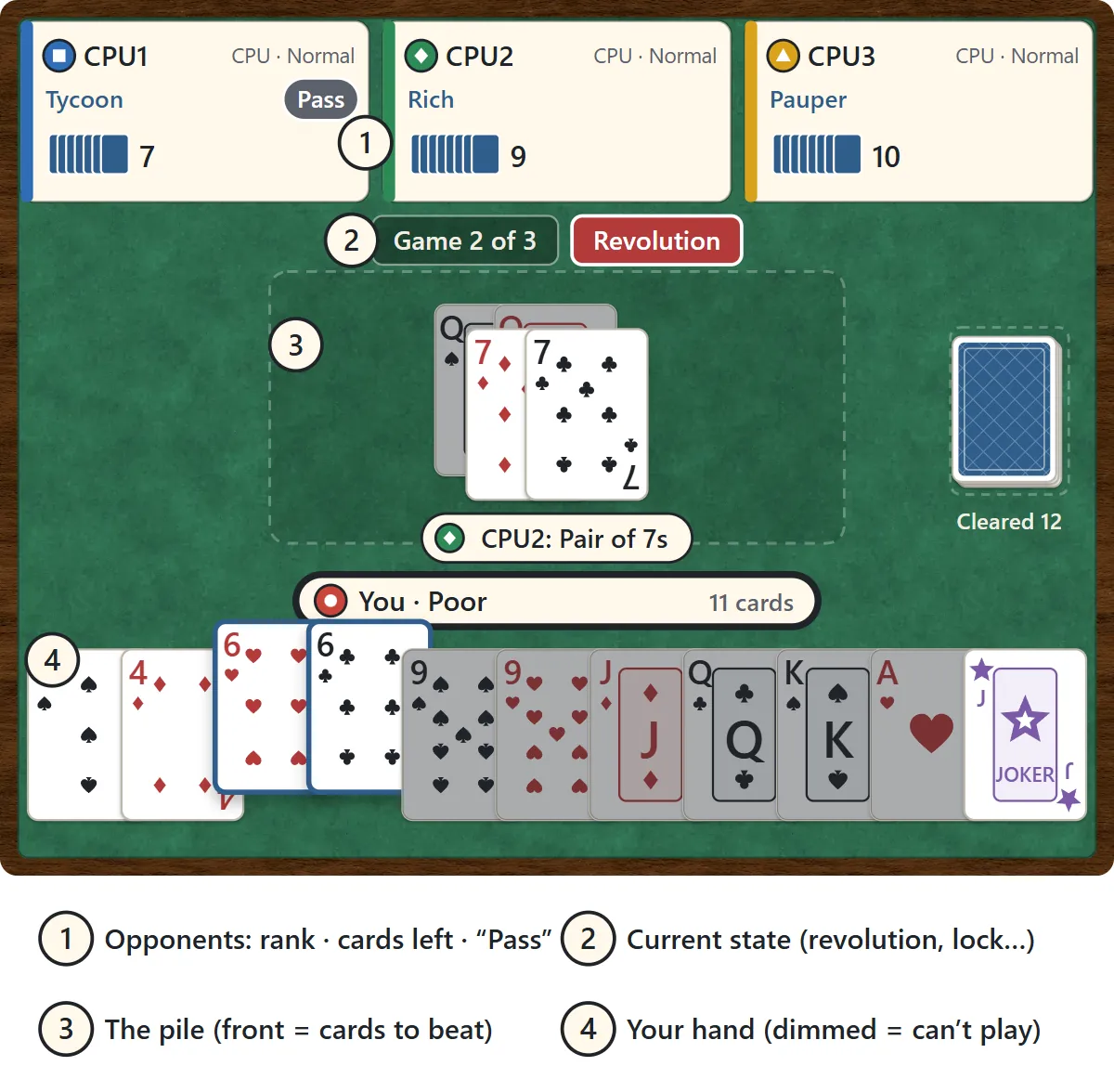
When it is your turn, tap the cards you want to play and press Play. Cards that cannot be played this turn are dimmed, so you can see your options at a glance. Once your selection forms a valid play, its name – “Pair of 7s”, for example – appears in the message bar. You can also play with the keyboard: arrow keys to move, Space to select, Enter to play and P to pass.
Card ranking in President and Daifugo
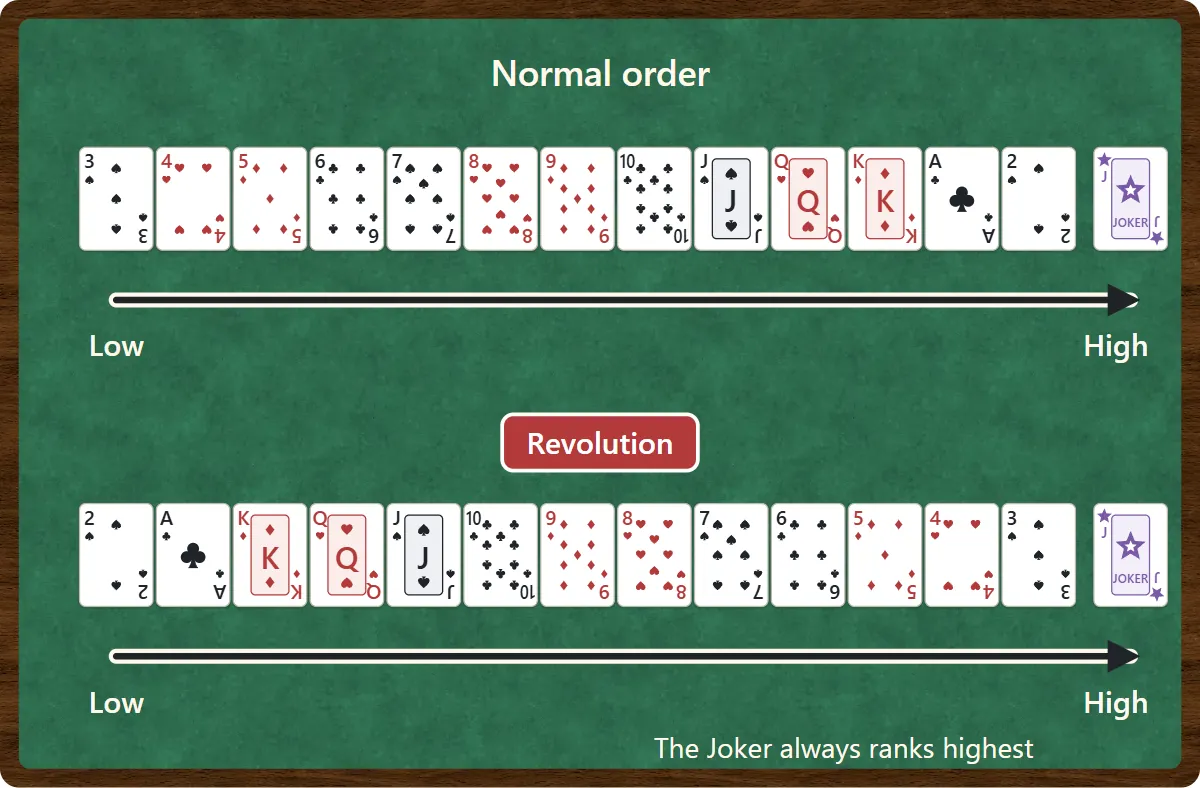
Suits do not matter for strength – only the rank does. From lowest to highest the order is 3, 4, 5, 6, 7, 8, 9, 10, J, Q, K, A, 2. The fact that the humble 2 outranks the ace surprises many newcomers, and it is the same in most President rule sets. The Joker beats everything and can also stand in for any other card, so a 7 and the Joker together make a pair of 7s.
What you can play
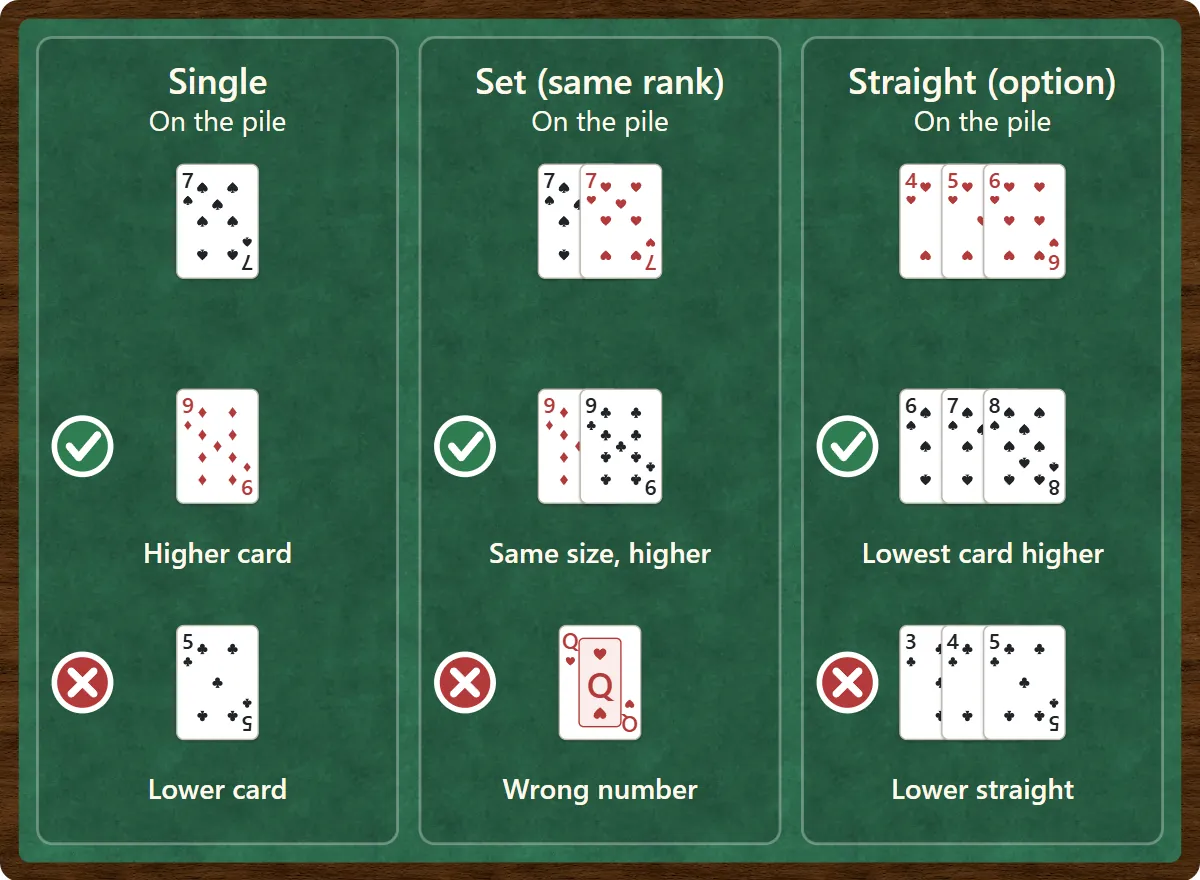
When the pile is empty, you “lead” and may play anything: a single card, or two, three or four cards of the same rank. Everyone after you must play the same number of cards, of a higher rank. After a pair of 7s, only a pair of 8s or better will do. If the Straights rule is on, you may also lead three or more cards of the same suit in sequence, such as ♥4-5-6. The next straight must have the same length and a higher lowest card, so ♠6-7-8 beats ♥4-5-6. A 2 and a 3 never connect.
Passing and clearing the pile
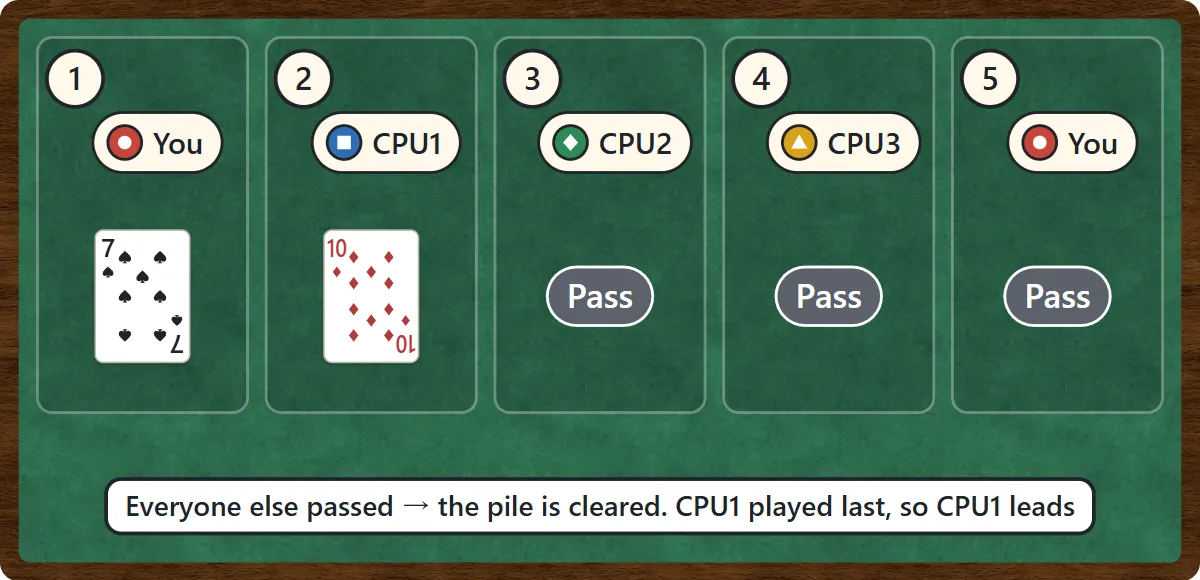
You may pass whenever you like, even if you hold a card that could be played. Once you pass, you are out of that trick until the pile is cleared. When everyone except the player who put down the last cards has passed, those cards are swept aside and that player leads a fresh trick with anything they want. The player who leads cannot pass.
Ranks and the card exchange
Players go out in turn as their hands run empty. With four players, the order of finishing gives the titles Tycoon (daifugō), Rich (fugō), Poor (hinmin) and Pauper (daihinmin). With five players there is a Commoner (heimin) in the middle, and with three players the titles are Rich, Commoner and Poor. In President these are often called President, Vice-President, Citizen and so on, but the idea is the same. The round ends as soon as one player is left.
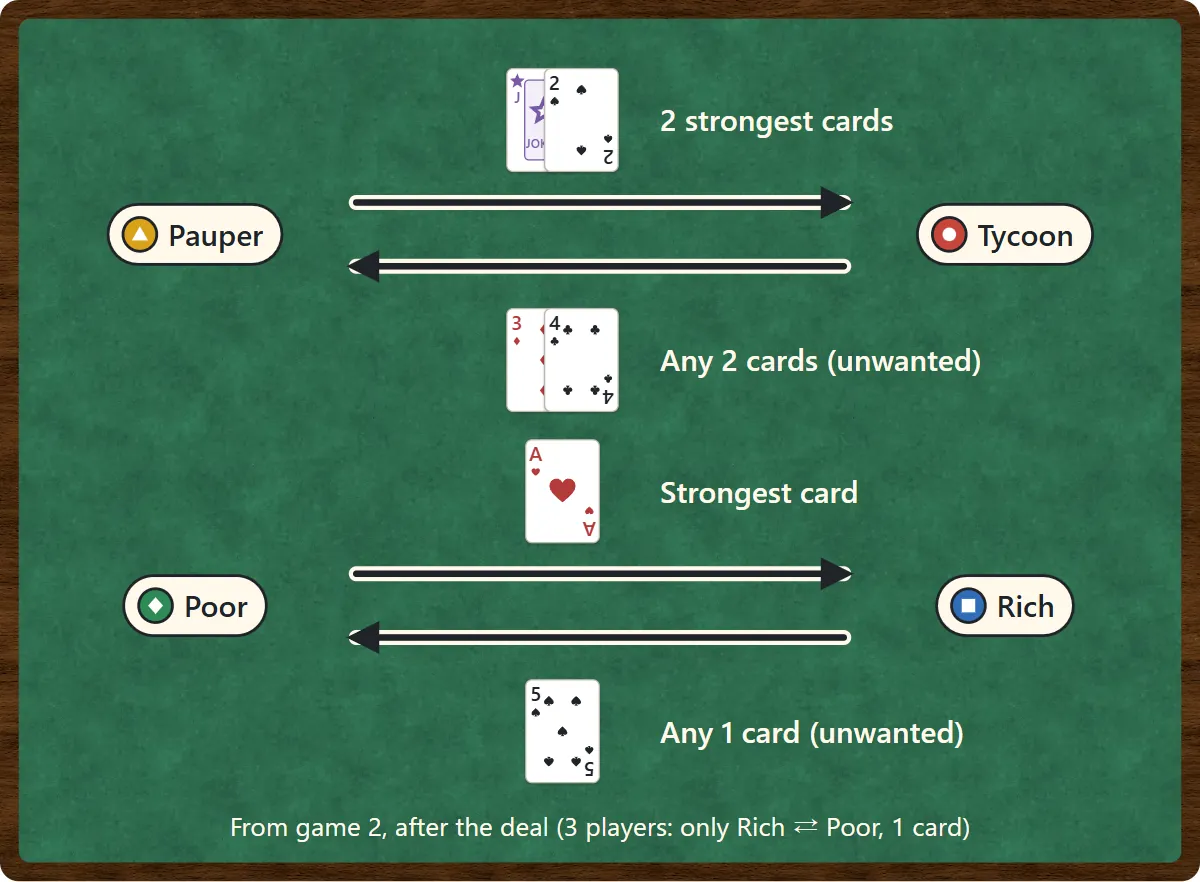
From the second round on, the cards are exchanged right after the deal. The Pauper must give their two strongest cards to the Tycoon, and the Tycoon returns any two cards they like. The Poor and the Rich swap one card the same way. The Pauper then leads first. Each round scores points by rank (with four players: Tycoon 3, Rich 2, Poor 1, Pauper 0), and after the number of rounds you chose, the highest total wins the match.
President card game rules: the popular house rules
Hardly any two groups play Daifugo exactly the same way, which is part of the fun. These are the special cards and rules you can switch on in this game. The Japanese names are given in brackets, because you will hear them from anyone who learned the game in Japan.

- Revolution (kakumei): play four cards of the same rank (a Joker may be one of them) and the order of all cards except the Joker flips – 3 becomes the highest and 2 the lowest. A second revolution flips it back.
- 8-cut (hachi-giri): playing an 8 clears the pile at once and you lead again. An 8 inside a straight does not count.
- Suit lock (shibari): if a play has exactly the same suits as the play before it, only those suits may be played until the pile is cleared.
- Jack back (eleven back): a jack reverses the order until the pile is cleared.
- 3♠ counter (supe-san gaeshi): a lone Joker can be beaten by the 3 of spades, which also clears the pile.
- Dethroning (miyako-ochi): if last round’s Tycoon fails to go out first, they drop out immediately and take last place.
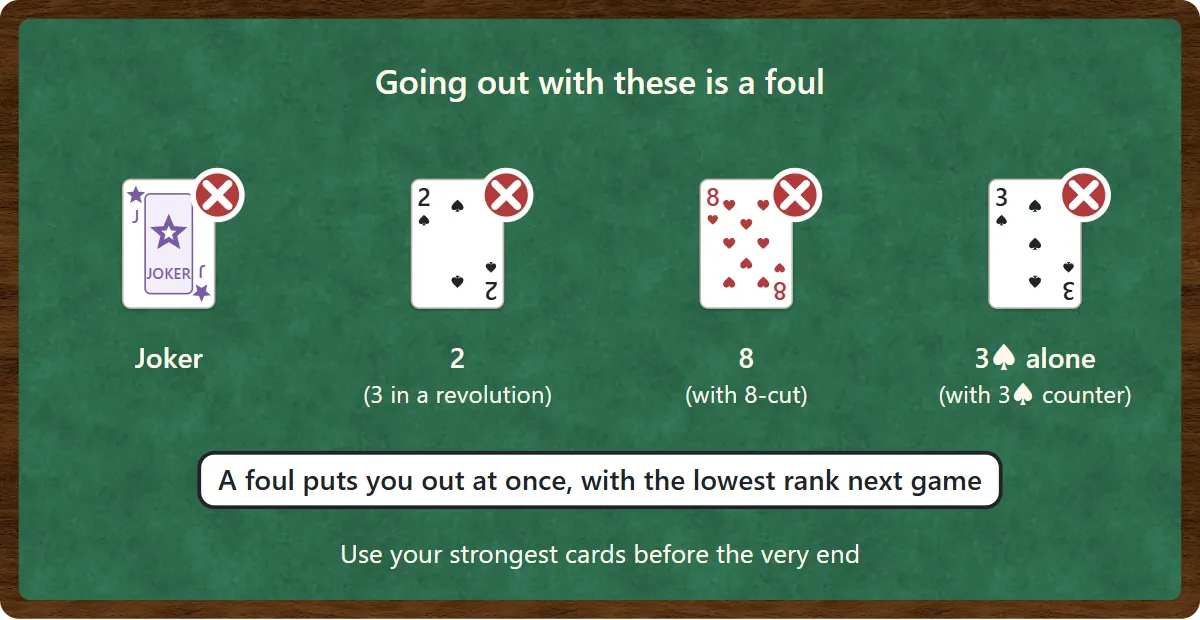
With the forbidden finish rule (agari-kinshi), your final play may not contain a Joker or a 2 (a 3 during a revolution), and it may not be just 8s or the lone 3 of spades when those special rules are on. A player who goes out that way is out on the spot and ranked last. Holding your strongest cards until the very end therefore backfires – spend them along the way.
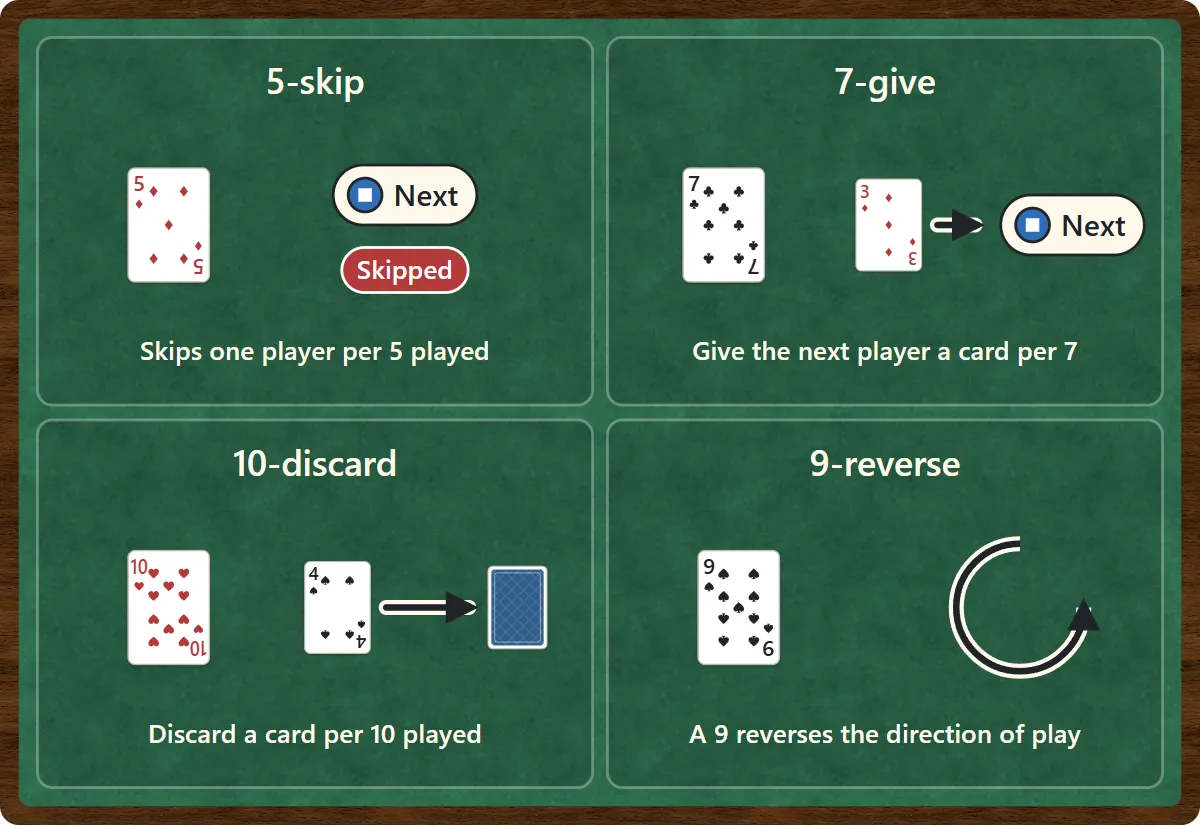
The All-in set adds four more: a 5-skip skips one player for each 5 played, a 7-give lets you pass that many unwanted cards to the next player, a 10-discard lets you throw away that many cards, and a 9-reverse changes the direction of play.
Rule sets
Because the house rules vary so much, the game offers four ready-made sets. Choose Custom to switch rules one by one.
| Set | Rules included |
|---|---|
| Simple | Card exchange, revolution, 8-cut |
| Standard | Simple + straights, suit lock, 3♠ counter, jack back, dethroning, forbidden finish |
| Tournament | Standard without jack back |
| All-in | Standard + straight revolution, 5-skip, 7-give, 10-discard, 9-reverse |
Tournament is close to the official rules used at Japanese tournaments. If you are new to the game, start with Simple and move to Standard once you are comfortable.
Daifugo strategy: tips to become the Tycoon
1. Get rid of your low cards first
Low cards such as 3s and 4s are hard to play unless you are leading, because almost anything beats them. Whenever you win the lead, use it to dump your weakest cards, ideally several at once. Keep your high cards to win the lead back.
2. Don’t break up pairs and straights
Playing a pair one card at a time costs you an extra turn to empty your hand. It is usually better to pass on a single than to split a pair to beat it. Count your hand in “plays” rather than cards: six cards in three pairs is only three plays away from going out.
3. Count the cards that win the lead
Jokers, 2s and (with 8-cut) 8s are the cards that let you clear the pile and lead again. Roughly speaking, if you have more of these “control” cards than groups of weak cards, you are on course to finish first.
4. Remember what has been played
Keep an eye on the 2s and the Joker. Once they are gone, your aces or kings may be the highest cards left, and a card nobody can beat is as good as a guaranteed lead.
5. Revolt when your hand is weak
A hand full of 3s and 4s turns into a strong one after a revolution. If you hold four of a kind and your other cards are low, the revolution can win you the round. If your hand is full of 2s and aces, watch out for players who might be holding four of a kind.
6. Plan your last play
With the forbidden finish rule, make sure your final card or set is not a Joker or a 2. And if you are the Tycoon with dethroning on, don’t sit back – attack early so nobody else goes out before you.
Daifugo FAQ
Is Daifugo the same as President?
They are close relatives. Both are climbing games where you beat the last play with higher cards, the 2 is the top card, and the finishing order decides who swaps cards next round. The Japanese game is known for its many special rules – revolution, 8-cut, suit lock and so on – while basic President in English-speaking countries is usually played with fewer extras. This game lets you play either way: Simple is close to plain President.
Why is it also called Daihinmin?
It depends on the region. In western Japan many people call the game after the loser (daihinmin, “grand pauper”) instead of the winner. The rules are the same; what really changes from group to group is which house rules are used.
What happens to the Joker during a revolution?
A single Joker is still the highest card during a revolution. When it is played together with other cards, it simply counts as the rank it replaces.
How do ranks and the exchange work with 3 or 5 players?
With three players the titles are Rich, Commoner and Poor, and only the Rich and the Poor swap one card. With five players the titles are Tycoon, Rich, Commoner, Poor and Pauper, and the Commoner does not exchange.
Which computer level should I choose?
Easy opponents grab tricks with their Jokers and 2s as soon as something is on the pile, so they run out of strong cards early, and they sometimes break up their pairs. Normal opponents keep their sets together and save strong cards to win the lead back, but they now and then spend a high card too soon or miss a chance for a revolution or an 8-cut. Hard opponents think about what the others might be holding from the cards already played and look a few turns ahead, though they don’t remember every card either. None of them ever looks at your hand, and no computer passes without a reason (Normal and Hard sometimes pass to save a strong card or keep a set together). The deal still matters, so you will win and lose at every level.
When do I get to choose how the Joker is used?
When a Joker sits at the end of a straight. With ♥7, ♥8 and a Joker you can play either 6-7-8 or 7-8-9, and the game shows one button for each choice.
Can I stop and continue later?
Yes. Open the game again on the same device and browser and press Continue in the settings. Sound is off at first; press “Sound: off” to turn it on.
Where Daifugo comes from
Daifugo is a staple of Japanese school trips and family gatherings. Games of the same family are played around the world, from President in North America and Europe to similar climbing games in China and Vietnam. Because it spread mostly by word of mouth, every region of Japan grew its own house rules, and tournament organisers have even written official rules to settle the arguments. Whichever rules you grew up with, you can probably recreate them here.