 Yorimichi Games
How to play the Constellation Quiz
This quiz helps you learn the constellations: their shapes and names, the season when each one is easiest to see, and the bright stars that belong to them. There are six question types – Shape → name, Name → shape, Bright stars, Season, Find in the sky and Polaris – plus a Mix of all of them. You can start with ten famous constellations, move on to the 35 you are most likely to notice in the night sky, and finish with all 88. It is a single-player game in the browser, with nothing to install and no account.
After every answer you get a short card about the constellation: the myth or object it shows, when it rides highest in the evening sky, and its brightest stars. The sky in this quiz is the sky of mid-northern latitudes – it is calculated for Tokyo, at about 36° north, which is close to the latitude of Los Angeles, Gibraltar or Seoul – so the seasons and the stars you can see match most of the United States, southern Europe and East Asia.
Shape → name and name → shape
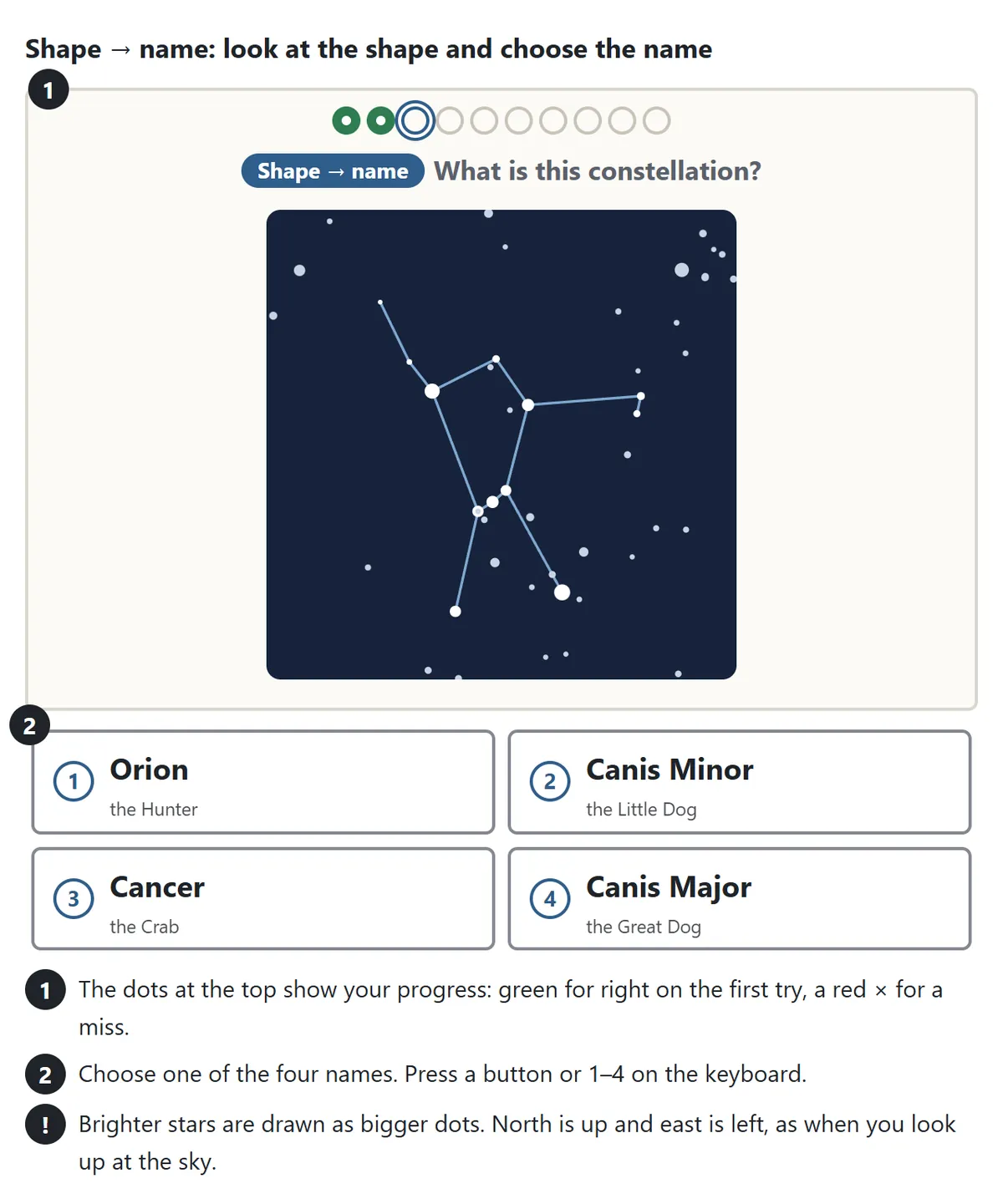
A constellation is drawn as it appears in the sky, with its stars joined by thin lines, and you choose its name from four. Brighter stars are drawn as bigger dots, so you also learn which stars stand out in the real sky. Name → shape works the other way round: you see the name and pick the right shape from four drawings. The wrong choices lean toward constellations of the same season, so you have to tell apart neighbors that are up at the same time.
Each name is the official Latin name used by the International Astronomical Union, such as Lyra or Ursa Major, with its English meaning – the Lyre, the Great Bear – shown in small type underneath.
Find constellations in the sky chart

Here you get a wide chart of the sky with several constellations on it, each with a numbered marker in the middle. Find the one in the question and tap its marker. A constellation you know well on its own can be surprisingly hard to spot among its neighbors, and this is the skill you need outside. Like a real view of the sky, the chart has north at the top and east on the left – the opposite of a land map, because you are looking up instead of down.
How to find the North Star (Polaris)

These questions show the northern sky as you would see it facing north from mid-northern latitudes. Use the Big Dipper or Cassiopeia to find Polaris. With the Big Dipper, join the two stars at the end of the bowl (the “pointer stars”) and go about five times that gap in the direction the bowl opens. With Cassiopeia, extend the two outer lines of the W until they meet, join that point to the middle star of the W and go five times that distance. Because the northern sky turns around Polaris, the Dipper and the W are tilted differently in every question – the method works however they are turned.
Bright stars and seasons
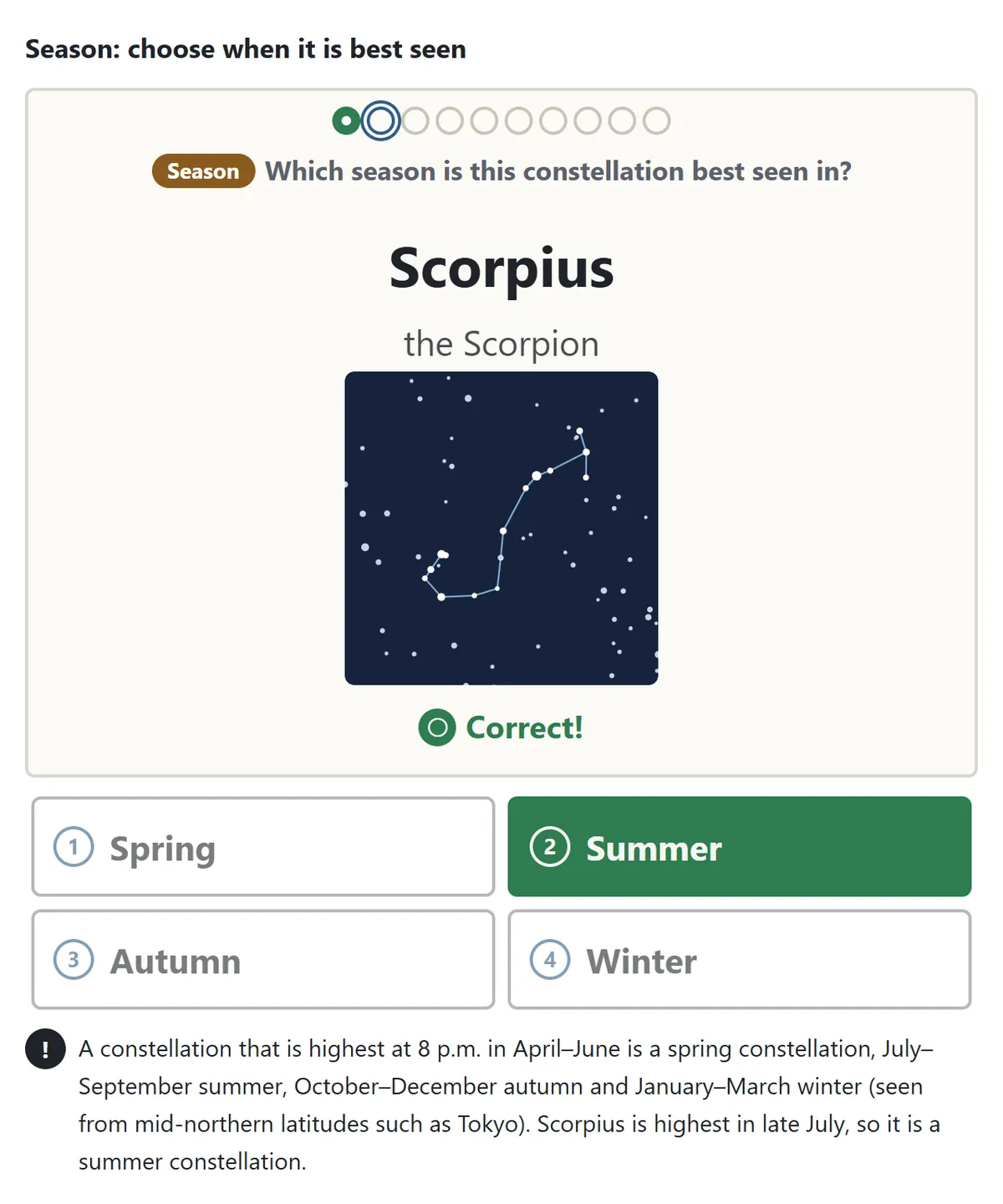
In Bright stars you see the name of one of the 21 first-magnitude stars – Sirius, Vega, Betelgeuse and the rest – or Polaris, and choose the constellation it belongs to. The answer card adds the star’s brightness and color: red, orange, yellowish, white or blue-white. In Season you choose spring, summer, autumn or winter. A constellation that is highest in the sky at 8 p.m. in April to June counts as a spring constellation, July to September as summer, October to December as autumn and January to March as winter. Constellations right on the edge between two seasons, and the northern ones that never set, are left out of the season questions because books disagree about them.
When you miss, and hints
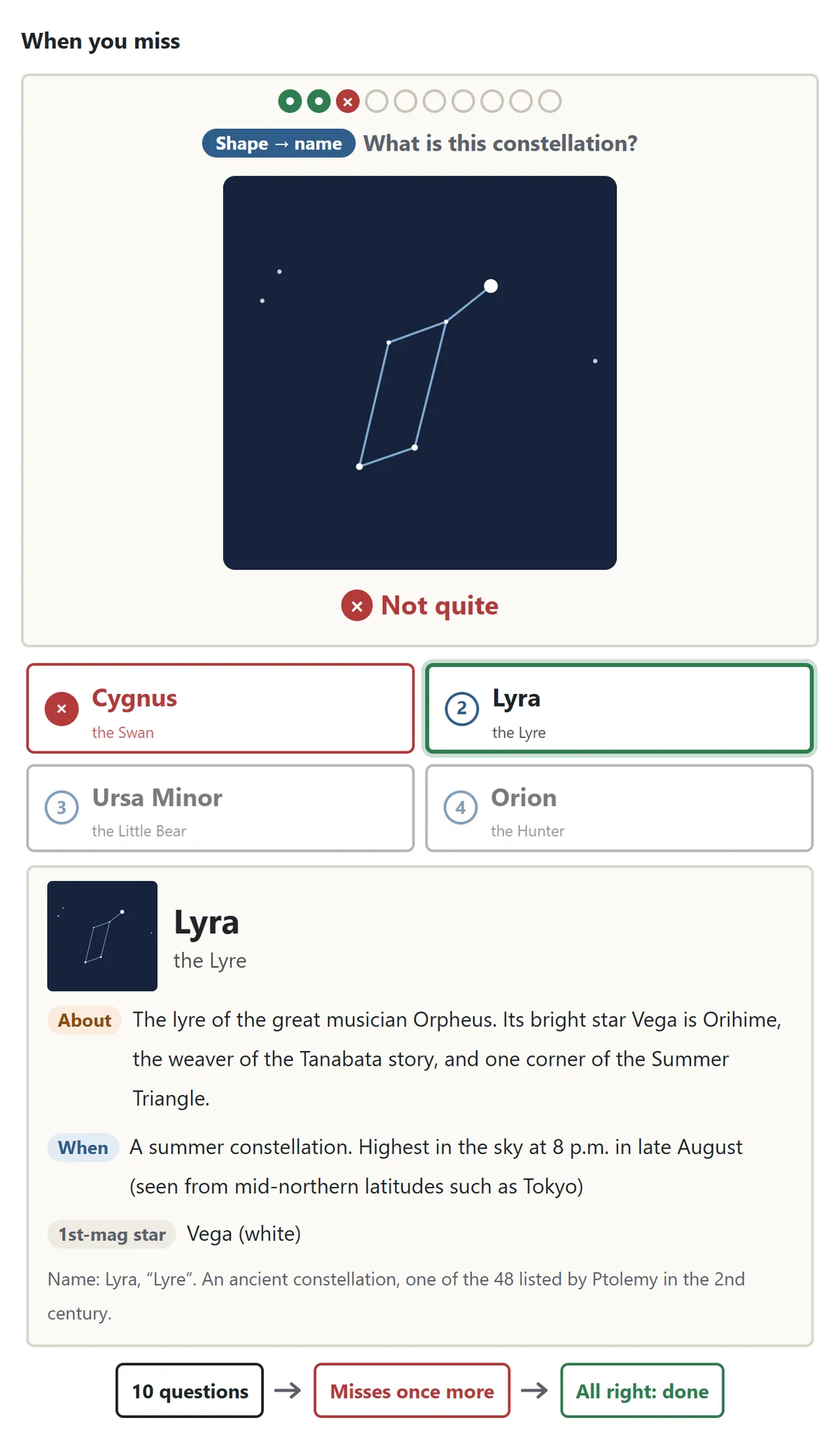
If you miss, the right answer gets a green frame and the fact card opens. When the round ends, the questions you missed – and any where you used a hint – come back once more, and the round is over when you get them all. Misses are also saved as Weak spots, which you can practice as a set; a question leaves the list after you get it right on the first try twice in a row. The hint (or the H key) tells you when the constellation is highest and the first letter of its name, or shows its shape for the sky-chart questions.
Three sets of constellations
| Set | Constellations |
|---|---|
| Starter 10 | Cygnus, Lyra and Aquila (the Summer Triangle), Scorpius, Orion, Canis Major and Canis Minor (the Winter Triangle), Ursa Major (the Big Dipper), Cassiopeia and Ursa Minor (Polaris) |
| Common 35 | The Starter 10, the zodiac (Aries, Taurus, Gemini, Cancer, Leo, Virgo, Libra, Sagittarius, Capricornus, Aquarius and Pisces), and constellations that rise fully above the horizon at mid-northern latitudes and hold a star brighter than magnitude 2.6: Andromeda, Auriga, Boötes, Cepheus, Cetus, Corona Borealis, Corvus, Draco, Hydra, Lepus, Ophiuchus, Pegasus, Perseus and Piscis Austrinus |
| All 88 | Every constellation recognized by the International Astronomical Union, including far-southern ones such as Octans and Chamaeleon that never rise at mid-northern latitudes |
The list of all 88 constellations shows each one with its shape, its Latin name and meaning, when to see it and its bright stars, sorted by season or alphabetically. Constellations you have answered right on the first try get a “Learned” tag, and ones on your weak list are marked too. Daily 10 is a set of ten mixed questions chosen by the date: everyone who plays on the same day gets the same questions, so you can compare scores with friends or family.
Tips for learning the constellations
1. Start with the asterisms
Rather than trying to learn every constellation at once, start with the bright, obvious patterns: the Summer Triangle (Vega, Altair and Deneb), the Winter Triangle (Betelgeuse, Sirius and Procyon), the Big Dipper, the W of Cassiopeia and the Great Square of Pegasus. Each one is a signpost that leads to the constellations around it.
2. Pair each bright star with its constellation
First-magnitude stars shine through even a city sky. If you know that Vega is in Lyra and Antares in Scorpius, then spotting a bright star tells you where you are. Color helps as well: Antares and Betelgeuse are red, while Rigel and Spica are blue-white. In spring, “arc to Arcturus and speed on to Spica” – follow the curve of the Big Dipper’s handle to find both.
3. Use the stories
Orion and Scorpius sit on opposite sides of the sky and are never high at the same time; one story says the hunter is still running from the scorpion that stung him. Perseus, Andromeda, Cassiopeia, Cepheus and Cetus, the sea monster, are all characters in a single myth, and they line up together in the autumn sky. Knowing the story makes it easier to remember which constellations sit side by side.
4. Think of the evening sky
A constellation’s season is the season when it is easy to see in the early evening. Later at night the sky has turned further, so you are seeing the next season’s stars ahead of time – that is why Orion, a winter constellation, rises in the east before dawn at the end of summer.
5. Learn the neighbors on the sky chart
The sky-chart questions teach you not just shapes but where constellations sit relative to each other, which is exactly what you need to find them outdoors. Remember that east is on the left when you look up.
Constellation quiz FAQ
Are the lines between the stars official?
No. The International Astronomical Union fixes the names of the 88 constellations and the boundaries that divide the whole sky between them, but not the lines joining the stars. Books and planispheres draw them in slightly different ways. The lines in this quiz were drawn for it, following the usual patterns through the bright stars.
How accurate are the star positions?
Star positions and brightness come from the Yale Bright Star Catalogue (5th revised edition). The charts show the brighter naked-eye stars. The Polaris charts show the northern sky as seen from Tokyo, at about 36° north.
I live farther north or south. Does the quiz still work?
The constellations and their shapes are the same everywhere. What changes with latitude is how high they climb and which ones you can see at all. Farther north, more of the northern constellations never set and fewer southern ones rise; south of the equator the seasons are reversed and the far-southern constellations in the All 88 set come into view.
The season answer is different from my book
Books divide the constellations into seasons in slightly different ways. This quiz uses the month when each constellation is highest at 8 p.m., and leaves out the ones that fall right between two seasons.
Where is my progress saved?
Your records and weak list are stored only in this browser on this device. There is no sign-up or login, and an unfinished round can be picked up again with Continue. Sound is off at first; press Sound: off to turn on short effects.
About the 88 constellations
Constellations are patterns of stars seen as people, animals and objects. Many of the ones we use began in ancient Mesopotamia, passed to the Greeks, and were collected by Ptolemy in the 2nd century as a list of 48. When European ships began sailing the southern oceans in the 16th to 18th centuries, astronomers and navigators filled the southern sky with new figures, many of them scientific instruments such as the telescope, the microscope and the air pump. In 1922 the International Astronomical Union settled on the 88 constellations used today, and in 1928 it drew boundaries so that every point in the sky belongs to exactly one of them. The largest is Hydra, the water snake; the smallest is Crux, the Southern Cross.
Star positions and brightness: Hoffleit, D. & Warren, W. H. Jr. 1991, The Bright Star Catalogue, 5th Revised Ed. (CDS VizieR V/50). Constellation names: International Astronomical Union. The constellation lines and all descriptions were made for this quiz.