 Yorimichi Games
How to play Geometry Quiz: Area and Angles
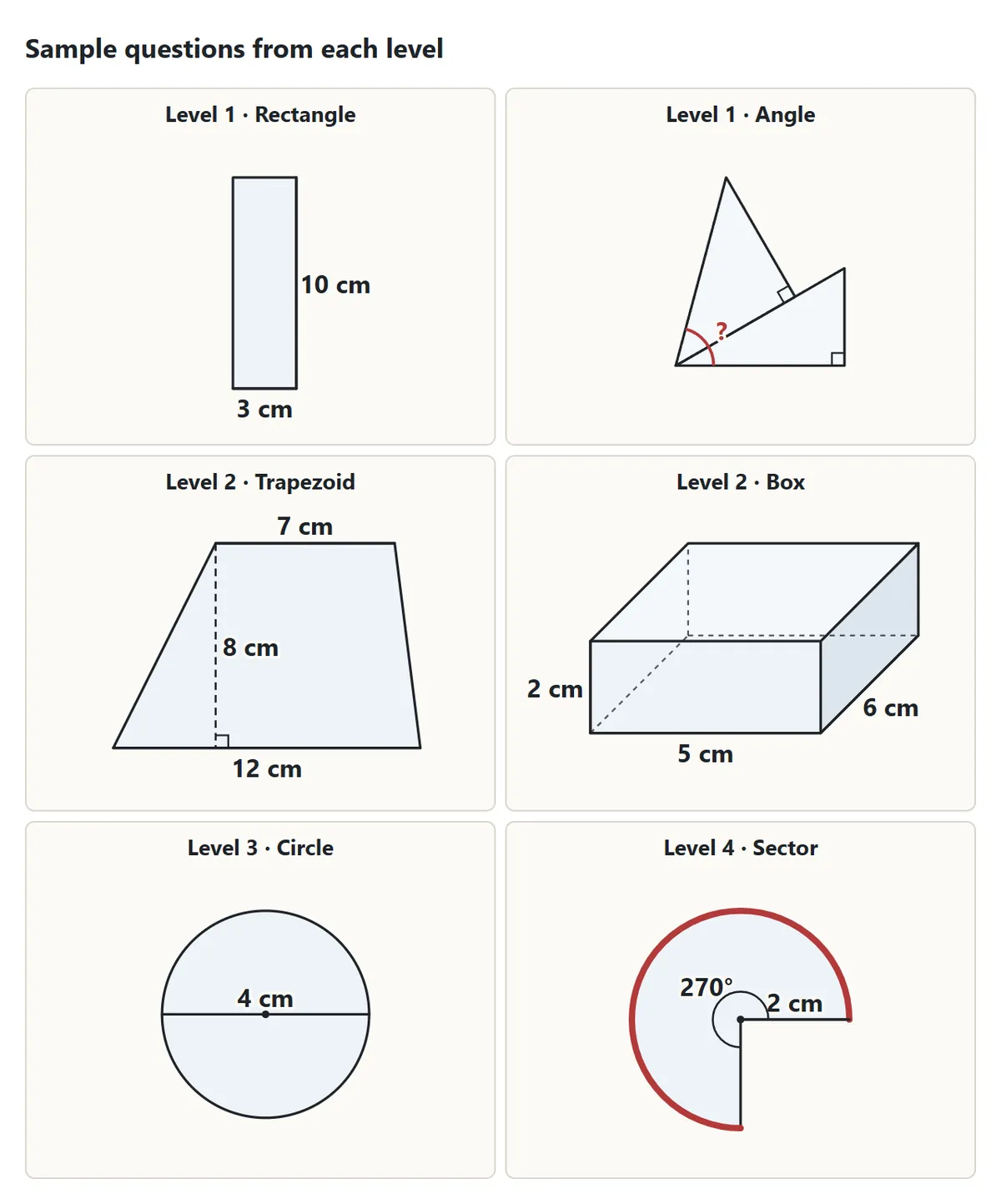
Geometry Quiz: Area and Angles is a free online geometry quiz. Each question shows a figure, and you find its area, a missing angle, a length or a volume. It starts with the area of rectangles and simple angle facts, moves on to triangles, parallelograms, trapezoids, rhombuses, polygon angles, the volume of boxes and the circumference of a circle, then the area of circles and the volume of prisms and cylinders, and finishes with sectors, pyramids, cones and spheres. Every question is generated with new numbers, so you can repeat a topic as often as you like. It is a single-player game that runs in your browser, with no sign-up and nothing to download.
Every figure is drawn to scale. A 10 cm side really is twice as long as a 5 cm side, and a 60° angle opens exactly twice as wide as a 30° angle. Solid shapes are shown as 3D drawings in which only the depth edges are drawn on a slant at half length. Even so, answer with the numbers and the formula, not by measuring the picture: that is the habit the quiz is built to train.
Type the answer
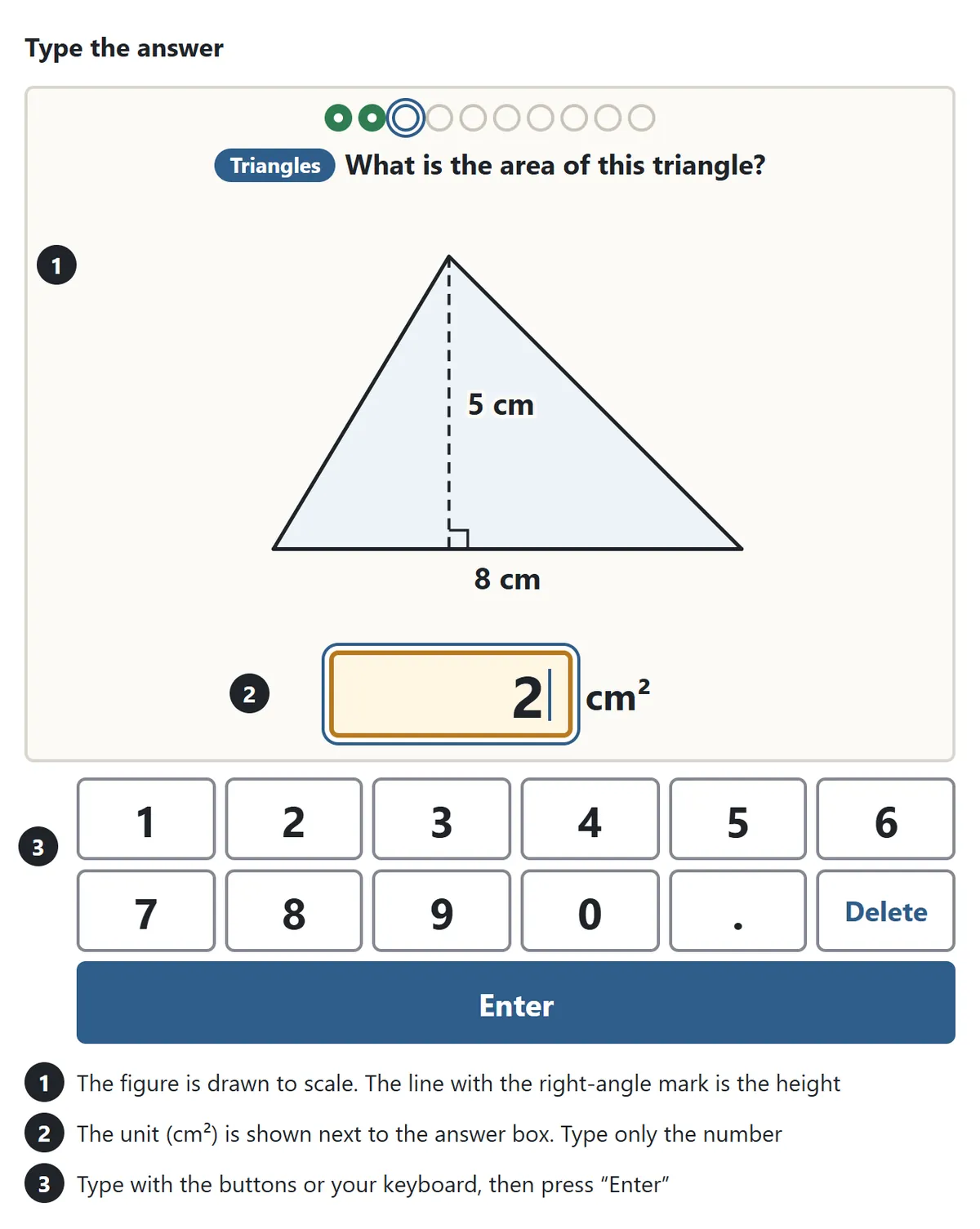
Type your answer with the number buttons and press “Enter”. On a computer you can also use the number keys and the Enter key, and on a phone or tablet the “Keyboard” button opens your device’s own number keyboard. The unit (cm², °, cm³ and so on) is shown next to the answer box, so you only type the number. When a problem uses 3.14 for pi, the answer can have decimals, such as 28.26.
Multiple choice

Choose “Multiple choice” under “Answer by” to pick one of four answers instead of typing. The wrong choices are not random: they are the numbers you get from the mistakes people really make, such as forgetting to divide a triangle by 2, using the diameter of a circle as the radius, or taking the slanted side of a parallelogram as its height. Seeing which wrong answer tempted you tells you exactly which part of the formula needs attention.
When you get one wrong
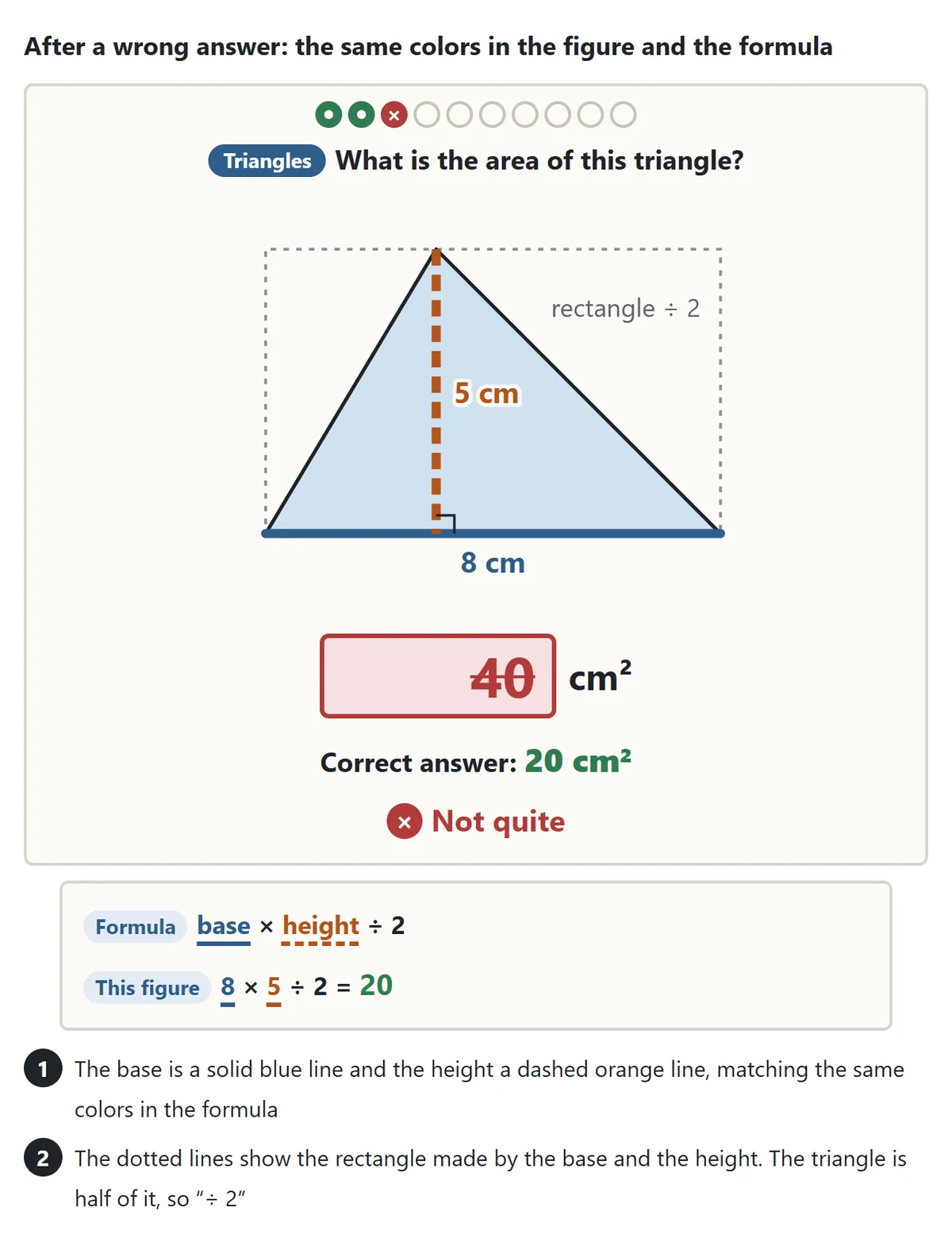
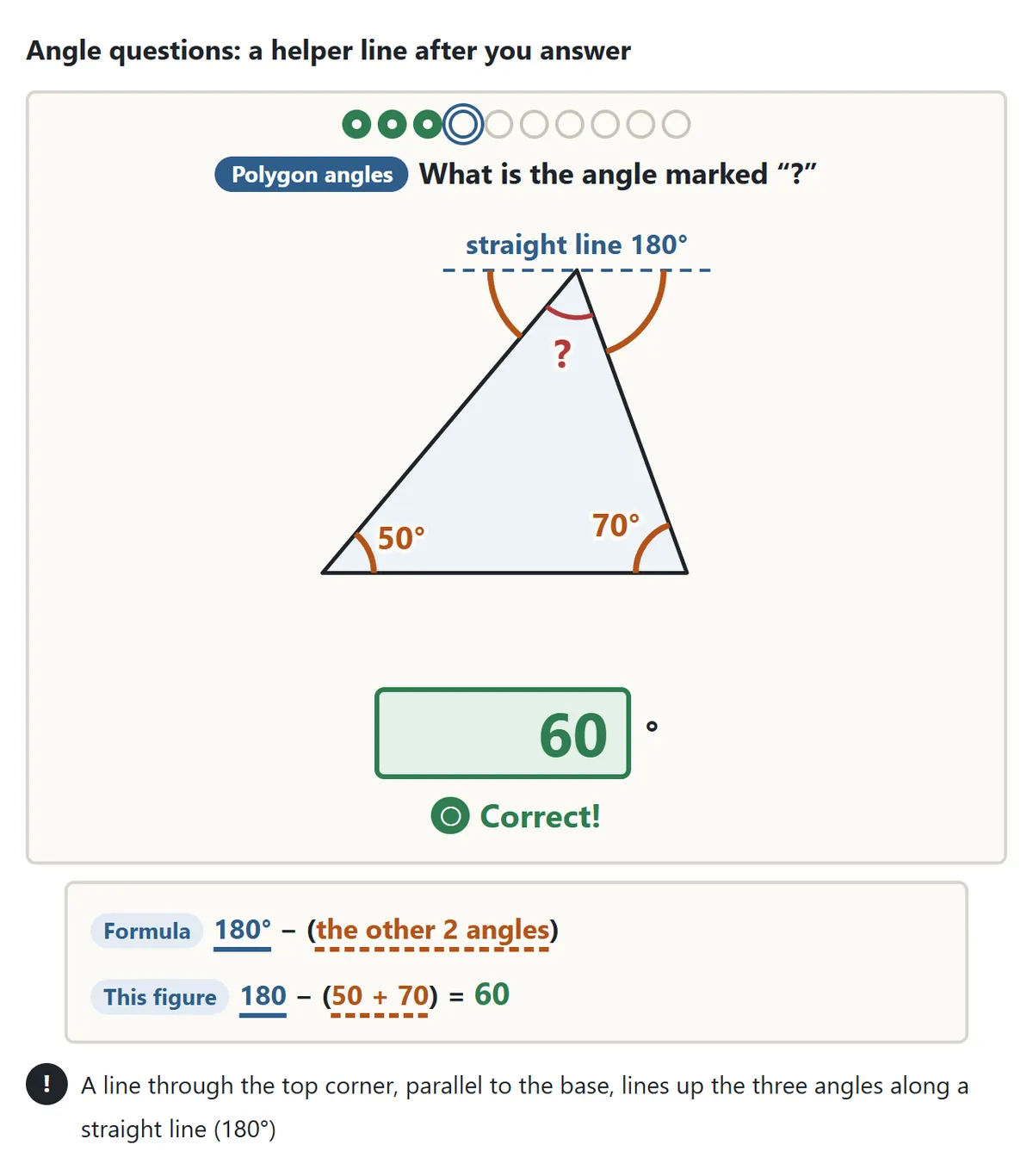
After you answer, the sides, heights and angles you need are colored in the figure, and the formula and the working for that figure appear underneath in the same colors. Helper lines show the idea behind each formula: for a triangle, the rectangle made by the base and the height (the triangle is half of it); for a trapezoid, the diagonal that splits it into two triangles; for an L-shaped figure, the line that splits it into two rectangles. The colors are blue, orange and green, and the lines also differ in style (solid, dashed and dotted), so you can match them even if some colors are hard for you to tell apart.

At the end of a round, only the questions you missed (and the ones where you used a hint) come back for one more try. Topics you miss are saved on your device as “Weak spots”, and the “Weak spots” mode gives you fresh questions from just those topics.
Four ways to play
| Mode | What you do |
|---|---|
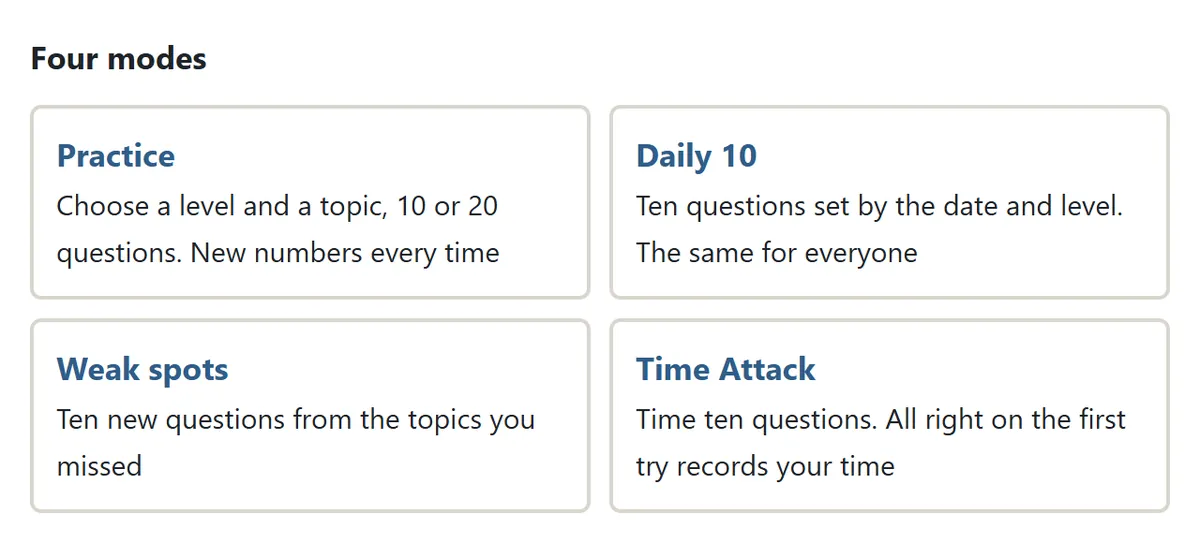
| Practice | Choose a level and a topic, then answer 10 or 20 questions. “Mixed” mixes all the topics of that level. |
| Daily 10 | Ten questions set by the date and the level. Everyone gets the same set on the same day, so you can compare scores. |
| Weak spots | Ten new questions from the topics you missed before. |
| Time Attack | Times how long you take for ten questions. Your time is saved when you get all ten right on the first try. |
Levels, topics and area formulas
| Level | Topics | Key formulas |
|---|---|---|
| Level 1 | Area of rectangles and squares, composite shapes, angles | width × length; a straight line is 180°, a full turn is 360° |
| Level 2 | Area of triangles, parallelograms, trapezoids and rhombuses; angles of triangles and polygons; volume of boxes and cubes; circumference | base × height ÷ 2; (top base + bottom base) × height ÷ 2; triangle angles add to 180°; width × length × height; diameter × 3.14 |
| Level 3 | Area of circles; volume of prisms and cylinders | radius × radius × 3.14; base area × height |
| Level 4 | Arc length and area of sectors; volume of pyramids and cones; volume and surface area of spheres | πr² × angle/360; base area × height × 1/3; 4/3 πr³; 4πr² |
The levels follow the order in which these ideas build on each other: you need the area of a rectangle to understand the triangle, the triangle to understand the trapezoid, and the circle to understand the cylinder and the cone. Levels 1 to 3 use 3.14 for pi and Level 4 uses the symbol π, so with “By level” selected, circle problems in Level 2 and Level 3 are answered with 3.14 and Level 4 problems with π. To answer with π, type only the number in front of it: for 36π, type 36. In the settings you can also switch every level to 3.14 or to π.
Printable geometry worksheets
The printable worksheets page lets you choose a level and a topic and print 12 problems with figures, plus an answer page that shows the formula and the working for each figure. Choose US Letter or A4 paper. The numbers change every time you open the page or press “New problems”. The sheets print in black and white, and the line styles still show which side is which.
Geometry tips: how to find area, angles and volume
1. The height meets the base at a right angle
The height of a triangle, parallelogram or trapezoid is measured straight up from the base, at a right angle. It is not the length of a slanted side. Look for the line with the small square (the right-angle mark). When one angle of a triangle is very wide, the height can even fall outside the triangle, measured to the base line extended.
2. Don’t forget to divide a triangle by 2
Two copies of the same triangle make a parallelogram, which is why the area of a triangle is base × height ÷ 2. A rhombus is half of the rectangle formed by its two diagonals, and a trapezoid is half of the parallelogram made from two copies of it. If you remember which shape is “half of what”, you can rebuild a forgotten formula on the spot.
3. Split or subtract composite shapes
For an L-shaped figure, draw one line to split it into two rectangles, or take the missing corner away from one big rectangle. Both methods give the same answer, so working it out the second way is a good check.
4. Angles start from 180° and 360°
A straight line is 180°, a full turn is 360°, the angles of a triangle add up to 180° and the angles of a quadrilateral add up to 360°. For any polygon, draw diagonals from one corner to split it into triangles: a pentagon gives 3 triangles (540°), a hexagon 4 (720°) and an octagon 6 (1080°). Divide by the number of corners to get one angle of a regular polygon.
5. Check whether a circle shows the radius or the diameter
The area of a circle is radius × radius × pi and the circumference is diameter × pi. The most common mistake is using a labeled diameter as if it were the radius, so check which one the figure shows before you start. A semicircle is half of the circle and a quarter circle is a quarter of it.
6. Volume is base area × height
Boxes, prisms and cylinders all follow the same rule: base area × height. A pyramid or a cone holds exactly one third of the prism or cylinder with the same base and height, so you multiply by 1/3. In a 3D drawing, find the base first, then the height that stands on it.
Geometry quiz FAQ
Which level should I start with?
If you want a gentle start, begin with Level 1 (rectangles and angles) and move up when a topic feels easy. Choosing a level shows only the topics in that level. If you just want a quick brain workout, try the Daily 10 or Time Attack on “All levels”.
Are the figures accurate?
Yes. Every figure in this quiz is drawn to scale, true to the labeled lengths and angles (only the depth of solid shapes is shortened, as is usual in 3D drawings). Many tests print “figures are not drawn to scale”, so it is still worth getting used to working from the numbers and the formula rather than the look of the picture.
How do I answer with π?
When the unit next to the answer box shows something like “π cm²”, type only the number in front of π. For example, if the answer is 36π cm², type 36.
Where is my progress saved?
Your records and weak spots are stored only in the browser on your device. There is no account or login. If you stop in the middle of a round, open the page again on the same device and browser and press “Continue”.
Does it work on a tablet or a Chromebook?
Yes. It runs in any modern browser, including on Chromebooks, iPads and phones. You can answer with the on-screen number buttons alone, so no physical keyboard is needed. Sound effects are off until you turn them on.
A short history of area and pi
Working out area is one of the oldest uses of mathematics. Ancient Egyptian and Mesopotamian scribes calculated the area of rectangular and triangular fields to measure land and set taxes. Pi has a long history too: in the 3rd century BC, Archimedes trapped the circle between regular polygons drawn inside and outside it and showed that pi lies between 3 10/71 and 3 1/7, close to 3.14. Later mathematicians in China, India, the Islamic world and Japan used polygons with more and more sides to compute pi to many more digits, long before computers took over the job.
Comments
Write a comment
No comments yet.