 Yorimichi Games
How to play the Showa Era Nostalgia Quiz
This is a nostalgia quiz about Japan in the Showa era, the period from 1926 to 1989. It looks back at the things ordinary families used at home, the toys children played with in the street, the snacks sold at festival stalls, the yearly festivals, the slang people used and the trains and towers that changed the cities. There are 105 questions in six categories: home and tools, toys and games, food and sweets, festivals and seasons, words and slang, and town and transport. Many questions come with a simple drawing of the object, such as a black rotary phone, a chabudai dining table or a kendama.
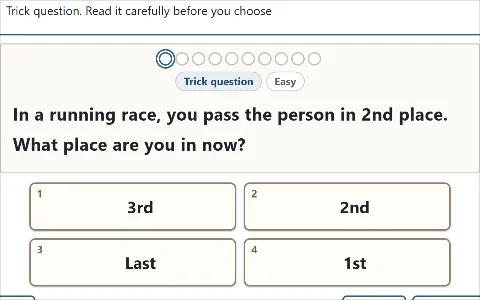
Every question is multiple choice: read the question and pick one of four answers. After each answer you get a short explanation, so even a wrong answer teaches you something about retro Japan. All the questions were written for this game, and the years, prices and names were checked one by one against reference works. There is nothing to download and no sign-up.
Choose one of four answers
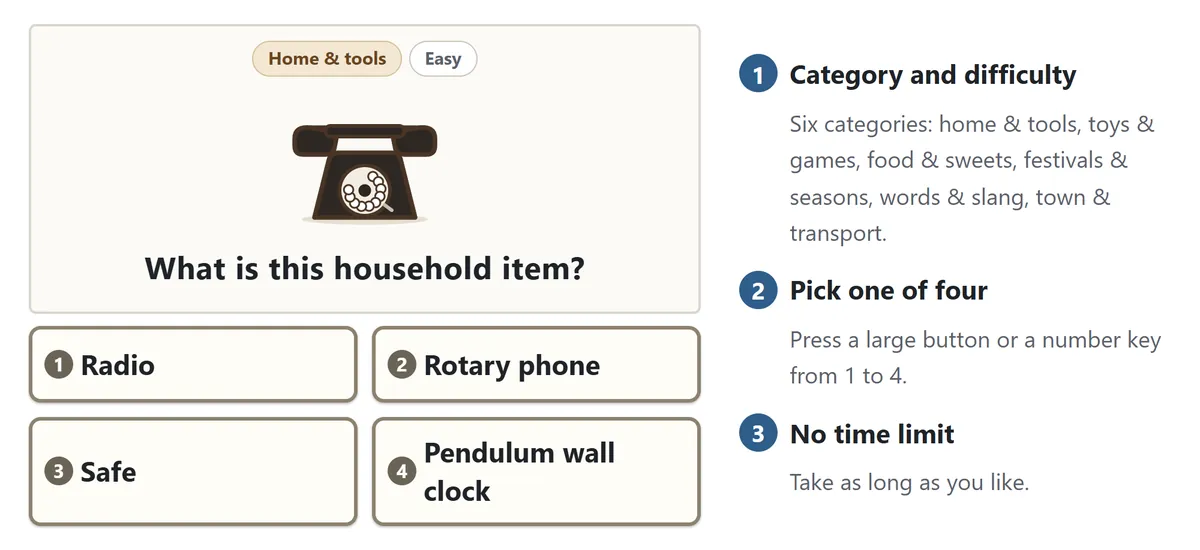
Below the question you will see four large buttons. Press the one you think is right. On a computer you can also press the number keys 1 to 4. There is no time limit, so take as long as you like and enjoy remembering, or imagining, how life used to be.
Japanese words are written in the Latin alphabet, often with a short English description in brackets, for example “Kaya (mosquito net)” or “Yutanpo (hot-water bottle)”. Years are given in the Western calendar with the Japanese era year in brackets, such as “1964 (Showa 39)”, because that is how Japanese people of the time counted the years.
Hints and explanations
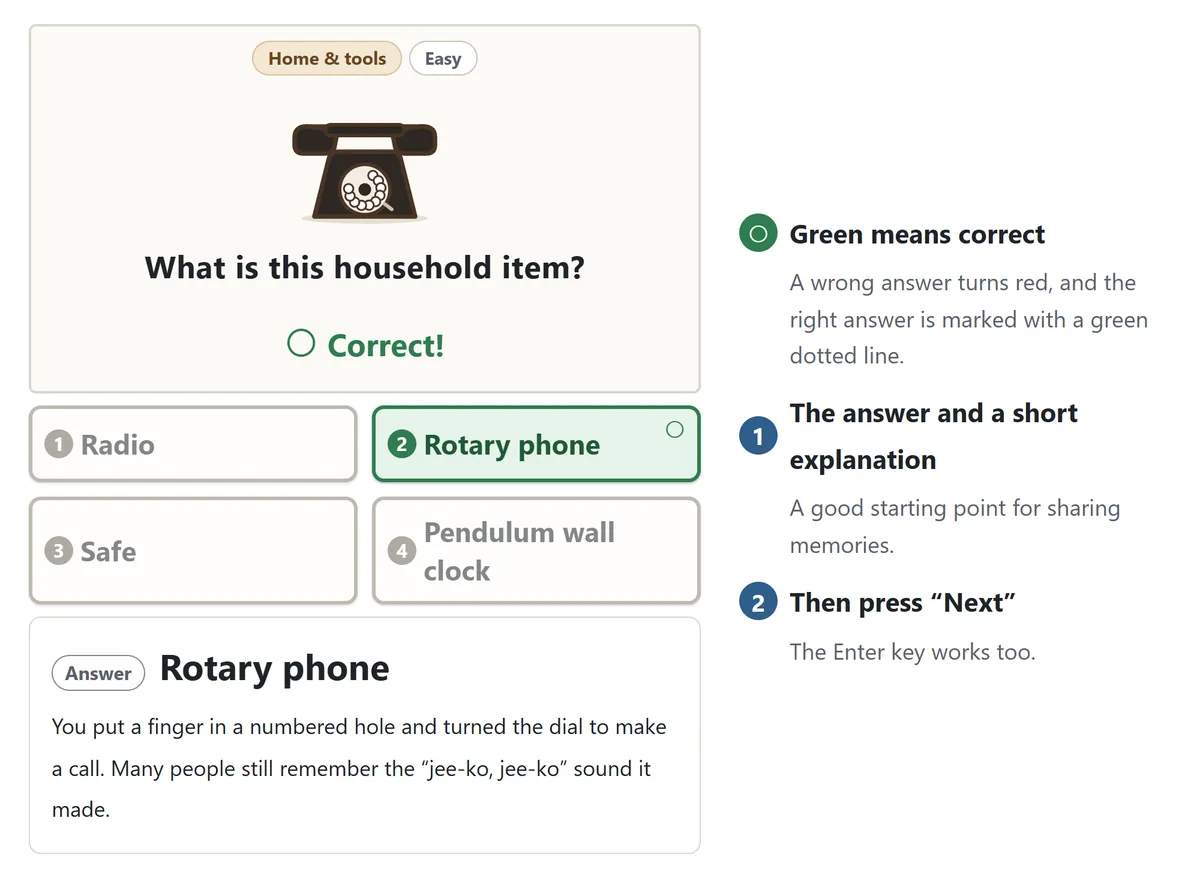
If you are stuck, press “Hint” to remove two of the wrong answers. When you answer, the button turns green if you are right and red if you are wrong, and the correct answer and an explanation appear. A correct answer after using a hint is marked with a triangle (△) instead of a circle (○). The explanations are written to give you a little “I didn’t know that”, so they are worth reading even when you get the question right. Playing with family or friends, an explanation is often the start of a good conversation about the old days.
Three ways to play
| Mode | What it is | Records |
|---|---|---|
| Today’s 10 | 10 questions set by the date (4 Easy, 4 Normal, 2 Hard). On the same day, everyone gets the same questions. | Your score and how many days in a row you have played |
| 10-Question Challenge | 10 questions at the difficulty you choose. Questions you have not seen yet come first. | A personal best for each difficulty |
| Group quiz | Shows only the question on a big screen. The answer appears when the host presses “Show answer”. You can choose the category and the number of questions (5, 10 or 20). | None (no scores are kept) |
Today’s 10 changes every day, so it makes a nice morning habit. Family members who live apart can play the same ten questions and talk about them later. If you stop partway, you can pick up where you left off with “Continue”, as long as you use the same device and browser.
A Showa nostalgia quiz for groups, clubs and senior activity sessions
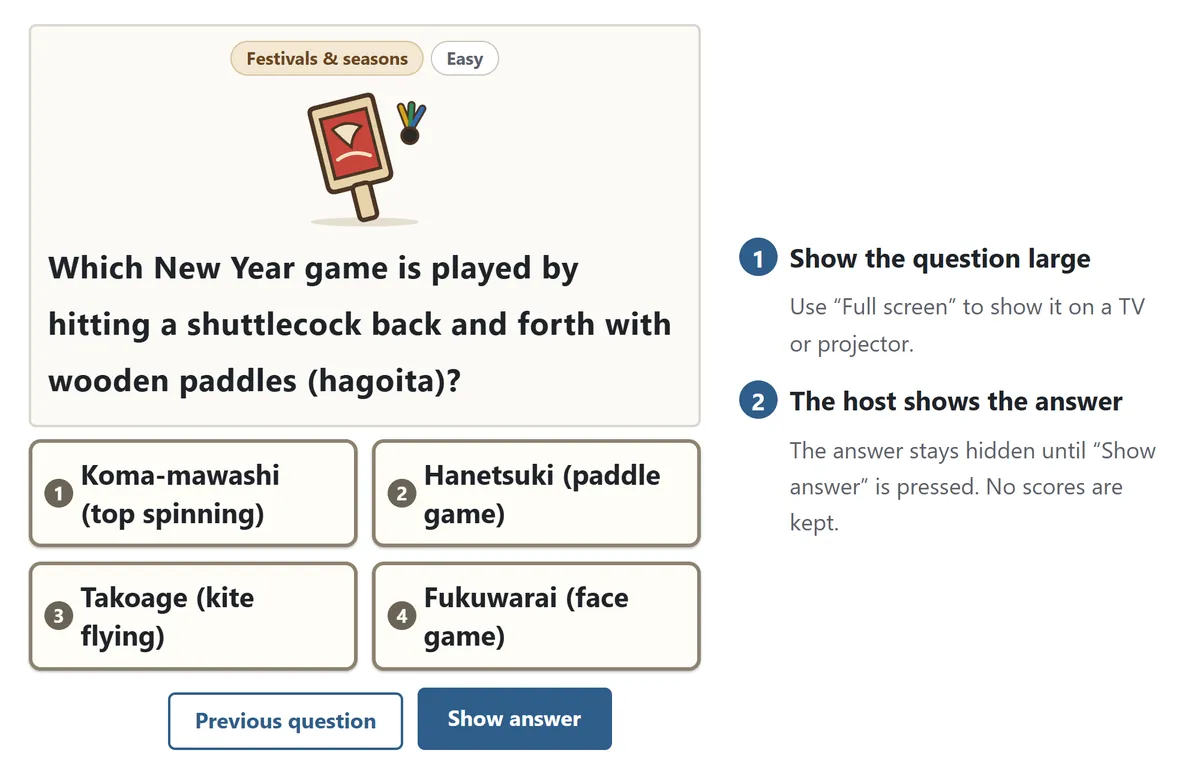
The Group quiz mode is made for playing together around one screen: a Japanese culture club, a language class party, a family gathering, or a recreation session at a senior center or day program. Connect a computer or tablet to a TV or projector and press “Full screen” to show the question across the whole screen. The answer stays hidden until the host presses “Show answer”. When someone in the room calls out “Number 2!”, the host can press that button to see whether it is right.
“Previous question” lets you go back to a question that got everyone talking. Narrowing the category to “Festivals & seasons” is a good way to start a conversation before New Year, the Doll Festival or the summer Obon holidays, and “Town & transport” works well for anyone who remembers the first bullet trains or the 1970 Osaka Expo.
Three difficulty levels
| Level | What kind of questions | Examples |
|---|---|---|
| Easy | Things many people know even without having lived in the Showa era: everyday objects shown in pictures, New Year games, seasonal festivals | Chabudai, kendama, ramune |
| Normal | Things anyone who knew Showa-era daily life would remember: appliances, school lunches, buses and streetcars, Showa slang | Icebox, gariban printing, “handon” |
| Hard | Years, prices and details | Postcard price, the first 500-yen coin, Expo ’70 visitors |
If you are new to Japanese history, start with Easy: the pictures and descriptions give you a fair chance even if you have never been to Japan. If you grew up in Japan, or you have read a lot of Japanese manga and novels set in the Showa period, Normal is where the real nostalgia begins.
What was the Showa era?
Japan has its own calendar of eras alongside the Western one. The Showa era ran from December 25, 1926 to January 7, 1989. Because it began only a week before the end of 1926, Showa 1 lasted just seven days, and Showa 64 also lasted only seven days, until the Heisei era began on January 8, 1989. To turn a Showa year into a Western year, add 1925: Showa 39 is 1964.
When people in Japan talk about “Showa nostalgia”, they usually mean the decades after the war, especially the Showa 30s and 40s (roughly 1955 to 1974). In those years the “Three Sacred Treasures” of home appliances, a black-and-white TV, an electric washing machine and an electric refrigerator, found their way into ordinary homes. The Tokaido Shinkansen and the first expressway opened, Tokyo hosted the 1964 Olympics, and Osaka hosted the 1970 World Expo under the theme “Progress and Harmony for Mankind”. Daily life changed enormously within a single generation.
Retro Japan in everyday objects
Much of the quiz is about small things that once filled every Japanese home and street. Families ate around a chabudai, a low dining table whose legs folded away after the meal. On summer nights they slept under a kaya, a large mosquito net hung from the four corners of the room, and on winter nights a yutanpo filled with hot water warmed the futon. Clothes were scrubbed on a washboard in a tub until washing machines arrived, and even the washing machines of the late 1950s squeezed the water out with two rollers turned by a handle.
Out in the town, round red postboxes stood on street corners, and many neighborhoods had a sento, a public bath, often with a huge painting of Mount Fuji on the wall above the tub. Sellers came round with their own sounds: the tofu seller’s horn in the evening and the call of the roasted sweet potato seller in winter. Children gathered for the kamishibai man, who told picture stories from the back of his bicycle and sold sweets such as mizuame syrup to twirl on chopsticks. They spun iron beigoma tops, slapped menko cards on the ground and played kick the can in the back streets.
Tips for enjoying the quiz
1. Enjoy the stories more than the score
The best part of this quiz is the conversation it starts. “Our chabudai was square” or “we made our tops heavier” are the kind of memories the answers bring back. Don’t worry about mistakes; read the explanation and keep talking.
2. Use the pictures and the descriptions
When an answer is a Japanese word, the description in brackets often tells you what it is. Picture questions can be solved just by looking carefully at the shape of the object.
3. Set the text size
Press “Bigger text” to make the question and the answer buttons even larger, or choose the text size before you start. Sound is off at first; press “Sound: off” to hear a chime for correct answers.
4. Link the years to big events
The Hard questions ask about years. They are easier to remember in pairs: the Shinkansen opened in the same year as the Tokyo Olympics, and telephone cards appeared in the same year as the 500-yen coin.
5. A little every day
Rather than answering dozens of questions in one go, try Today’s 10 every day. The game keeps count of how many days in a row you have played.
Showa Era Nostalgia Quiz FAQ
Do I need to know Japanese?
No. The questions, answers and explanations are all in English, and Japanese words are written in the Latin alphabet with a short explanation. The Japanese version of this page also has fill-in-the-blank questions on Japanese children’s songs and set phrases; those only work in Japanese, so they are not included here.
Is it good for brain training?
Remembering and talking about the past is sometimes used as a recreation activity, and many people enjoy it as a light brain workout. This page, however, is simply a quiz for enjoying memories of the Showa era and makes no health or medical claims. If you are concerned about your memory or health, please talk to a doctor.
How were the answers checked?
Years, prices and names were checked one by one in encyclopedias and other references. For things that differed by region or by family, such as local customs, the most widely known version is used as the answer, and some explanations mention the other versions.
Can I play on a phone or tablet?
Yes. The buttons are large and there is no time limit, so it works well on a tablet held in your hands. In a group, one person can be the host and press the buttons while everyone else calls out their answers.
Where are my records kept?
Your personal bests and the number of days in a row are saved only in the browser on the device you are using. There is no account and no login.
Comments
Write a comment
No comments yet.