 Yorimichi Games
How to play the Metric Unit Conversion Quiz
This free quiz asks you to convert metric units: “2 m 35 cm is how many cm?”, “1.5 L is how many mL?”, “72 km/h is how many m/min?”. It covers length (mm, cm, m, km), capacity (mL, dL, L, kL), weight (mg, g, kg, t), area (cm², m², a, ha, km²), volume (cm³ and m³, and how they relate to liters), time (seconds, minutes, hours and days) and speed (km/h, m/min and m/s). Pick a level and a topic, and the game builds new questions with different numbers every time, so you can repeat the same topic as often as you like. There are also everyday topics such as cooking measures and land area. It is a one-player game that runs in your browser, with no sign-up and nothing to download.
Type the answer
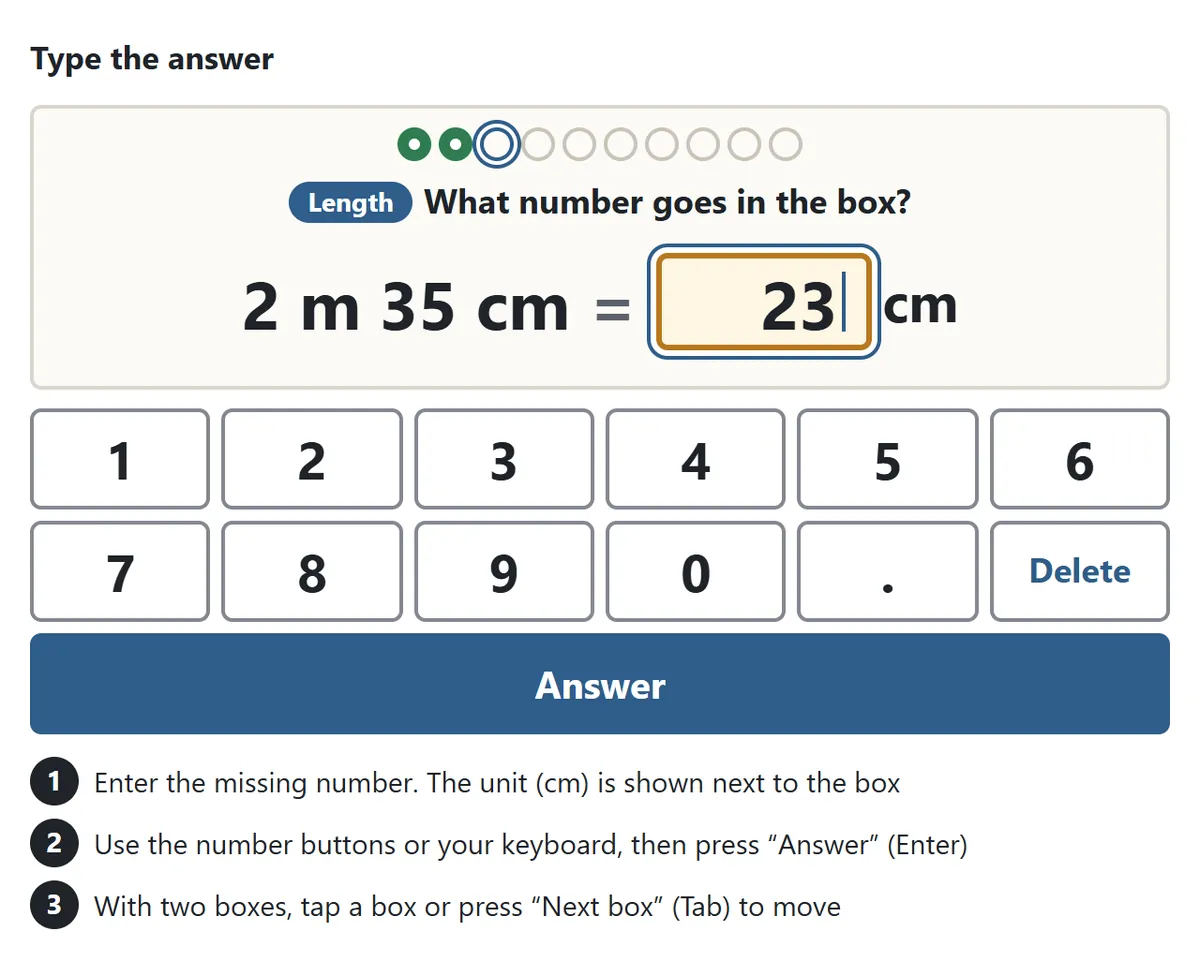
Enter the missing number with the number buttons and press “Answer”. On a computer you can also type the digits and press Enter; on a phone or tablet the “Keyboard” button opens your device’s number keyboard. Some questions have two boxes, such as “□ m □ cm”: tap a box or press “Next box” (Tab or the right arrow key on a keyboard) to move between them. When the answer is a fraction, as in “15 min = □ h”, there are separate boxes for the numerator and the denominator, and the “/” key jumps to the denominator.
Multiple choice
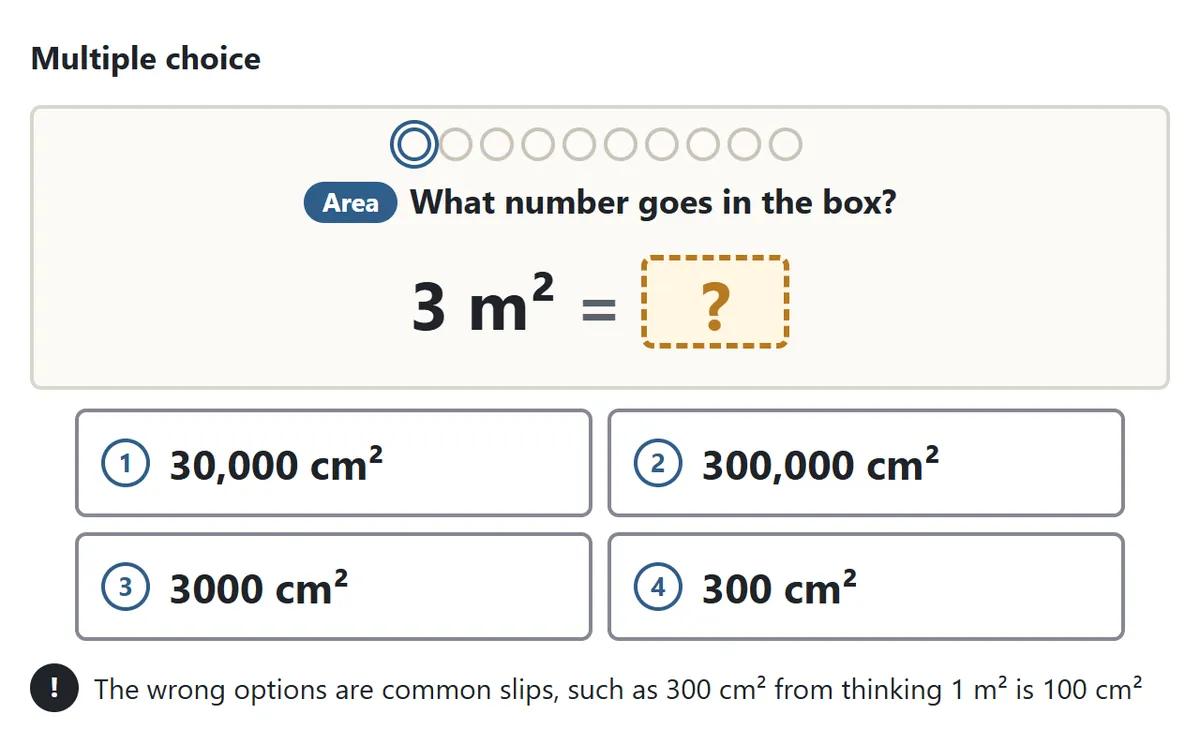
Choose “Multiple choice” under Answer in the settings to pick from four options instead. The wrong options are not random: they are the answers that typical slips produce. You will see 300 cm² offered for 3 m² (treating 1 m² as 100 cm² instead of 10,000 cm²), “1 h 70 min” for 170 minutes (counting 100 minutes to the hour), or 25 cm for 2 m 5 cm (dropping the zero). Working out why an option is wrong is half the practice.
When you get it wrong
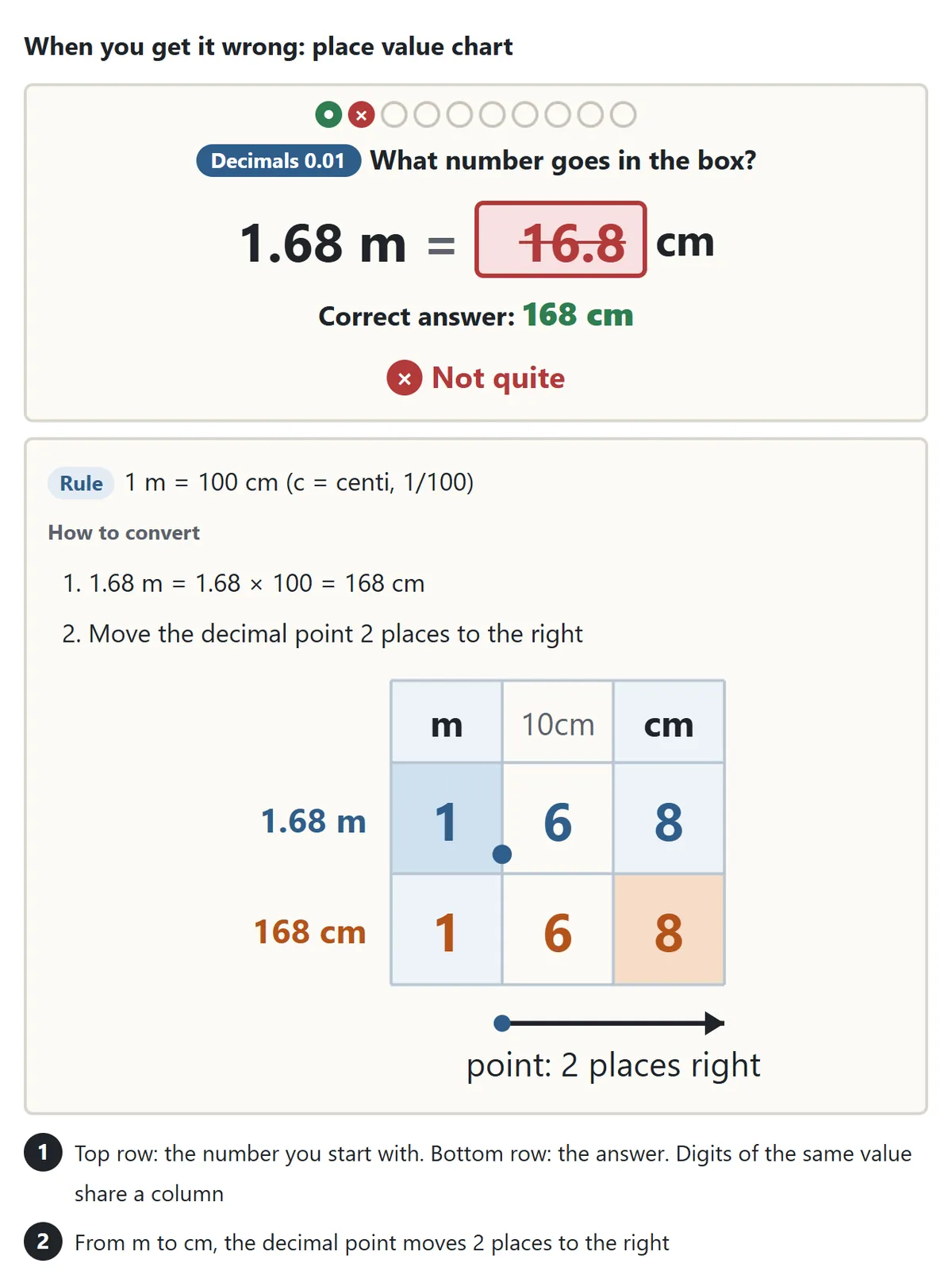
After every answer the game shows the correct answer and the steps of the conversion. For length, capacity and weight it draws a place value chart whose columns are units such as km, m, cm and mm. The original number and the answer are written with their digits in the same columns, and an arrow shows how many places the decimal point moved. Converting between metric units really is just moving the decimal point, and the chart makes that easy to see.
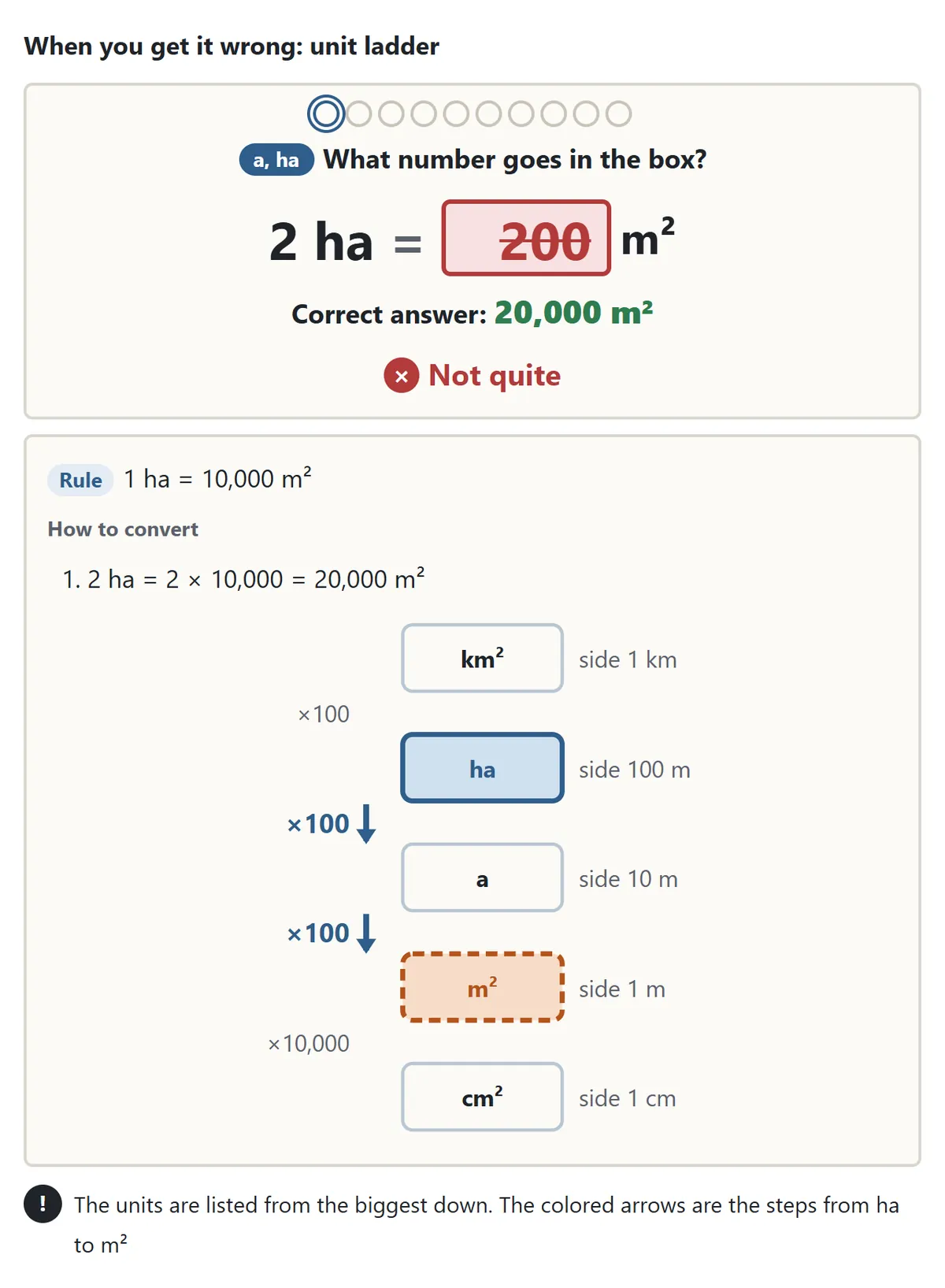
For area, volume and time you get a unit ladder instead. It lists the units from the biggest down, shows the factor between each pair of neighbors and highlights the steps your conversion passes through. The area ladder also shows the square that each unit stands for: 1 a (one are) is a square 10 m on each side, and 1 ha (one hectare) is a square 100 m on each side. Questions that use two time units, or fractions of an hour, come with a number line that shows the groups of 60 minutes.

At the end of a round, the questions you missed, and the ones where you used a hint, come back once more. Topics you miss are saved on your device as “Tricky units”, and choosing that mode gives you a fresh set of questions from just those topics.
Game modes
| Mode | What you do |
|---|---|
| Practice | Choose a level and a topic for 10 or 20 questions. “Mixed” mixes all the topics of the level |
| Daily 10 | Ten questions picked by the date and level. Everyone gets the same set on the same day, so you can compare scores |
| Tricky units | Ten new questions from the topics you have missed |
| Time Attack | Ten questions against the clock. Your time is recorded when you get every question right on the first try |
Metric conversion levels and topics
| Level | Topics | Key facts |
|---|---|---|
| Level 1 | Length (mm, cm, m), capacity (mL, dL, L), days, hours and minutes | 1 cm = 10 mm, 1 m = 100 cm, 1 L = 10 dL, 1 L = 1000 mL, 1 h = 60 min, 1 day = 24 h |
| Level 2 | km, weight (g, kg, t), minutes and seconds, decimals to tenths, metric prefixes | 1 km = 1000 m, 1 kg = 1000 g, 1 t = 1000 kg, 1 min = 60 s; k means ×1000 and m means 1/1000 |
| Level 3 | Area (cm², m², km²), ares and hectares, decimals to thousandths | 1 m² = 10,000 cm², 1 a = 100 m², 1 ha = 100 a, 1 km² = 100 ha |
| Level 4 | Volume and capacity (cm³, m³, L), speed, time as fractions and decimals | 1 L = 1000 cm³, 1 m³ = 1000 L, km/h, m/min and m/s, 15 min = 1/4 h |
| Everyday | Cooking measures, land area, everyday amounts | 1 tbsp = 15 mL, 1 tsp = 5 mL, 1 cup = 200 mL (Japanese cup), one 1-yen coin = 1 g |
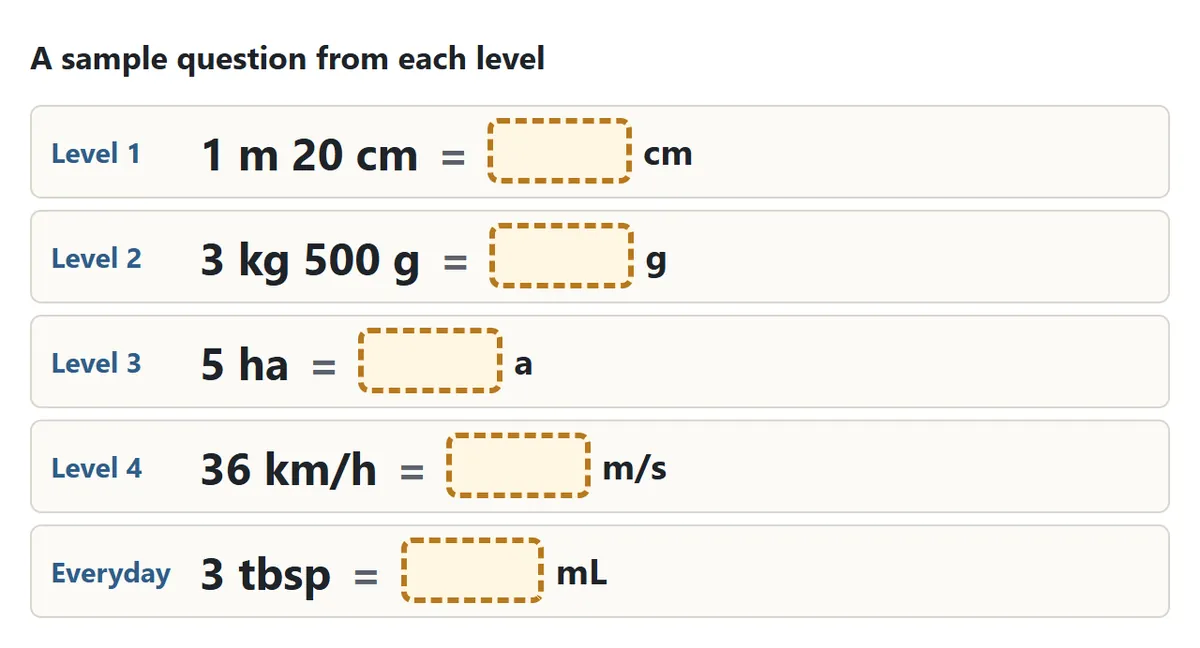
The levels build on each other. Level 1 uses whole numbers only. Decimals start at Level 2 with tenths (0.8 L, 2.5 L, 9.2 cm), and Level 3 goes on to hundredths and thousandths (1.68 m, 2.345 kg). Fractions appear only in Level 4, where an hour or a minute is split into equal parts. “All” mixes every topic, which makes a good warm-up if you learned these units a long time ago and want to see what you still remember.
The are (a) and the hectare (ha) are used mainly for land: farm fields, parks and building plots. Japanese law allows these two units only for measuring land, so this quiz uses them for fields and plots of land. The milligram (mg) and the kiloliter (kL) appear in the prefix topic as examples of the same “milli” and “kilo” rule applied to other units: think of 100 mg on a medicine label or a water meter reading in kL.
About the units used here
The quiz writes SI symbols with a space between the number and the unit: m, cm, mL, kg, m² and so on. Time uses h, min and s, and speeds use km/h, m/min and m/s. The deciliter (dL) is rarely used in some countries, but it is a perfectly valid metric unit (1 dL = 100 mL) and is common in Japanese recipes and on measuring cups, so it is included. The cooking topic uses the metric tablespoon (15 mL), the metric teaspoon (5 mL) and the Japanese measuring cup of 200 mL. A US customary cup is about 240 mL and the metric cup used in Australia and Canada is 250 mL, so every question with cups reminds you that a cup here means 200 mL.
Metric unit conversion tips
1. Know how many times bigger the next unit is
The most useful thing to remember is the factor between neighboring units. For length, 1 cm = 10 mm, 1 m = 100 cm and 1 km = 1000 m. For capacity, 1 L = 10 dL and 1 dL = 100 mL. For weight, 1 kg = 1000 g and 1 t = 1000 kg. With these few facts, every conversion in the quiz is a single multiplication or division.
2. Learn what k, c, m and d mean
The prefix k (kilo) means 1000 times, c (centi) means one hundredth, m (milli) means one thousandth and d (deci) means one tenth. The prefixes work the same way for every quantity: 1 km = 1000 m and 1 kg = 1000 g are the same rule, and so are 1 mm = 1/1000 m and 1 mL = 1/1000 L. Learn the prefixes once and you have learned dozens of conversions.
3. To a bigger unit, divide; to a smaller unit, multiply
To change 3 m to centimeters, multiply: 1 m is 100 cm, so 3 × 100 = 300 cm. To change 300 cm back to meters, divide: 300 ÷ 100 = 3 m. A smaller unit gives a bigger number, and a bigger unit gives a smaller number. After each answer, check that the size of the number makes sense. If you converted to a smaller unit and the number got smaller, something went wrong.
4. Picture area and volume as squares and cubes
Because 1 m = 100 cm, a square 1 m on each side measures 100 cm × 100 cm = 10,000 cm². Many people answer 1 m² = 100 cm², so picture the square instead of the line. Volume works the same way: a cube 1 m on each side is 100 × 100 × 100 = 1,000,000 cm³. A cube 10 cm on each side holds exactly 1 L of water, which is why 1 L = 1000 cm³ and 1 mL = 1 cm³.
5. Time comes in groups of 60 and 24
Time is the one quantity here that does not go up in powers of ten: 1 min = 60 s, 1 h = 60 min and 1 day = 24 h. Writing 170 minutes as “1 h 70 min” is the classic mistake of counting 100 minutes to the hour. Ask instead how many whole groups of 60 fit: 170 = 120 + 50, so 170 min = 2 h 50 min. The same idea turns 45 minutes into 3/4 of an hour, because 45 is three of the four 15-minute parts of an hour.
6. Convert speed through distance per unit of time
72 km/h means traveling 72 km, or 72,000 m, in one hour. One hour is 60 minutes, so in one minute you travel 72,000 ÷ 60 = 1200 m: that is 1200 m/min. One minute is 60 seconds, so in one second you travel 1200 ÷ 60 = 20 m, which is 20 m/s. Doing the distance step and the time step one at a time keeps you from getting lost. Once you are comfortable, a handy shortcut is that 1 m/s = 3.6 km/h.
Get a feel for metric sizes
Knowing the size of each unit from everyday objects helps you judge whether an answer is reasonable. A Japanese 1-yen coin weighs exactly 1 g and is 20 mm (2 cm) across. A standard milk carton holds 1 L (1000 mL), and a cube 10 cm on each side holds 1 L of water. One liter of water weighs about 1 kg; in fact, the kilogram was originally defined as the mass of one liter of water. A tablespoon is 15 mL and a teaspoon is 5 mL. One are is a square 10 m by 10 m, about the size of a small vegetable plot, and one hectare is a square 100 m by 100 m, a little bigger than a soccer field.
Metric Conversion Quiz FAQ
Where should I start?
Level 1 starts with length, capacity and time using whole numbers, and each level shows only its own topics. If you just want a quick mental workout, try the Daily 10 or Time Attack with “All”. For kitchen and land units, choose “Everyday”.
How do I enter a fraction?
For a fraction answer the box is split into a numerator on top and a denominator below. Type the numerator, then move to the denominator with “Next box”, Tab or the “/” key. A fraction that is not simplified is still accepted as long as its value is right, and the explanation shows the simplified form.
Do I need to type commas in big numbers?
No. Numbers of 10,000 and above are shown with thousands separators to make them easier to read, but you only need to type the digits.
Why are there units like dL and a that I never use?
Every unit in the quiz is a real metric unit. The deciliter and the are are less common in some countries, but they are still part of the metric system, and working with them is good practice with factors of 10 and 100.
Where are my scores saved?
Your records and tricky topics are stored only in this browser on this device. There is no account or login. If you stop in the middle of a round, open the page again in the same browser and press “Continue”.
Can I play on a tablet or phone?
Yes. It runs in any modern browser on a Chromebook, iPad or phone, and you can answer with the on-screen number buttons alone, so no keyboard is needed. Sound effects start turned off.
About the metric system
The meter, the gram and the liter come from the metric system, created in France at the end of the 18th century to replace the many local units that differed from town to town. Its key idea is to build every unit from a base unit plus a prefix meaning 10, 100 or 1000 times, or a tenth, a hundredth or a thousandth (kilo, centi, milli and so on), so the same reasoning works for length, mass and volume. Today it lives on as the International System of Units (SI), used around the world in science, trade and daily life. Even where other units are common day to day, metric units appear on food labels, medicine, sports and maps, so converting them quickly is a useful everyday skill.
Comments
Write a comment
No comments yet.