 Yorimichi Games
How to play Odd One Out
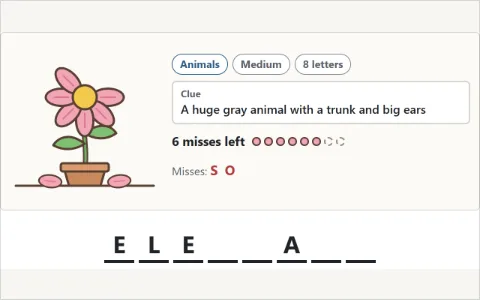
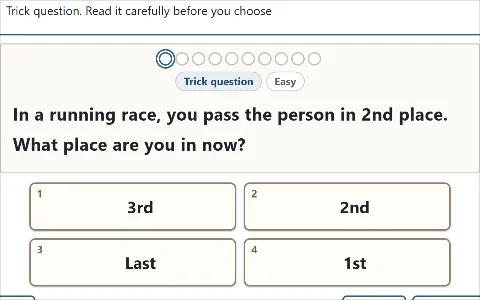
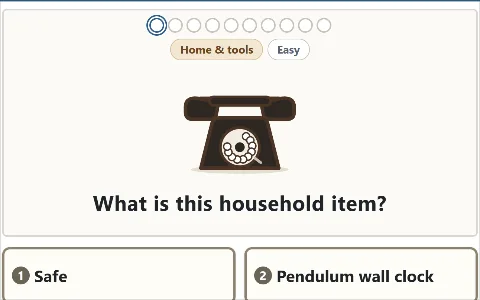
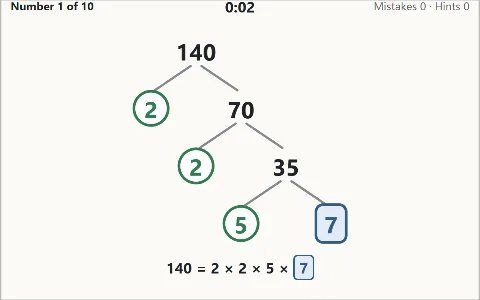
Odd One Out is a free online quiz in which you look at four or five items and find the one that doesn’t belong with the others. Take “Dolphin, Bonito, Tuna, Sardine”: bonito, tuna and sardines are fish, but the dolphin is a mammal, so the dolphin is the odd one out. There are 113 questions in six topics (Animals, Food, Geography, Numbers & Shapes, Science and Everyday Life) at three levels: Easy, Normal and Hard. It is a game for one player that runs in your browser, with no sign-up and nothing to download.
What makes the game more than a guessing game is the explanation. Every time you answer, you see why the odd one out is different, together with a small table that sorts every item by the same rule. Even when you get a question wrong, you come away knowing something new about crustaceans, capital cities or prime numbers.
Pick one item to answer
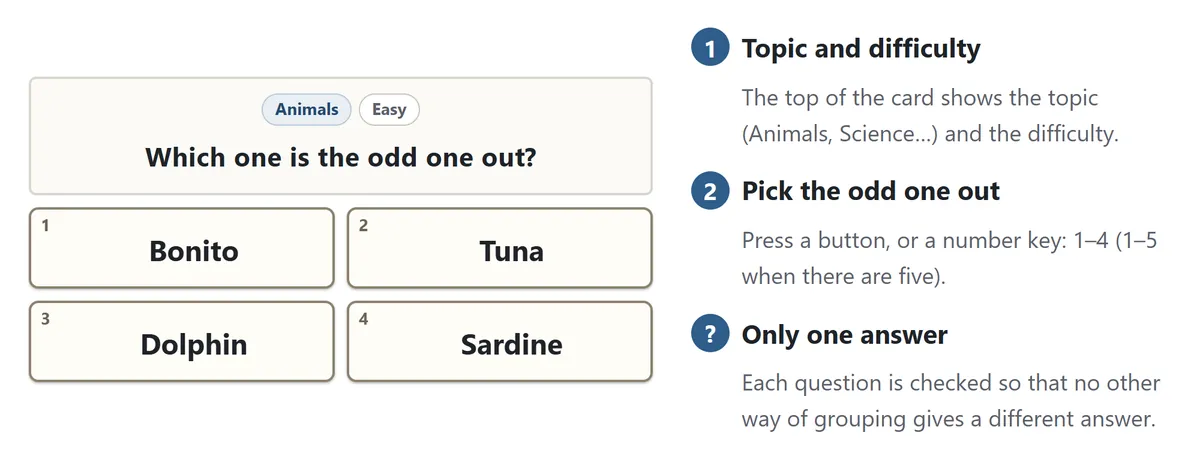
The top of the card shows the topic and the difficulty of the question, and the items appear as buttons underneath. Press the one you think is the odd one out. On a computer you can also answer with the number keys 1 to 5. The order of the items is shuffled every time, so the answer is not always in the same place, even for a question you have seen before.
Every answer comes with the reason
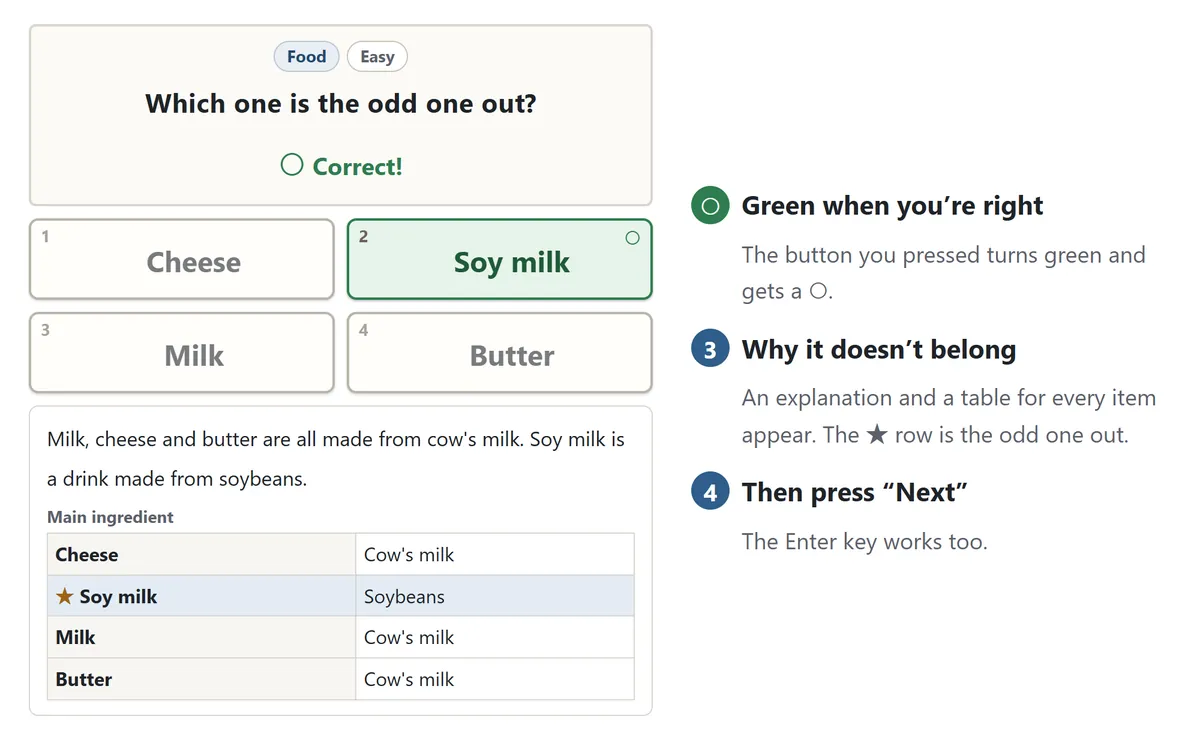
As soon as you answer, you find out whether you were right. An explanation of why the odd one out doesn’t belong appears, along with a table that lists each item by the rule behind the question: its animal group, its main ingredient, the continent it is on, and so on. The odd one out is marked with a ★. When you have read it, press “Next” (or the Enter key) to move on.
When you get it wrong
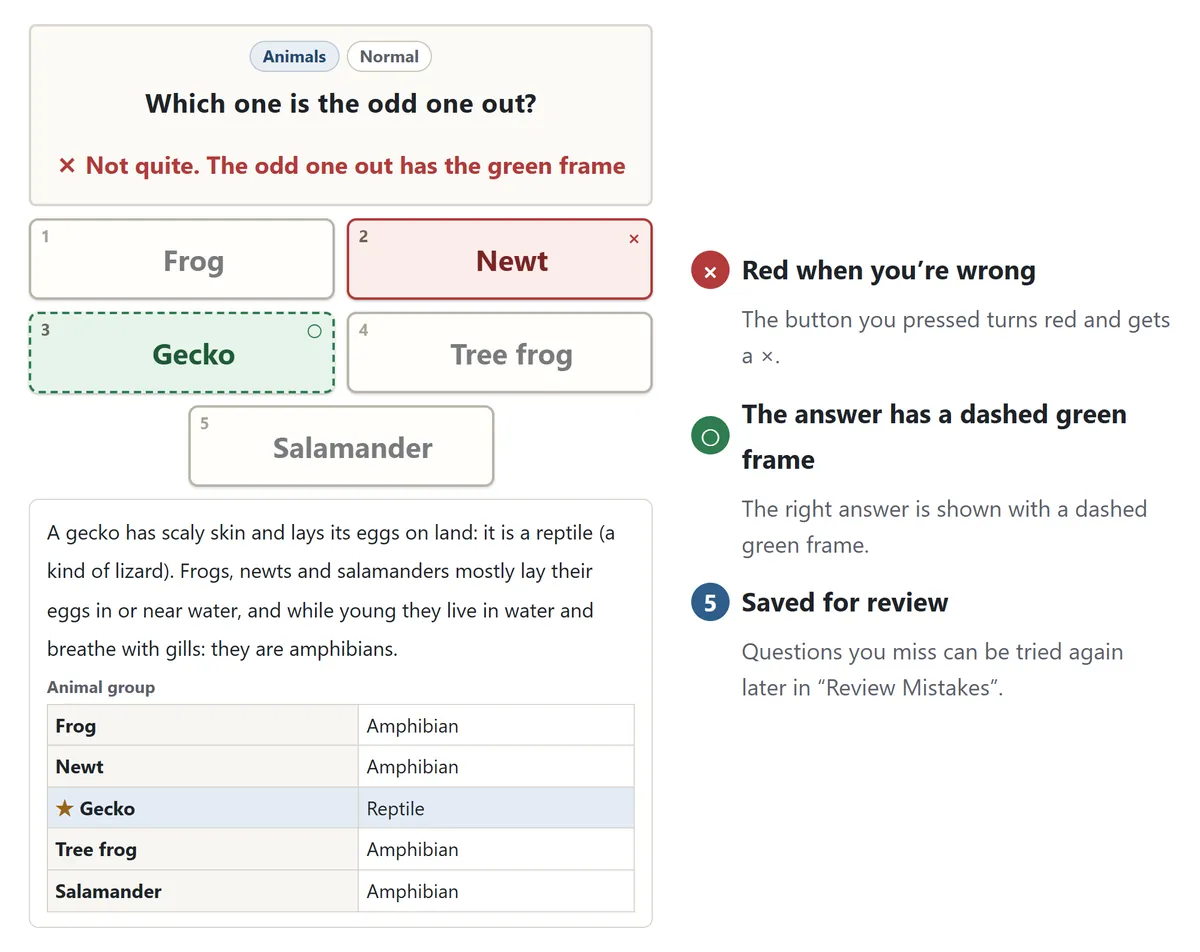
If you pick the wrong item, your button turns red and the correct answer is shown with a dashed green frame. Read the explanation and you will see why. Questions you miss are saved on your device as mistakes to review, and you can try them again in “Review Mistakes”. Get a question right on the first try twice in a row and it leaves the list.
Hints
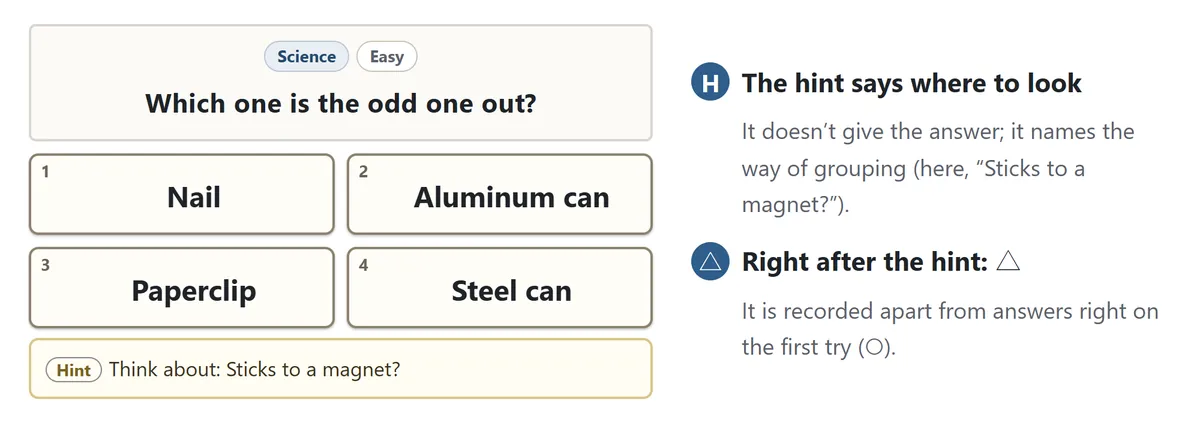
If you are stuck, press “Hint” (or the H key) to see which way of grouping the items leads to the answer, for example “Sticks to a magnet?” or “Animal group”. The hint never names the answer itself. Questions you get right after using the hint are recorded with a △, separately from the ○ for answers that were right on the first try.
Four game modes
| Mode | What you play |
|---|---|
| 10-Question Challenge | Ten questions from a mix of topics at the difficulty you choose; questions you haven’t seen come first. “Mixed” gives 4 Easy, 4 Normal and 2 Hard. Your personal best and perfect rounds are saved for each difficulty. |
| Daily 5 | Five questions chosen by the date (2 Easy, 2 Normal, 1 Hard), all from different topics. Everyone who plays on the same day gets the same questions in the same order. The game counts how many days in a row you have played. |
| Topic Practice | Ten questions from one topic, at the difficulty you choose. The game keeps track of how many questions in each topic you got right on the first try, and your score in each topic. |
| Review Mistakes | Up to ten questions you got wrong or used the hint on. The list shrinks as you get them right. |
At the end of a round, the results screen lists each question with its answer and the key fact behind it, and points out your weakest topics. In the settings, the number next to each topic shows how many of its questions you have already answered correctly on the first try, so you can see which topics are your strong points. If you stop in the middle of a round, you can pick up where you left off with “Continue”, as long as you use the same browser on the same device.
Six question topics
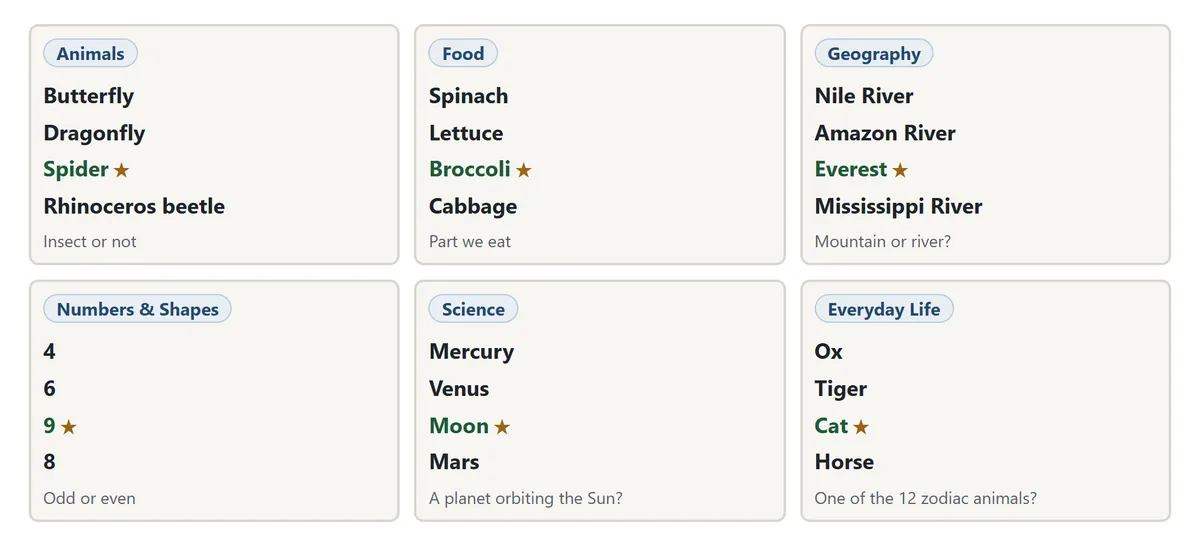
| Topic | What the questions are about |
|---|---|
| Animals | Mammals, birds, fish, amphibians, reptiles and insects; what animals eat and how they grow |
| Food | What foods are made from, which part of a plant we eat, plant families |
| Geography | Countries and continents, capital cities, the equator, languages, rivers, mountains and oceans |
| Numbers & Shapes | Odd and even numbers, multiples, primes, fractions and decimals, units, corners and faces of shapes |
| Science | Planets and stars, metals and magnets, the human body, states of water, plants, rocks |
| Everyday Life | Musical instruments, sports, the zodiac animals, tools and household things |
Animals
The animal questions ask which group a creature really belongs to: mammal, bird, fish, amphibian, reptile, insect or something else. Many of them are built around animals that look like they belong somewhere else. A bat flies but is a mammal, a pill bug crawls around with the insects but has fourteen legs, and a whale shark is a fish despite its name. Other questions ask what an animal eats, whether it raises its young in a pouch, or whether an insect goes through a pupa stage.
Food
Food questions look at what things are made from and where they come from. Is it made from milk, from soybeans or from vegetable oil? Do we eat the root, the stem, the leaves, the flower buds or the fruit? A potato, for example, is not a root at all but a swollen stem that grows underground, and broccoli is a bunch of flower buds. A few questions ask which plant family a fruit or vegetable belongs to, which can be surprising.
Geography
The geography questions are about the world: which continent a country is on, which city is the national capital, which countries the equator crosses or which are in the Southern Hemisphere, and which have a coastline. Watch out for the famous city that is not the capital, and for bodies of water whose names don’t tell the whole story.
Numbers & Shapes
These questions use odd and even numbers, multiples, prime numbers, square numbers, fractions, decimals and percentages, units of time, length and volume, and the corners and faces of shapes. You don’t need to write anything down: the numbers are small enough to work out in your head, and the explanation shows the working afterwards. Units are metric (such as centimeters, liters and deciliters), and one question counts Japanese yen coins, which only needs simple multiplication.
Science
Science questions cover the planets and stars, which materials conduct electricity or stick to a magnet, the organs of the human body, solids, liquids and gases, the weather, plants and how their seeds travel, and the way rocks form. They are the kind of facts most people met at school, and the explanations are short enough to read between questions.
Everyday Life
Everyday Life covers the things around us: how musical instruments make their sound (strings, wind, percussion), which sports use a ball, what a tool is for, and which animals are among the twelve animals of the East Asian zodiac.
Three difficulty levels
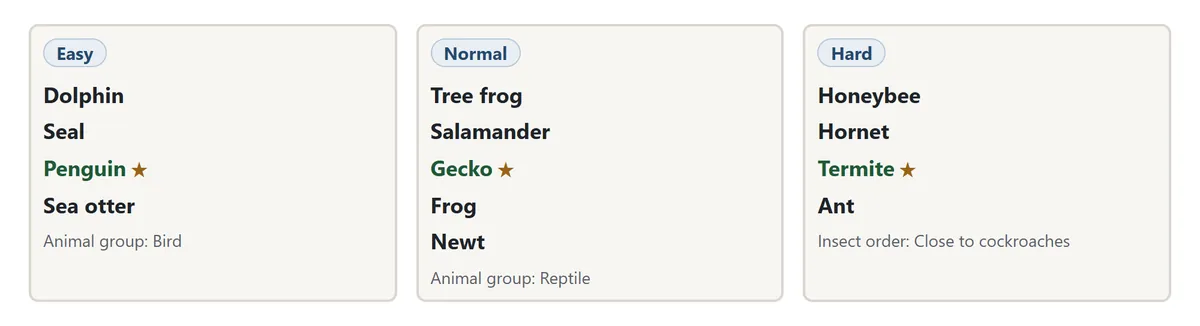
| Level | What to expect |
|---|---|
| Easy | Everyday knowledge is enough. Four items |
| Normal | Things most adults know or once learned |
| Hard | Names and looks that mislead you (ants and termites), or facts you need to know. Some have five items |
If you want a quick warm-up, start with Easy; for a real test, choose Normal or Mixed. The Daily 5 is a nice way to play with friends or family: everyone solves the same five questions on the same day, and you can compare scores afterwards.
Odd one out tips and strategy
1. Look for what most of them have in common
Instead of hunting for the odd one straight away, ask what three (or four) of the items share. Once you find the shared trait, the item that doesn’t have it is your answer. “Bat, Penguin, Owl, Chicken” all have wings, but three of them lay eggs, and that points to the bat.
2. Don’t be fooled by names and looks
A whale shark has “whale” in its name but is a fish. Coral looks like a plant but is an animal. Pteranodon lived at the same time as the dinosaurs, yet it was a flying reptile from a different group. Termites live in big colonies like ants, yet they are closer to cockroaches. The more two items look or sound alike, the more carefully you should check what group they really belong to.
3. Try more than one way of grouping
There are always several ways to sort things. For animals you can ask what group they belong to, where they live or what they eat; for food, what it is made from or which part of the plant it is; for numbers, whether they are odd or even, multiples of something or prime. If one way of grouping doesn’t single out an item, switch to another.
4. Once you have a rule, check the others
When you think you have found the odd one out, make sure the remaining items really do belong together under the same rule. A different rule can sometimes make another item stand out, so pick the rule that leaves exactly one item on its own. Every question in this game has been checked against the other obvious ways of grouping its items, so that only one answer works.
5. Use the hint to learn the rule
The hint only tells you which way of grouping to use. Once you know the rule, the rest is remembering what you already know. If the same kind of rule keeps coming up in a topic, learning it can make a whole group of questions easy.
6. Read the table, even when you are right
The table after each answer lists every item by the rule of the question: animal group, ingredient, continent, number of faces and so on. Reading it, even after a correct answer, helps the next time a similar question appears.
Odd One Out FAQ
Can a question have two answers?
Each question was written so that the rule behind it singles out one item, and was checked against other common ways of grouping the same items. If you still find a question where another answer seems to work, please let us know through the contact page.
Where is my progress saved?
Personal bests, the Daily 5 streak and the questions to review are saved only in the browser on your device. There is no account and no log-in. Clearing your browser data resets them.
Is there sound?
Sound is off at first. Press “Sound: off” to turn on the sound effects for right and wrong answers.
Does it work on phones?
Yes. The game works on phones, tablets and computers, by touch, mouse or keyboard. On a phone, the question and all of its items fit on one screen; the explanation table appears below them.
Why are there fewer topics than in the Japanese version?
The Japanese version of this game also has topics on kanji and Japanese history, and more questions on Japanese geography, everyday life in Japan and Japanese food. They only work in Japanese, so they are not included here. All the questions in this version work without any knowledge of Japanese.
About odd one out puzzles
Finding the one thing that is different from the rest is an old and familiar kind of puzzle. It shows up in riddles, brain teasers and reasoning tests, and it is also an easy game to play out loud with a group. Solving one means sorting things by what kind of thing they are, so the puzzles are a good way to widen your general knowledge as you play. All the questions and explanations in this game were written for it.
Comments
Write a comment
No comments yet.